Valour positions itself as a bridge between traditional financial markets and the emerging Web 3.0 ecosystem. The deck reveals a company already operating in the public markets, listed on the OTCQB, NEO, and Frankfurt exchanges. With a reported Assets Under Management (AUM) of $212,128,000 as of May 3, 2022, Valour demonstrates significant scale in the Exchange Traded Products (ETP) space. Their revenue model is multifaceted, capturing value from trading flows, management fees, and lending/staking yields. Beyond product issuance, the company operates Valour Ventures to invest in early-stage D…
Key takeaways
- Valour is a publicly traded entity with tickers on the OTCQB (DEFTF), NEO (DEFI.NE), and Frankfurt (FRA: RMJ) exchanges as shown on slide 1.
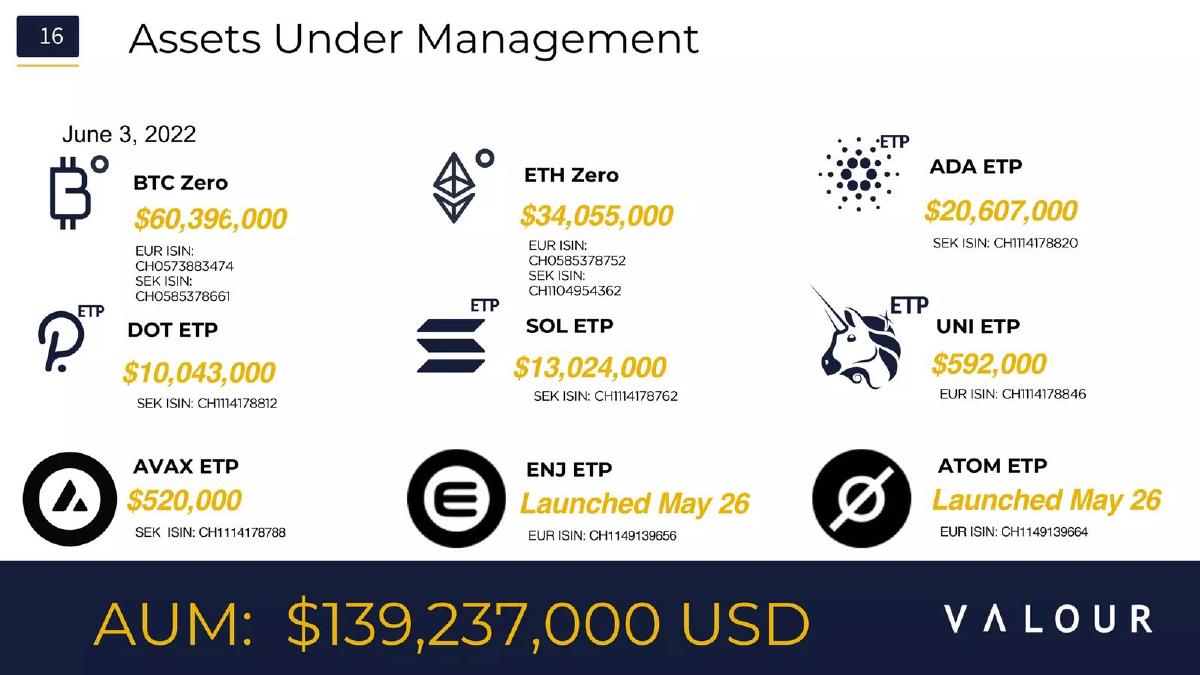
- The company reported a total AUM of $212,128,000 USD as of May 3, 2022, across seven different crypto ETPs (slide 16).
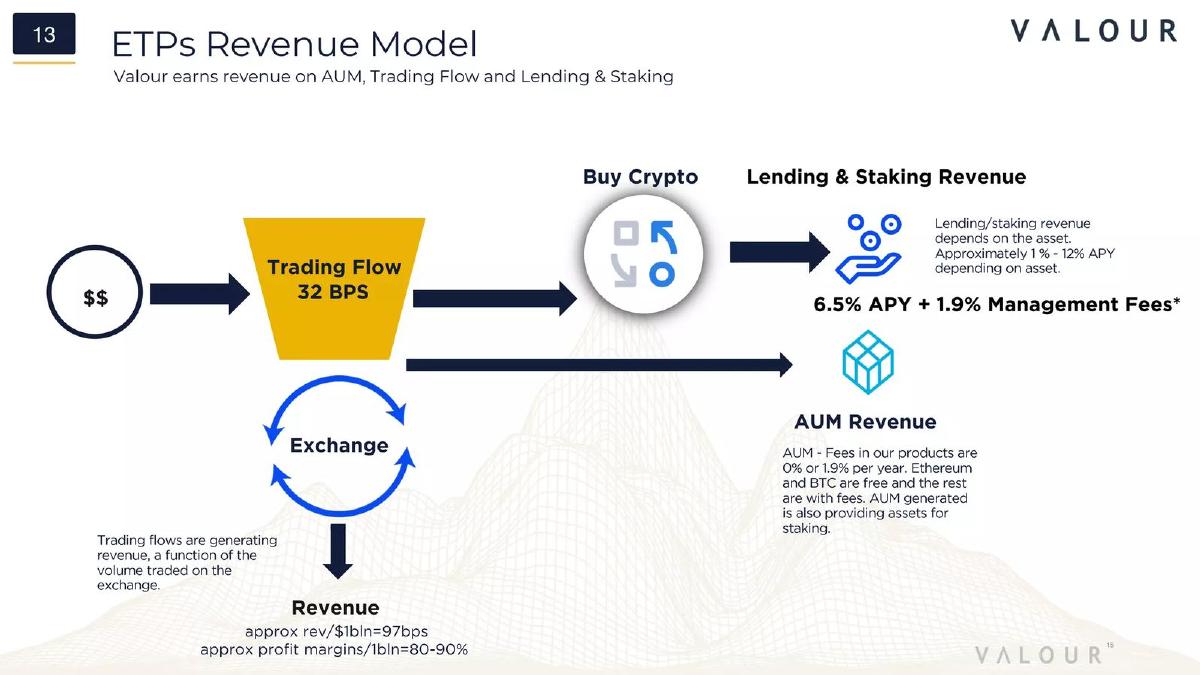
- Revenue is generated through three primary channels: trading flow (32 BPS), management fees (up to 1.9%), and lending/staking (1% - 12% APY) as detailed on slide 13.
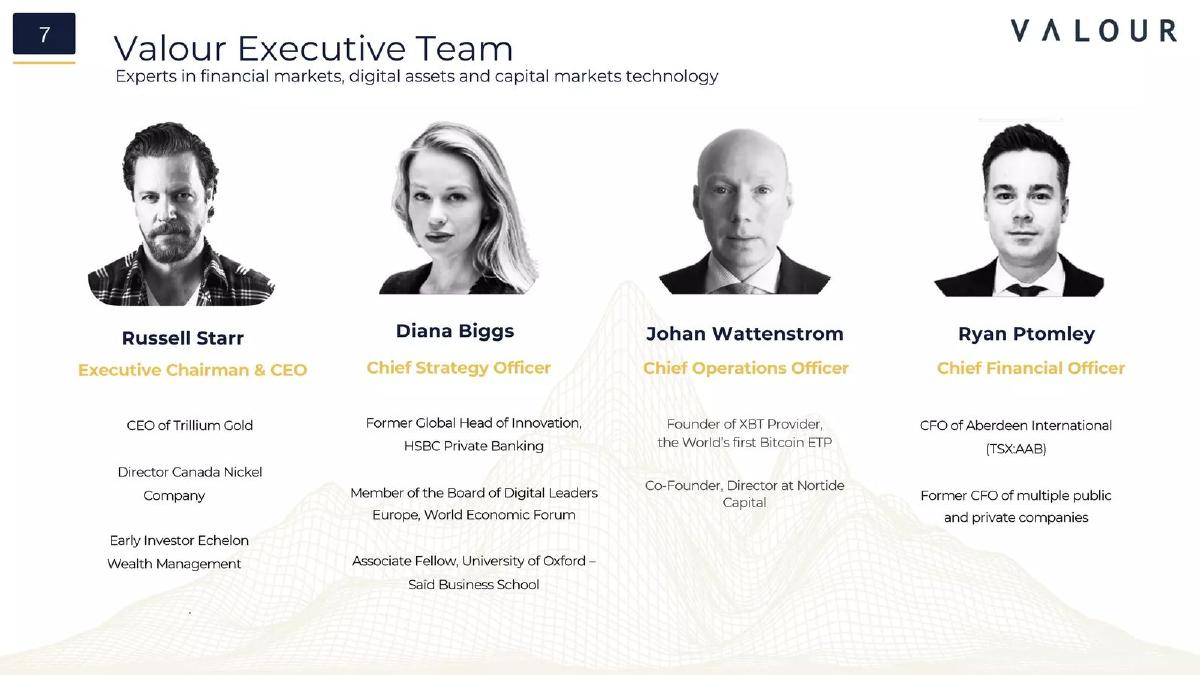
- The executive team includes the founder of XBT Provider, which launched the world's first Bitcoin ETP (slide 7).
- Valour maintains a venture arm that invests in pre-seed to Series A startups, including Luxor Mining and Skolem Labs (slide 19).
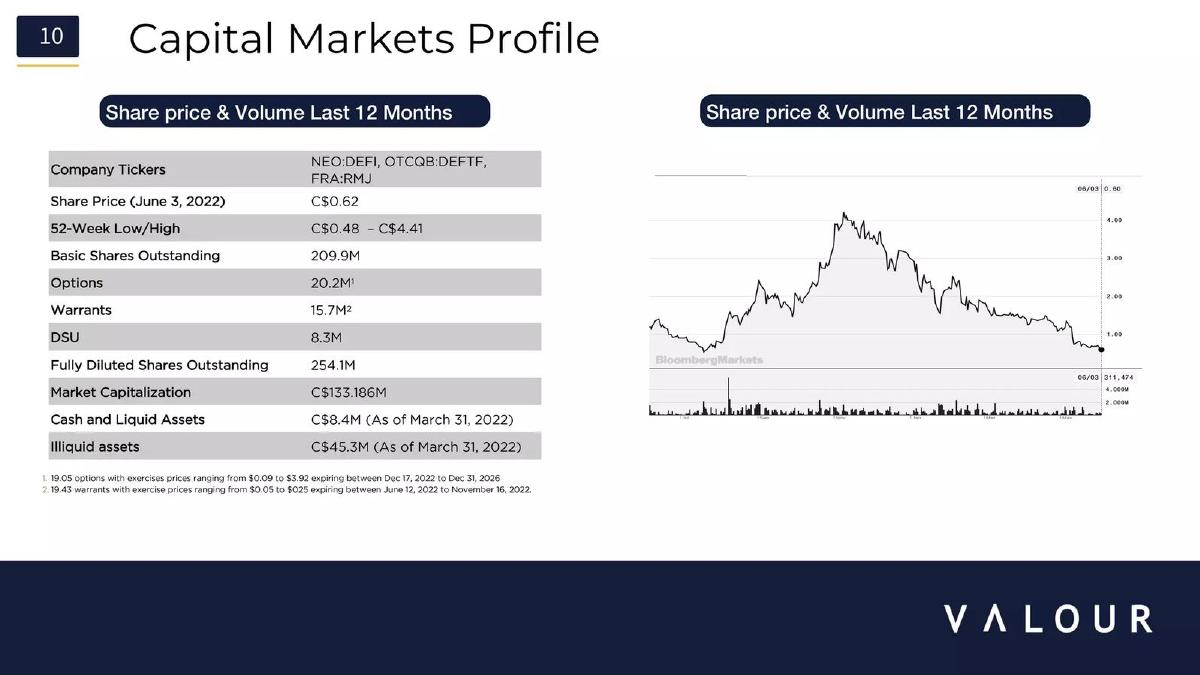
- As of May 18, 2022, the company had a market capitalization of C$145.672M and C$16.4M in cash and liquid assets (slide 10).
- The deck cites a Citibank prediction of a $13 trillion TAM for the Metaverse economy by 2030 to justify its market opportunity (slide 21).
- The company offers 'Zero' fee products for Bitcoin and Ethereum to capture market share, while charging 1.9% on other assets like ADA and SOL (slide 13 and 16).
Valour Investor Deck Analysis
The Valour investor deck from 2022 presents a company that has moved beyond the typical startup phase and is operating as a publicly traded financial services firm. The deck focuses on the intersection of traditional equity markets and the decentralized finance (DeFi) ecosystem. By providing regulated ETPs, Valour aims to solve the accessibility and security concerns that often prevent institutional and retail investors from entering the crypto space.
Slide 1: Title and Public Listing Information
The cover slide establishes Valour's identity as a bridge between traditional financial markets and Web 3.0. Crucially, it lists the company's public tickers across three major regions: OTCQB: DEFTF (United States), DEFI.NE (Canada), and FRA: RMJ (Frankfurt). This immediately signals to the reader that this is not a pitch for a private seed round, but rather a corporate overview for a public entity.
Slide 4: Mission Driven
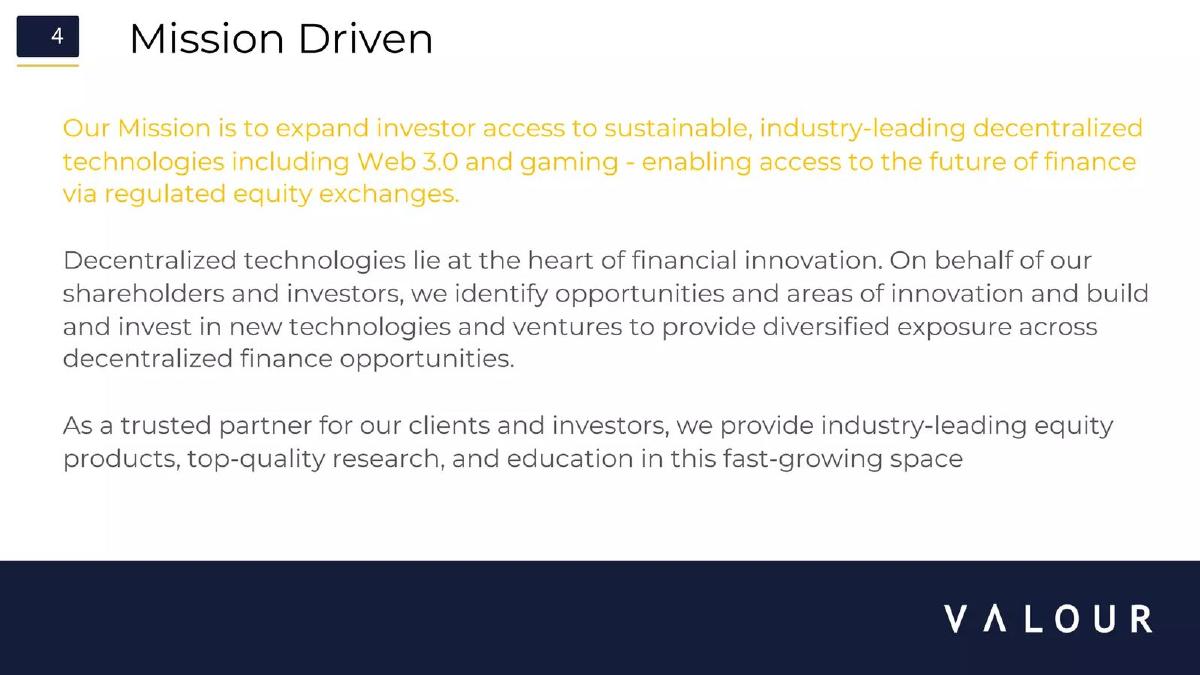
The mission statement emphasizes expanding investor access to 'sustainable, industry-leading decentralized technologies.' The slide highlights three pillars: identifying innovation, building/investing in new technologies, and providing diversified exposure through equity products. It positions Valour as a 'trusted partner' that offers research and education alongside its financial products, suggesting a value-add beyond simple asset management.
Slide 7: Valour Executive Team
The team slide focuses on pedigree in capital markets and digital assets. Russell Starr (CEO) brings experience from Trillium Gold and Echelon Wealth Management. Diana Biggs (CSO) is a former Global Head of Innovation at HSBC Private Banking. Johan Wattenstrom (COO) provides the core technical credibility as the founder of XBT Provider, the issuer of the world's first Bitcoin ETP. Ryan Ptomley (CFO) rounds out the team with experience as a CFO for multiple public companies, including Aberdeen International. The team is balanced between traditional banking, public market compliance, and crypto-native innovation.
Slide 10: Capital Markets Profile
This slide provides a snapshot of the company's financial health as of May 2022. Key metrics include a share price of C$0.70, a 52-week high of C$4.41, and a market cap of C$145.672M. The company reported C$16.4M in cash and liquid assets as of September 30, 2021. A share price chart from Bloomberg Markets shows a significant decline from a peak in late 2021, reflecting the broader downturn in the crypto markets during that period. The slide also notes 259M fully diluted shares outstanding, including options and warrants.
Slide 13: ETPs Revenue Model
Valour provides a transparent breakdown of how it makes money. The model is three-pronged: Trading Flow (generating 32 basis points), AUM Revenue (management fees of 0% for BTC/ETH and 1.9% for others), and Lending & Staking Revenue (yielding 1% to 12% APY). The slide claims an approximate profit margin of 80-90% per $1 billion in AUM, which is a significant efficiency metric for an asset manager. The 'Zero' fee strategy on flagship assets is clearly a customer acquisition play designed to drive trading volume and staking opportunities.
Slide 16: Assets Under Management
This slide lists the specific products and their AUM as of May 3, 2022. The total AUM is stated as $212,128,000 USD. The portfolio includes BTC Zero ($76.7M), ETH Zero ($54.8M), SOL ($29.5M), ADA ($28.9M), DOT ($16.9M), AVAX ($996k), and UNI ($846k). Each product is listed with its specific ISIN (International Securities Identification Number) for the EUR and SEK exchanges, demonstrating the company's regulatory footprint in Europe.
Slide 19: Valour Ventures
Valour Ventures is described as a research-based early-stage venture arm. It focuses on pre-seed to Series A investments in DeFi and Web 3.0. The slide displays logos for several portfolio companies, including Luxor Mining, Sovryn, Skolem Labs, Clover, Blocto, and Oxygen. This arm of the business suggests that Valour is not just a passive index provider but an active participant in the development of the blockchain ecosystem.
Slide 21: Web 3.0 and Blockchain: By the Numbers
To justify the long-term opportunity, Valour uses macro statistics. These include a $3.1 trillion value add to businesses by 2030, a $39.7 billion blockchain gaming market by 2025, and a Citibank prediction of a $13 trillion TAM for the Metaverse. It also notes the growth of crypto users from 295 million in December 2021 to a projected 1 billion by December 2022. These figures are intended to show that despite short-term market volatility, the underlying trend is one of massive expansion.
Slide 25: Closing and Social Media
The final slide repeats the public tickers and provides links to Twitter, LinkedIn, Telegram, and YouTube. It maintains the 'Confidential and Proprietary' footer, though the information presented is largely consistent with public disclosures for a listed company.
What Valour Does Well
Revenue Transparency: Slide 13 is exceptionally clear about how the company monetizes its AUM. By breaking down trading flow, management fees, and staking yields, they show a diversified income stream that isn't solely dependent on asset prices. · Regulatory Credibility: The inclusion of ISIN numbers on slide 16 and the listing of multiple public exchanges on slide 1 demonstrate that Valour has successfully navigated the complex regulatory requirements of European and North American capital markets. · Team-Market Fit: The executive team (slide 7) is perfectly suited for this specific business. Having the founder of the first Bitcoin ETP as COO is a powerful signal to institutional investors. · Strategic Product Mix: Offering 'Zero' fee products for the most popular assets (BTC/ETH) is a smart way to build a large AUM base that can then be monetized through secondary channels like staking or by cross-selling higher-margin altcoin ETPs.
What Is Missing from the Deck
Historical AUM Growth: While slide 16 shows a snapshot of AUM, there is no chart showing the growth of AUM over time. For an asset manager, the rate of net inflows is a critical metric for investors. · Operational Expenses: While the deck mentions 80-90% profit margins on AUM (slide 13), it does not provide a clear picture of the company's total burn rate or path to overall corporate profitability, which is important given the C$16.4M cash position. · Competitive Landscape: The deck does not mention competitors like 21Shares, CoinShares, or Grayscale. A slide showing how Valour's fees or product features compare to these established players would strengthen the case for their market share. · Specific Use of Capital: Since this is an investor deck, a slide detailing the 'Ask' or how new capital would be deployed (e.g., new product launches, geographical expansion, or venture capital) is missing.
What Other Founders Should Copy
The 'Profile' Slide: Slide 10 is a great template for any public or late-stage private company. It puts all the critical financial data (shares, cash, market cap) in one place, making it easy for analysts to digest. · Visualizing the Revenue Funnel: The diagram on slide 13 effectively explains a complex multi-revenue business model. Founders with complicated monetization strategies should use similar flowcharts to explain how value is captured at different stages of the customer journey. · Macro-to-Micro Narrative: Valour does a good job of starting with a broad mission (slide 4), moving to specific products and traction (slide 16), and then zooming back out to the massive market opportunity (slide 21). This helps frame the company's current success within a larger, more exciting context. · Leveraging Pedigree: The team slide (slide 7) doesn't just list titles; it lists specific, relevant achievements (e.g., 'Founder of XBT Provider'). Founders should always highlight the 'firsts' or major milestones their team members have achieved in the industry.
Frequently asked questions
- What is Valour's core business model?
- Valour operates primarily as an issuer of Exchange Traded Products (ETPs) that track digital assets. According to slide 13, they earn revenue through a combination of trading flow (32 basis points), management fees (up to 1.9% per year), and lending or staking the underlying assets (yielding 1% to 12% APY). This allows them to offer some products, like BTC Zero and ETH Zero, with no management fees to attract AUM while still monetizing the assets.
- How much capital does Valour currently manage?
- As of May 3, 2022, Valour reported a total AUM of $212,128,000 USD. Slide 16 breaks this down by asset: BTC Zero ($76.7M), ETH Zero ($54.8M), SOL ETP ($29.5M), ADA ETP ($28.9M), DOT ETP ($16.9M), AVAX ETP ($996k), and UNI ETP ($846k). The concentration is heavily weighted toward Bitcoin and Ethereum, which together account for over 60% of their total AUM.
- Is Valour a private startup or a public company?
- Valour is a public company. Slide 10 provides a 'Capital Markets Profile' showing listings on the NEO exchange in Canada (DEFI), the OTCQB in the United States (DEFTF), and the Frankfurt exchange in Germany (RMJ). As of the deck's reporting date in May 2022, it had a market capitalization of C$145.672 million and 211.102 million basic shares outstanding.
- Who is leading the company?
- The executive team, detailed on slide 7, consists of Russell Starr (Executive Chairman & CEO), Diana Biggs (Chief Strategy Officer), Johan Wattenstrom (COO), and Ryan Ptomley (CFO). Notably, Johan Wattenstrom is credited as the founder of XBT Provider, which created the world's first Bitcoin ETP, providing the team with significant domain expertise in crypto-linked financial products.
- What is Valour Ventures?
- Valour Ventures is the company's early-stage investment arm. Slide 19 explains that it focuses on pre-seed to Series A funding for leaders, protocols, and networks in the DeFi and Web 3.0 ecosystem. The slide lists several portfolio companies, including Luxor Mining, Sovryn, Skolem Labs, and Blocto, indicating that Valour seeks to participate in the growth of the underlying technology as well as the asset markets.