Vacayo's 2017 seed deck is a concise 11-slide presentation that successfully navigated the competitive short-term rental market by positioning itself as a solution for 'passive' landlords. By leasing and managing inventory directly, Vacayo addressed the friction of furnishing and managing Airbnb listings. The deck is notable for its early-stage traction, reporting $670K in net revenue and presence in 6 cities with over 60 homes. While it lacks a traditional 'Ask' slide and detailed product screenshots, its focus on LTV/CAC ratios ($17,100 vs $2,500) and a clear 32% margin provided the financi…
Key takeaways
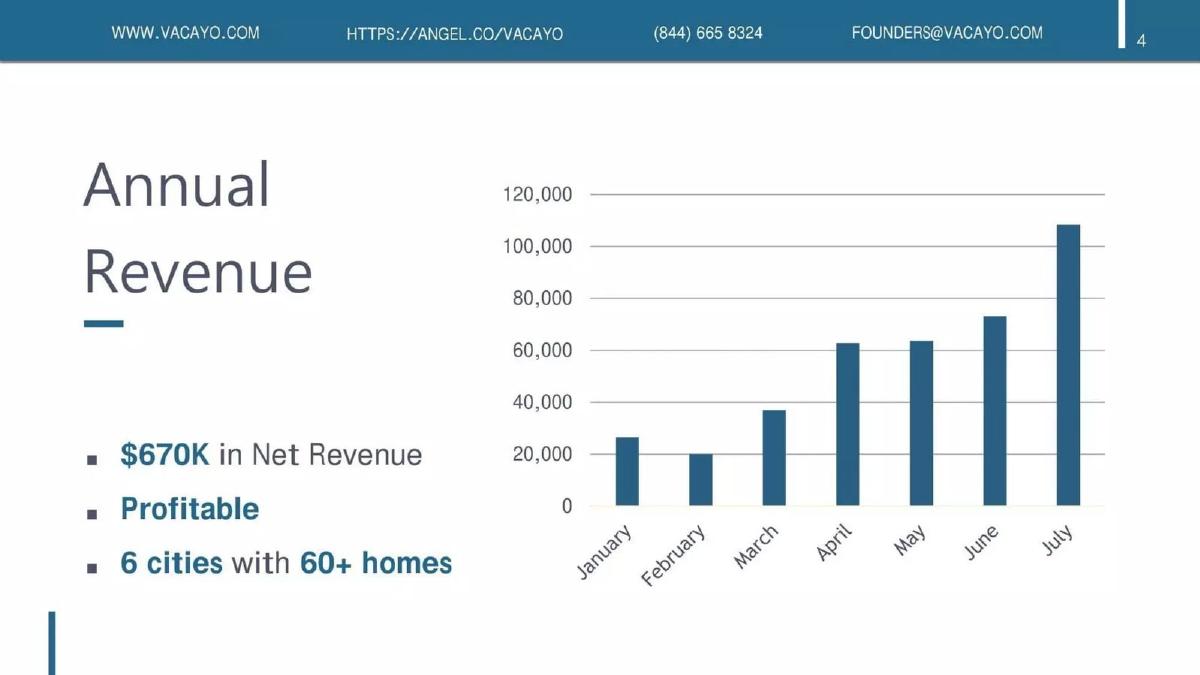
- The deck reports $670K in net revenue and claims the company is already profitable on slide 4.
- Vacayo differentiates itself through a 'Community of Superhosts' and a 'Landlord Analytics Dashboard' as shown on slide 6.
- The US Total Addressable Market is calculated at $51 billion based on 6 million investment homes and $8,571 average net revenue per slide 8.
- Unit economics are a highlight, with a Customer Acquisition Cost (CAC) of $2,500 against a Lifetime Value (LTV) of $17,100 on slide 9.
- The team slide features three 'Repeat Founders' with backgrounds from Columbia University, Boston University, and firms like Deutsche Bank and Omnicom on slide 10.
- Revenue growth is benchmarked against industry giants, showing Vacayo's 35% Y-o-Y growth alongside Airbnb's 40% and Booking.com's 30% on slide 7.
- The final slide summarizes key metrics including $2.1 million in Gross Revenue and a 32% margin.
- There is no specific 'Ask' slide detailing how much capital is being raised or how it will be deployed.
The Managed Inventory Play: Vacayo's $1.4M Seed Deck
Vacayo’s 2017 seed deck is a lean, 11-slide presentation that focuses on the operational side of the short-term rental market. At a time when Airbnb was already a household name, Vacayo identified a specific friction point: landlords who wanted the high yields of short-term rentals but lacked the time or desire to manage the 'hospitality project.' This teardown examines how they used traction and unit economics to validate a capital-intensive arbitrage model.
Slide 1: Title and Contact
The cover slide is standard, featuring the Vacayo logo—a stylized house/bed icon—and the name of the Founder & CEO, Truth Oladapo. It includes a website URL, Angel.co link, phone number, and a general contact email. The background image of a modern, glass-walled home immediately sets the aesthetic tone for a high-end real estate and hospitality brand.
Slides 2-3: The Problem and the Gap
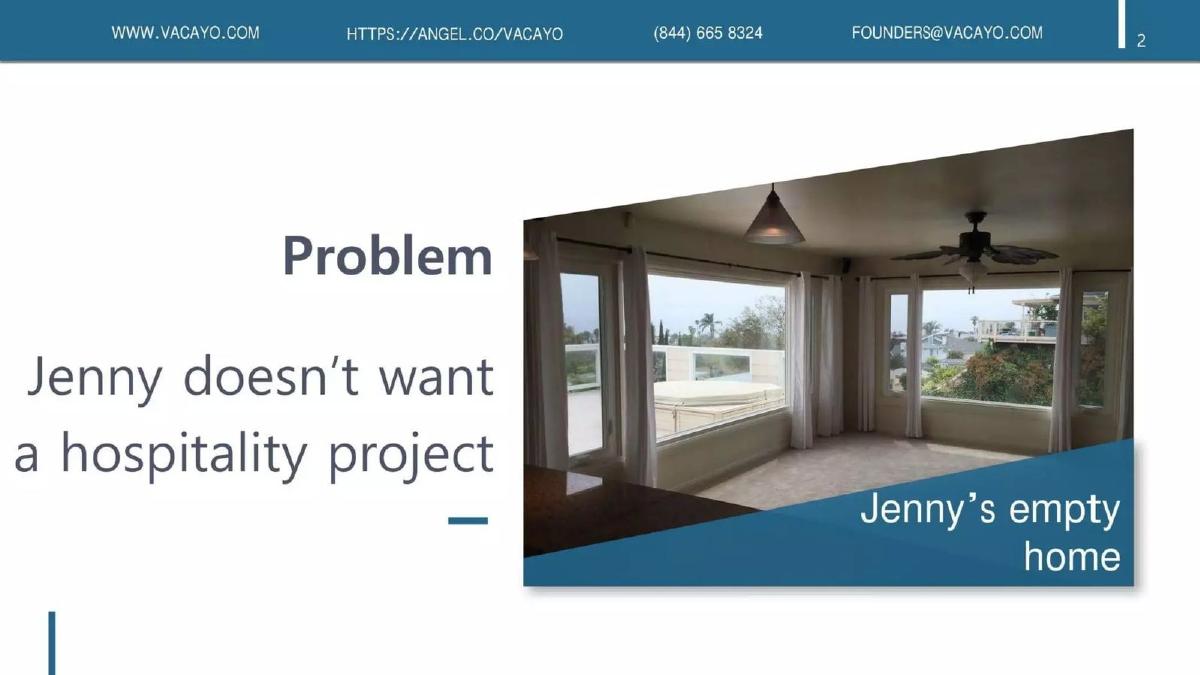
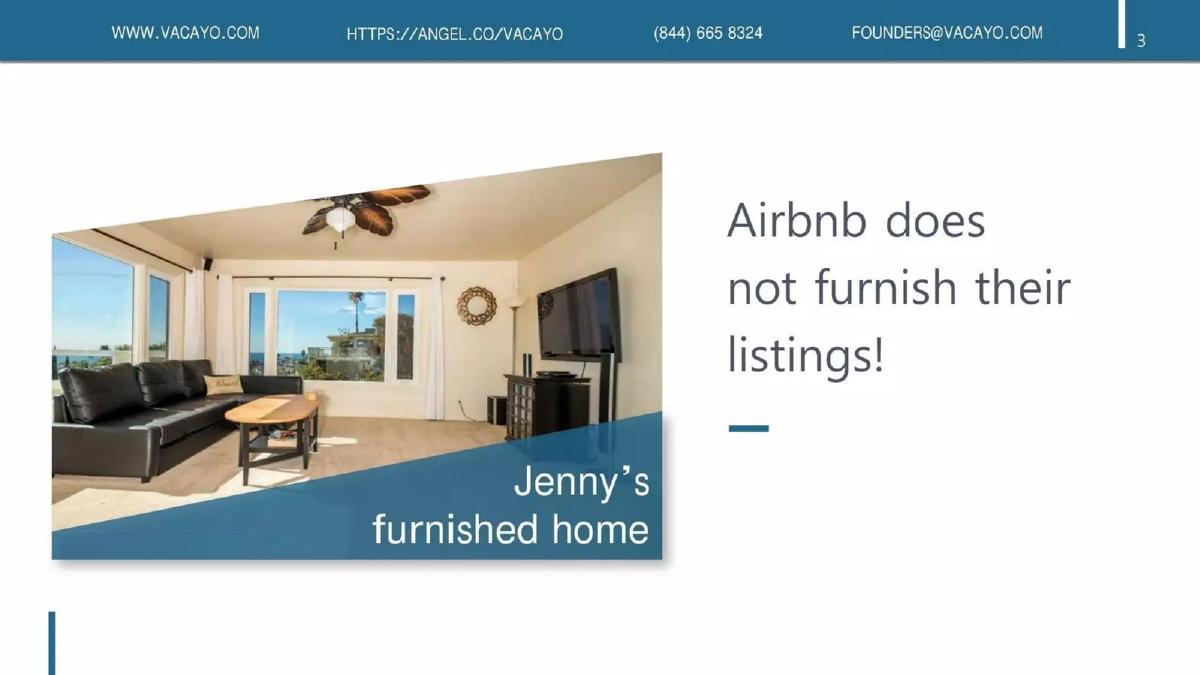
Slide 2 introduces the 'Problem' using a persona: 'Jenny doesn’t want a hospitality project.' It shows a photo of 'Jenny’s empty home.' This is a classic storytelling technique to humanize the pain point of vacancy and the effort required to furnish and manage a rental. Slide 3 highlights the market gap: 'Airbnb does not furnish their listings!' accompanied by a photo of 'Jenny’s furnished home.' By contrasting the empty and furnished states, Vacayo positions itself as the bridge between a vacant asset and a revenue-generating listing.
Slide 4: Traction and Annual Revenue
This is the 'meat' of the early deck. Vacayo claims $670K in Net Revenue and states they are Profitable . The bar chart shows a clear upward trend from January to July, with July revenue exceeding 100,000 (presumably USD, though the axis is just labeled in units). They also note presence in 6 cities with 60+ homes . For a seed round, claiming profitability while scaling across multiple cities is a very strong signal to investors.
Slide 5: The Value Proposition
Slide 5 serves as a transition, using a quote-style layout to state: 'Vacayo software guarantees landlords higher income and eliminates vacancy risk.' This slide is light on detail but heavy on the promise. It suggests that their proprietary software is the engine behind the 'guarantee,' though it doesn't explain the mechanics of that software yet.
Slide 6: Differentiation
Under the heading 'How are we different?', Vacayo points to two pillars: a Community of Superhosts and a Landlord Analytics Dashboard . The slide uses simple icons—a handshake and a hand holding a house key. While this identifies their focus areas, it lacks specific detail on what makes their dashboard superior to existing property management tools or how they source and vet their 'Superhosts.'
Slide 7: Market Context and Growth
Slide 7 places Vacayo's 35% Y-o-Y Growth in the context of the broader industry. They list competitors and peers: Airbnb (40% Y-o-Y), HomeAway (37% Y-o-Y), FlipKey (31% Y-o-Y), and Booking.com (30% Y-o-Y). This slide serves two purposes: it validates the sector's health and shows that Vacayo is growing at a rate comparable to the market leaders. They also cite a World Wide Market Est. $100 billion .
Slide 8: Total Addressable Market (TAM)
Vacayo narrows the market focus to the US on Slide 8. They calculate a $51 B TAM by multiplying 6 M Investment Homes by $8,571 K Average Net Revenue . The math is simple and transparent, allowing investors to stress-test the assumptions. Using investment homes as the base unit is a logical choice for a B2B2C model.
Slide 9: Unit Economics
This is arguably the most important slide for a managed inventory business. Vacayo shows a CAC of $2,500 against an LTV of $17,100 . A roughly 6.8x LTV/CAC ratio is highly attractive. It suggests that despite the high cost of acquiring a landlord/property, the long-term revenue generated from that property justifies the upfront spend. The use of coin stack graphics is a bit dated but effectively communicates the scale difference.
Slide 10: The Team
The 'Repeat Founders' slide features Truth Oladapo (CEO), Isabel Berney (COO), and Olof Matti (Head of Growth). They highlight academic credentials from Columbia University and Boston University . More importantly, they include a logo bar of former employers: Thump, Deutsche Bank, Omnicom, BMO, and SecondMarket . This builds institutional credibility, suggesting the team has experience in both high finance and growth marketing.
Slide 11: The Summary and Closing
The final slide functions as a summary rather than a traditional 'Ask.' It reiterates the TAM and adds new, higher-level metrics: $2.1 million in Gross Revenue , a 32% Margin , and 20% MoM growth . The contact information is repeated. The jump from $670K net revenue on slide 4 to $2.1M gross revenue here provides a sense of the scale of the operation versus the net take.
What Works in This Deck
The deck’s greatest strength is its clarity on unit economics . In a business model that involves leasing physical assets (rental arbitrage), investors are often wary of thin margins and high acquisition costs. By putting the $17,100 LTV front and center on Slide 9, Vacayo addresses these fears head-on. The 32% margin mentioned on the final slide further reinforces that this is a sustainable business, not just a high-volume, low-margin pass-through.
The use of a persona (Jenny) in the problem slides is also effective. It clearly defines the target customer—not the traveler, but the property owner. This distinguishes Vacayo from the thousands of 'Airbnb clones' that focused solely on the guest experience. By solving the landlord's problem (vacancy and management hassle), they secure the inventory, which is the scarcest resource in the short-term rental market.
What Is Missing
The most glaring omission is a specific 'Ask' slide . While the catalogue facts state they raised $1.4 million, the deck itself does not specify how much they were seeking or how they intended to use the funds (e.g., hiring, city expansion, software development). This is often removed for public versions of decks, but in a live pitch, it is a critical component.
Additionally, the deck is light on product detail . The 'Landlord Analytics Dashboard' is mentioned as a key differentiator, but there are no screenshots or feature lists. In a 'Software-enabled' service business, investors want to see the software to ensure it isn't just a manual services business in disguise. There is also no competitive landscape matrix . While they compare growth rates to Airbnb and HomeAway, they don't explain how they compete with other property management companies like Vacasa or Sonder, which were active during the same period.
What a Founder Should Copy
Founders should emulate Vacayo’s benchmarking strategy on Slide 7. Comparing your growth rate to the industry giants is a powerful way to show that you are 'keeping pace' with the best in the business. It frames the startup as a peer to billion-dollar companies rather than a small, insignificant player.
The TAM calculation on Slide 8 is another best practice. Instead of just pulling a large number from a Gartner report, Vacayo built the number using 'Bottom-Up' logic: (Number of Homes) x (Revenue per Home). This makes the market size feel earned and believable. Finally, the bold claim of profitability on Slide 4 is a massive lever for any founder who can truthfully make it; it shifts the conversation from 'will this work?' to 'how fast can we make this bigger?'
Final Thoughts
Vacayo’s deck is a 'traction-first' presentation. It doesn't rely on flashy design or complex technical diagrams. Instead, it relies on the fact that they have 60+ homes, millions in gross revenue, and a healthy margin. For seed-stage companies that have already launched and found a repeatable way to acquire customers, this 'numbers-heavy' approach is often the most effective way to close a round.
Frequently asked questions
- What is Vacayo's core business model according to the deck?
- Vacayo operates a managed inventory model for short-term rentals. According to the catalogue listing and slide 5, they lease properties from landlords and manage them using software that 'guarantees landlords higher income and eliminates vacancy risk.' This is essentially a rental arbitrage model where Vacayo takes the operational burden off the property owner.
- How does Vacayo justify its market size?
- On slide 8, Vacayo defines its US Total Addressable Market (TAM) as $51 billion. They arrive at this figure by multiplying 6 million investment homes by an average net revenue of $8,571. They also cite a $100 billion worldwide market estimate on slide 7 to show the global potential.
- What traction did Vacayo have at the time of this seed round?
- The company showed significant early traction for a seed stage. Slide 4 notes $670K in net revenue, profitability, and operations in 6 cities with over 60 homes. By the final slide, they update these figures to $2.1 million in gross revenue and 20% month-over-month growth.
- Who are the founders and what is their background?
- Slide 10 lists three 'Repeat Founders': Truth Oladapo (CEO), Isabel Berney (COO), and Olof Matti (Head of Growth). Their collective experience includes education at Columbia and Boston University, and professional stints at Deutsche Bank, Omnicom, BMO, and SecondMarket.
- What is missing from the Vacayo pitch deck?
- The deck is missing a clear 'Ask' slide detailing the funding goal. It also lacks a detailed competition matrix, a roadmap for future expansion, and specific product screenshots of the 'Landlord Analytics Dashboard' mentioned on slide 6. The 'How we are different' slide is conceptual rather than technical.