Artificial Societies secured $5.3M in Seed funding in 2025 by presenting a compelling case for 'Artificial Collective Intelligence' (ACI). The deck is remarkably lean at just 10 slides, focusing heavily on immediate market validation and technical superiority. Within just 100 days of launch, the company reported 15,000+ registered accounts and 1 million+ AI personas created. Rather than getting bogged down in the mechanics of LLMs, the founders used a direct head-to-head accuracy chart, claiming an 82% success rate in predicting content performance compared to 64% for Claude 3.7 Sonnet. The n…
Key takeaways
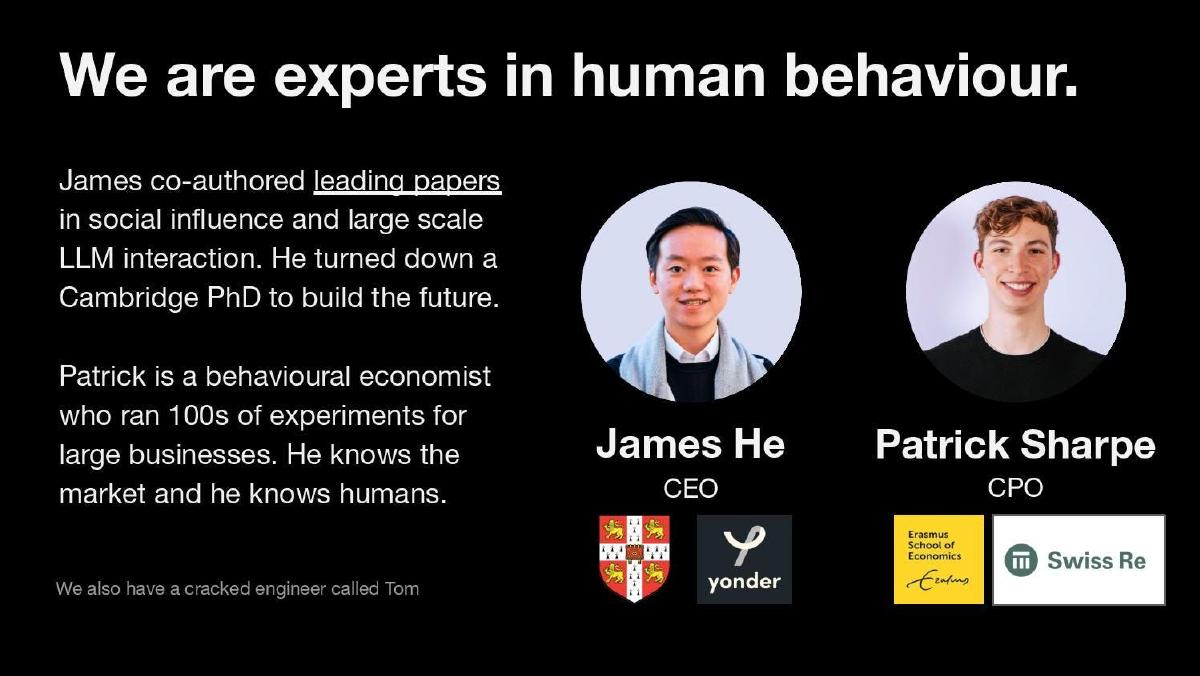
- The deck leads with founder pedigree, highlighting that CEO James He turned down a Cambridge PhD and co-authored papers on social influence (Slide 2).
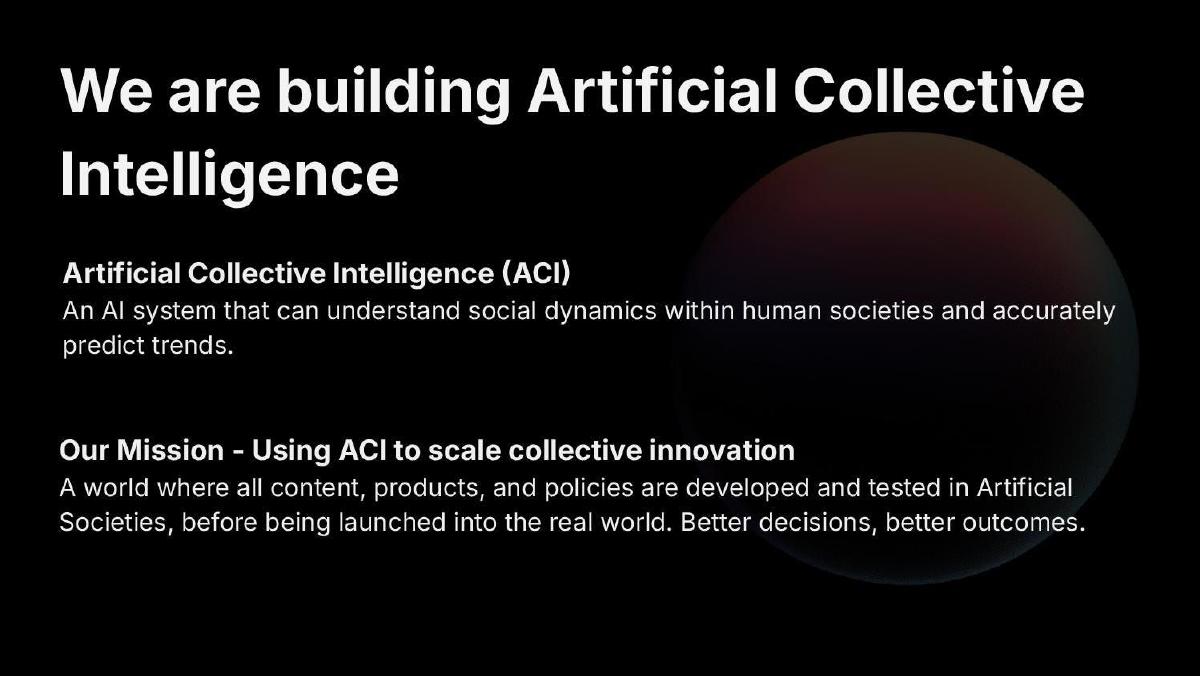
- Artificial Societies defines its core technology as 'Artificial Collective Intelligence (ACI),' an AI system designed to understand social dynamics and predict trends (Slide 3).
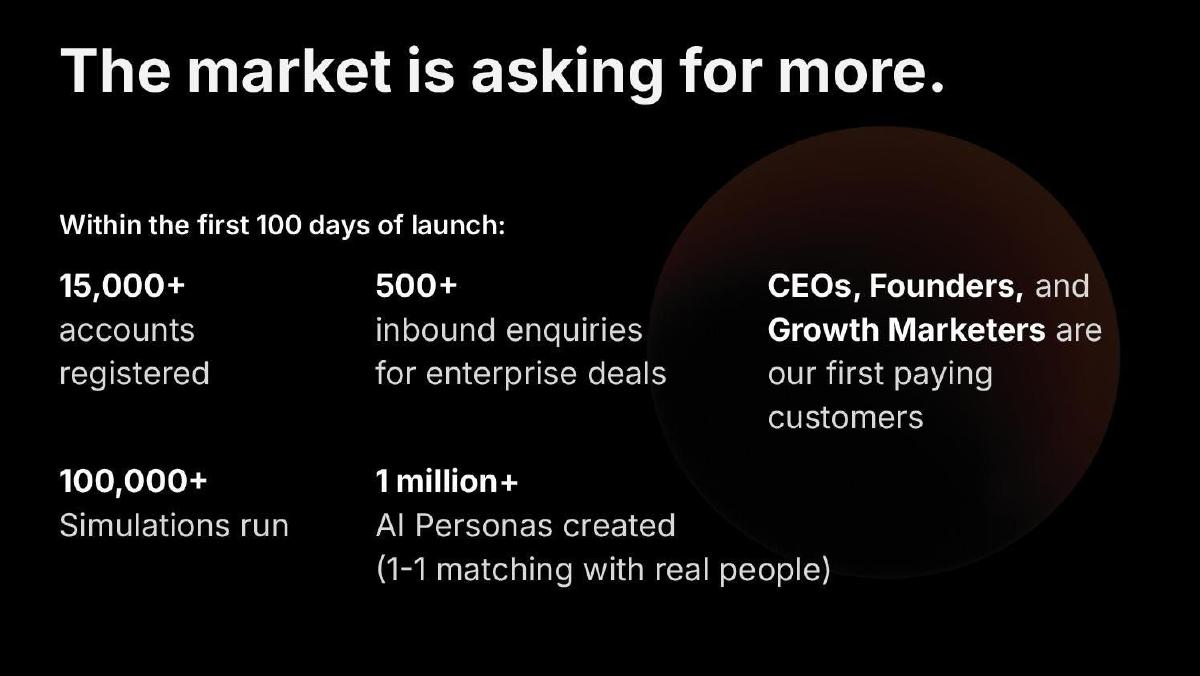
- The company demonstrates massive early velocity, reporting 100,000+ simulations run within the first 100 days of launch (Slide 5).
- A million AI personas have already been created, which the company claims have a 1-1 matching with real people (Slide 5).
- The deck uses a direct benchmark to prove technical defensibility, showing their model outperforms GPT-4o and Claude 3.7 Sonnet at picking winning LinkedIn posts (Slide 7).
- The roadmap suggests a transition from messaging and marketing feedback into policy and macroeconomics (Slide 8).
- The fundraising 'Ask' slide is specific about the goal of achieving $2m+ ARR with the new capital (Slide 9).
- The deck omits a traditional competition grid, choosing instead to frame the entire market research industry as the incumbent to be disrupted (Slide 8).
The 10-Slide Sprint to $5.3M
Artificial Societies represents a new wave of AI startups that prioritize 'proof of utility' over 'proof of concept.' In a crowded market of LLM wrappers, this deck attempts to carve out a new category called Artificial Collective Intelligence (ACI). According to publisher reports, the company raised a $5.3M Seed round in 2025. The deck is brief, punchy, and relies heavily on the momentum of its first 100 days post-launch.
Slide 1: Title Slide
The deck opens with a minimalist black background featuring the company logo—a stylized 'A'—and the tagline: 'Simulating Human Societies with AI.' It is clean, professional, and sets a serious tone for a company dealing with complex social dynamics.
Slide 2: The Team
Placing the team slide second is a classic move for founders with high academic or professional pedigree. James He (CEO) is positioned as a researcher who 'turned down a Cambridge PhD' and co-authored papers on social influence. Patrick Sharpe (CPO) is described as a behavioral economist who ran hundreds of experiments for large businesses. Notably, the slide includes a small footer mentioning a 'cracked engineer called Tom,' a nod to the lean, high-talent density culture common in early-stage AI startups. Logos for Cambridge, Yonder, Erasmus School of Economics, and Swiss Re provide immediate institutional credibility.
Slide 3: The Vision and Mission
This slide introduces the term Artificial Collective Intelligence (ACI) . It defines the technology as a system that understands social dynamics and predicts trends. The mission statement is ambitious: a world where 'all content, products, and policies' are tested in Artificial Societies before real-world launch. This frames the company not just as a marketing tool, but as a foundational layer for decision-making across all sectors of society.
Slide 4: Product Use Cases
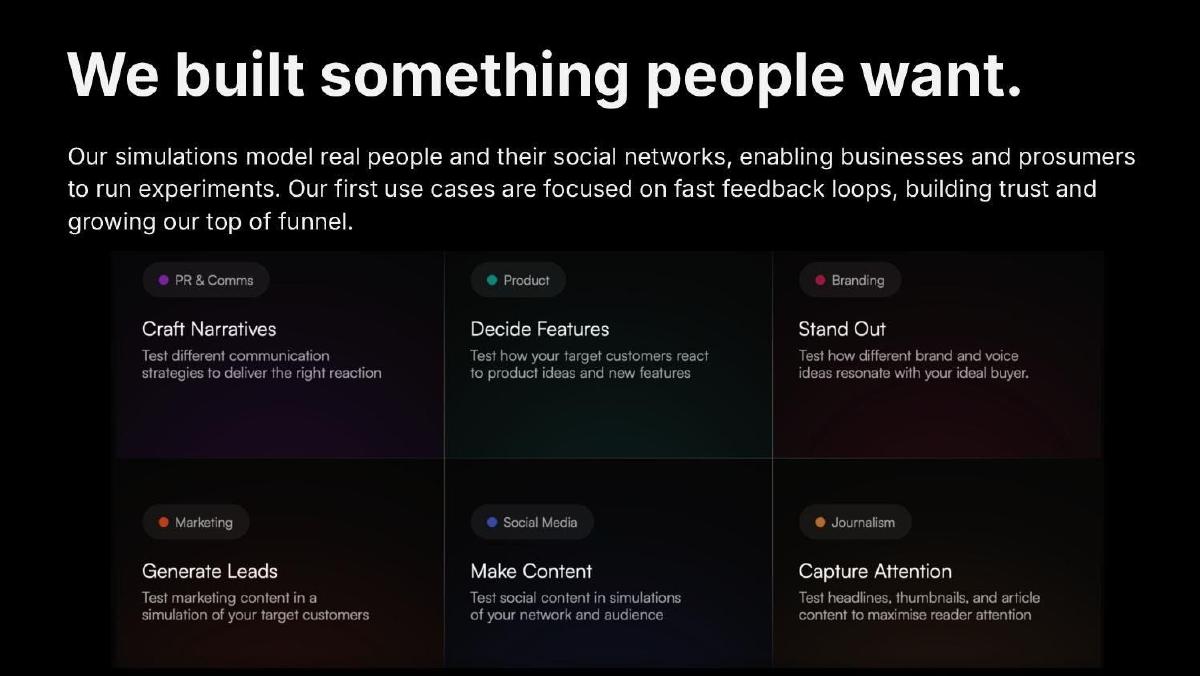
Slide 4 breaks down the immediate utility of the platform into six categories: PR & Comms, Product, Branding, Marketing, Social Media, and Journalism. Each category has a specific value proposition, such as 'Test how your target customers react to product ideas' or 'Test headlines... to maximise reader attention.' This slide effectively answers the 'What do I actually do with this?' question that plagues many AI infrastructure decks.
Slide 5: Traction and Growth
This is arguably the most important slide in the deck. It lists metrics achieved within the first 100 days of launch : 15,000+ registered accounts, 500+ inbound enterprise enquiries, 100,000+ simulations run, and 1 million+ AI personas created. The claim of '1-1 matching with real people' for these personas is a significant technical boast that suggests a high level of data granularity. The mention of CEOs and Growth Marketers as paying customers validates the willingness to pay early in the lifecycle.
Slide 6: Social Proof
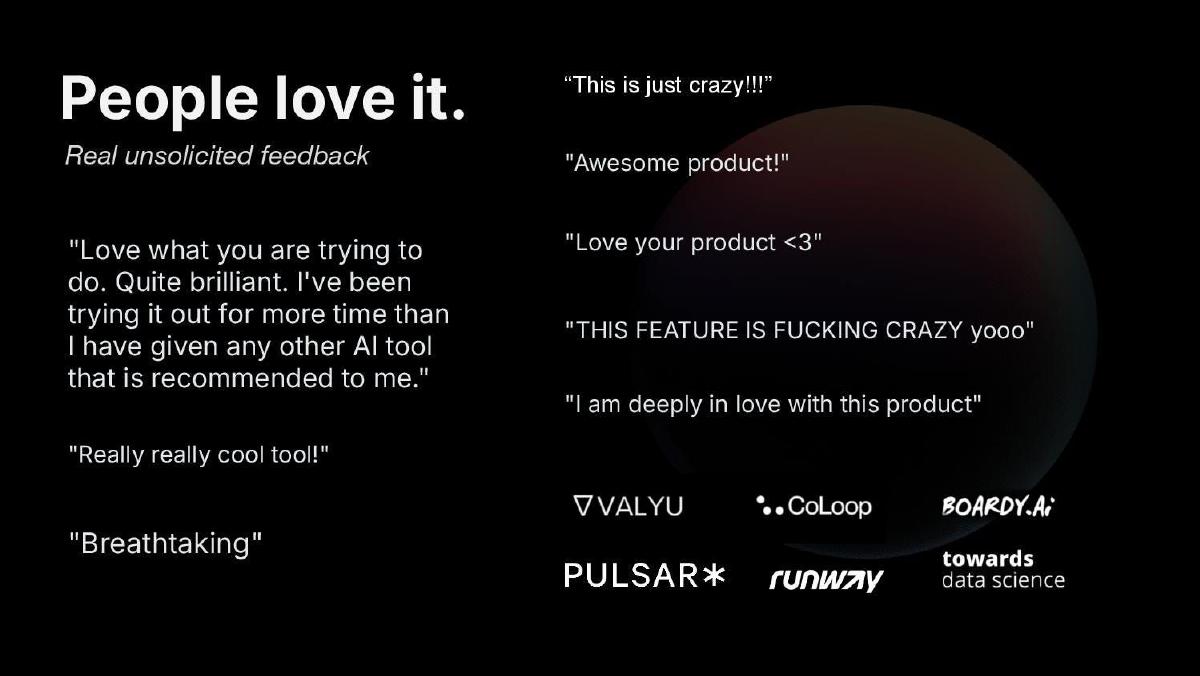
Titled 'People love it,' this slide is a collection of 'unsolicited feedback' quotes. While quotes like 'This is just crazy!!!' are subjective, the inclusion of logos like Runway, Pulsar, and Towards Data Science at the bottom suggests that the product is being used and recognized by industry peers and sophisticated tech users. It serves to humanize the data presented on the previous slide.
Slide 7: Technical Benchmarking
Artificial Societies addresses the 'moat' question by showing a bar chart of success rates in picking winning LinkedIn posts. They claim an 82% success rate , which they contrast against Claude 3.7 Sonnet (64%) and GPT-4o (60%) . By using a specific, measurable task (predicting content performance), they provide a concrete reason why an enterprise would choose their specialized ACI over a general-purpose LLM.
Slide 8: Market Opportunity and Roadmap
The company identifies market research as a $100B+ market . However, the roadmap shown in a grey box—'Messaging -> product market research -> policy -> macroeconomics -> everything'—indicates that they view market research as merely the entry point. The ultimate goal is to become a simulation engine for global policy and economics, a much larger (if more abstract) opportunity.
Slide 9: The Ask
The fundraising slide is direct. It lists four goals for the Seed financing: GTM, building product/engineering capabilities, assembling a research team, and achieving $2m+ ARR . Setting a specific revenue target for the round gives investors a clear metric for success and suggests the founders have a firm grasp on their unit economics and sales velocity.
Slide 10: Call to Action
The deck concludes with a simple URL: societies.io . There are no contact details for the founders on this slide, which implies the deck might be intended for a platform or a situation where the recipient already has the sender's info, or it simply reflects the founders' confidence in the product's ability to speak for itself.
What Artificial Societies Does Well
The deck excels at velocity signaling . By framing all their traction within a 'first 100 days' window, they create a sense of urgency and inevitable growth. Investors are often more attracted to the rate of change than the absolute numbers, and 15,000 users in three months is a powerful rate of change for a Seed-stage company.
Furthermore, the comparative accuracy chart on Slide 7 is a brilliant way to handle the 'OpenAI will just build this' objection. By showing that their specialized model significantly outperforms the latest models from Anthropic and OpenAI on a specific task, they demonstrate a technical edge that justifies their $5.3M valuation.
What is Missing from the Deck
The most notable omission is Unit Economics . While they mention having paying customers and a goal of $2M ARR, there is no information on CAC (Customer Acquisition Cost), LTV (Lifetime Value), or even the basic pricing model. For a Seed round, this isn't always a dealbreaker, but it leaves a gap in the business logic.
There is also no Competition Slide . While Slide 7 compares their technology to other AI models, it doesn't mention other startups in the 'synthetic users' or 'AI persona' space. Acknowledging the competitive landscape and explaining why their approach to 'Collective Intelligence' is superior to other persona-based competitors would have strengthened the defensibility argument.
Finally, the Ask Slide (Slide 9) does not state the actual dollar amount being raised. While publisher reports confirm it was $5.3M, leaving the number off the slide is a common tactic to allow for flexibility during negotiations, but it can sometimes make the 'Achieve $2m+ ARR' goal feel disconnected from the capital required to get there.
Founder Takeaways: Copy This
Use a 'First X Days' Frame: If you have strong early traction, don't just list the numbers. List the numbers within a tight timeframe to show momentum. · Benchmark Against the Giants: If your product uses AI, show a head-to-head comparison against GPT-4 or Claude on a specific, relevant task. It proves you aren't just a wrapper. · Define a New Category: Artificial Societies didn't just say they do 'AI Market Research.' They branded their tech as 'Artificial Collective Intelligence.' This makes them the leader of a new category rather than a participant in an old one. · Keep it Lean: 10 slides is the sweet spot. This deck moves from Team to Vision to Traction to Tech without any filler.
Frequently asked questions
- What is Artificial Collective Intelligence (ACI)?
- According to Slide 3, ACI is an AI system capable of understanding social dynamics within human societies and accurately predicting trends. The company's mission is to use this technology to allow all content, products, and policies to be tested in digital simulations before they are launched in the real world.
- How does Artificial Societies prove its AI is better than OpenAI or Anthropic?
- Slide 7 features a bar chart showing a success rate at 'picking winners from 500 pairs of LinkedIn posts.' Artificial Societies claims an 82% accuracy rate, significantly higher than Claude 3.7 Sonnet (64%), Gemini 1.5 Pro (63%), GPT-4o (60%), and GPT-3.5 Turbo (54%).
- Who are the primary users of the platform currently?
- Slide 5 identifies CEOs, Founders, and Growth Marketers as the first paying customers. The slide also notes that the company has received over 500 inbound enquiries for enterprise deals within its first 100 days.
- What are the specific use cases for the technology?
- Slide 4 outlines six primary use cases: PR & Comms (crafting narratives), Product (deciding features), Branding (standing out), Marketing (generating leads), Social Media (making content), and Journalism (capturing attention).
- What are the financial goals for this Seed round?
- Slide 9 explicitly states that the seed financing is intended to help the company achieve $2m+ ARR. Other goals include scaling GTM efforts, building out product and engineering capabilities, and assembling a research team.