Bridge Round on a Pitch Deck Ask Slide: 9 Real Examples
How to present a bridge or seed extension round: how much, on what instrument and terms, what milestone it reaches and which round it leads to.
How to Present a Bridge Round on Your Ask Slide
Nine slides from nine real pitch decks show how founders present a bridge round: a smaller raise between two priced rounds. The best give the amount, the instrument, the terms, the milestone the money reaches and the round it leads to. The weakest mention a bridge in passing with no figures at all.
TL;DR
A bridge slide must answer three questions an investor will ask at once: how much, on what terms, and what does it get you to? Give the amount and how much is already committed, the instrument (convertible note, SAFE or priced equity) with its cap, discount, interest and maturity, the milestone the money reaches, and the size of the next round. Carlson Wireless does nearly all of this: an $800,000 bridge with $450,000 committed, a convertible note capped at a $16.9M valuation, 4% simple interest, 24-month maturity and automatic conversion at a Series A of $5M or more. Chekkit raises $1,000,000 on a SAFE at a $15m pre-money valuation, with a 30% discount in January falling to 20% in February and a closing date of 28 February 2022. Cardinal Analytx shows its $7M Series A bridge between a $6M Series A and a $22M Series B, with clients rising from 1 to 11 across the bridge year. Patriot Shield plans a $500K convertible bridge, then $5MM and $10MM, adding up to its $15.5MM headline. Change Heroes, Brandvee and Arist give the amount and context but fewer terms. Caura and Li-Bio mention a bridge with no figures.
Bridge round slides from real pitch decks
Each example shows the exact stored slide above its analysis and links to the full teardown. Stage and year are given only where the deck states them. Figures are the company's own claims.
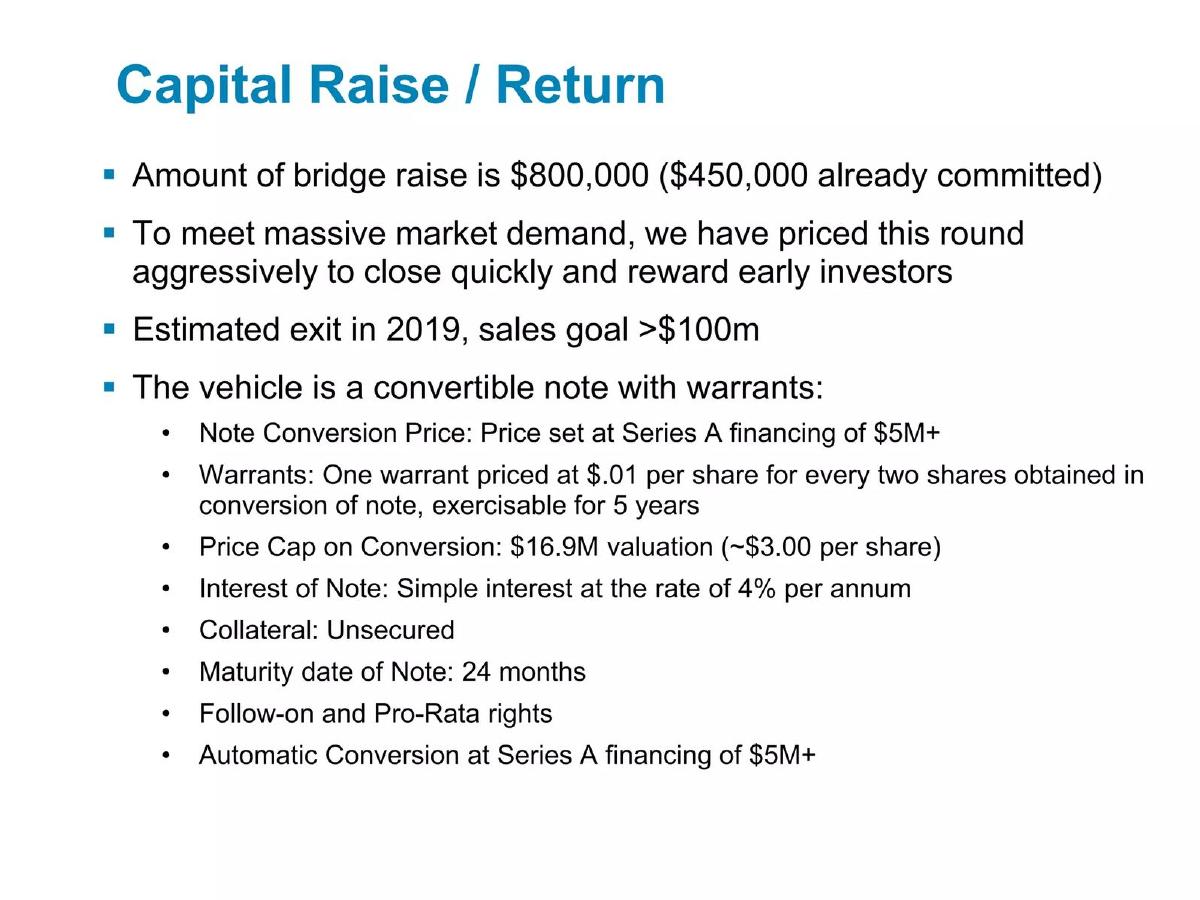
Carlson Wireless ask slide — slide 24
Rural wireless broadband equipment maker.
Carlson Wireless deck, slide 24. Exact stored slide matched to this analysis.
Our analysis: Nearly a full term sheet on one slide, with the committed amount.
Evidence and limitation: Claims such as "priced aggressively" with no reference valuation.
What a founder can adapt: Drop the exit aspiration or support it separately.
Supporting analysis
What the deck claims: Bridge raise $800,000 ($450,000 committed). Convertible note with warrants; cap $16.9M (~$3.00/share); 4% simple interest; unsecured; 24-month maturity; automatic conversion at Series A of $5M+. Estimated exit in 2019, sales goal >$100m.
Presentation choice: Nearly a full term sheet on one slide, with the committed amount.
When it does not fit: Claims such as "priced aggressively" with no reference valuation.
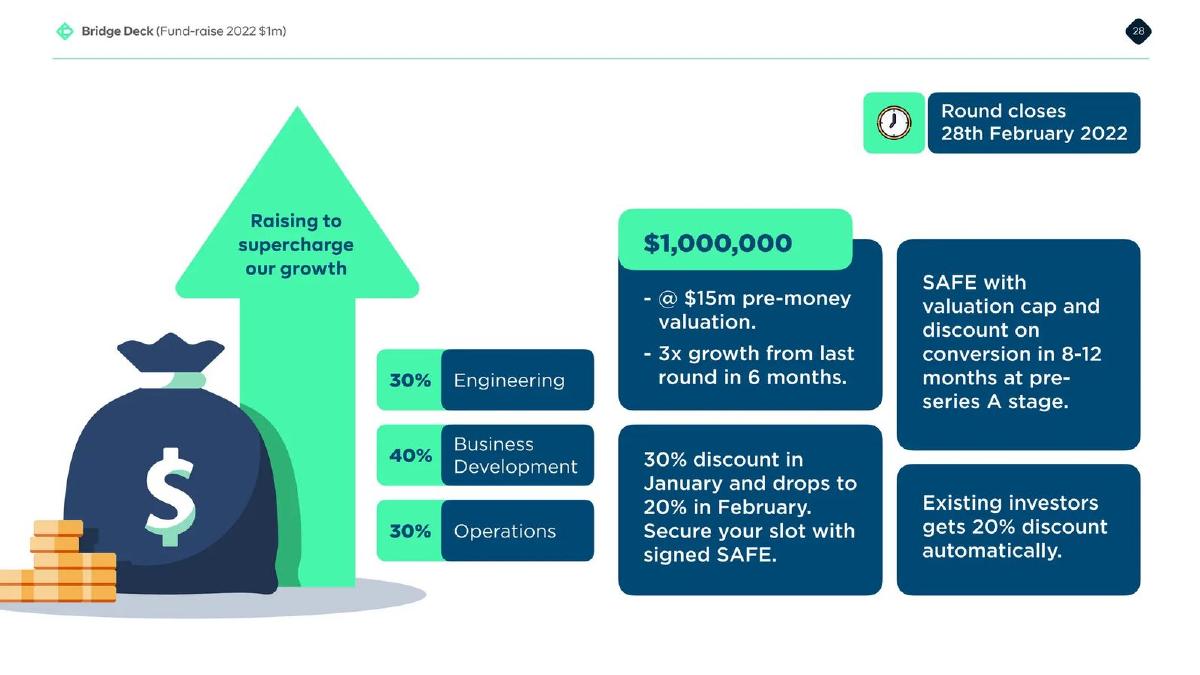
Chekkit deck, slide 28. Exact stored slide matched to this analysis.
Our analysis: Amount, instrument, price, deadline and uses together; the split adds up to 100%.
Evidence and limitation: Deadlines with no reason for the price.
What a founder can adapt: Say what milestone the $1M reaches before the Series A.
Supporting analysis
What the deck claims: $1,000,000 SAFE at $15m pre-money with cap and discount; 3x growth from last round in 6 months. 30% discount in January, 20% in February; existing investors 20%. Closes 28 February 2022. Uses 30% engineering, 40% business development, 30% operations.
Presentation choice: Amount, instrument, price, deadline and uses together; the split adds up to 100%.
When it does not fit: Deadlines with no reason for the price.
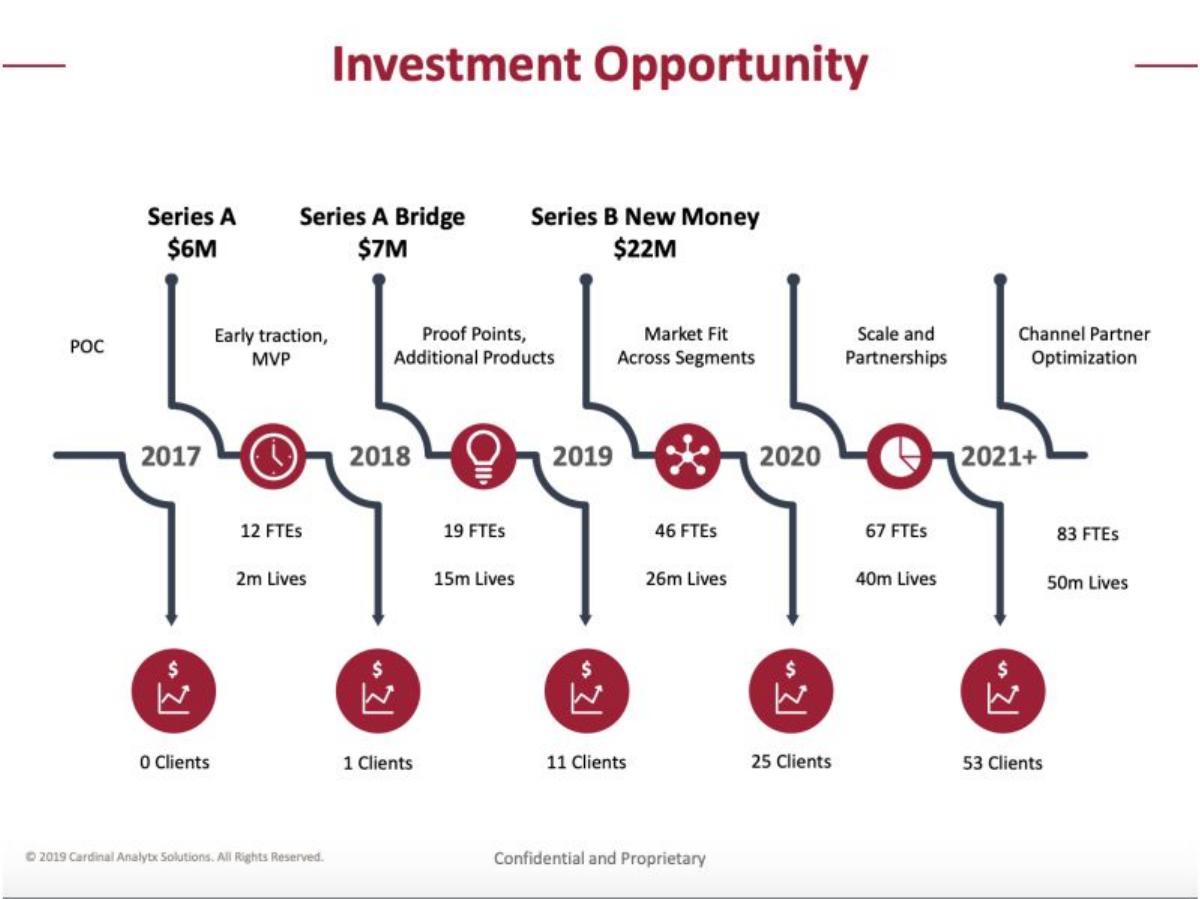
Cardinal Analytx deck, slide 13. Exact stored slide matched to this analysis.
Our analysis: Places the bridge between two rounds and shows what changes across it.
Evidence and limitation: Unexplained bridge sizes.
What a founder can adapt: Explain why the bridge is larger than the Series A.
Supporting analysis
What the deck claims: Series A $6M (2017); Series A Bridge $7M (2018, proof points, additional products); Series B $22M (2019). Clients 0, 1, 11, 25, 53; FTEs 12, 19, 46, 67, 83.
Presentation choice: Places the bridge between two rounds and shows what changes across it.
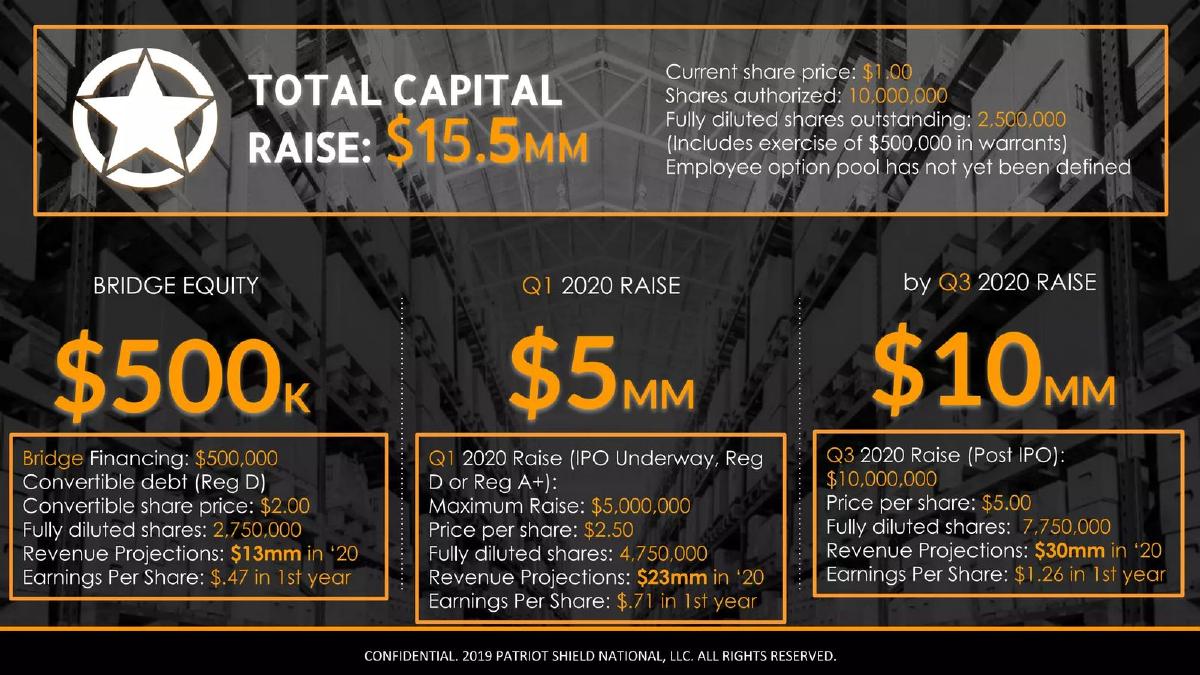
Patriot Shield deck, slide 16. Exact stored slide matched to this analysis.
Our analysis: The three stages add up to the total, and the price rises at each step.
Evidence and limitation: Three different forecasts for the same year.
What a founder can adapt: Give one revenue plan and what the bridge alone achieves.
Supporting analysis
What the deck claims: Total capital raise $15.5MM. Bridge equity $500K convertible debt at $2.00. Q1 2020 raise $5MM at $2.50 (IPO underway). Q3 2020 raise $10MM post-IPO at $5.00. Revenue projections $13mm, $23mm, $30mm in 2020.
Presentation choice: The three stages add up to the total, and the price rises at each step.
When it does not fit: Three different forecasts for the same year.
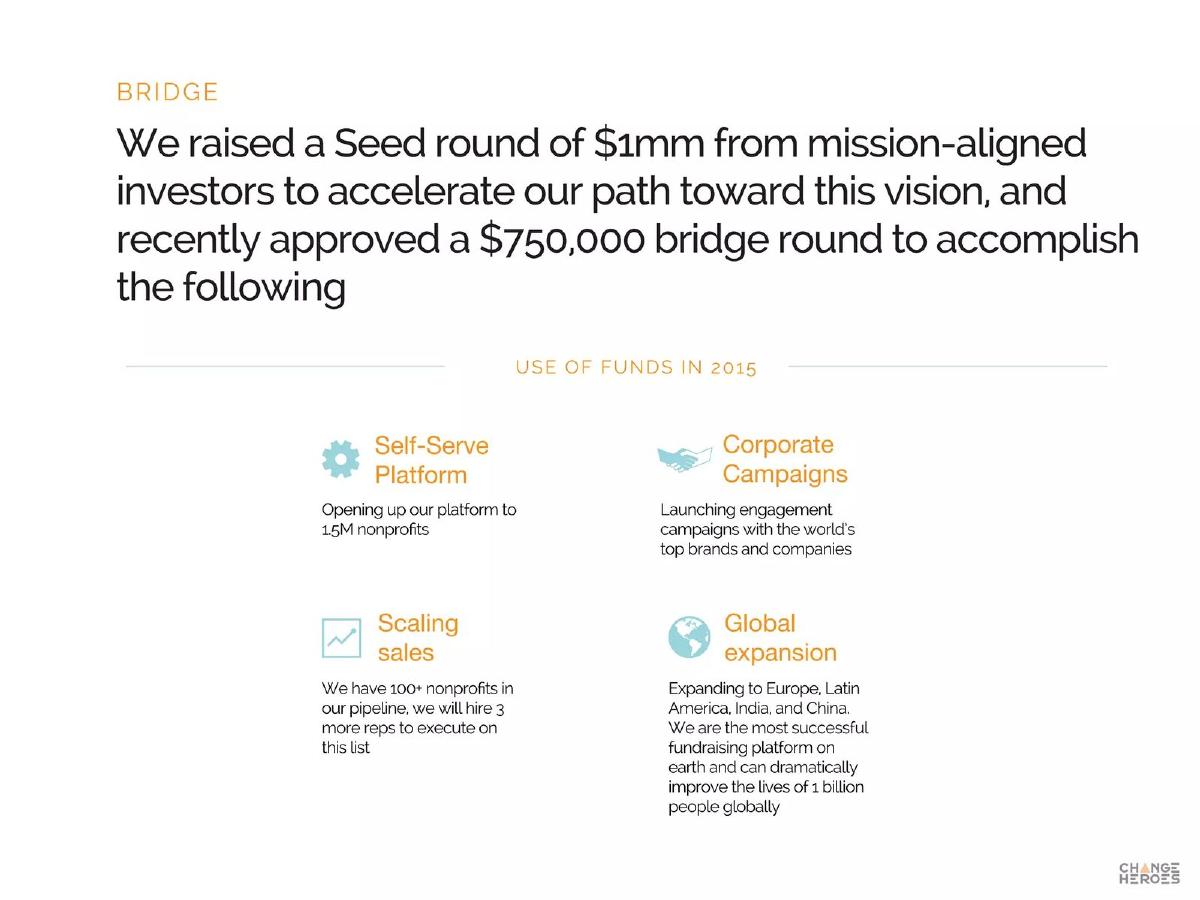
Change Heroes deck, slide 23. Exact stored slide matched to this analysis.
Our analysis: One sentence names the previous round, the bridge and its purpose.
Evidence and limitation: Global plans on a small bridge with no split.
What a founder can adapt: Put amounts against each use.
Supporting analysis
What the deck claims: Seed round of $1mm, then a $750,000 bridge round. Uses in 2015: self-serve platform for 1.5M nonprofits, corporate campaigns, 3 more sales reps, global expansion.
Presentation choice: One sentence names the previous round, the bridge and its purpose.
When it does not fit: Global plans on a small bridge with no split.
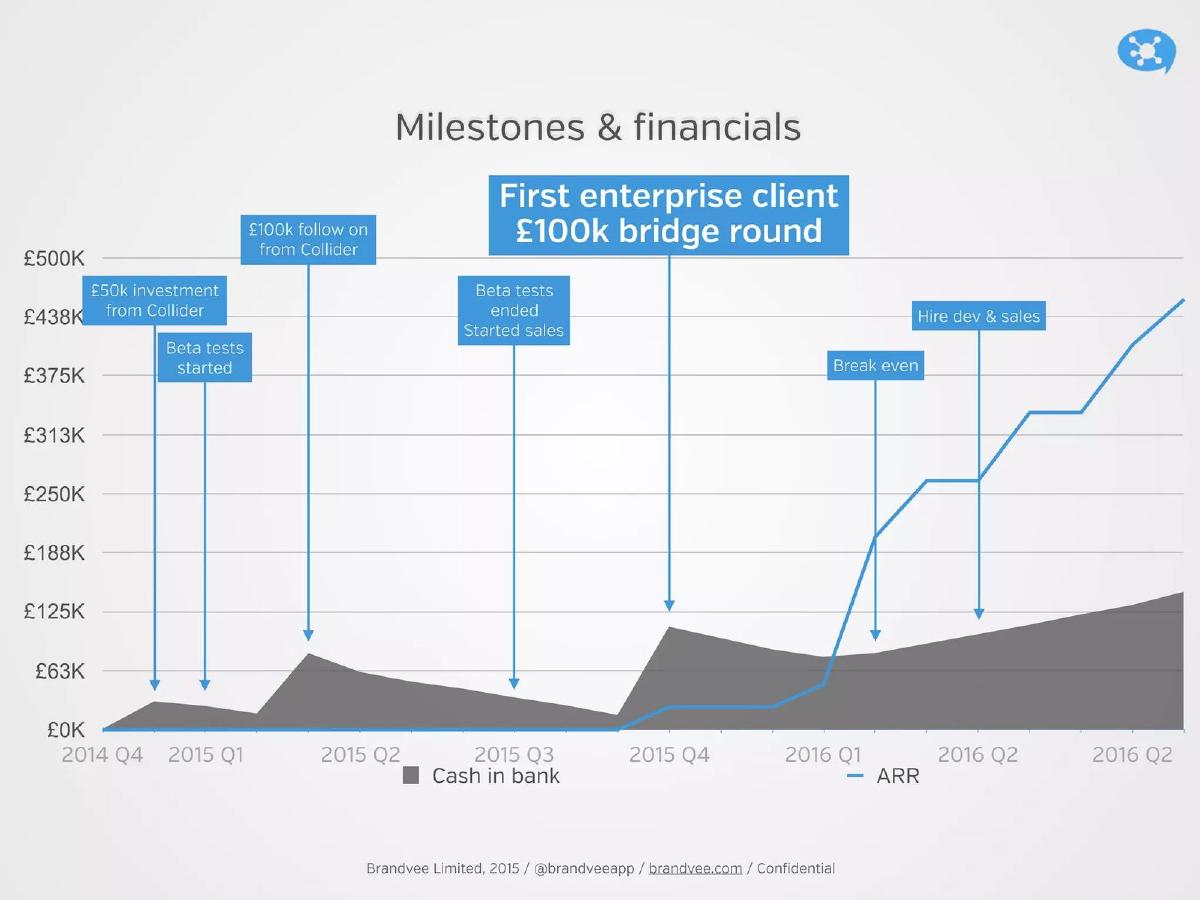
Brandvee deck, slide 13. Exact stored slide matched to this analysis.
Our analysis: Shows the bridge topping up cash just as revenue starts.
Evidence and limitation: Charts with unlabelled lines.
What a founder can adapt: Label the revenue values on the chart.
Supporting analysis
What the deck claims: Milestones and financials chart: £50k investment and £100k follow-on from Collider; first enterprise client and £100k bridge round; break-even 2016 Q1; cash in bank and ARR to 2016 Q2.
Presentation choice: Shows the bridge topping up cash just as revenue starts.
When it does not fit: Charts with unlabelled lines.
Text-message training platform; Y Combinator company.
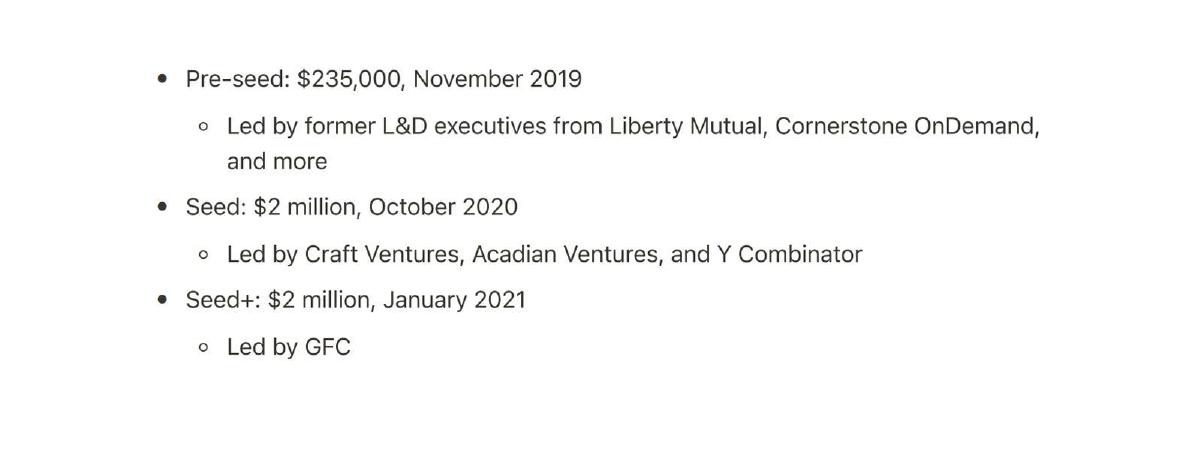
Arist deck, slide 22. Exact stored slide matched to this analysis.
Our analysis: An extension three months after the seed reads as demand.
Evidence and limitation: Leaving investors to guess why you extended.
What a founder can adapt: Say the extension was at a higher price, if it was.
Supporting analysis
What the deck claims: Pre-seed $235,000 (Nov 2019). Seed $2 million (Oct 2020), Craft Ventures, Acadian Ventures, Y Combinator. Seed+ $2 million (Jan 2021), led by GFC.
Presentation choice: An extension three months after the seed reads as demand.
When it does not fit: Leaving investors to guess why you extended.
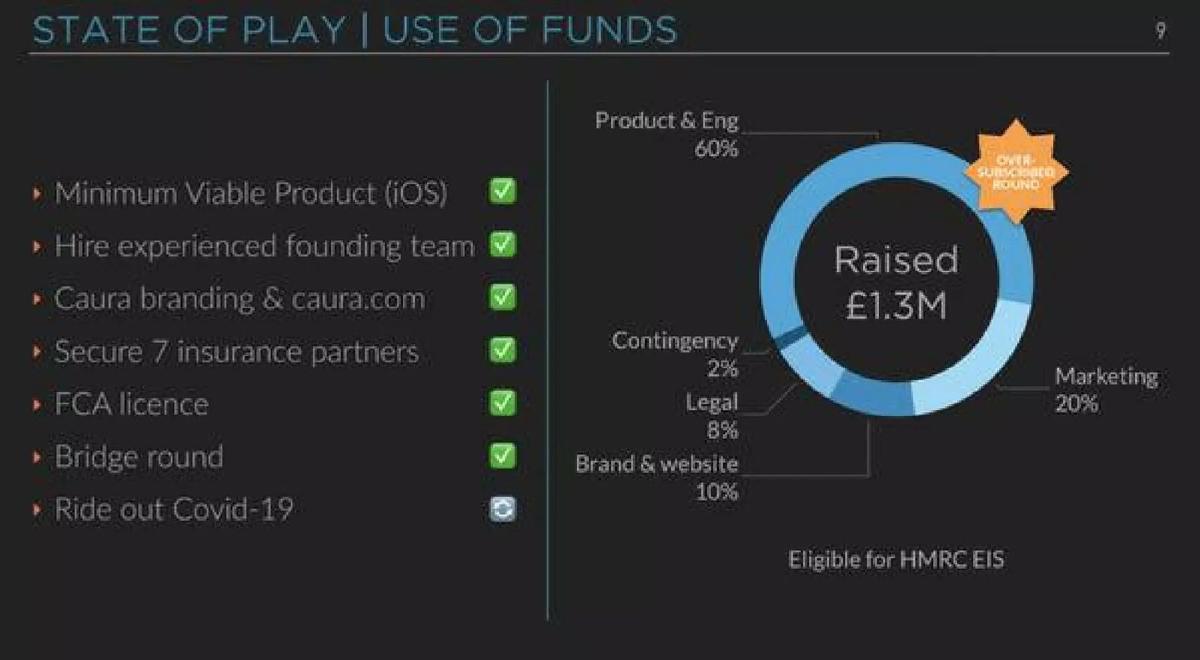
Caura deck, slide 9. Exact stored slide matched to this analysis.
Our analysis: Shows the bridge is done.
Evidence and limitation: A ticked bridge with no figure.
What a founder can adapt: Give its amount and whether it is inside the £1.3M.
Supporting analysis
What the deck claims: State of play: MVP, team, branding, 7 insurance partners, FCA licence, bridge round (ticked), ride out Covid-19. Raised £1.3M, EIS eligible.
Presentation choice: Shows the bridge is done.
When it does not fit: A ticked bridge with no figure.
Most slides give the amount; few give terms, milestone and next round together.
Example
Amount
Terms given
Milestone
Next round
Carlson Wireless
$800,000
Full
Series A
$5M+
Chekkit
$1,000,000
SAFE, cap, discount
Pre-Series A
Not sized
Cardinal Analytx
$7M
No
Proof points
$22M
Patriot Shield
$500K
Convertible, price
IPO
$5MM, $10MM
Change Heroes
$750,000
No
Four uses
No
Brandvee
£100k
No
Break-even
No
Arist
$2M seed+
No
No
No
Caura
Not given
No
No
No
Li-Bio
Not given
No
No
No
Key Takeaways
Give the amount and how much is already committed.
Name the instrument and its terms: cap, discount, interest, maturity.
Say what milestone the bridge reaches.
Show the next round's size and when it is expected.
Explain why a bridge rather than the next round now.
Test your bridge slide before you send it
Answer these with numbers, even if they are targets.
Amount. How much, and how much is committed?
Instrument. Note, SAFE or equity; cap, discount, interest, maturity?
Milestone. What will you have achieved when the bridge is spent?
Next round. How big, and when?
Why a bridge. Why not raise the next round now?
Copyable framework: Bridge: [amount] on [instrument], [committed] committed by [investors]. Cap [cap], discount [x]%. Reaches [milestone] in [n] months. Next: [round] of [amount] in [quarter]. Uses: [use] [amount], [use] [amount]
Illustrative example 1 — written by us
Before: Raised seed financing, currently raising a bridge round.
After: Raising a [amount] bridge on [instrument], [committed] committed. Reaches [milestone] by [date]; Series A of [amount] to follow
What improved: Our illustrative rewrite, not Li-Bio's text. Bracketed parts are placeholders, not company facts. It turns a passing mention into an ask.
What this guide covers
A bridge round is a smaller raise between two larger rounds. It is used to reach a milestone that will make the next round easier: a first enterprise customer, a product launch, a regulatory approval, a revenue level. Some bridges are called seed extensions, seed+ rounds or Series A extensions; the idea is the same. Most are raised from existing investors, often on a convertible note or a SAFE so that the price can be set later by the next round.
Investors read bridge slides carefully because a bridge can mean two very different things. It can mean the company is doing well and wants a little more money to reach a better valuation. Or it can mean the company is running out of cash and could not raise the next round in time. The slide has to make clear which, and the strongest way to do that is to say what the money buys and what happens next.
None of our existing ask-slide guides covers bridge rounds. The deal terms guide explains convertible notes and SAFEs in general; the runway guide covers how long money lasts. We searched the corpus for bridge, extension and seed+ terms near a figure. Most hits were property loans, takeover financing or listed companies, which we excluded. We read the remaining startup candidates from images of the original deck pages and kept nine slides from nine private companies. Two candidates dropped out: one slide was already used in another guide and one deck file was missing.
Give the full terms
Because most bridges are convertible, the terms decide how much of the company the bridge investors end up owning. An investor needs them before they can decide. A slide that gives the amount but not the terms forces a second conversation.
Carlson Wireless, a rural wireless broadband company, puts the whole term sheet on one slide titled Capital Raise / Return. The bridge is $800,000, of which $450,000 is already committed. The instrument is a convertible note with warrants: one warrant at $.01 per share for every two shares received on conversion, exercisable for five years. The note converts at the price set at a Series A of $5M or more, with a price cap of a $16.9M valuation (about $3.00 per share). It carries 4% simple interest, is unsecured, matures in 24 months, gives follow-on and pro-rata rights, and converts automatically at the Series A. That is nearly everything an investor's lawyer would ask for, on one page.
Two lines on the same slide are weaker. "We have priced this round aggressively to close quickly" is a claim the reader cannot check without comparing it with a recent valuation. And "estimated exit in 2019, sales goal >$100m" is an aspiration placed next to hard terms. The terms are what make the slide useful; the exit line would be better left out or moved to a separate slide with its own reasoning.
Saying how much is already committed matters. $450,000 of $800,000 tells a new investor the round is more than half full and who is likely already in. Bridges are often led by existing investors, and showing their commitment is a signal of confidence.
Use the terms to create a reason to act
Chekkit, an anti-counterfeiting company in Nigeria, titled its whole deck a Bridge Deck (Fund-raise 2022 $1m). Its ask slide gives the amount, $1,000,000, on a SAFE with a valuation cap and discount, at a $15m pre-money valuation, converting in 8 to 12 months at the pre-Series A stage. It claims 3x growth from its last round in six months to justify the price. The discount is 30% in January, dropping to 20% in February; existing investors get 20% automatically; and the round closes on 28 February 2022. Spending is split 30% engineering, 40% business development and 30% operations, which adds up to 100%.
The falling discount is a deliberate device to get investors to commit early. It is legitimate and clearly stated, but it is worth thinking about how it reads. To some investors a deadline signals momentum; to others it reads as pressure. Pairing it with the 3x growth claim, as Chekkit does, gives a reason for the price as well as the deadline. A following slide links to the standard Y Combinator SAFE, which helps: investors know exactly what document they would sign.
Show the bridge between two rounds
The clearest way to explain why a bridge exists is to show it on a timeline between the round before and the round after, with what changes in between.
Cardinal Analytx, a healthcare analytics company, does this on a slide titled Investment Opportunity. A Series A of $6M in 2017 is labelled early traction, MVP. A Series A bridge of $7M in 2018 is labelled proof points, additional products. A Series B of $22M in 2019 is labelled market fit across segments. Below the line, the company tracks full-time staff (12, 19, 46, 67, 83), lives covered (2m, 15m, 26m, 40m, 50m) and clients (0, 1, 11, 25, 53). Across the bridge year, clients go from 1 to 11. That is the argument: the bridge pays for the proof that justifies the Series B. The company did go on to raise a $22 million Series B in 2019.
One thing an investor will notice is that the bridge is larger than the Series A that came before it. That is unusual; a bridge is normally smaller. It is not necessarily a problem, but a slide like this should say why: perhaps the A was spent faster than planned, or the company chose to add products before the B. Leaving it unexplained invites the question.
Patriot Shield, a hemp logistics company, sets out three stages under a headline of Total Capital Raise $15.5MM. Bridge equity of $500K is convertible debt (Reg D) at a $2.00 conversion price. A Q1 2020 raise of $5MM is described as "IPO underway, Reg D or Reg A+" at $2.50 per share. A Q3 2020 raise of $10MM, post-IPO, is at $5.00 per share. The three add up to $15.5MM. Showing the price rising at each step tells bridge investors what they get for going first.
But each column also gives a different revenue projection for the same year: $13mm, $23mm and $30mm in 2020, with matching earnings per share. The figures are presumably meant to show what each amount of money could achieve, but presented this way they look like three different forecasts for one year. A bridge slide should give one plan and say what the bridge alone achieves. Our search found no sign that the planned listing took place.
Say what the bridge pays for
Change Heroes, a fundraising platform for nonprofits, opens its slide with a plain statement: "We raised a Seed round of $1mm from mission-aligned investors to accelerate our path toward this vision, and recently approved a $750,000 bridge round to accomplish the following." Four uses follow under Use of Funds in 2015: opening a self-serve platform to 1.5M nonprofits, launching corporate campaigns, hiring three more sales reps to work a pipeline of 100+ nonprofits, and expanding to Europe, Latin America, India and China. The opening sentence is a good model: it names the previous round, the bridge and its purpose in one line. The uses, though, have no amounts, and global expansion on a $750,000 bridge is ambitious. A split by line, as Chekkit gives, would make the plan easier to judge.
Brandvee, a UK software company, places its bridge on a chart of cash in the bank and annual recurring revenue from 2014 Q4 to 2016 Q2. Earlier markers show a £50k investment and a £100k follow-on from Collider. The highlighted marker reads "First enterprise client, £100k bridge round", after which revenue begins and the chart marks break-even in 2016 Q1. The picture tells the story well: the bridge tops up cash just as revenue starts. But the revenue line has no labelled values, so the reader cannot tell how much revenue the company expects. The y-axis steps (£63K, £125K, £188K and so on) are also odd intervals to read.
Extensions after a strong seed
Not every bridge is a rescue. Arist, a text-message training platform, lists its funding history: pre-seed $235,000 in November 2019, seed $2 million in October 2020 led by Craft Ventures, Acadian Ventures and Y Combinator, and seed+ $2 million in January 2021 led by GFC. A seed+ only three months after a seed usually means investors wanted in, not that the company ran short. TechCrunch reported the extension was raised at a higher price than the first seed tranche. The slide itself does not say that, and it should: a higher price is the single best signal that an extension is good news.
The weak version: a bridge mentioned in passing
Caura, a UK car-ownership app, shows a state-of-play checklist beside a £1.3M raised chart: minimum viable product, team, branding, seven insurance partners, an FCA licence, "bridge round" (ticked) and "ride out Covid-19" (in progress). The bridge is ticked as done but has no amount, terms or explanation. A reader cannot tell whether it is part of the £1.3M or in addition to it.
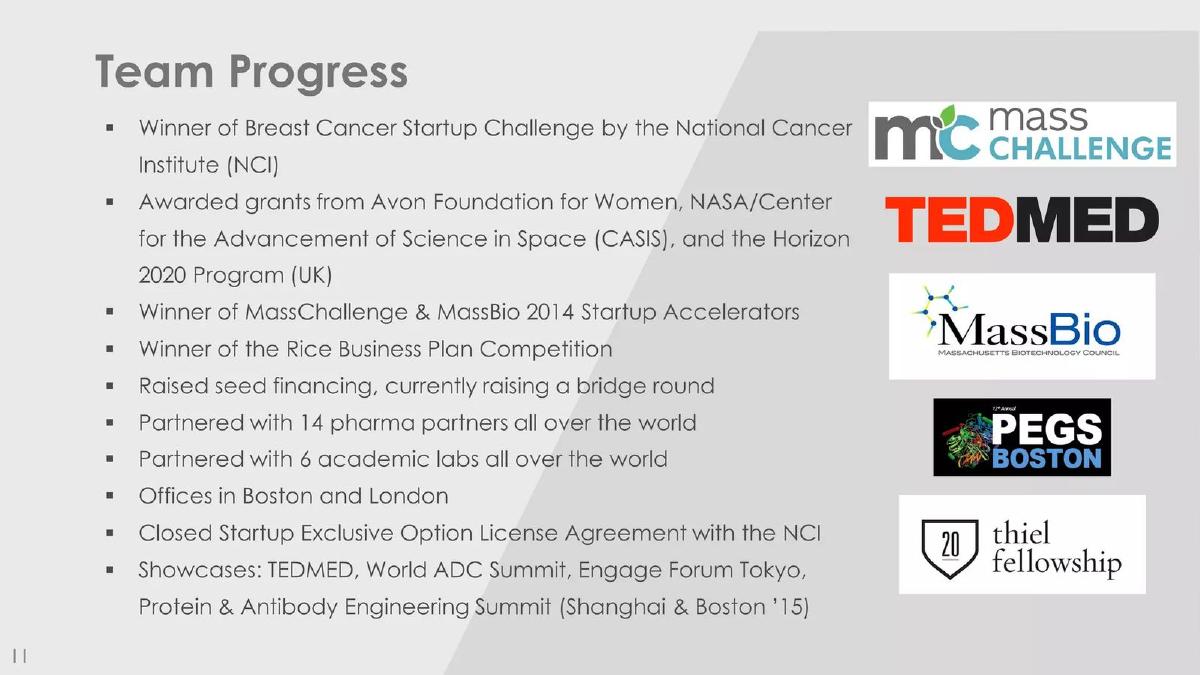
Li-Bio, a biotech company, lists team progress: awards, grants, accelerator wins, 14 pharma partners and "raised seed financing, currently raising a bridge round". Again, no amount, no terms and no milestone. Mentioning a bridge on a progress slide without the details tells investors a raise is happening but gives them nothing to act on. If you are raising a bridge, it deserves its own slide.
A worked example
Here is how a founder might set out a bridge on one slide. All figures are illustrative, not from any company in this guide.
Bridge: $750,000 on a SAFE, $500,000 committed by our seed investors. Valuation cap $12M, 20% discount, converts at the Series A. Why now: we reach $1M annual recurring revenue in nine months, up from $420K today; the bridge covers 11 months of runway at $68,000 a month. Series A target: $6M in Q3 next year. Uses: two account executives $300,000, product $250,000, marketing $200,000.
Check the arithmetic: $300,000 + $250,000 + $200,000 = $750,000, and 11 × $68,000 = $748,000, so the runway claim matches the amount. That covers the five things an investor looks for: amount and commitment, terms, the milestone, the next round and the uses.
Common mistakes
No terms. Give the instrument, cap, discount and maturity.
No milestone. Say what the bridge reaches.
No next round. Size the round the bridge leads to.
Several forecasts. Give one plan, not one per tranche.
Passing mention. A bridge deserves its own slide.
Diagnostic checklist
Amount and committed amount.
Instrument and terms.
Milestone the bridge reaches.
Next round size and timing.
Uses of the bridge money.
Frequently asked questions
How we chose these examples
Corpus: published pitch deck teardowns on StartupFundraising.com. Founder-uploaded private decks are excluded.
Selection (2026-10-01): we searched extracted slide text for bridge, extension and seed+ terms near a figure, excluded property loans, takeover financing and listed companies, and read each remaining candidate from images made from the original deck files.
Eligibility: each company was private when its deck was made. Cardinal Analytx, Arist, Chekkit and Carlson Wireless were checked against public funding records. Patriot Shield's 2019 deck describes a planned listing; we found no sign it took place, and the company was an LLC when the deck was made. Change Heroes, Brandvee, Caura and Li-Bio rest on their own decks, with no sign of a listing.
Not used: Ourobio (slide already used in another guide); GoCoin (deck file missing).
Overlap check: the deal terms and runway guides cover instruments and runway in general; no guide covers bridge rounds. None of these slides appears in another guide.
Review: all nine slide images were inspected on 2026-10-01 and matched to company, deck and slide number (AI editorial model review). No person has yet completed an editorial review of this page. The worked example uses illustrative figures, not company data.
Figures are the companies' own claims; we did not verify underlying data. We make no claim that any slide caused a fundraising outcome.