CBDS Health’s 2018 corporate deck outlines a two-pronged approach to the cannabis industry: GrowBuddy, a cultivation management software, and an IoT platform for clinical research. The deck relies heavily on a case study with DeepRoots Harvest to prove that its software can increase yields to 1.3 grams per watt and eliminate crop failure. While the cultivation side offers immediate utility, the company clearly aims for the higher margins of the pharmaceutical sector, leveraging 15 years of legacy IoT development from the OrcaTech initiative at OHSU. The presentation provides granular pricing…
Key takeaways
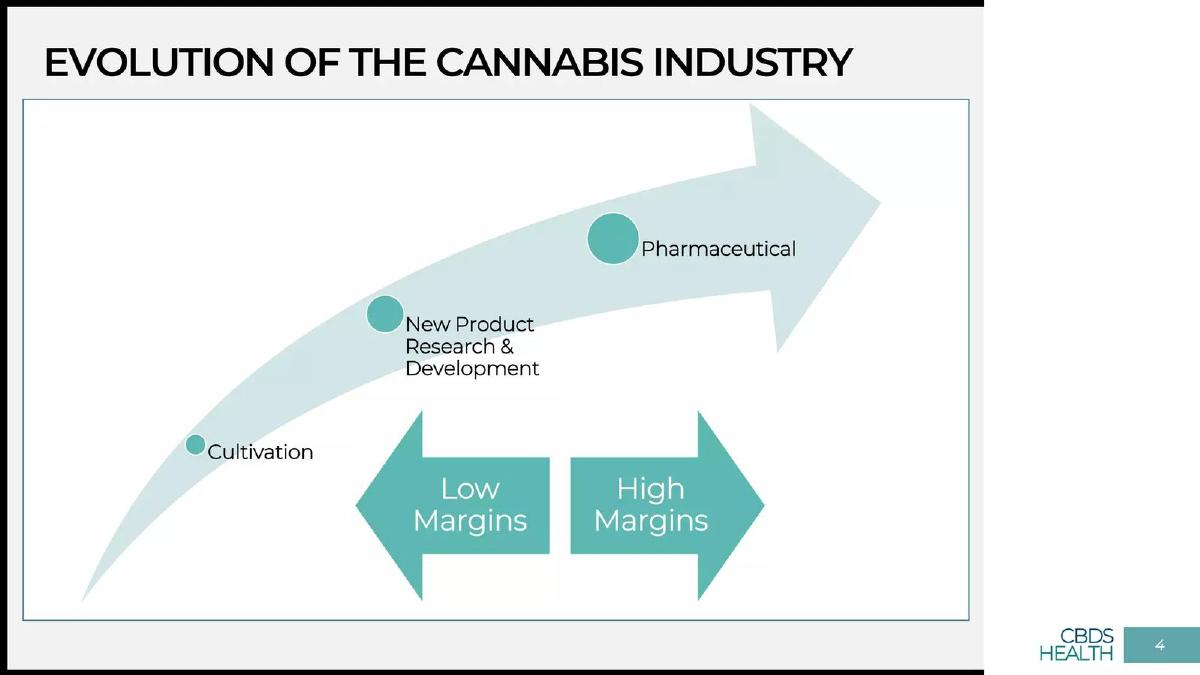
- The company positions itself as moving from low-margin cultivation to high-margin pharmaceutical research (Slide 4).
- GrowBuddy software claims to increase yields to 1.3 grams per watt, cited via a Nevada-based LP case study (Slide 10).
- The platform claims to have achieved 94 consecutive successful grows without a failure for a specific client (Slide 10).
- Operating margin increases are projected to reach $7,560,000 for a 1,000,000 square foot facility (Slide 13).
- The IoT platform is built on 15 years of research from the OrcaTech initiative at Oregon Health Science University (Slide 19).
- OrcaTech’s legacy includes 60+ research studies and over one million hours of patient monitoring data (Slide 19).
- Pricing for clinical sleep studies is highly specific, with a total annual cost of $207,500 for a 100-participant study (Slide 22).
- The deck omits a team slide, financial history, and a specific funding request in the provided pages.
Executive Summary: The Bridge Between AgTech and BioTech
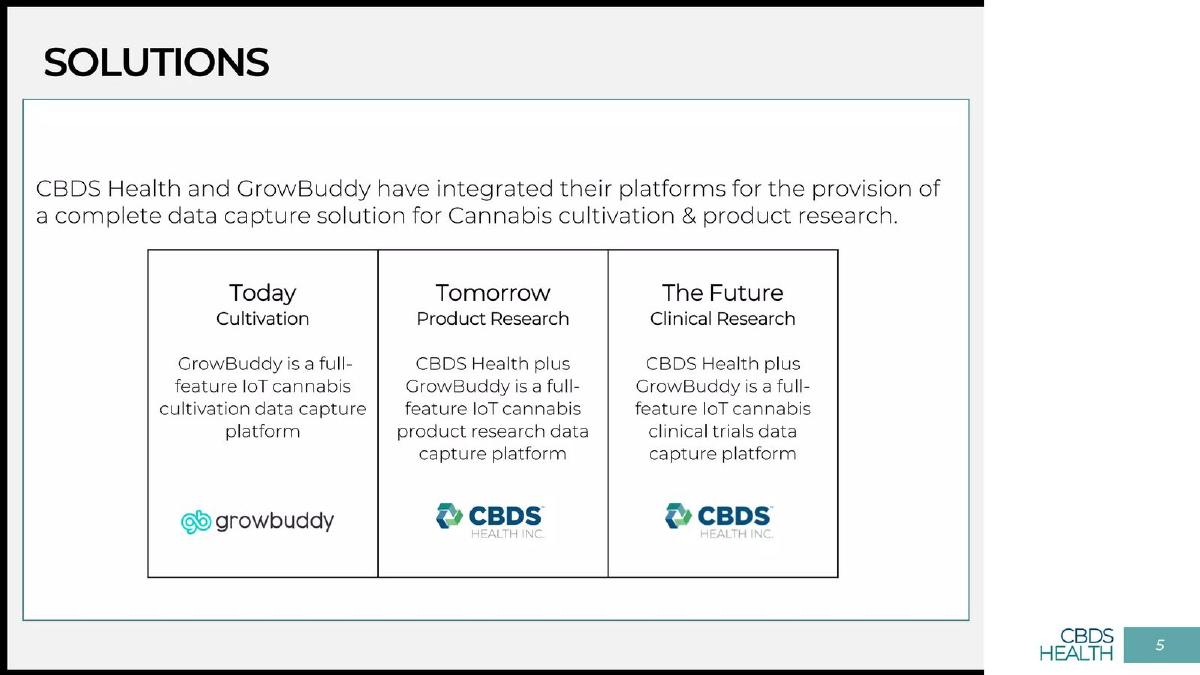
The CBDS Health corporate deck, dated December 2018, attempts to solve a common problem in the cannabis industry: the transition from commodity cultivation to high-value pharmaceutical data. The deck is structured around two distinct brands—CBDS Health and GrowBuddy—which represent the research and cultivation arms of the business, respectively. While the presentation provides deep technical and financial projections for both sides, it struggles to present a unified narrative on how these two halves function as a single company.
Slide 1: Title and Branding
The cover slide introduces the dual branding of "CBDS Health Inc." and "GrowBuddy." The tagline for GrowBuddy is "Grow Smarter." The slide is labeled as a "Corporate Deck," suggesting it may be intended for partners or stakeholders rather than being a pure venture capital pitch. The imagery of a cannabis leaf establishes the sector immediately.
Slide 4: Industry Evolution and Margin Strategy
This slide serves as the strategic thesis for the company. It maps the "Evolution of the Cannabis Industry" along an upward-curving arrow. At the bottom left is "Cultivation," labeled as "Low Margins." The arrow moves through "New Product Research & Development" toward "Pharmaceutical" at the top right, which is labeled as "High Margins." This slide clearly communicates that while the company is involved in cultivation, its long-term goal is to capture the higher value associated with pharmaceutical-grade data and products.
Slide 7: Customer Solutions - Cultivation
This is a transition slide marking the beginning of the section focused on GrowBuddy. It uses high-resolution imagery of a cannabis plant to ground the software solution in the physical reality of farming.
Slide 10: GrowBuddy Case Study - DeepRoots Harvest
This slide provides the most compelling evidence for the GrowBuddy software. It highlights a Nevada-based Licensed Producer (LP), DeepRoots Harvest, which has used the software for several years. The metrics cited are specific: a yield increase to 1.3 grams/watt and 94 consecutive successful grows without a failure. The slide includes testimonials from a Cultivation Consultant and a Cultivation Manager, both emphasizing predictability, repeatability, and the ability to refine nutrient schedules based on data. This is a strong "proof of concept" slide that moves beyond theory into realized gains.
Slide 13: The Economics of Yield Improvement
Slide 13 attempts to quantify the value GrowBuddy brings to a commercial operation. It uses an "Annual Plant Capacity Formula" to show that even a 20% minimum yield increase and a 50% crop loss correction result in a 28% increase in value. The table projects annual operating margin increases based on facility size, ranging from $75,600 for a 10,000 sq. ft. facility to $7,560,000 for a 1,000,000 sq. ft. facility. The note at the bottom mentions that historical industry yields are 0.5 grams per watt, contrasting sharply with the 1.3 grams per watt achieved by GrowBuddy users.
Slide 16: Customer Solutions - Research
This transition slide shifts the focus from the farm to the lab. The imagery changes to a medical cross and digital bitstreams (001010), signaling the move into the "High Margin" pharmaceutical and research space mentioned on Slide 4.
Slide 19: The OrcaTech Legacy and IoT Platform
This slide establishes the technical credibility of the CBDS Health platform. It claims the platform has been 15 years in the making , originating from the OrcaTech initiative at Oregon Health Science University (OHSU). The slide lists impressive credentials: 60+ research studies, 1,000+ individuals monitored, over one million hours of data, and 130+ peer-reviewed publications. A "wall of logos" includes massive entities like Intel, Microsoft, Pfizer, and Sony , though these are attributed to the OrcaTech program rather than CBDS Health directly. This slide is intended to show that the company isn't a new startup, but rather a commercialization of a mature, academic-grade IoT platform.
Slide 22: Sleep Study Unit Economics
The final slide in the provided set breaks down the costs for conducting clinical sleep studies using the CBDS Health IoT hub. The pricing is granular, covering hardware (Hub, Sleep Sensor, Pill Box, Vape Pen) and monthly service fees. The total annual cost for a 100-participant study is listed at $207,500 . This slide is critical because it demonstrates a clear B2B revenue model for the research side of the business, moving away from the speculative nature of cultivation yields into fixed-contract research services.
What Works in This Deck
Specific Metrics: The use of "1.3 grams/watt" and "94 consecutive grows" on Slide 10 provides concrete targets that experienced cultivators can validate. This is much more effective than vague claims of "better yields."
Academic Pedigree: Leveraging 15 years of OHSU research (Slide 19) gives the company a level of technical defensibility that most cannabis startups lack. It positions the hardware not as a new gadget, but as a proven medical tool.
Clear Margin Strategy: Slide 4 effectively explains why the company is pursuing two different markets. It acknowledges that cultivation is a race to the bottom (low margins) and justifies the investment in research as a path to higher profitability.
What Is Missing from This Deck
The Team: In the provided slides, there is no mention of the founders, the management team, or the engineers. For a company claiming to bridge OHSU research with commercial cannabis, the lack of biographical data on the people executing this transition is a significant gap.
The Integration Plan: The deck presents GrowBuddy and CBDS Health as two separate entities. It does not explain how data from the GrowBuddy cultivation software feeds into the CBDS Health research platform. Are they two separate businesses, or is there a data flywheel effect?
The Ask: There is no slide detailing how much capital the company is looking to raise, the valuation, or the specific use of funds. Without this, the deck feels more like a sales presentation for partners than a fundraising tool for investors.
Competitive Landscape: The deck assumes a vacuum. There is no mention of other cultivation ERPs (like MJBiz or Seed-to-Sale platforms) or other IoT health monitoring companies. Investors need to know why this specific IoT hub is superior to existing wearables or medical sensors.
Founder's Guide: What to Emulate and What to Avoid
Emulate the Case Study Depth: Slide 10 is a masterclass in using a single client to prove multiple value propositions (yield, reliability, nutrient refinement). If you have one "super-user," dedicate a full slide to their success metrics.
Emulate the Unit Economics: Slide 22 shows exactly what a customer will pay. This removes the guesswork for investors trying to understand the revenue model. Even if the numbers change, showing the structure of your pricing (Setup + Monthly Service) is vital.
Avoid the "Logo Soup" Ambiguity: While the logos on Slide 19 are impressive, they are collaborators of a university program from which the tech originated, not necessarily partners of the startup itself. Founders should be careful to distinguish between their own corporate partnerships and the historical associations of their technology to avoid appearing misleading during due diligence.
Avoid the "Two-Headed Monster" Problem: Running a software company for farmers and a medical data company for researchers are two very different tasks. If your deck covers both, you must spend time explaining how the organization is structured to handle both without losing focus. This deck leaves that question unanswered.
Frequently asked questions
- What is the primary value proposition of GrowBuddy?
- GrowBuddy is presented as a cultivation management tool that increases predictability and yield. According to Slide 10, it helped a Nevada-based LP achieve 94 consecutive grows without failure and increased yields to 1.3 grams per watt. The software allows growers to refine nutrient schedules and test new growth methods using data-driven insights to produce larger, healthier plants.
- How does CBDS Health plan to generate revenue from research?
- The company offers an IoT hub and platform for clinical studies, specifically targeting sleep research. Slide 22 details a tiered pricing model based on participant count. For example, a 100-participant study involves an $87,500 initial setup cost and $120,000 in monthly service fees, totaling $207,500 annually. Revenue streams include hardware (hubs, sensors, pill boxes) and recurring service fees.
- What is the origin of the company's IoT technology?
- As stated on Slide 19, the technology was developed over 15 years under the OrcaTech initiative at the Oregon Health Science University (OHSU). This initiative produced over 130 peer-reviewed publications and captured more than one million hours of patient data. CBDS Health has transitioned this original networked technology to a cloud-based platform with edge intelligence capabilities.
- What are the projected financial impacts for large-scale cultivators?
- Slide 13 provides a 'Value Increase' table projecting that GrowBuddy can increase operating margins by 28%. For a commercial facility of 500,000 square feet (50,000 plants), the projected annual margin increase is $3,780,000. These calculations are based on a minimum yield increase of 20% and a 50% reduction in crop loss.
- Who are the collaborators mentioned in the deck?
- Slide 19 displays a wide array of logos representing collaborators with the OrcaTech program at OHSU. These include major corporations like Intel, Microsoft, Sony, and Pfizer, as well as academic and health institutions like the Mayo Clinic, Berkeley, the Alzheimer's Association, and the National Institute on Aging.