Energy Startup Solution Slide: Pitch Deck Examples
How energy and battery startups present the solution in a pitch deck: show the product beside what it replaces, give one measured gain in weight.
Energy Startup Solution Slide: Real Pitch Deck Examples
Eight solution slides from energy startups (grid storage, motor couplings, fuel cells, portable power, home energy, EV software and battery materials), shown in full, compare whether each slide shows the product, what it replaces, and a measured gain.
TL;DR
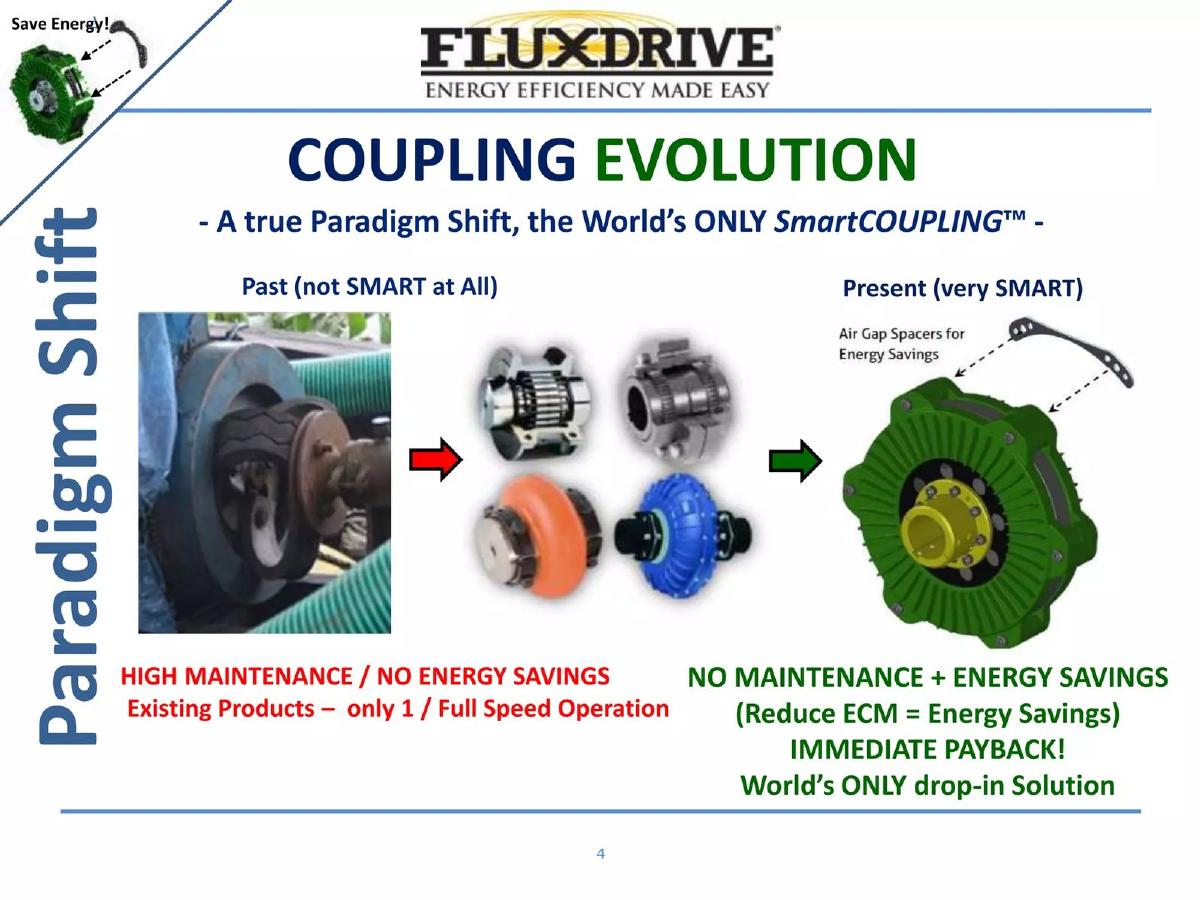
An energy solution slide works best as a before-and-after with one number. Neah Power is the clearest: a fuel cell for a 72-hour mission, "Total weight = 8 lbs", against 12 military batteries, "Total weight = 27 lbs" — "Reduces Weight 70% on 72-Hour Mission." FluxDrive shows the same shape for industrial motors: "Past (not SMART at All)" beside "Present (very SMART)", from "High maintenance / no energy savings" to "No maintenance + energy savings." The Elysium Project's six logos ("Waste to Energy", "Tidal Power", a resort, a marina) show no product and no gain, the weaker pattern.
Energy solution slides from real pitch decks
Each example shows the exact stored slide above its analysis and links to the full teardown. Claims are as shown on the slides; we have not verified them.
Neah Power solution slide — slide 6
Fuel cells for portable and military power. A side-by-side of what a 72-hour mission needs.
Neah Power deck, slide 6. Exact stored slide matched to this analysis.
Our analysis: The strongest example here: same mission, old kit against new, one number for the gain.
Evidence and limitation: A like-for-like comparison with weights.
What a founder can adapt: Pick one real job and compare what it takes with your product and without.
Supporting analysis
What the deck claims: "Shedding The Pounds." "Fuel Cell for a 72-hour Mission": "1 fuel cell", "9 fuel cartridges", "Total weight = 8 lbs". "BA-5590 72-hour Mission": "12 BA-5590 military standard batteries", "Total weight = 27 lbs". Banner: "Reduces Weight 70% on 72-Hour Mission."
Presentation choice: It answers its problem slide ("Heavy" lithium-ion batteries) directly.
When it does not fit: Say whether the 8 lbs is tested or designed.
Magnetic couplings for industrial motors. Past-to-present photos with arrows.
FluxDrive deck, slide 4. Exact stored slide matched to this analysis.
Our analysis: A clear before-and-after that matches its problem slide, but the savings aren't measured.
Evidence and limitation: No figures; photos of each generation.
What a founder can adapt: Show the part you replace next to yours and say how it's installed.
Supporting analysis
What the deck claims: "Coupling Evolution - A true Paradigm Shift, the World's ONLY SmartCOUPLING™." "Past (not SMART at All)" → existing couplings → "Present (very SMART)" with "Air Gap Spacers for Energy Savings". "HIGH MAINTENANCE / NO ENERGY SAVINGS, Existing Products – only 1 / Full Speed Operation." "NO MAINTENANCE + ENERGY SAVINGS (Reduce ECM = Energy Savings). IMMEDIATE PAYBACK! World's ONLY drop-in Solution."
Presentation choice: "Drop-in" tells the buyer they don't have to redesign anything.
When it does not fit: "IMMEDIATE PAYBACK!" without a payback period.
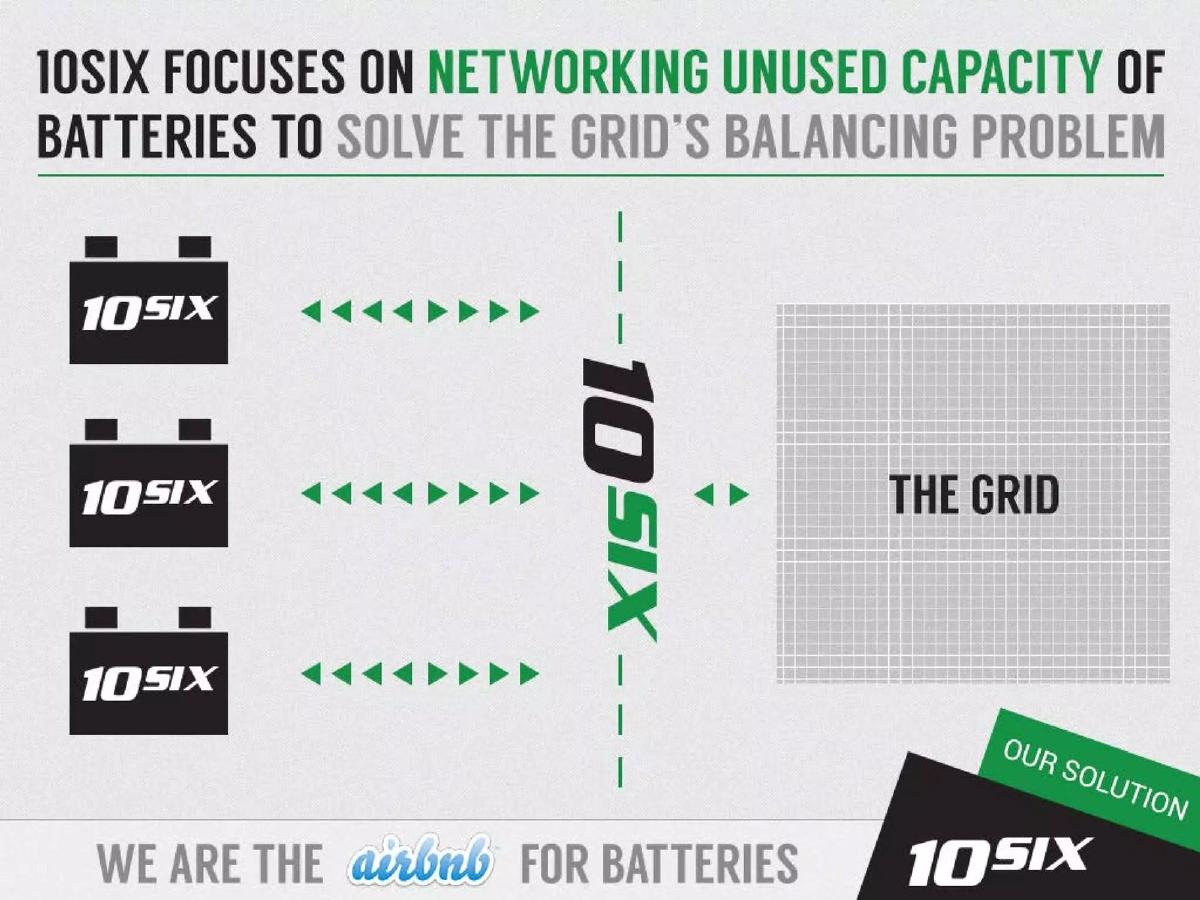
Networking idle backup batteries for the grid. A simple diagram.
10SIX deck, slide 5. Exact stored slide matched to this analysis.
Our analysis: It answers its problem slide ("<2% use") with one idea, and the diagram shows where the company sits.
Evidence and limitation: No figures.
What a founder can adapt: Draw your product between the asset and the buyer.
Supporting analysis
What the deck claims: "10SIX focuses on networking unused capacity of batteries to solve the grid's balancing problem." Diagram: three batteries ↔ 10SIX ↔ "The Grid". "We are the airbnb for batteries."
Presentation choice: "Airbnb for batteries" explains the model in five words.
When it does not fit: Add what one battery owner earns.
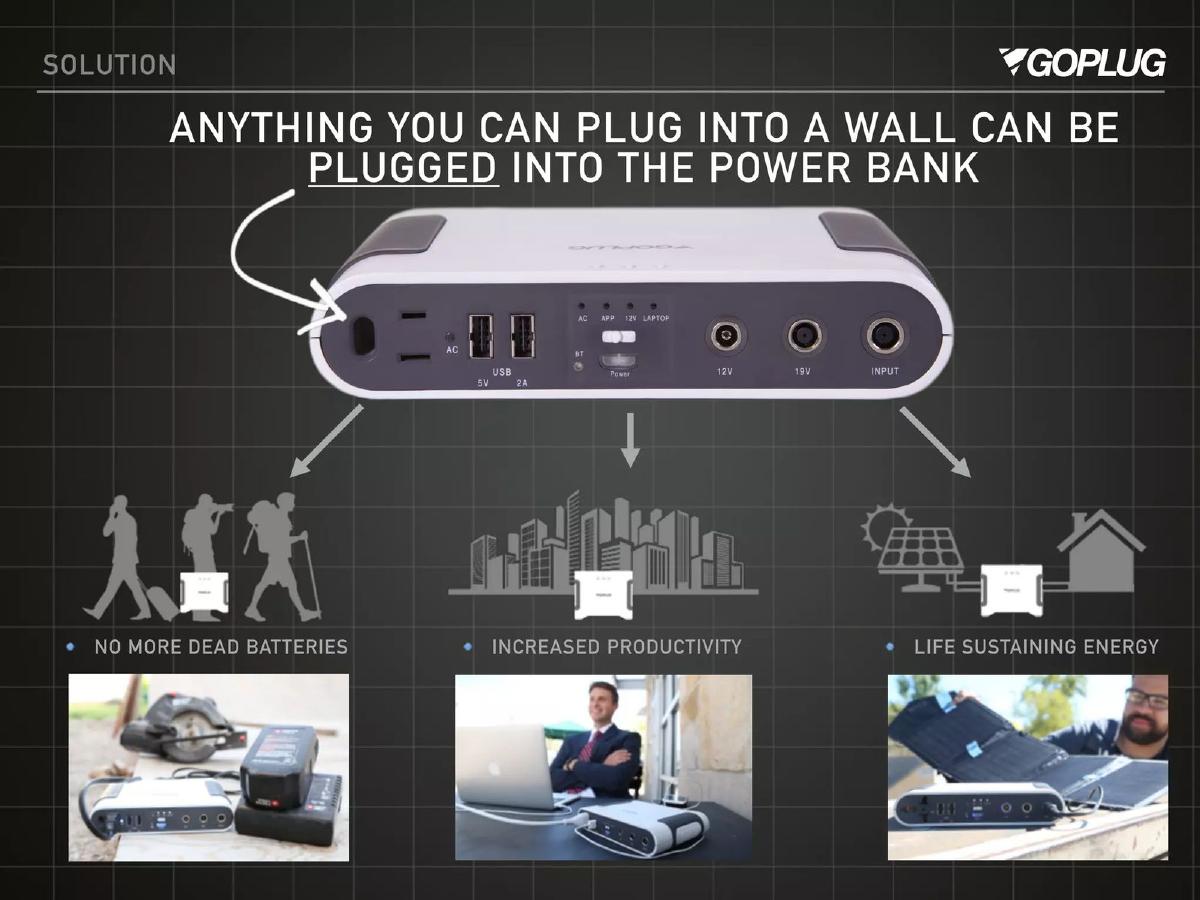
High-capacity portable power. Product photo with three use cases.
GoPlug deck, slide 4. Exact stored slide matched to this analysis.
Our analysis: It shows the product and three people using it, answering the problem slide's "AC power source" point.
Evidence and limitation: No figures.
What a founder can adapt: Show the product and the three places people use it.
Supporting analysis
What the deck claims: "Anything you can plug into a wall can be plugged into the power bank." Product photo with AC, USB and DC ports. "No more dead batteries" (outdoors); "Increased productivity" (office); "Life sustaining energy" (solar, home).
Presentation choice: The headline is a claim a buyer can test: plug in anything.
When it does not fit: Add capacity and runtime (hours for a laptop).
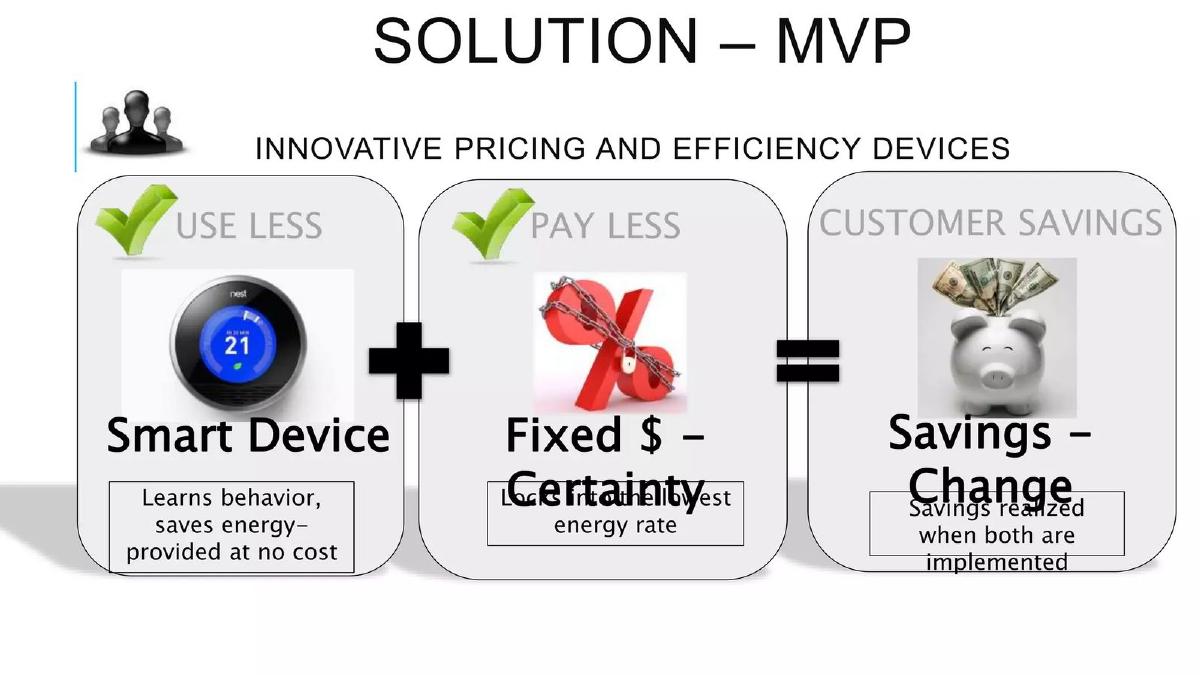
Home energy pricing plus a smart thermostat. An equation of three tiles.
Better NRG deck, slide 4. Exact stored slide matched to this analysis.
Our analysis: The equation answers its problem slide ("use less", "pay less") point for point.
Evidence and limitation: No figures.
What a founder can adapt: Reuse your problem-slide headings on the solution slide.
Supporting analysis
What the deck claims: "Solution – MVP." "Innovative pricing and efficiency devices." "Use less: Smart Device — Learns behavior, saves energy – provided at no cost" + "Pay less: Fixed $ – Certainty — Locks in the lowest energy rate" = "Customer savings: Savings – Change — Savings realized when both are implemented."
Presentation choice: Matching the headings to the problem slide makes the answer obvious.
When it does not fit: Say how much a household saves.
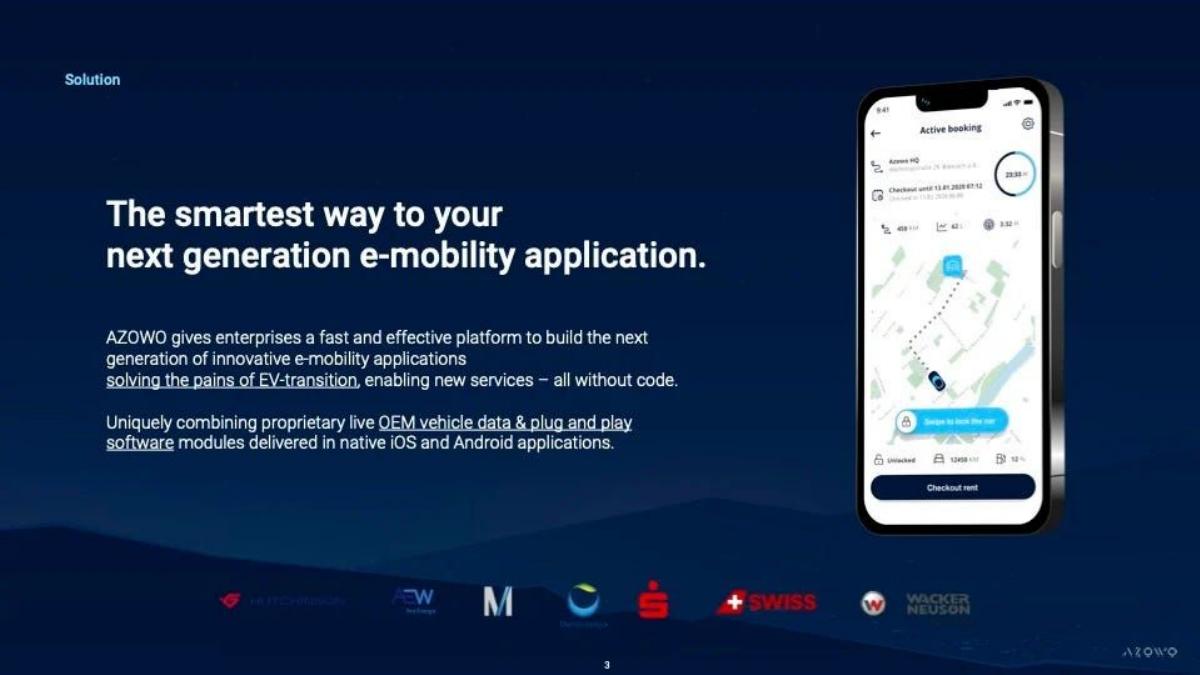
Software platform for EV and charging apps. Text beside an app screen and customer logos.
Azowo deck, slide 3. Exact stored slide matched to this analysis.
Our analysis: It shows the product and who buys it, but not how it fixes the missing link on its problem slide.
Evidence and limitation: Customer logos; no figures.
What a founder can adapt: Say which link it connects: car data to the charger to the utility.
Supporting analysis
What the deck claims: "The smartest way to your next generation e-mobility application." "AZOWO gives enterprises a fast and flexible platform to build the next generation of innovative e-mobility applications solving the pains of EV-transition, enabling new services – all without code." "Uniquely combining proprietary live OEM vehicle data & plug and play software modules delivered in native iOS and Android applications."
Presentation choice: Customer logos show the product is in use.
When it does not fit: "Smartest" and "innovative" in place of a result.
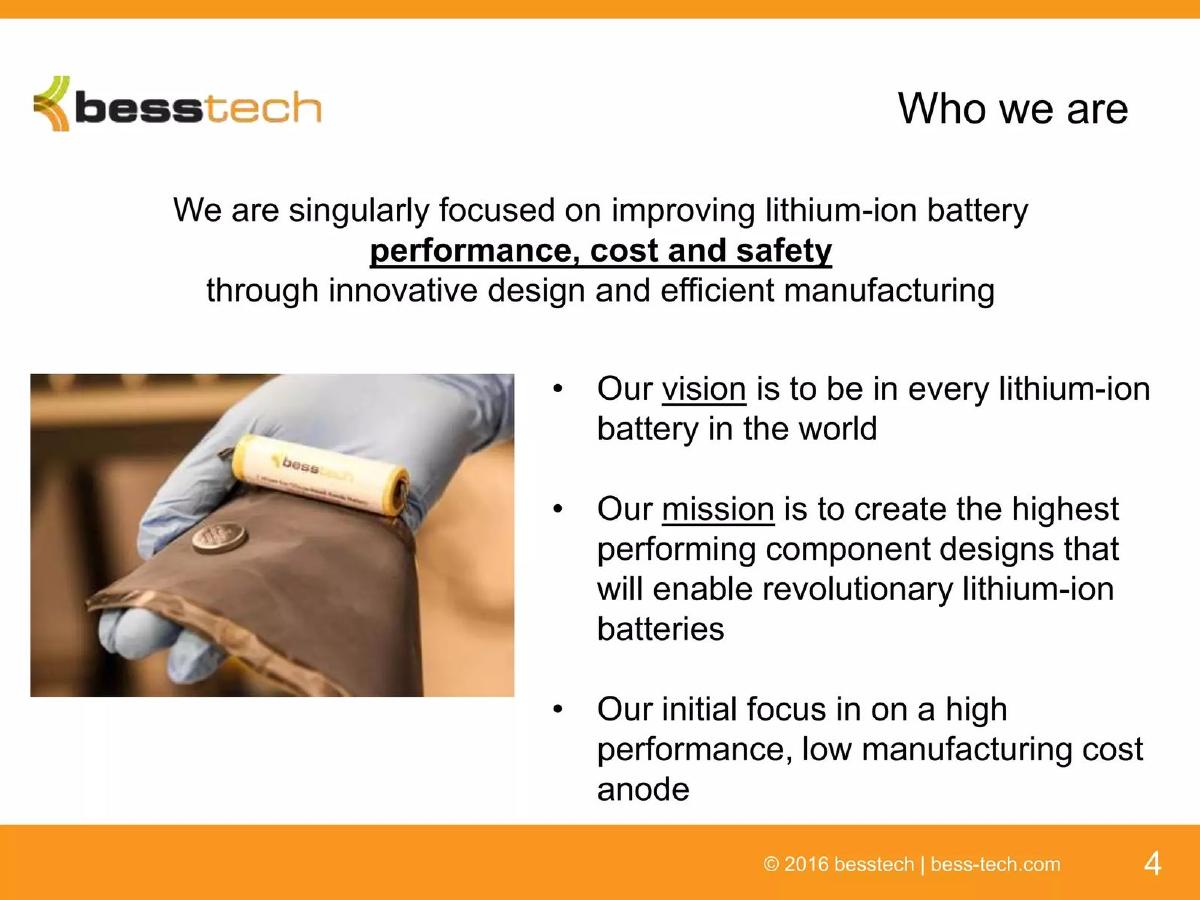
Battery anode materials. "Who we are" slide with a cell photo.
Besstech deck, slide 4. Exact stored slide matched to this analysis.
Our analysis: Partial: it names the product (an anode) but frames it as vision and mission, with no gain.
Evidence and limitation: No figures.
What a founder can adapt: State how much better the anode is: capacity, cost per kWh, cycles.
Supporting analysis
What the deck claims: "We are singularly focused on improving lithium-ion battery performance, cost and safety through innovative design and efficient manufacturing." "Our vision is to be in every lithium-ion battery in the world." "Our initial focus in on a high performance, low manufacturing cost anode."
Presentation choice: It follows its problem slide's point that "the key to building a better battery is a better anode."
When it does not fit: A mission statement where the solution should be.
Whether each slide shows the product, what it replaces, and a measured gain.
Example
Product shown
What it replaces
Measured gain
Neah Power
Yes
Yes (12 batteries)
Yes (70% lighter)
FluxDrive
Yes
Yes (existing couplings)
No (claimed)
10SIX
Diagram
Implied
No
GoPlug
Yes
Implied (wall outlet)
No
Better NRG
Yes
Implied
No
Azowo
Yes (app)
No
No
Besstech
Partly
No
No
The Elysium Project
No
No
No
Key Takeaways
Put the product beside what it replaces.
Give one measured gain: weight, kWh, runtime, cost.
Answer the problem slide point for point.
Show who uses it and where.
A diagram of your concept is fine; a row of logos is not a solution.
Build your energy solution slide
The product beside what it replaces, one measured gain, who uses it.
Product. What is it: device, material, software, network?
Replaces. What does the customer use today?
Gain. One number: weight, kWh, runtime, cost, payback months.
Who. Who installs or uses it, and where?
Copyable framework: [Product] replaces [current option] for [user]. On [real job], it [gain with number] ([tested / modelled]).
Illustrative example 1 — written by us
Before: Our innovative smart solution delivers immediate payback and energy savings.
After: Our coupling replaces the standard coupling on existing pumps in under two hours; on a 50 kW pump running 6,000 hours a year it cut power use 18% in a 3-month site trial, paying back in 11 months.
What improved: Our illustrative rewrite; the figures are invented for the example. It names what's replaced, the job, the gain and the evidence.
What this guide adds
It follows the energy problem guide; six of the eight decks appear there, so you can read each problem slide and the solution that answers it. The climate solution guide covers emissions and materials; this one covers storage, efficiency and power supply. None of these eight slides appears in another guide.
Energy solutions usually do one of three things: use capacity that already exists, waste less, or store and deliver more.
Three things an energy solution slide proves
What it is: a network of idle batteries (10SIX), a coupling (FluxDrive), a fuel cell (Neah Power), a power bank (GoPlug).
What it replaces: "Existing Products – only 1 / Full Speed Operation" (FluxDrive); "12 BA-5590 military standard batteries" (Neah Power).
The gain: "Reduces Weight 70%" (Neah Power); "IMMEDIATE PAYBACK!" (FluxDrive, stated but not measured).
Common mistakes
"Immediate payback" with no period. Give the months.
Mission statement as solution. Show the product and what it does.
Icons in place of the product. Show one thing and its result.
Not answering the problem slide. Reuse its headings.
Designed figures presented as tested. Say which.
Diagnostic checklist
It shows the product.
It says what it replaces.
It gives one measured gain.
It names who uses it.
It answers the problem slide.
Frequently asked questions
How we chose these examples
Corpus: published pitch deck teardowns on StartupFundraising.com. Founder-uploaded private decks are excluded.
Selection (2026-09-25): we inspected the slides following each problem slide in the energy problem guide, plus Better NRG. Twelve stored images were inspected. Left out: Galatica slide 5 (a scam-verification product unrelated to energy), Besstech slide 3 and Better NRG slide 3 (market and advertising slides), Neah Power slide 4 (a technology explainer). Amogy and ComBio are already in the climate solution guide. Besstech is marked partial; The Elysium Project is kept as a weaker contrast.
Overlap check: none of these eight slides appears in another guide. Better NRG slide 2 is in the marketplace problem guide and Azowo slide 5 in the technology slide guide; those slides are not used here.
Review: all eight stored slide images were inspected on 2026-09-25 and matched to company, deck and slide number (editorial model review). No person has yet completed an editorial review of this page.
Claims are as shown on the slides; we have not verified them. We make no claim that any slide caused a fundraising outcome.