Energy Competition Slide Examples: How Energy Startups
How energy and cleantech pitch decks compare their technology with incumbents: comparison tables, cost and performance claims, and gaps to avoid.
Energy Competition Slide Examples: How Energy Startups Compare Technologies
Five competition and competitive-advantage slides from real energy pitch decks, shown in full, compare what each deck measures itself against and how checkable its claims are.
TL;DR
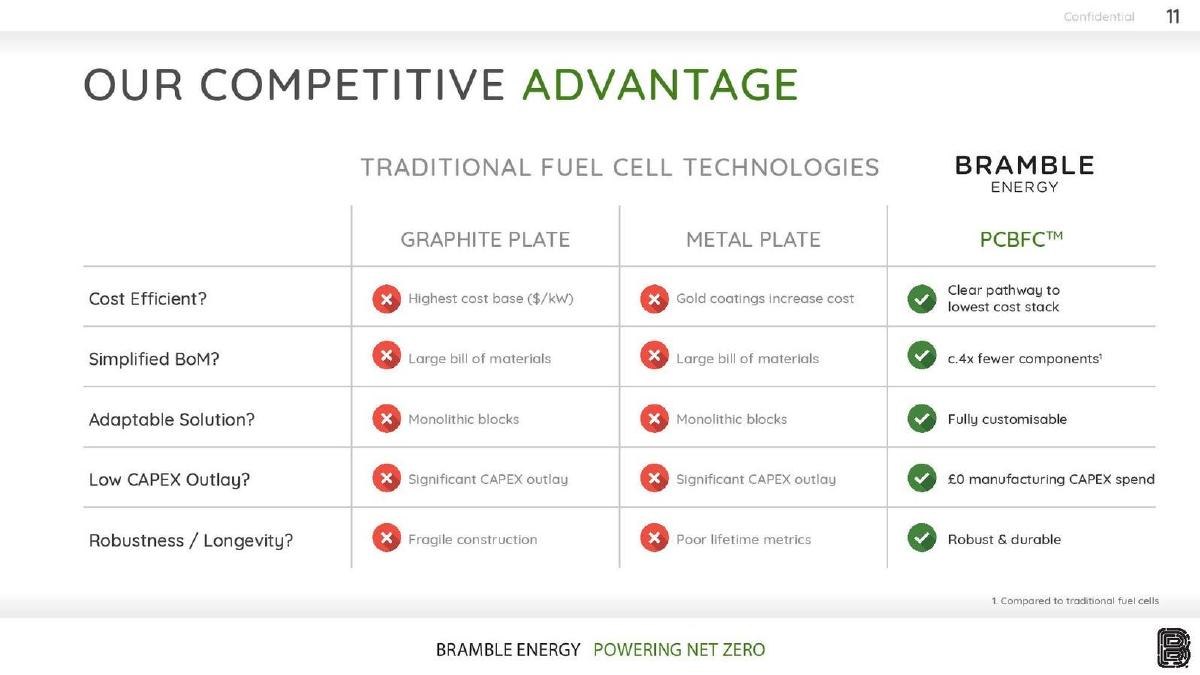
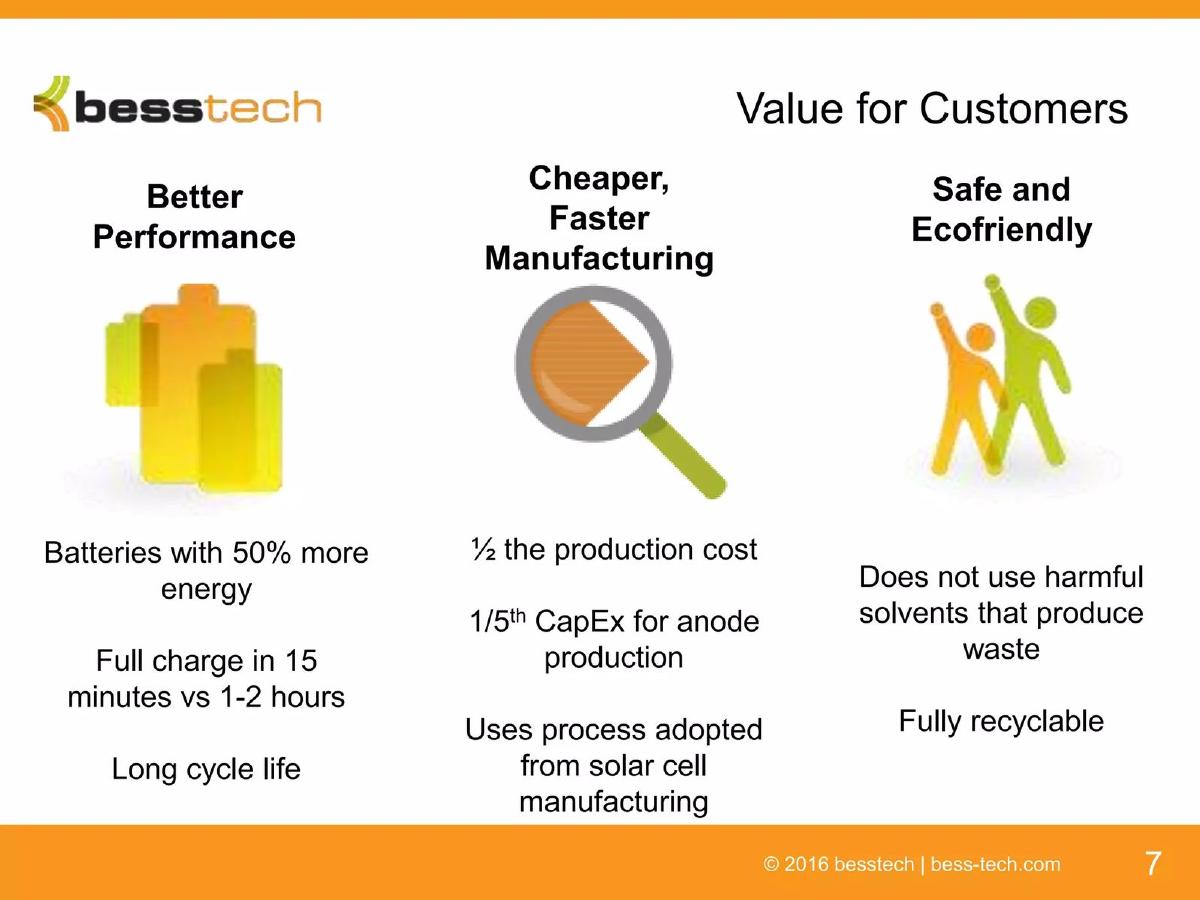
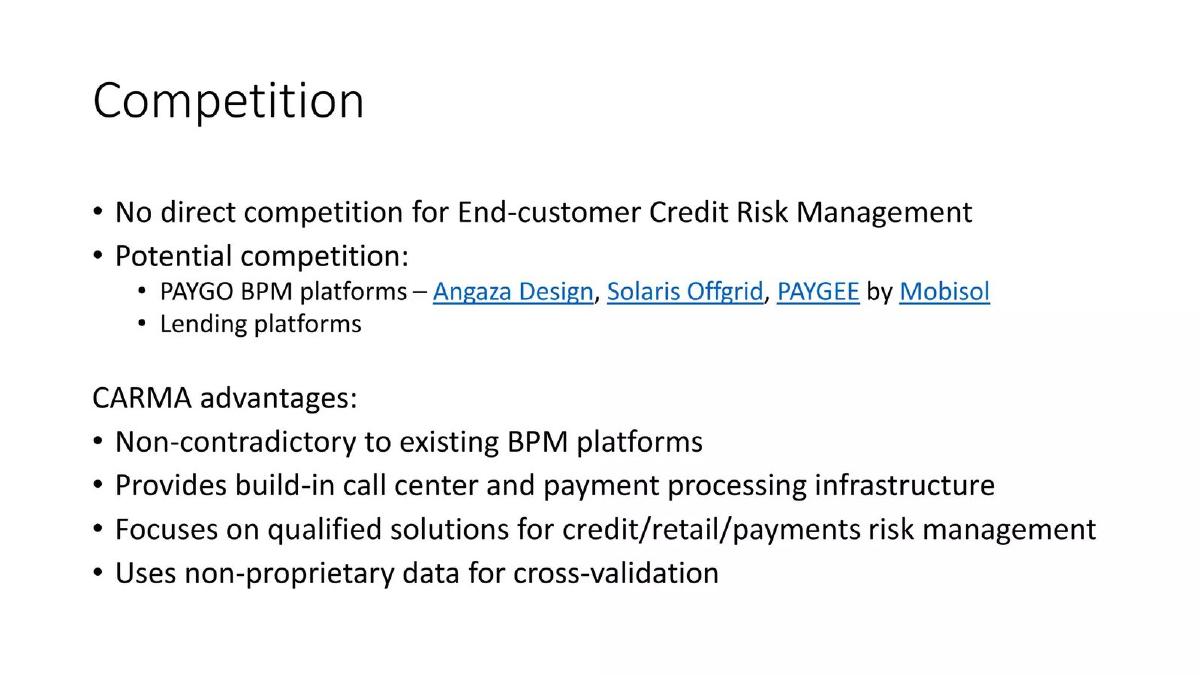
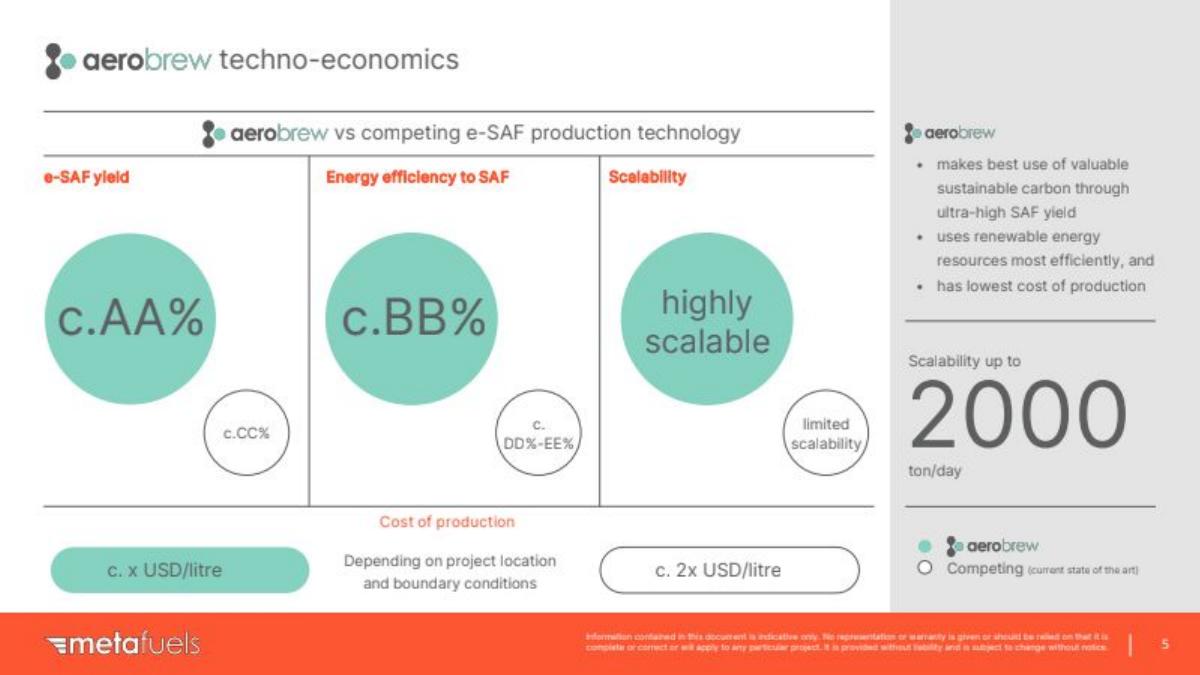
In energy decks the main rival is often an existing technology rather than a named company. Bramble Energy compares its printed-circuit-board fuel cell with graphite-plate and metal-plate fuel cells on five rows, such as cost and bill of materials ("c.4x fewer components"). Besstech compares its batteries with today's on charge time ("15 minutes vs 1-2 hours"). Metafuels sets up a strong layout against "competing e-SAF production technology", but the numbers were left as placeholders ("c.AA%"). Carma names its closest rivals (Angaza, Solaris Offgrid, PAYGEE by Mobisol), while Galatica makes moat claims with no comparison at all.
Energy competition slides from real pitch decks
Each example shows the exact stored slide above its analysis and links to the full teardown. Stage and year are given only where the deck states them. Performance and cost claims are quoted as the slide states them; we have not checked them.
Bramble Energy competition slide — slide 11
Fuel cells built on printed circuit boards (PCBFC). Stage and year not stated.
Bramble Energy deck, slide 11. Exact stored slide matched to this analysis.
Our analysis: It names the incumbent technologies, uses rows a fuel cell buyer cares about, and footnotes the baseline for its one number.
Evidence and limitation: Only one row has a number. "Clear pathway to lowest cost stack" and "Robust & durable" would be stronger with a $/kW figure or lifetime hours.
What a founder can adapt: Build rows from your buyer's purchase criteria and give each cell a short, specific reason, as Bramble does.
Supporting analysis
What the deck claims: "Our Competitive Advantage": a table comparing "Traditional Fuel Cell Technologies" (graphite plate, metal plate) with Bramble's PCBFC on five rows: cost efficient ("Highest cost base ($/kW)", "Gold coatings increase cost" vs "Clear pathway to lowest cost stack"), simplified bill of materials ("c.4x fewer components", footnoted "Compared to traditional fuel cells"), adaptable solution, low capex outlay ("£0 manufacturing CAPEX spend") and robustness/longevity.
Presentation choice: It names the incumbent technologies, uses rows a fuel cell buyer cares about, and footnotes the baseline for its one number.
When it does not fit: Only one row has a number. "Clear pathway to lowest cost stack" and "Robust & durable" would be stronger with a $/kW figure or lifetime hours.
Besstech deck, slide 7. Exact stored slide matched to this analysis.
Our analysis: The charge-time claim includes its baseline ("vs 1-2 hours"), which makes it easy to compare.
Evidence and limitation: "50% more energy" and "½ the production cost" don't say compared with what, and no source or test is cited. It is framed as customer value, so the reader must infer the rival technology.
What a founder can adapt: Put the incumbent's figure next to each of yours, as the charge-time line does.
Supporting analysis
What the deck claims: "Value for Customers" in three columns: Better Performance ("Batteries with 50% more energy", "Full charge in 15 minutes vs 1-2 hours", "Long cycle life"); Cheaper, Faster Manufacturing ("½ the production cost", "1/5th CapEx for anode production", "Uses process adopted from solar cell manufacturing"); Safe and Ecofriendly (no harmful solvents, "Fully recyclable").
Presentation choice: The charge-time claim includes its baseline ("vs 1-2 hours"), which makes it easy to compare.
When it does not fit: "50% more energy" and "½ the production cost" don't say compared with what, and no source or test is cited. It is framed as customer value, so the reader must infer the rival technology.
Credit risk management for pay-as-you-go (PAYGO) off-grid energy sellers. Stage and year not stated.
Carma deck, slide 8. Exact stored slide matched to this analysis.
Our analysis: Even while claiming no direct rival, it names the platforms buyers already use and says Carma works alongside them rather than replacing them.
Evidence and limitation: "No direct competition" invites doubt. The advantages are features, with no evidence such as lower default rates for a customer.
What a founder can adapt: If you sit on top of existing platforms, name them and say you complement them, as Carma does.
Supporting analysis
What the deck claims: "Competition": "No direct competition for End-customer Credit Risk Management". "Potential competition: PAYGO BPM platforms – Angaza Design, Solaris Offgrid, PAYGEE by Mobisol; Lending platforms". "CARMA advantages": "Non-contradictory to existing BPM platforms", built-in call center and payment processing, focus on credit/retail/payments risk, "Uses non-proprietary data for cross-validation".
Presentation choice: Even while claiming no direct rival, it names the platforms buyers already use and says Carma works alongside them rather than replacing them.
When it does not fit: "No direct competition" invites doubt. The advantages are features, with no evidence such as lower default rates for a customer.
Sustainable aviation fuel (e-SAF) production technology called aerobrew. Stage and year not stated.
Metafuels deck, slide 5. Exact stored slide matched to this analysis.
Our analysis: The layout is the right one for a process technology: the startup and the current state of the art side by side on yield, efficiency, scalability and cost.
Evidence and limitation: The figures are placeholder letters (AA%, BB%, x USD/litre) in the published version, so the slide makes no checkable claim. Check every figure before sending a deck.
What a founder can adapt: Use this structure with real figures and a source for the state-of-the-art values.
Supporting analysis
What the deck claims: "aerobrew techno-economics — aerobrew vs competing e-SAF production technology": e-SAF yield "c.AA%" vs "c.CC%"; energy efficiency to SAF "c.BB%" vs "c. DD%-EE%"; scalability "highly scalable" vs "limited scalability"; cost of production "c. x USD/litre" vs "c. 2x USD/litre". Side panel: "Scalability up to 2000 ton/day". Legend: "Competing (current state of the art)".
Presentation choice: The layout is the right one for a process technology: the startup and the current state of the art side by side on yield, efficiency, scalability and cost.
When it does not fit: The figures are placeholder letters (AA%, BB%, x USD/litre) in the published version, so the slide makes no checkable claim. Check every figure before sending a deck.
Energy infrastructure and software company. The energy problem guide uses a different slide from this deck.
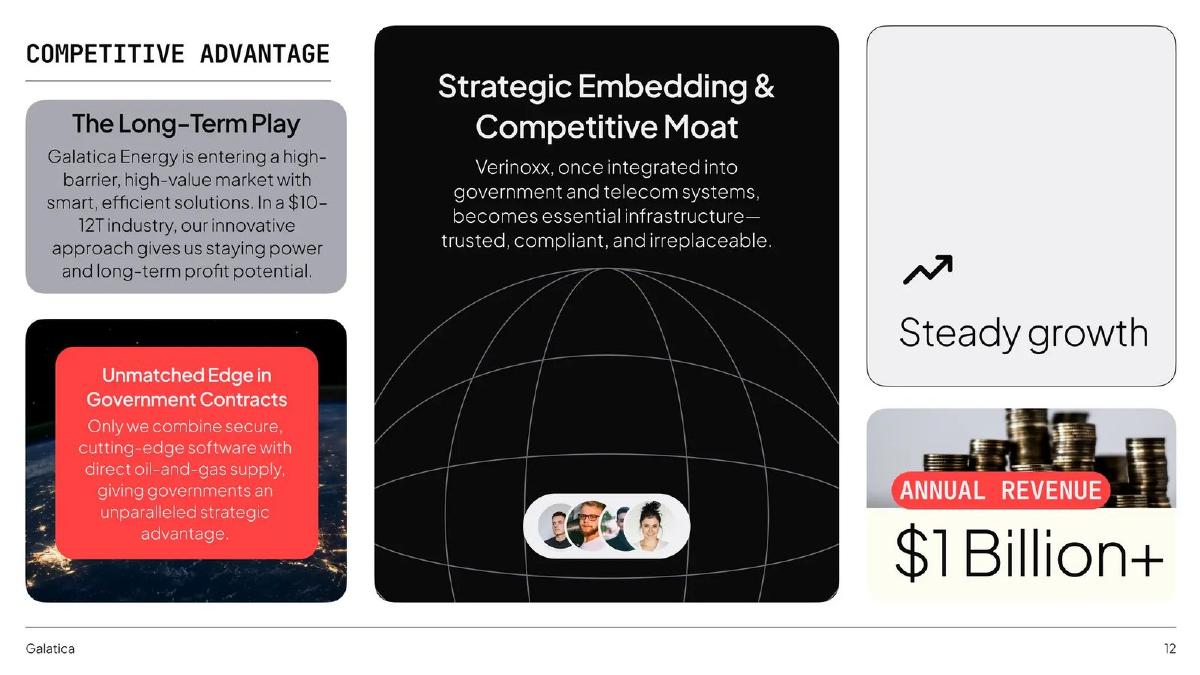
Galatica deck, slide 12. Exact stored slide matched to this analysis.
Our analysis: It states one specific combination it says only it offers (software plus direct oil-and-gas supply), which is a claim a reader could test.
Evidence and limitation: No competitor is named. "$1 Billion+" annual revenue appears with no period, source or explanation of whether it is actual or projected, and "unmatched" and "irreplaceable" are unsupported.
What a founder can adapt: Name the rivals who offer each half of your combination, and show why together is better.
Supporting analysis
What the deck claims: "Competitive Advantage": "The Long-Term Play" ("a high-barrier, high-value market… In a $10-12T industry"); "Unmatched Edge in Government Contracts" ("Only we combine secure, cutting-edge software with direct oil-and-gas supply"); "Strategic Embedding & Competitive Moat" ("Verinoxx, once integrated into government and telecom systems, becomes essential infrastructure"); "Steady growth"; "Annual Revenue $1 Billion+".
Presentation choice: It states one specific combination it says only it offers (software plus direct oil-and-gas supply), which is a claim a reader could test.
When it does not fit: No competitor is named. "$1 Billion+" annual revenue appears with no period, source or explanation of whether it is actual or projected, and "unmatched" and "irreplaceable" are unsupported.
What each energy competition slide compares against
Named baselines and real numbers make a comparison useful.
Example
Compared against
Format
Numbers with baseline
Main gap
Bramble Energy
Graphite and metal plate fuel cells
Table, five rows
1 ("c.4x fewer components")
Few figures
Besstech
Current batteries (implied)
Three benefit columns
1 ("15 minutes vs 1-2 hours")
Baselines missing
Carma
Angaza, Solaris Offgrid, PAYGEE
Bullet list
0
No evidence
Metafuels
State-of-the-art e-SAF
Side-by-side figures
Placeholders only
No real numbers
Galatica
No one named
Claim cards
0
Unsourced revenue claim
Key Takeaways
If you compete with a technology rather than a company, name that technology and compare on the measures buyers use: cost per kW, lifetime, charge time, yield.
A table with rows buyers care about beats a list of adjectives.
Every number needs its baseline ("vs traditional fuel cells") and ideally a source.
Check the final deck for placeholder figures before sending it.
If there are companies in your space, name them, even if you argue they are not direct rivals.
Build your energy competition slide
Answer these before designing the slide.
Incumbent. Which technology or company does your buyer use today?
Criteria. Which three to five measures decide their purchase (cost per kW, lifetime, efficiency, capex)?
Figures. Your figure and the incumbent's figure for each measure.
Source. Where does each figure come from: your tests, a third party, published data?
Named rivals. Which companies work on the same problem, and how do you differ?
Copyable framework: [Measure]: us [figure] vs [incumbent] [figure] (source: [test or publication]).
Illustrative example 1 — written by us
Before: e-SAF yield c.AA% vs c.CC%
After: e-SAF yield: [our tested %] vs [state-of-the-art %] (source: [pilot run or publication]).
What improved: Our illustrative rewrite, not Metafuels' text. Bracketed parts are placeholders to fill with real, sourced figures before use.
How this guide relates to the other competition and energy guides
The main competition guide covers comparison tables, positioning maps and feature matrices for any company. The energy problem and solution guides and the climate guides use other slides from Besstech, Galatica and other energy decks. This guide covers what is specific to energy competition slides: comparing against an incumbent technology, and making cost and performance claims a technical investor will check.
Common mistakes
No baseline. "50% more energy" needs "than what".
Placeholders left in. Check every number before a deck goes out.
"No direct competition". Name the nearest alternatives anyway.
Adjectives instead of figures. Replace "robust" with lifetime hours or cycles.
Unexplained headline figures. Say whether revenue is actual or projected, and for what period.
Diagnostic checklist
The incumbent technology or company is named.
Rows match the buyer's purchase criteria.
Each figure shows the baseline it is compared with.
Figures have a source or test behind them.
No placeholder values remain.
Frequently asked questions
How we chose these examples
Corpus: published pitch deck teardowns on StartupFundraising.com. Founder-uploaded private decks are excluded.
Selection (2026-09-28): we searched extracted slide text for slides whose opening words include "competition", "competitive", "landscape", "vs" or "alternatives" and whose text mentions energy, batteries, fuel cells, solar, carbon or related terms. Excluded: Neah Power's "Fuel cells vs. batteries" slide (explains the technology rather than comparing competitors), Arrival (used by other guides), public-company overviews and slides outside energy.
Images: four slide images (Bramble Energy, Carma, Galatica, Besstech) were rendered from the published deck PDFs and stored on 2026-09-28; Metafuels' was already stored.
Overlap check: no competition-slide facet for energy existed. Besstech and Galatica appear in other guides with different slides.
Review: all five stored slide images were inspected on 2026-09-28 and matched to company, deck and slide number (editorial model review). Performance, cost and revenue claims are quoted from the slides and were not checked. No person has yet completed an editorial review of this page.
We make no claim that any slide caused a fundraising outcome.