The Goldmoney November 2020 investor deck serves as a quarterly update for a publicly traded entity (TSX: XAU) rather than a traditional startup seed deck. It emphasizes a diversified ecosystem centered on precious metals, including 100% ownership of Goldmoney Holding and Lend & Borrow Trust Company, a 50% stake in SchiffGold, and a 37% stake in the luxury jewelry brand Menē. Financial highlights from Q2 2021 show significant growth, with revenue reaching $243.6 million and client assets under custody hitting $2.59 billion. The deck focuses heavily on operational scale, citing a network of 15…
Key takeaways
- Goldmoney reported Q2 2021 revenue of $243,609,000, a significant increase from $127,154,000 in Q2 2020 (Slide 10).
- The company manages $2.59 billion in client assets under custody as of Q2 2021 (Slide 10).
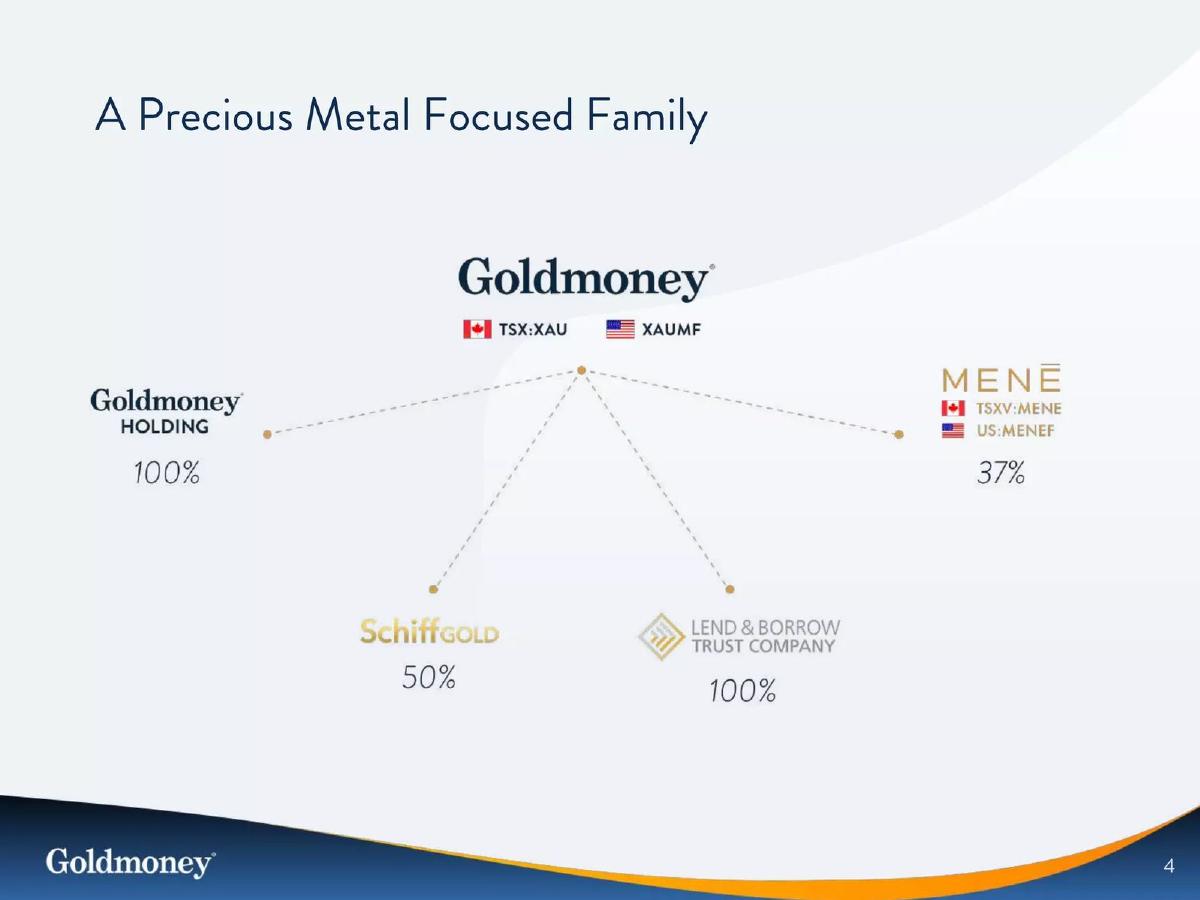
- Corporate structure is highly diversified, including a 37% stake in Menē and 50% in SchiffGold (Slide 4).
- The infrastructure relies on a network of 15 vaults in 8 countries, utilizing partners like Brinks, Loomis, and the Royal Canadian Mint (Slide 13).
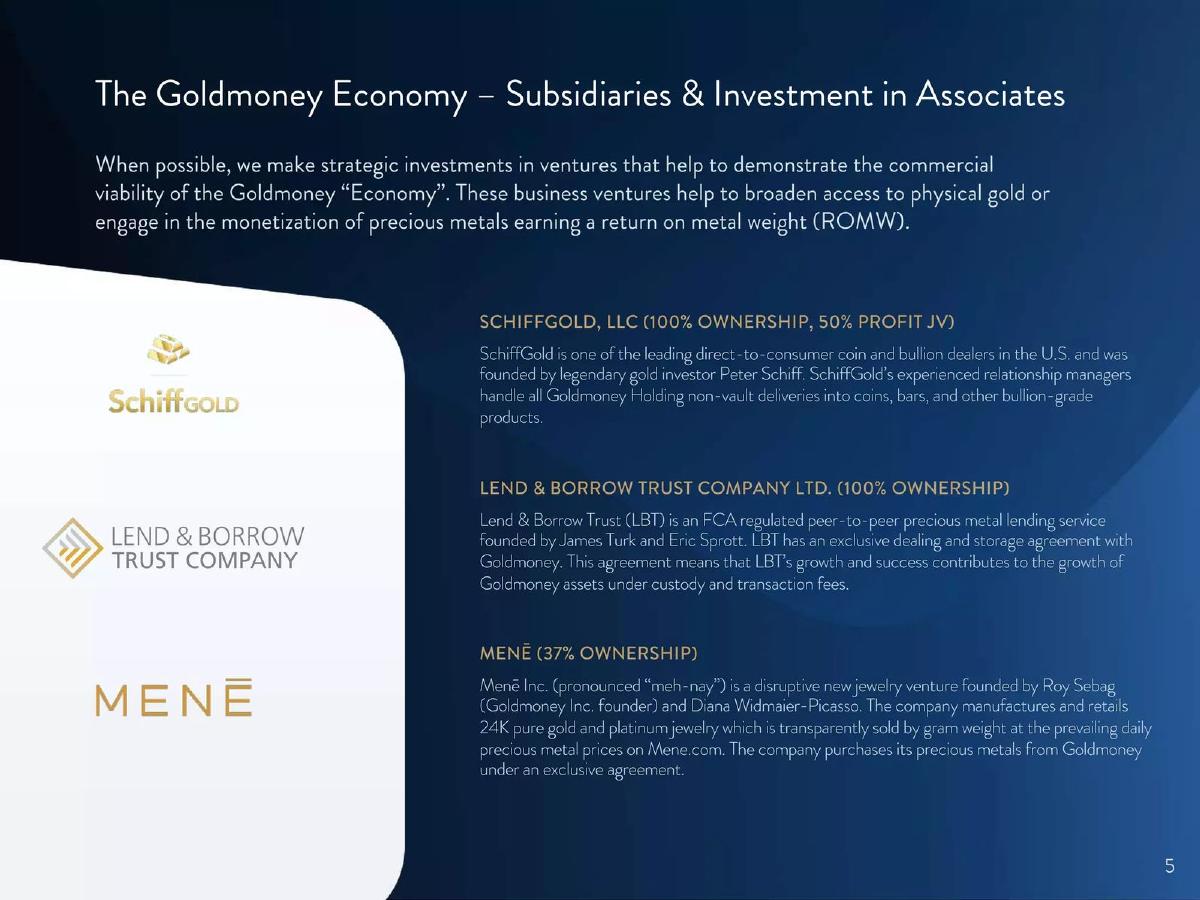
- Menē is positioned as a 'vertically integrated' business that sells 24-karat gold and platinum jewelry direct-to-consumer (Slide 18).
- The deck highlights a 'passionate community' through user-generated content and Trustpilot reviews to demonstrate brand loyalty (Slides 21, 22).
- CEO Roy Sebag forecasts a minimum growth of 5,000-7,500 gold equivalent troy ounces in the company's precious metal position for fiscal year 2022 (Slide 10).
- The presentation is designed for public market investors, featuring TSX and US ticker symbols on the cover and throughout (Slide 1).
Goldmoney November 2020 Investor Deck: A Public Market Analysis
The Goldmoney November 2020 Investor Deck is a comprehensive look at a mature, publicly traded financial institution specializing in precious metals. Unlike early-stage startup decks that focus on a singular problem and a hypothetical solution, this deck is a report on a complex, multi-entity ecosystem. It serves to update current and potential shareholders on the company's financial health, its diverse holdings, and its global infrastructure. With a focus on consolidated results and vertical integration, the deck paints a picture of a company that has moved beyond the 'proof of concept' phase and is now focused on scaling its assets under custody and expanding its retail footprint through subsidiaries like Menē.
Slide 1: Title and Market Presence
The cover slide establishes Goldmoney's brand identity with the tagline, "The World's Most Trusted Name in Precious Metals." Crucially for an investor presentation, it immediately lists its trading symbols: TSX: XAU and US: XAUMF . This signals that the company is publicly listed in both Canada and the United States, setting the stage for a presentation focused on institutional-grade transparency and regulatory compliance.
Slide 4: A Precious Metal Focused Family
This slide provides a structural overview of the Goldmoney group. It visualizes the company as a parent entity with four primary branches:
Goldmoney Holding: 100% ownership. · SchiffGold: 50% ownership. · Lend & Borrow Trust Company: 100% ownership. · Menē: 37% ownership (listed on TSXV: MENE and US: MENEF).
This structure demonstrates a strategy of diversification within a single asset class. By owning a dealer (SchiffGold), a lending arm (Lend & Borrow), and a retail brand (Menē), Goldmoney captures value at multiple points in the precious metals lifecycle.
Slide 9: Consolidated Financial Results
Slide 9 introduces the Q2 2021 results (covering July 1, 2020 – September 30, 2020). It features a quote from CEO Roy Sebag, who describes the performance as "outstanding, establishing new all-time records in revenue and earnings per share." The use of a quote from the CEO is a standard public company practice to provide narrative context to the raw data that follows.
Slide 10: Selected Key Financial Information
This is the most data-dense slide in the presentation, providing a year-over-year and quarter-over-quarter comparison. Key figures include:
Revenue ($000s): $243,609 in Q2 2021 vs. $127,154 in Q2 2020. · Gross Profit ($000s): $10,421 in Q2 2021 vs. $5,636 in Q2 2020. · Client Asset Under Custody ($ billion): $2.59 in Q2 2021 vs. $1.80 in Q2 2020.
The slide also includes a forward-looking statement from the Q2 2021 press release, noting a goal to grow the precious metal position by a "minimum of 5,000-7,500 gold equivalent troy ounces in fiscal year 2022." This combination of historical growth and specific future targets is designed to build investor confidence.
Slide 13: Global Vaulting Infrastructure
Goldmoney emphasizes its physical security and global reach on Slide 13. The company utilizes a network of 15 vaults in 8 countries . Rather than building its own vaults, Goldmoney partners with established logistics and security firms including Loomis International, Brinks, G4S, Malca-Amit, Rhenus Logistics, and the Royal Canadian Mint. The slide highlights the "Vault-to-Vault Metal Exchange" feature, which allows clients to move assets between these locations easily. This decentralized but highly regulated storage model is a key part of their value proposition for high-net-worth individuals and institutional clients.
Slide 18: Menē – Investment in Pure 24K
This slide focuses on the 37% owned subsidiary, Menē. It describes the business as a "vertically integrated business" that designs, manufactures, and markets 24-karat gold and platinum jewelry. The slide highlights a direct-to-consumer model and a mission to "restore the link between jewelry and savings." A bar chart compares Menē's use of 24K gold against the 18K, 14K, and 10K gold typically used by competitors, emphasizing the purity of their product as a financial asset rather than just a fashion accessory.
Slide 21: Passionate Community & Reviews
To demonstrate market fit and customer satisfaction for Menē, Slide 21 showcases four Trustpilot reviews. The reviews from Mei C., Michael K., Jonathan B., and Laura C. focus on transparency, the investment concept, and the ability to follow an investment portfolio online. This social proof is intended to show that the "jewelry as an investment" thesis is resonating with actual consumers.
Slide 22: Goldmoney Brand Community
Slide 22 shifts the focus back to the parent brand, displaying a collage of eight photos featuring customers wearing Goldmoney-branded apparel in various global locations (e.g., in front of the Wall Street Bull, in a hospital setting, underwater). This slide aims to humanize the brand and demonstrate a "passionate & global community of clients," suggesting that Goldmoney is not just a financial utility but a lifestyle brand for precious metal enthusiasts.
Slide 25: Investor Relations Contacts
The final slide provides direct contact information for Renee Wei, Head of Investor Relations , including an email address and a Toronto-based phone number. This is a standard closing for a public company deck, ensuring that analysts and institutional investors have a clear path for follow-up inquiries.
What Goldmoney Does Well
The deck excels at demonstrating scale and legitimacy . By prominently featuring its public ticker symbols and its partnerships with world-class security firms like the Royal Canadian Mint and Brinks, Goldmoney removes the 'trust' barrier that often plagues fintech and crypto-adjacent companies. The financial reporting on Slide 10 is clear and shows a strong upward trajectory in both revenue and assets under custody, which is the primary metric investors in this space care about.
Furthermore, the strategic clarity regarding its subsidiaries is a strength. The deck clearly explains how Menē and SchiffGold fit into the broader ecosystem. The vertical integration of Menē—from metal acquisition to in-house manufacturing—is presented as a competitive advantage that protects margins and ensures product quality.
What is Missing from the Deck
Because this is a public company investor deck, it lacks several elements common in startup pitches. There is no 'Problem' slide ; the company assumes the audience already understands the value of gold as a hedge or investment. There is also no 'Ask' —the company is not requesting a specific amount of capital for a specific equity stake, as its shares are already traded on the open market.
Additionally, the deck is light on unit economics . While it shows total revenue and gross profit, it does not break down the cost of customer acquisition (CAC) or the lifetime value (LTV) of a Goldmoney user. For a company that relies on a digital platform to manage $2.59 billion in assets, understanding the efficiency of its marketing spend would be highly valuable for a deeper analysis.
What Founders Should Copy
Founders building in the fintech or asset management space should look at Slide 13 as a masterclass in leveraging third-party credibility . Goldmoney doesn't just say they are secure; they list the logos of the most trusted security firms in the world. This 'borrowed trust' is essential when you are asking customers to store significant wealth on your platform.
Another takeaway is the use of social proof (Slides 21 and 22). Even for a 'serious' financial company, showing real people using the product and sharing their positive experiences helps to build a narrative of market dominance and community. Finally, the clear corporate structure on Slide 4 is a great way to explain a complex business. If your startup has multiple product lines or subsidiaries, a simple hub-and-spoke diagram is the most effective way to communicate how they all relate to the parent company's mission.
Frequently asked questions
- Is Goldmoney a startup looking for venture capital?
- No. Based on the ticker symbols (TSX: XAU and US: XAUMF) displayed on Slide 1 and Slide 4, Goldmoney is a publicly traded company. This deck is an 'Investor Deck' intended for public market shareholders and analysts rather than private venture capital firms. The content focuses on quarterly financial results and consolidated holdings rather than a seed-stage pitch.
- What are the primary revenue drivers for Goldmoney?
- According to Slide 10, revenue is categorized into total revenue ($243.6M in Q2 2021) and fee revenue ($1.77M in Q2 2021). The business earns through precious metal sales, custody fees on $2.59 billion in assets, and its various subsidiaries including SchiffGold (precious metals dealer) and Menē (luxury jewelry).
- How does Goldmoney handle the physical storage of gold?
- Slide 13 details a 'Global Vaults' strategy. Goldmoney does not operate its own proprietary vaults but instead uses a network of 15 secure locations in 8 countries. These are operated by professional third-party partners including Loomis International, Brinks, G4S, Malca-Amit, Rhenus Logistics, and the Royal Canadian Mint.
- What is the relationship between Goldmoney and Menē?
- Slide 4 shows that Goldmoney owns 37% of Menē. Slide 18 further explains that Menē is a vertically integrated jewelry brand co-founded by Goldmoney CEO Roy Sebag and Diana W. Picasso. It specializes in 24K investment-grade jewelry sold at transparent prices based on the prevailing market weight of the metal.
- What financial trends are highlighted in the deck?
- The deck highlights aggressive growth between 2020 and 2021. Slide 10 shows that Gross Profit nearly doubled from $5.6M in Q2 2020 to $10.4M in Q2 2021. Additionally, Client Assets Under Custody grew from $1.80 billion to $2.59 billion in the same period, indicating increased market adoption or rising metal prices.