OhmConnect’s deck is a rare example of a 'Steve Jobs-style' presentation applied to the energy sector. Eschewing dense bullet points, the 15-slide deck relies on evocative imagery and simple diagrams to illustrate a three-way value exchange between residents, utilities, and energy operators. By focusing on the 'Adam' persona, the deck humanizes the abstract concept of demand response. The narrative builds from the environmental problem of 'peaker' plants to a clear demonstration of 20% week-over-week growth. While it lacks a traditional 'Ask' or detailed financial projections, the team’s deep…
Key takeaways
- The deck uses a minimalist visual style with almost no body text, forcing the presenter to drive the narrative.
- Slide 8 highlights a massive market inefficiency: 1% of the time accounts for 15% of total energy costs.
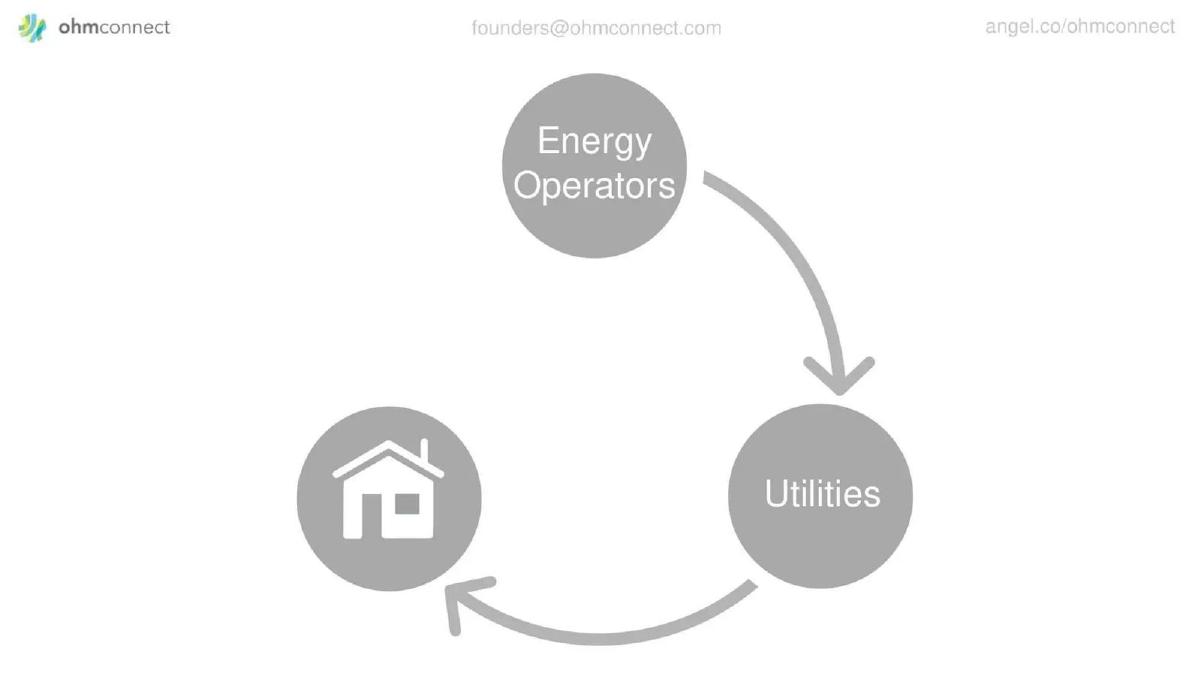
- The business model is explained through a simple circular flow diagram involving homes, utilities, and energy operators (Slides 5-7).
- Traction is demonstrated with a clear hockey-stick graph showing 20% week-over-week growth after winning a U.S. Department of Energy challenge (Slide 13).
- The deck uses a specific user persona, 'Adam,' to ground the technology in a real-world use case (Slides 4 and 9).
- The team slide (Slide 15) establishes high founder-market fit, noting the CEO's background in trading electricity futures at DC Energy.
- The deck completely omits a formal 'Ask' slide, financial forecasts, or a detailed competitive analysis.
- Visual metaphors, such as a collapsing smokestack on Slide 14, are used to represent the company's impact on carbon-heavy infrastructure.
The Visual Power of Energy Arbitrage
OhmConnect’s pitch deck is a masterclass in minimalist storytelling. In an industry often bogged down by regulatory jargon and complex infrastructure diagrams, this deck chooses to focus on the human element and the sheer economic inefficiency of the current power grid. With only 15 slides and very few words, it manages to convey a massive opportunity in the 'demand response' space. According to catalogue facts, the company eventually raised $83,500,000, and this deck shows the early narrative that fueled that growth.
Slides 1-4: The Hook and the Human
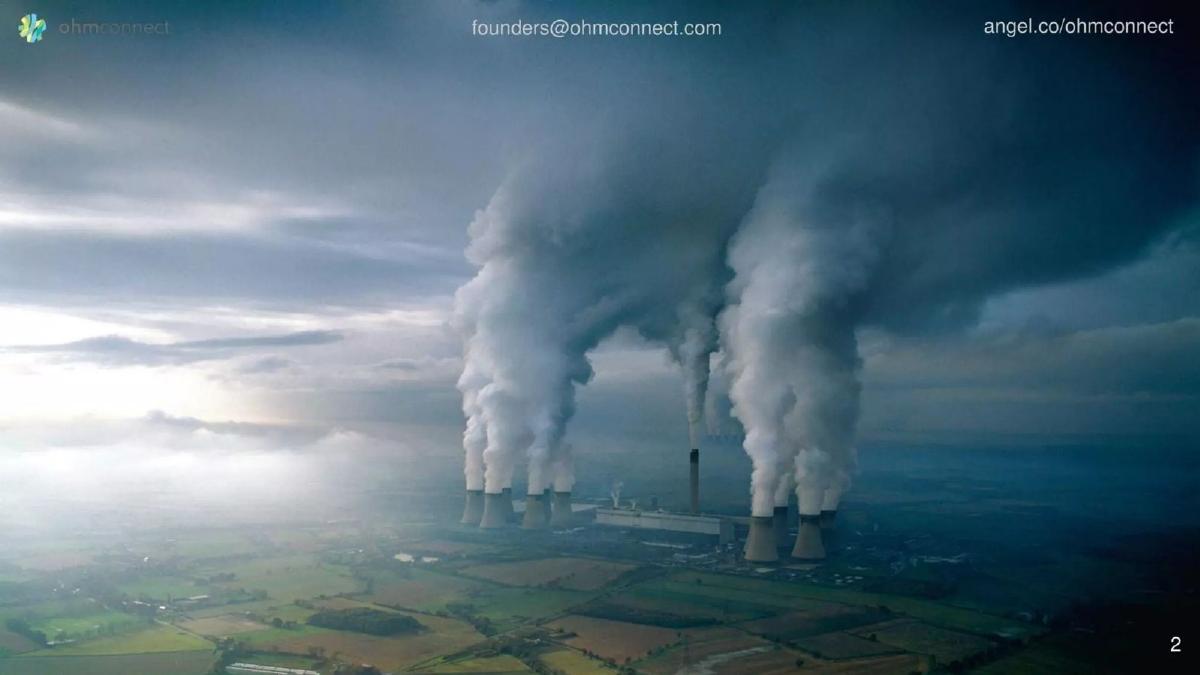
Slide 1 is a standard title slide, but it introduces the tagline: 'Your home energy. Empowered.' This immediately frames the company as a consumer-empowerment tool rather than a utility-side software play. Slide 2 is a powerful, wordless image of a massive coal or gas power plant emitting plumes of smoke. This establishes the 'villain' of the story—carbon-heavy peaker plants—without needing a single bullet point about CO2 emissions.
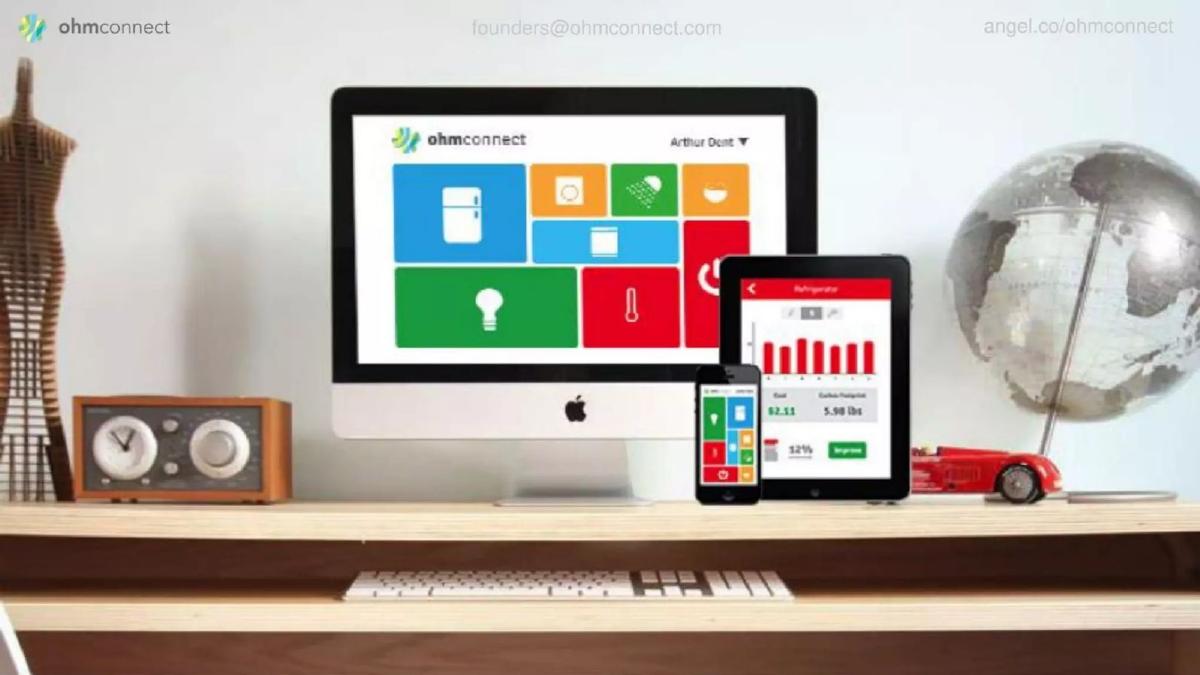
Slide 3 shows the product interface across multiple devices (iMac, iPad, iPhone). The UI is colorful and tile-based, reminiscent of the Windows Metro design era, suggesting ease of use. Slide 4 introduces 'Adam,' a father holding a baby. This is a classic marketing tactic to ground a technical product in a relatable persona. The goal here is to show that OhmConnect isn't for 'energy nerds'; it's for everyday families.
Slides 5-7: Explaining the Ecosystem
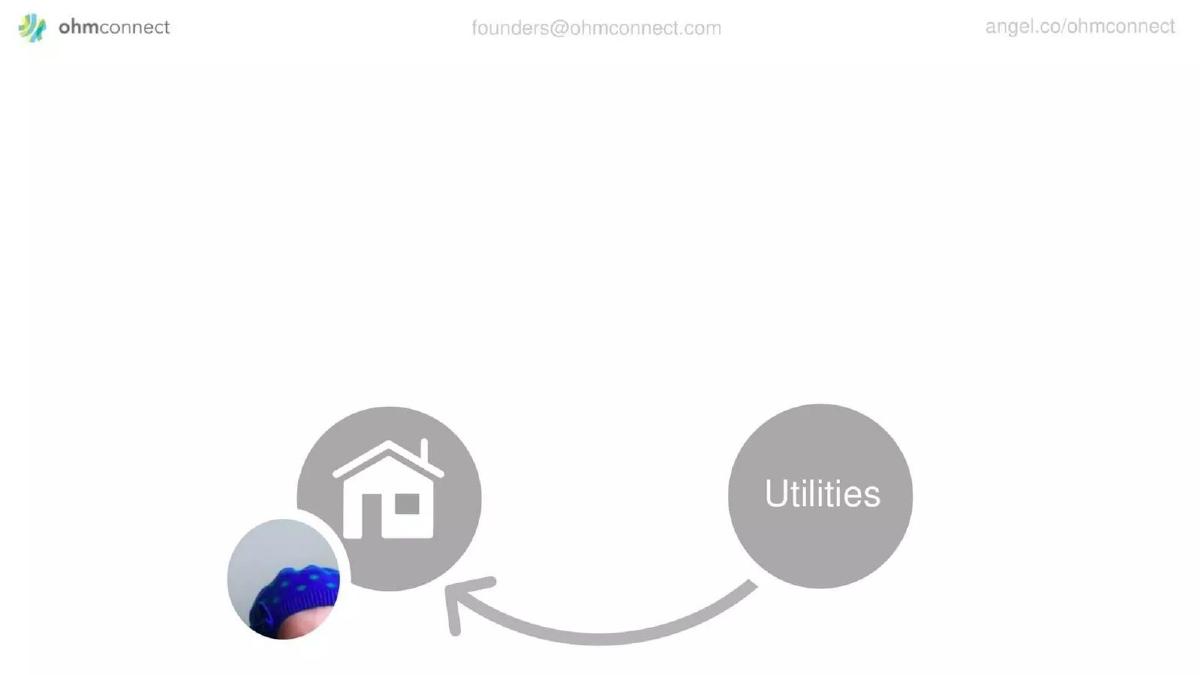
This sequence is the most critical part of the deck's logic. Slide 5 shows a simple gray icon of a home and a circle labeled 'Utilities.' An arrow points from the utility to the home, representing the status quo. Slide 6 adds a third player: 'Energy Operators.' The arrow now flows from the operators to the utilities, and then to the home. This illustrates the traditional supply chain.
Slide 7 introduces the OhmConnect logo into the mix. A bright blue arrow now connects the 'Home' directly to the 'Energy Operators,' bypassing or supplementing the traditional utility relationship. This visualizes the company's core innovation: aggregating residential energy savings to sell back to the wholesale market (the operators). It turns the home from a passive consumer into an active participant in the energy market.
Slides 8-12: The Economic Opportunity and User Action
Slide 8 is the 'Money Slide.' It features a simple see-saw graphic showing that '1% of time' outweighs '15% of costs.' This is a brilliant way to explain the concept of peak pricing. It tells the investor that if you can solve the problem for just a few hours a year, you can unlock 15% of the total market value. It is the most text-heavy slide in the deck, and for good reason—it defines the unit economics of the problem.
Slide 9 returns to 'Adam,' reminding the audience who is solving this problem. Slides 10, 11, and 12 are a progressive build showing how Adam interacts with the product. Slide 10 shows a light switch icon, Slide 11 adds a thermostat, and Slide 12 adds a Wi-Fi/power icon. This sequence suggests that OhmConnect can control various devices in the home to save energy automatically, moving from manual intervention to automated smart-home management.
Slides 13-15: Traction, Impact, and Team
Slide 13 provides the 'Proof of Life.' It shows a hockey-stick growth curve of 'Users signed up with ohmconnect' from October to May. A large blue circle highlights '20% week over week growth.' Crucially, the slide notes that they were the 'U.S. Department of Energy American Energy Data Challenge Winner' in January, which serves as a massive credibility booster and explains the inflection point in the graph.
Slide 14 is a dramatic visual of a power plant smokestack being demolished, with the text '33%... to making this happen.' This is a bold, mission-driven statement. It implies that their current trajectory could eliminate a third of the need for these plants. Slide 15 closes with the team. The pedigree here is high: Matt Duesterberg (CEO) is a Stanford grad who traded electricity futures; Curtis Tongue (CMO) founded a carbon footprint tracker; and advisor Rahul Prakash co-founded a company sold to Nest. This slide answers the 'Why this team?' question by showing deep expertise in both energy markets and consumer tech.
What Works
Visual Narrative: The deck is designed for a live pitch. It uses large, evocative images that trigger emotional responses (the baby, the collapsing smokestack) and simple diagrams that explain complex market dynamics. · The 1%/15% Metric: This is a perfect 'anchor' metric. It is easy to remember and perfectly encapsulates the inefficiency the company is targeting. · Traction Validation: Using the Department of Energy win as a marker on the growth chart provides external validation that the technology is sound, which is vital in a regulated industry like energy. · Founder-Market Fit: The CEO's background in trading electricity futures is the 'secret sauce.' It tells investors that the company understands the complex financial side of the grid, not just the app interface.
What is Missing
The Ask: There is no slide stating how much money they are raising or what the funds will be used for. This is a significant omission for a standard pitch deck. · Business Model Specifics: While the flow diagram is good, it doesn't explain the revenue split. How much does Adam make? How much does OhmConnect keep? · Competition: The deck ignores other demand-response players or smart-home incumbents like Nest (though they mention an advisor from a company sold to Nest). · Financial Projections: There are no forward-looking statements regarding revenue, burn rate, or profitability.
What a Founder Should Copy
The 'Adam' Persona: If you are building a technical product for a general audience, use a persona to show how the tech changes a real person's life. The Progressive Build: Slides 5-7 and 10-12 use a 'build' technique where elements are added one by one. This is an excellent way to explain a multi-sided marketplace or a multi-step process without overwhelming the viewer. High-Contrast Metrics: Use the Slide 8 approach. Find the two most shocking numbers in your industry and put them on a see-saw. It creates an immediate sense of 'this is a problem that needs to be solved.' Clean Design: The consistent use of the brand's blue and green palette, combined with ample white space, makes the deck look professional and modern, which is essential for a software company in a 'legacy' industry.
Frequently asked questions
- Why is there so little text on these slides?
- This is a 'presentation deck' rather than a 'reading deck.' It is designed to support a live pitch where the speaker provides the context. The minimalist design prevents the audience from reading ahead and keeps the focus on the founder's story. For a later-stage company like OhmConnect, this approach emphasizes the clarity of their vision and the strength of their existing traction.
- How does OhmConnect actually make money based on this deck?
- While not explicitly stated in a 'Business Model' slide, the flow diagram on Slides 5-7 implies an arbitrage or service model. By connecting homes to Energy Operators, OhmConnect helps manage grid load. The catalogue listing clarifies that they reward users for saving energy, which suggests the company earns revenue from utilities or grid operators for the 'negawatts' (saved energy) they provide during peak times.
- What is the significance of the 1% vs 15% metric on Slide 8?
- This is the 'Why Now' and the 'Economic Gap' slide. It illustrates that a tiny fraction of time (peak demand periods) creates a disproportionate amount of cost for the energy grid. This inefficiency is the market opportunity OhmConnect exploits; by reducing usage during that 1%, they can capture a portion of that 15% cost savings.
- Is the lack of a financial slide a red flag?
- In a seed-stage deck, yes. However, for a later-stage company with a clear growth chart (Slide 13) and a high-pedigree team (Slide 15), investors often move the financial deep-dive to the due diligence phase. The deck's job is to sell the 'Big Idea' and the team's ability to execute, which the traction slide handles effectively.
- Who is the target audience for this deck?
- The deck targets sophisticated investors who understand the energy market but need to see how a consumer-facing app can solve grid-level problems. By using 'Adam' as a persona, OhmConnect proves they have solved the 'last mile' problem of energy management: getting actual humans to change their behavior.