The Seat14a pitch deck is a masterclass in presenting a complex operational advantage through simple, visual storytelling. By focusing on the 'complete look' rather than individual items, the company addresses the common male consumer pain point of curation. However, the real strength of the pitch lies in its backend economics: vertical integration and a 'made-to-measure' model that results in negative working capital. The deck claims 50%+ margins and a price point 4x cheaper than comparable brands. While it lacks traditional traction slides or detailed market sizing, it effectively communica…
Key takeaways
- The company positions itself as a simplifier of men's fashion, focusing on curated 'complete looks' delivered via email (Slide 2, 4).
- Seat14a utilizes a made-to-measure model, which allows for a 'perfect fit' without the overhead of traditional sizing (Slide 7, 8).
- The business model boasts negative working capital, meaning customers pay before the company spends on manufacturing or fabric (Slide 9).
- Vertical integration is a core pillar, with the company managing design, sourcing, and logistics in-house to maintain 50%+ margins (Slide 9).
- Price competitiveness is a primary value proposition, claiming to be 4x cheaper than 'other brands' for comparable quality (Slide 5, 8).
- The team slide highlights a mix of technical and business backgrounds from institutions like UPenn, Microsoft, and Oracle (Slide 10).
- The funding ask is clearly stated as $500k on the final slide (Slide 11).
- The deck relies heavily on high-quality lifestyle photography to communicate brand identity rather than dense text (Slides 2-8).
The Vision: Simplifying Men's Fashion
The Seat14a deck, produced in 2013, targets a specific psychological barrier in men's retail: the difficulty of coordination. By moving away from the 'aisle of shirts' model and toward a 'complete look' model, the company attempts to sell convenience as much as clothing. The aesthetic of the deck is clean, utilizing large-scale imagery and minimal text to mirror the simplicity they promise the consumer.
Slide 1: Title and Contact
The opening slide is standard but functional. It features the brand logo, which uses a clean sans-serif font with '14a' in a lighter weight, perhaps nodding to the premium feel of an airplane seat assignment. It includes the CEO's name, Jas Banwait, and direct contact information. Notably, it includes a link to their AngelList profile, which was a common practice for startups during the early 2010s to provide investors with immediate access to more detailed due diligence materials.
Slide 2: The Mission Statement
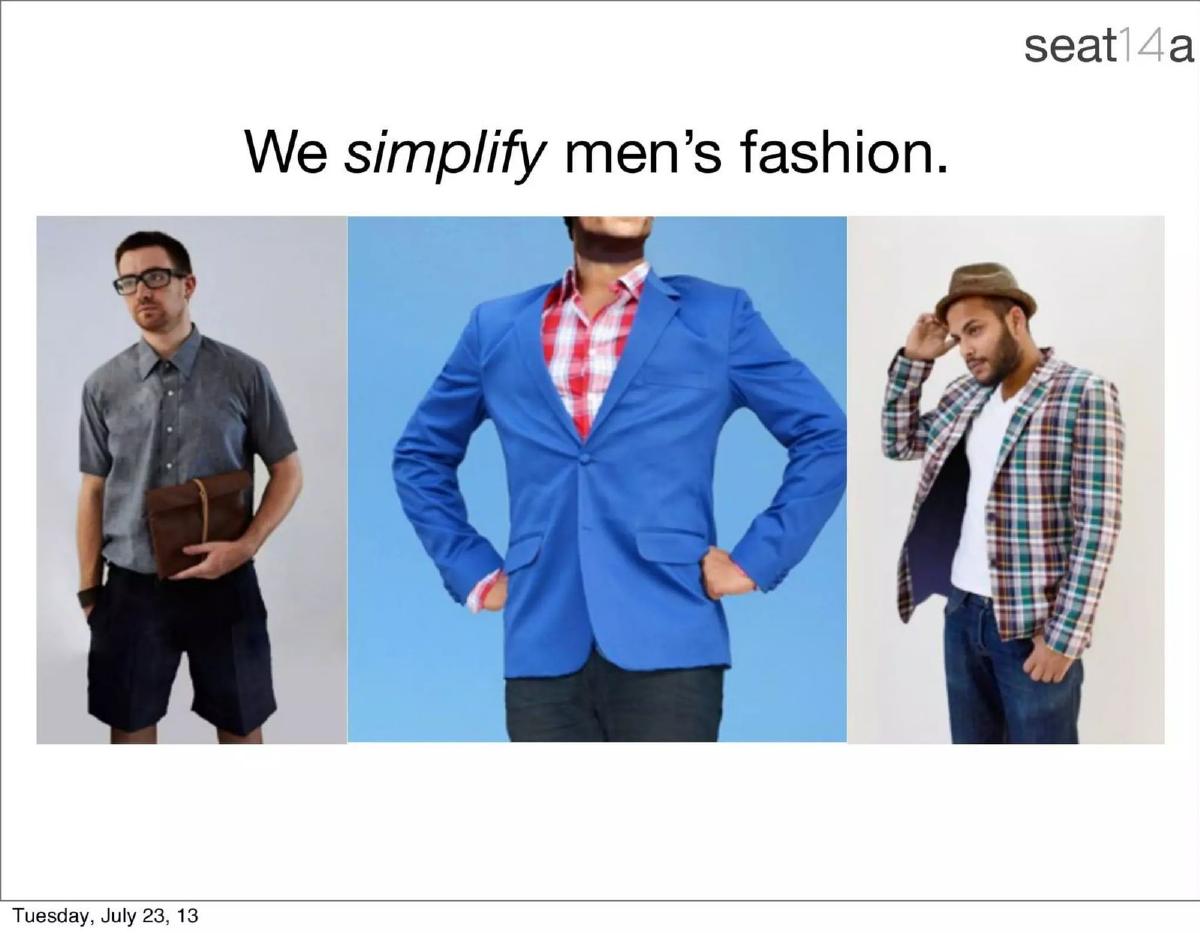
"We simplify men's fashion." This slide serves as the 'Why.' It features three distinct looks: a casual short-sleeve button-down with a leather clutch, a bold blue blazer with a plaid shirt, and a plaid blazer with a fedora. The imagery suggests a target demographic that is fashion-forward but perhaps lacks the time or confidence to assemble these outfits independently. The slide establishes the brand's visual identity—clean, bright, and modern.
Slide 3: Brand Heritage and Savillian
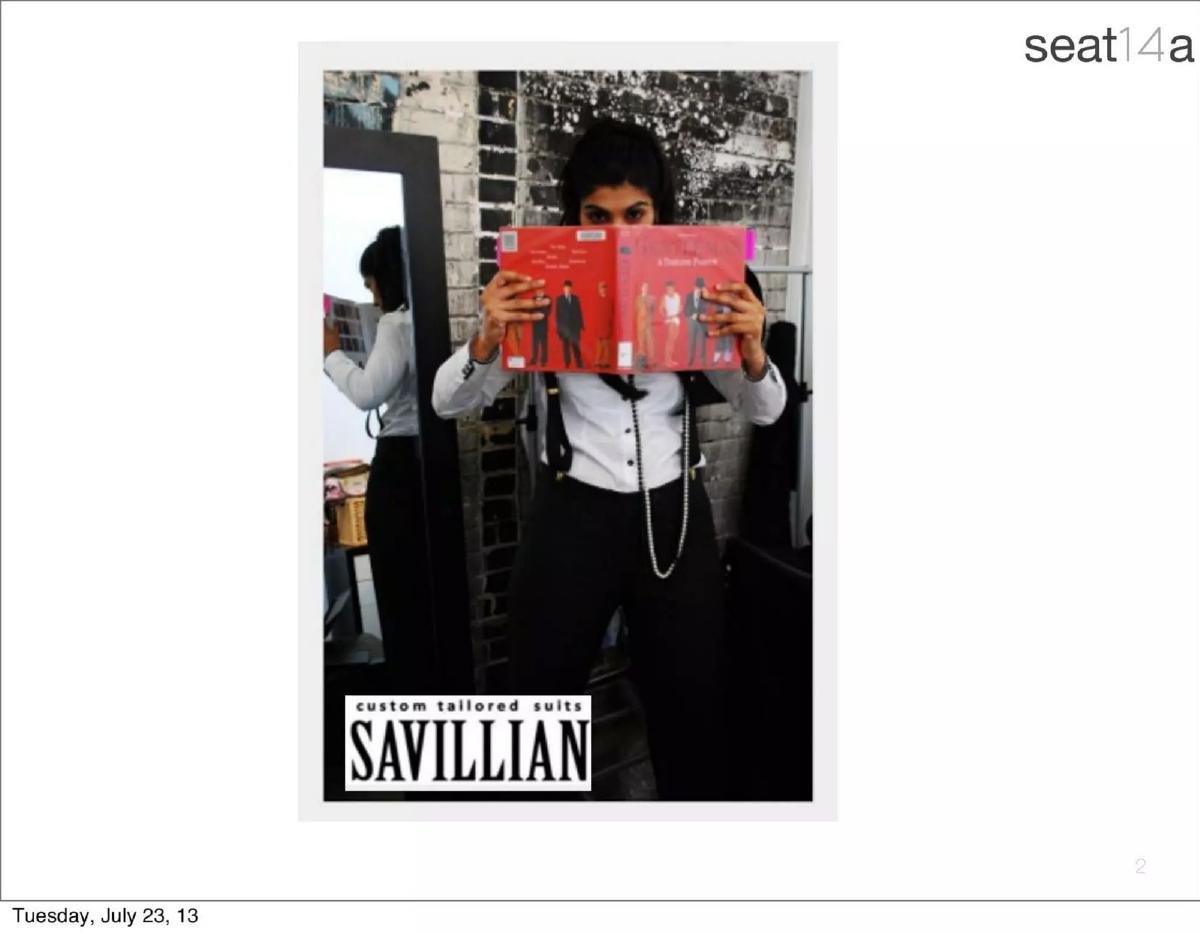
This slide features a woman holding a book titled 'Gentleman' over her face, with a logo for 'SAVILLIAN' at the bottom. The text 'custom tailored suits' suggests a connection to a bespoke tailoring background. While the deck doesn't explicitly detail the relationship here, the inclusion implies that the founders have roots in high-end tailoring, providing the 'designer quality' credibility mentioned later in the deck. It bridges the gap between mass-market e-commerce and traditional craftsmanship.
Slide 4: The Delivery Mechanism
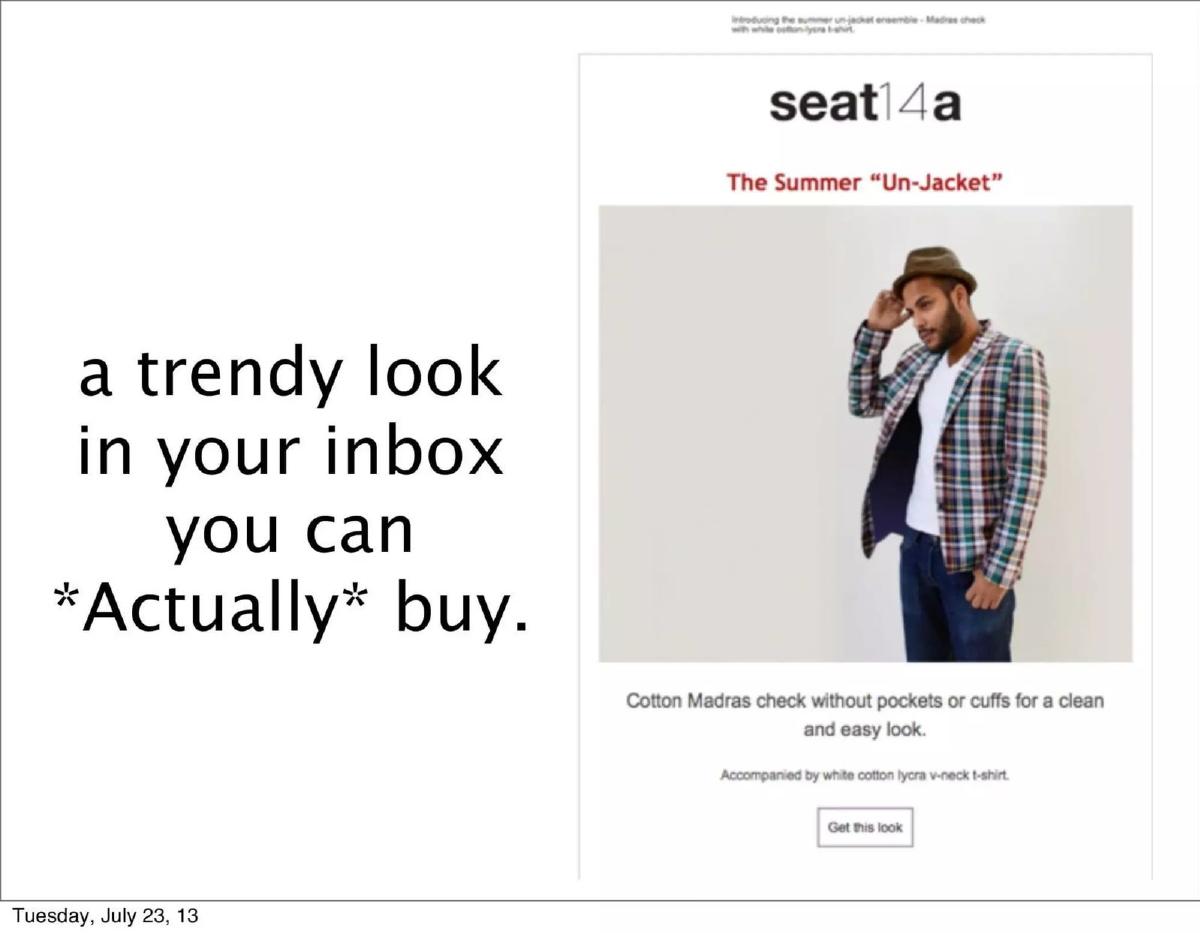
Slide 4 introduces the 'How.' It shows a mock-up of an email newsletter featuring 'The Summer "Un-Jacket."' The text "a trendy look in your inbox you can Actually buy" is a subtle jab at fashion magazines or blogs that showcase looks without providing a direct path to purchase. The 'Get this look' button in the email mock-up emphasizes the frictionless transition from inspiration to transaction.
Slide 5: Price Comparison and Value Prop
This is a critical 'Value' slide. It compares a Seat14a outfit to 'Other Brands.' On the top row, a shirt, trousers, and belt are priced at $800 . Below, a similar set from Seat14a is priced at $150 (though the zero in the graphic is slightly misaligned). This 4x price difference is the core economic hook for the consumer. It positions the brand as a 'luxury for less' play, made possible by their manufacturing model.
Slide 6: Curation and Trends
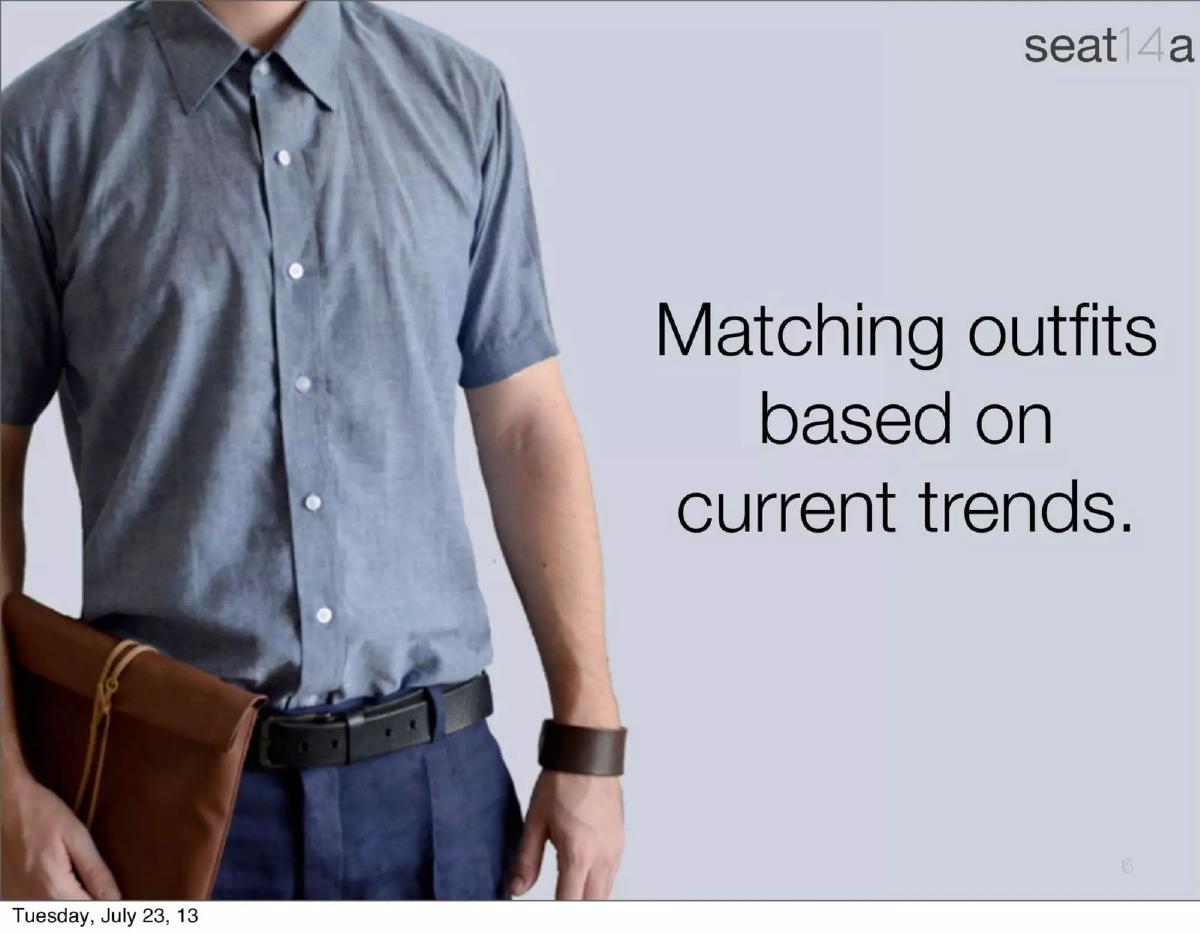
The deck reinforces the 'complete look' concept. "Matching outfits based on current trends" is the text overlaying a close-up of a linen-style shirt and a leather wristband. This slide speaks to the 'Curation' aspect of the business. By selling the outfit as a unit, Seat14a increases the Average Order Value (AOV) compared to brands selling single items, while solving the customer's coordination problem.
Slide 7: The Made-to-Measure Advantage
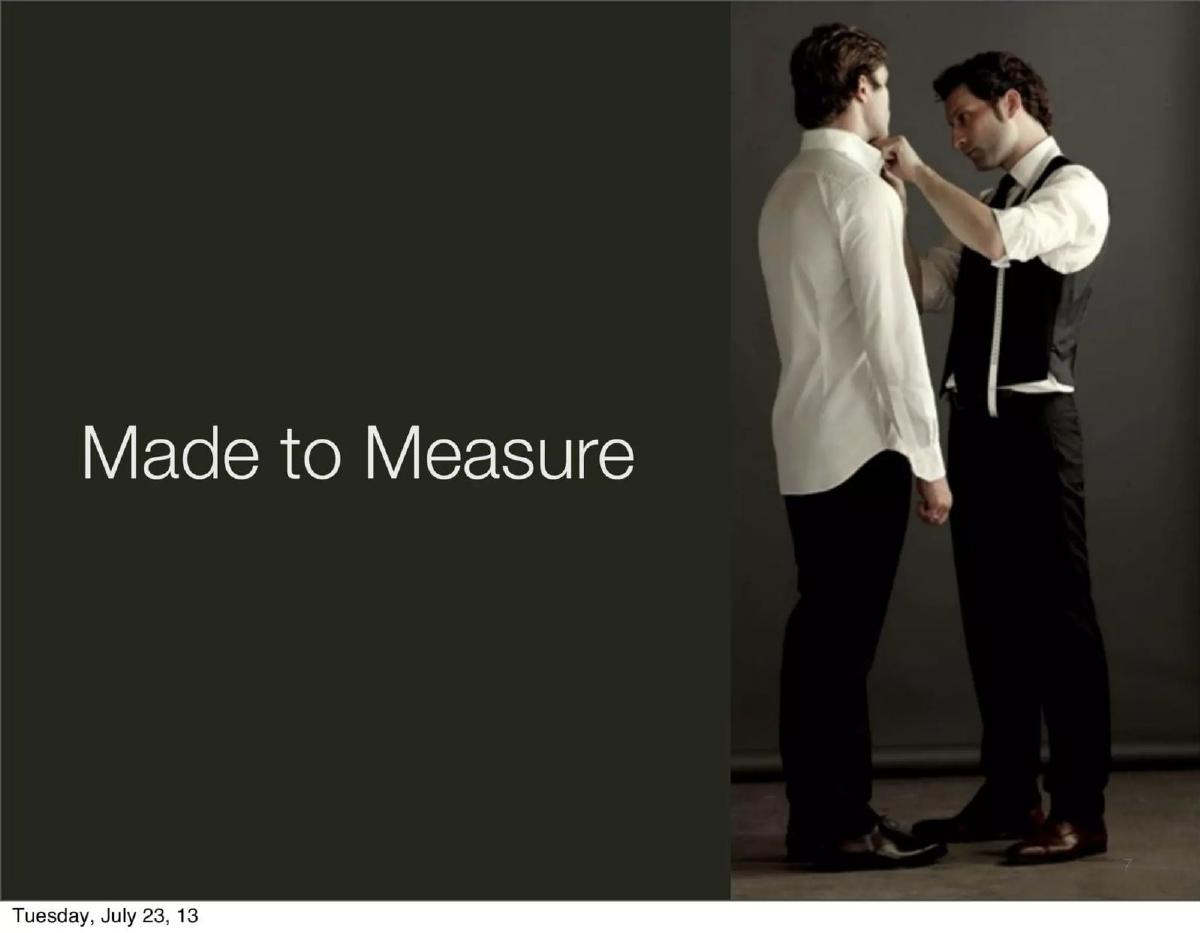
This slide features an image of a tailor measuring a client. The text "Made to Measure" is the first hint at the operational complexity that allows for their unique business model. Unlike 'off-the-rack' retailers that must guess which sizes will sell, Seat14a builds to the specific dimensions of the buyer. This reduces returns due to poor fit—one of the highest costs in fashion e-commerce.
Slide 8: The Summary Value Proposition
This slide acts as a mid-deck recap. It lists three pillars: "complete OUTFITS" (Curated Style), "4X CHEAPER" (vs. comp. brands), and "HIGH QUALITY with PERFECT FIT." The imagery shows a teal blazer with a pocket square, reinforcing the 'GQ' aesthetic mentioned in the company's self-description. It’s a concise summary of why a customer would choose them over a traditional retailer.
Slide 9: The Business Model and Economics
For an investor, this is the most important slide in the deck. It features a Shiba Inu wearing a scarf (a nod to the 'Doge' meme popular in 2013, perhaps to show personality) alongside three heavy-hitting financial points: "negative WORKING CAPITAL," "Vertically integrated," and "50%+ MARGINS." This slide explains how the $150 price point is sustainable. By owning the factory (vertical integration) and getting paid before production (negative working capital), they eliminate the two biggest killers of fashion startups: middleman markups and inventory bloat.
Slide 10: The Team
The team slide is purely visual, showing four individuals with logos of their pedigrees below. The logos include University of Waterloo, Indian Institute of Technology Roorkee, UPenn, Microsoft, Oracle, and TwoMangoes.com . The mix of elite technical education (IIT, Waterloo) and big-tech experience (Microsoft, Oracle) suggests a team capable of building both the e-commerce platform and the supply chain logistics required for a vertically integrated model.
Slide 11: The Ask
The final slide is a direct "$500k" ask. It provides the AngelList URL, the website, the Twitter handle, and the founder's email. It is a no-nonsense conclusion to a deck that focused heavily on the 'what' and 'how' of the business.
What Works in This Deck
The Seat14a deck succeeds because it identifies a clear operational 'unfair advantage' and explains it simply. Most fashion decks focus on 'style' and 'brand,' which are subjective and hard to defend. Seat14a focuses on negative working capital and vertical integration . These are objective business strengths that appeal to a seed-stage investor's desire for capital efficiency. The use of 'Made to Measure' as a way to solve the inventory problem is a brilliant framing of a logistical challenge as a customer benefit (the 'Perfect Fit').
What Is Missing from This Deck
While the deck is visually strong, it is light on hard data. There is no Traction slide showing month-over-month growth, customer acquisition cost (CAC), or lifetime value (LTV). While the catalogue facts mention they are 'profitable on first buy,' this is not explicitly detailed in the slides with a unit economics breakdown. Furthermore, there is no Market Size (TAM/SAM/SOM) slide. Investors in 2013 would have wanted to know how large the 'curated men's fashion' market actually was, especially given the rise of competitors like Bonobos and Indochino. Finally, the Competition slide is entirely absent; the deck assumes the 'Other Brands' comparison on Slide 5 is sufficient, but it doesn't address other direct-to-consumer (DTC) players.
What a Founder Should Copy
Founders should emulate the way Seat14a uses high-quality imagery to tell a story . Instead of explaining that they coordinate clothes, they show the clothes coordinated. More importantly, the Slide 9 'Economics' approach is a great template for any startup with a non-obvious operational advantage. If your business model allows you to avoid the standard pitfalls of your industry (like inventory in retail), that should be a standalone 'hero' slide. Finally, the simplicity of the 'Ask' on the final slide is refreshing; it leaves no ambiguity about what the company needs to reach the next stage.
Frequently asked questions
- How does Seat14a handle inventory risk?
- According to the deck and catalogue facts, Seat14a operates with negative working capital. Because they use a made-to-measure model where items are manufactured after the customer pays, they do not hold traditional inventory. This eliminates the risk of unsold stock and allows them to spend on fabric and labor only after revenue is secured.
- What is the primary customer acquisition channel mentioned?
- The deck emphasizes an 'inbox' strategy. Slide 4 describes 'a trendy look in your inbox you can *Actually* buy.' This suggests a heavy reliance on email marketing and curated newsletters to drive sales, rather than a traditional storefront or broad e-commerce search.
- What are the reported profit margins for Seat14a?
- Slide 9 explicitly states that the company achieves 50%+ margins. This is attributed to their vertical integration and the removal of middlemen in the design, sourcing, and manufacturing process, which reportedly takes place in New Delhi, India.
- Is Seat14a a subscription service?
- No. The catalogue facts clarify that this is NOT subscription commerce. Customers buy specific looks they like from the periodic emails; there are no mandatory monthly or weekly boxes. This distinguishes them from competitors like Trunk Club or Stitch Fix that were prominent during the same era.
- What is the specific product offering?
- Seat14a sells 'complete outfits' rather than individual pieces. Slide 6 and 8 highlight 'matching outfits based on current trends' and 'curated style.' These outfits typically include 2-4 items, such as a jacket, shirt, and trousers, coordinated by the brand's stylists.