Vizit’s 19-slide Series B deck is a masterclass in category creation, moving the conversation from generative AI (creation) to 'Intuitive AI' (measurement). The narrative argues that while the cost of creating images is plummeting due to tools like Midjourney, the value of knowing which images convert has never been higher. The deck relies heavily on a high-caliber customer list including Mars, P&G, and Unilever to validate its 'Vizit Score' as a new industry standard. While it lacks traditional financial slides like a P&L or detailed burn rate, it compensates with deep case studies showing 3…
Key takeaways
- The deck positions Vizit as the leader of a new 'Intuitive AI' category, distinct from generative or sensory AI (Slide 7).
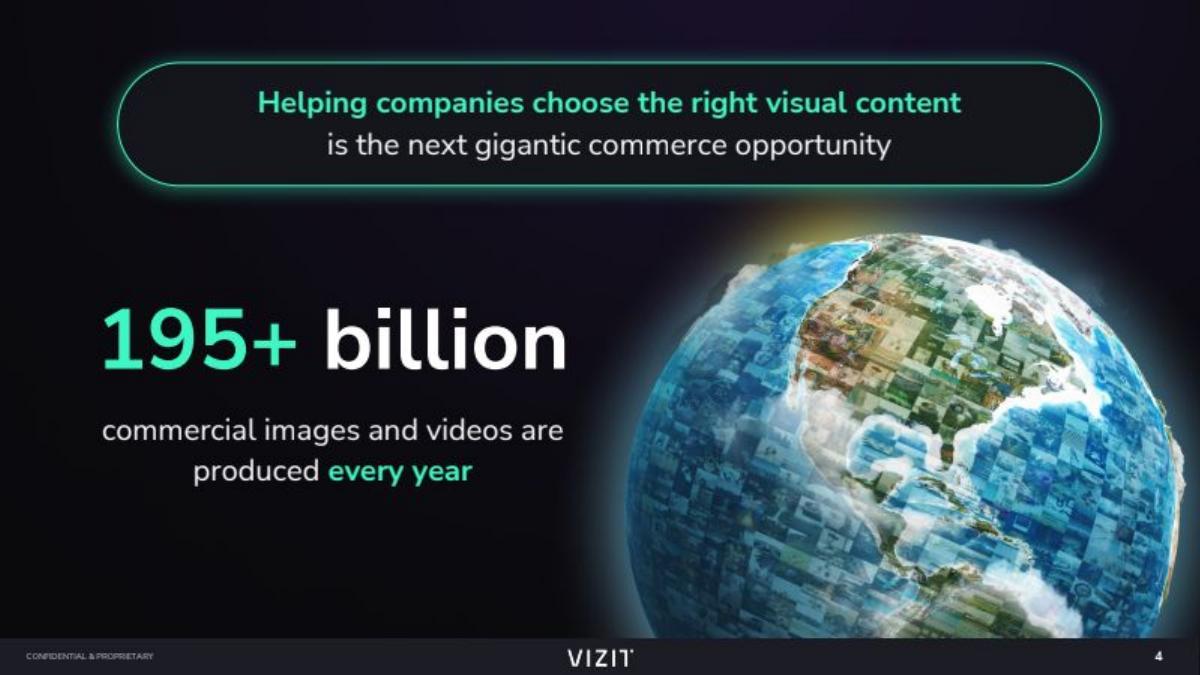
- It leverages a massive market stat: 195+ billion commercial images and videos are produced every year (Slide 4).
- The 'Vizit Score' is presented as a replacement for traditional, slow methods like focus groups and gut checks (Slide 8).
- Customer validation is a core strength, featuring logos from global giants like Nestle, L'Oreal, and Mars (Slide 12).
- Specific ROI metrics are highlighted, such as a 30% conversion uplift for Mars and 10% for Ghirardelli (Slides 15-16).
- The team slide emphasizes previous success, noting that 5 members worked together at a startup sold for $450M (Slide 14).
- Market sizing uses an 'iceberg' analogy to show a $9B beachhead within a $188B+ total addressable market (Slide 13).
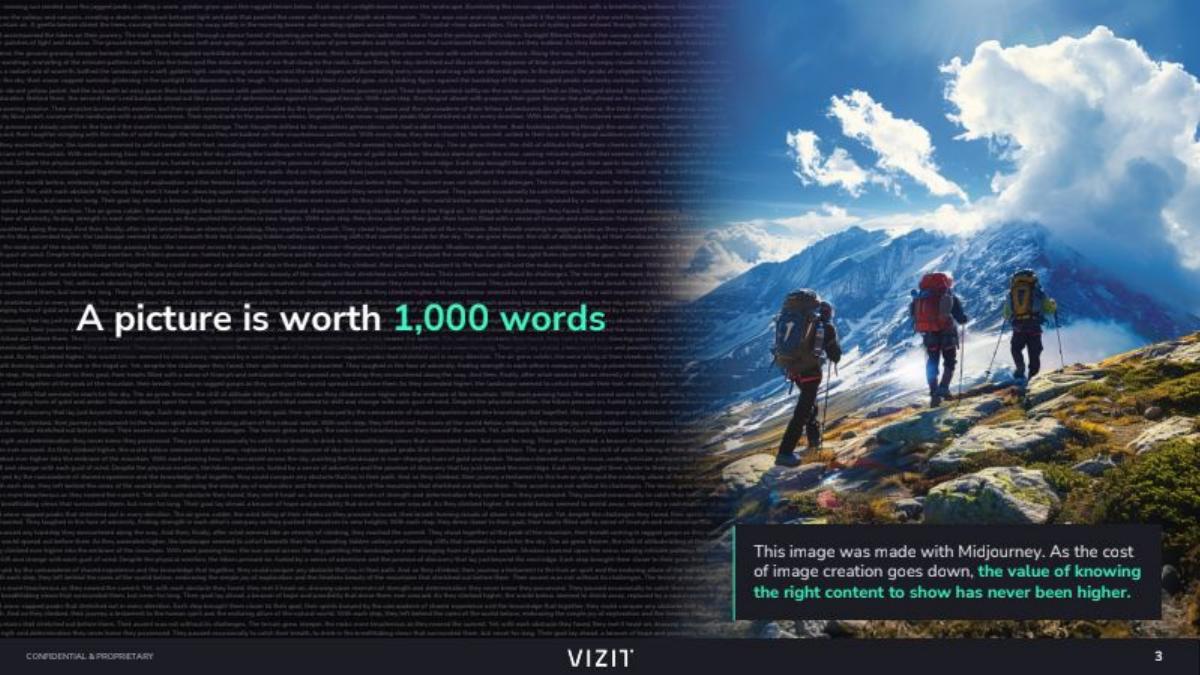
- The deck identifies a shift in value: as image creation costs go down, the value of content selection goes up (Slide 3).
The Narrative: From Creation to Selection
Vizit’s Series B deck arrives at a pivotal moment in the AI cycle. While the world is obsessed with the creation of content via generative AI, Vizit makes a compelling counter-argument on Slide 3: "As the cost of image creation goes down, the value of knowing the right content to show has never been higher." This is the foundational thesis of the deck. It shifts the investor's focus from the commodity (the image) to the intelligence (the selection).
Slides 1-4: The Macro Opportunity
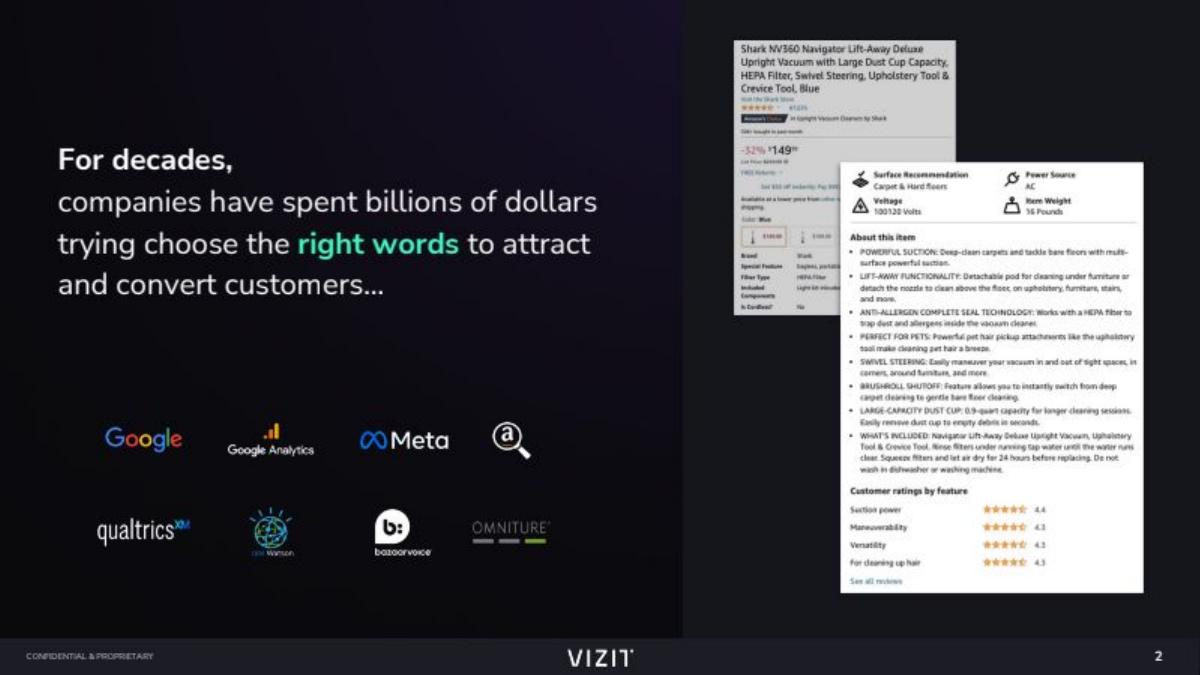
The deck opens with a clear mission statement: turning visual content into a brand's most powerful sales force. Slide 2 establishes the historical context, noting that companies have spent billions optimizing words through tools like Google Analytics and Meta, while ignoring the visual element. Slide 4 provides the scale of the problem, stating that 195+ billion commercial images and videos are produced every year. By framing the problem this way, Vizit isn't just a tool; it's the necessary infrastructure for a massive, unmanaged asset class.
Slides 5-7: Defining the Technology
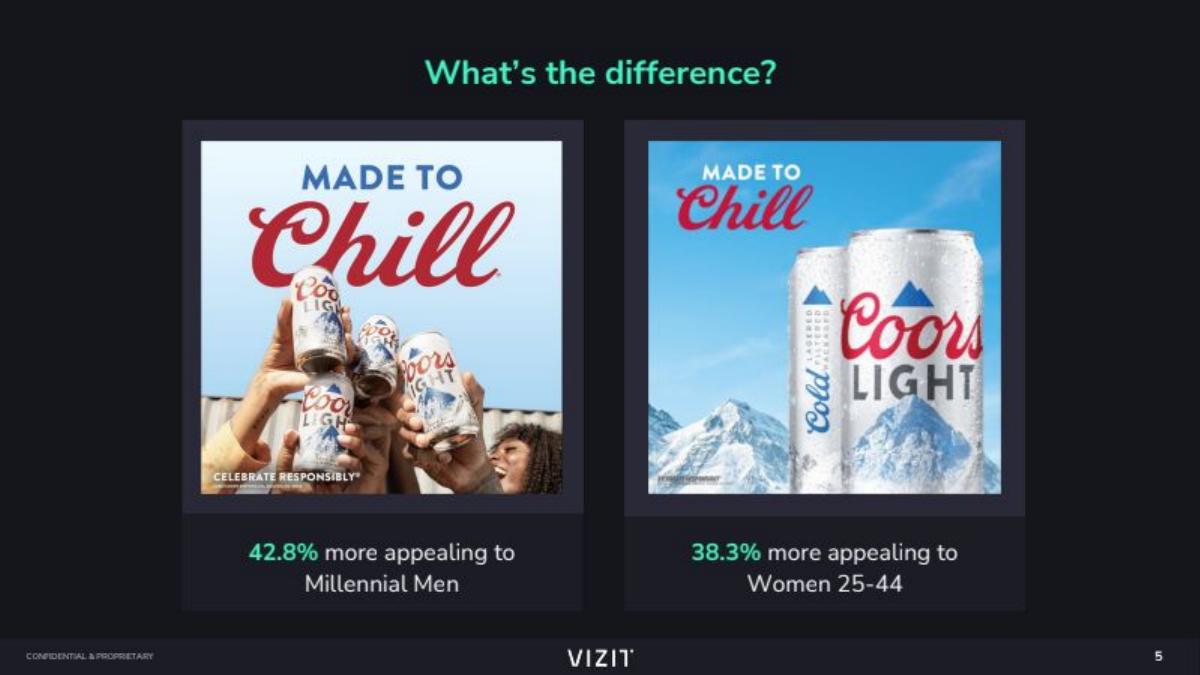
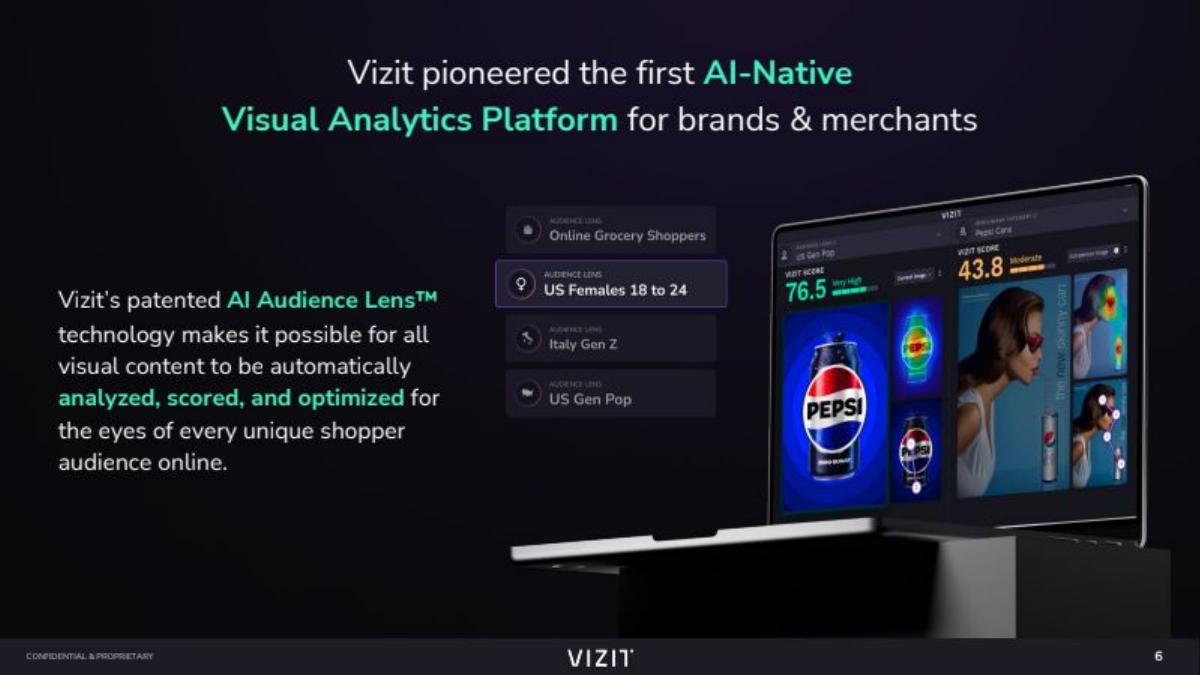
Slide 5 uses a concrete example with Coors Light to show how visual preferences differ by demographic—42.8% more appealing to Millennial Men vs. 38.3% for Women 25-44. This leads into the introduction of their Audience Lens technology on Slide 6. Slide 7 is a critical piece of category positioning. It places Vizit in the "Intuitive AI" bucket, which they claim is the next evolution beyond Passive AI (Siri/Google), Sensory AI (Waymo/Tesla), and Generative AI (Anthropic/OpenAI). This is a classic Series B move: defining a new category that you already lead.
Slides 8-11: Product and Workflow
Slide 8 introduces the concept of a "software platform of record." This is a high-value term in SaaS, implying that the tool is indispensable to the enterprise workflow. The diagram shows Vizit integrated into every stage of the content lifecycle: Planning, Brief, Inspiration, Creation, Testing, Selection, Publication, and Effectiveness Measurement. Slide 9 breaks down the user journey into four simple steps: Imagery, Audience, AI Analysis, and Insights. Slide 11 shows the breadth of the platform, covering Attention Maps, Focal Points, Gaze Sequences, and Video Analytics, emphasizing that this is a comprehensive suite rather than a single-feature tool.
Slides 12-13: Market Validation and TAM
The "Logo Slide" (Slide 12) is exceptionally strong for a Series B company. Featuring Mars, P&G, Unilever, Nestle, and L'Oreal provides immediate credibility. Slide 13 uses an iceberg graphic to illustrate the market opportunity. They identify a $9+ Billion beachhead in Enterprise CPG and Retail, sitting atop a $188+ Billion TAM . This suggests that while they are currently focused on a specific niche, the technology is applicable to anyone selling anything online.
Slide 14: The Team
The leadership team slide is designed to de-risk the investment. It highlights that 5 team members worked together at a previous AI startup sold for $450M . It also mentions that their CRO scaled Adobe’s Digital Marketing Cloud from $30M to $500M+ ARR . This combination of prior exits and scaling experience is exactly what Series B investors look for.
Slides 15-17: Deep-Dive Case Studies
The deck concludes its persuasive section with three detailed case studies. Mars (Slide 15) reports a 30% conversion uplift . Ghirardelli (Slide 16) reports a 10% conversion lift and 10x faster image selection. A North American Sports Retailer (Slide 17) projects 16,000 hours of annual time savings. These slides move the conversation from "cool technology" to "measurable business impact," which is the requirement for a $25M round.
What Works in This Deck
The Counter-Intuitive Hook: The argument that generative AI makes Vizit more valuable, not less, is brilliant. It addresses a potential objection (that images are becoming cheap/easy) and turns it into a tailwind. · Enterprise Credibility: The use of high-fidelity logos and specific, named case studies (Mars, Ghirardelli) is far more effective than anonymous "Fortune 500" claims. · Category Creation: By labeling themselves "Intuitive AI," they avoid being compared to the crowded field of generative AI startups and position themselves as a unique, high-value layer of the stack. · Workflow Integration: Showing how the product fits into the existing creative process (Slide 8) helps investors understand how the product becomes "sticky" within a large organization.
What Is Missing
Financial Performance: There is a total absence of revenue figures, growth percentages, or unit economics. While this information is usually in the data room, a Series B deck typically includes at least a high-level growth chart. · Competitive Landscape: The deck assumes Vizit has no direct competitors. While they claim category leadership, investors would want to see how they stack up against traditional A/B testing tools or other emerging visual AI players. · The "Ask": The deck does not explicitly state how much they are raising or how the capital will be deployed (e.g., sales expansion, R&D, international growth). · Product Roadmap: While the current platform is well-described, there is little mention of where the technology goes next.
What Other Founders Should Copy
The ROI Slide Format: Slides 15-17 are perfect. They combine a recognizable brand, a clear problem statement, and two high-impact, quantified results. · The "Platform of Record" Diagram: Slide 8 is a great way to show that your tool isn't just a "nice-to-have" but is integrated into the core business process. · Demographic Specificity: Using the Coors Light example (Slide 5) makes the abstract concept of "visual intelligence" immediately understandable to anyone. · Leveraging Team History: If your team has worked together before or has specific scaling experience, highlight it with bold numbers (e.g., the $450M exit and $500M ARR growth on Slide 14).
Frequently asked questions
- What is Vizit's core product offering?
- Vizit offers a Visual AI platform that uses patented 'Audience Lens' technology to predict how specific consumer segments will respond to visual content. It provides 'Vizit Scores' to help brands measure, manage, and optimize their imagery for ecommerce, advertising, and social media before publication, effectively replacing traditional focus groups.
- How does Vizit differentiate itself from other AI companies?
- The deck categorizes Vizit as 'Intuitive AI,' which focuses on synthetic human preferences and emotional responses. It contrasts this with 'Generative AI' (like Midjourney or Anthropic) which creates content, and 'Sensory AI' (like Waymo or Tesla) which detects objects. Vizit's value proposition is in the measurement and prediction of content effectiveness.
- Who are Vizit's primary customers?
- Vizit targets enterprise-level Consumer Packaged Goods (CPG) and retail brands. The deck showcases a high-tier client list including Mars, P&G, Unilever, Nestle, L'Oreal, and Ghirardelli. These companies use the platform as a 'software platform of record' for their global digital shelf imagery.
- What kind of ROI does the platform provide?
- The deck cites specific case studies: Mars saw a 30% conversion uplift and 30% faster content development; Ghirardelli achieved a 10% conversion rate lift on Amazon and was 10x faster at selecting images; a major sports retailer projected 16,000 hours of annual time savings.
- What is missing from this pitch deck?
- As a Series B deck, it is notably light on hard financial data. There are no slides showing ARR growth, churn rates, CAC/LTV ratios, or a detailed breakdown of how the $25M will be spent. It also lacks a competitive landscape slide, choosing instead to focus entirely on its own category leadership.