Cryptsonic Technologies targets the massive digital piracy market, which they estimate causes $250 billion in annual losses for the US entertainment industry (Slide 2). The company proposes a two-stage solution: a software-only implementation followed by a hardware chipset designed to provide 'unbreakable' encryption (Slide 5). Their business model relies heavily on IP licensing, projecting a jump from $580,700 in Year 1 sales to over $57 million by Year 3 (Slide 8). The deck seeks a total of $1.3 million across two phases to fund prototyping, software development, and chipset design (Slide 1…
Key takeaways
- The problem is framed by massive financial losses: $250 billion in US entertainment and $3 billion in e-books annually (Slide 2).
- The solution is bifurcated into a software stage and a hardware chipset stage for device integration (Slide 5).
- Cryptsonic claims a competitive advantage through 'Open Quantum Safe' encryption algorithms designed to resist quantum computing (Slide 6).
- Revenue is projected to come from three sources: Software IP licensing (60%), Hardware IP licensing (30%), and Consulting (10%) (Slide 7).
- Financial projections show a net loss of $1.43 million in Year 1, turning into a $44.59 million net profit by Year 3 (Slide 8).
- The project timeline spans from marketing analysis in 2005 to planned chipset embedding in late 2021 (Slide 9).
- The funding ask is split: $800,000 for Seed (prototyping/software) and $500,000 for Seed Plus/Series A (chipset design) (Slide 10).
- The leadership team includes a founder with a USPTO patent (#8,291,219) and a co-founder with a PhD from Georgia Tech (Slide 11).
Company Overview
Cryptsonic Technologies Incorporated is a digital rights management (DRM) company focused on eliminating unauthorized use of digital content. The deck, published in 2020, outlines a transition from a software-based security layer to a dedicated hardware chipset intended for integration into consumer electronics.
Slide 1: Title Slide
The title slide introduces the company name, Cryptsonic Technologies Incorporated, and their tagline: "Content Delivery Eliminating Unauthorized Use." The visual design is minimal, featuring a circular teal logo.
Slide 2: The Problem
Slide 2 quantifies the impact of digital piracy. It states that in the US alone, annual losses are estimated at $250 billion for the entertainment industry and $3 billion for e-books. The slide characterizes digital piracy as a "serious problem that the online community is facing today."
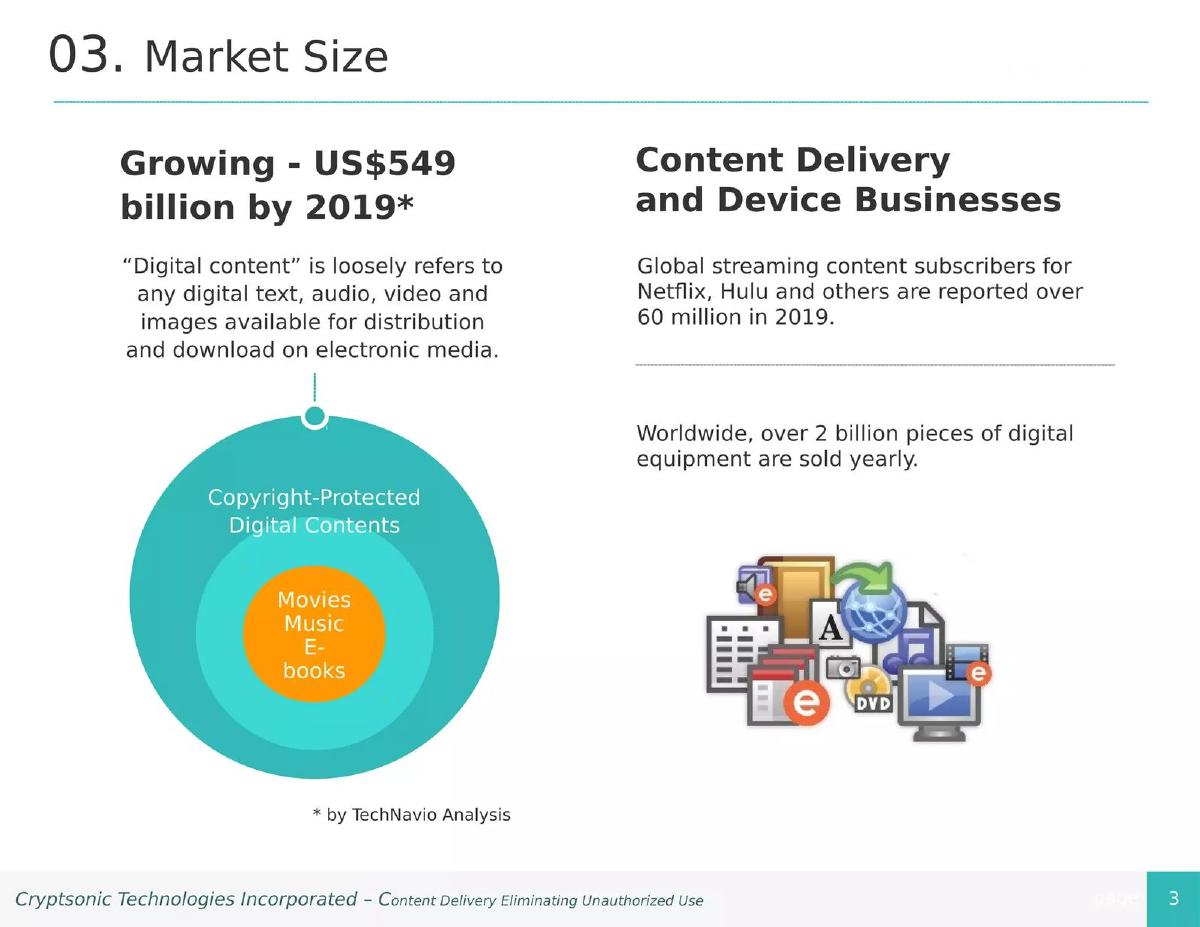
Slide 3: Market Size
This slide defines the total addressable market. It cites a TechNavio Analysis stating that "Digital content" is growing to US$549 billion by 2019. It also notes that global streaming content subscribers for services like Netflix and Hulu were reported at over 60 million in 2019, and that over 2 billion pieces of digital equipment are sold worldwide annually.
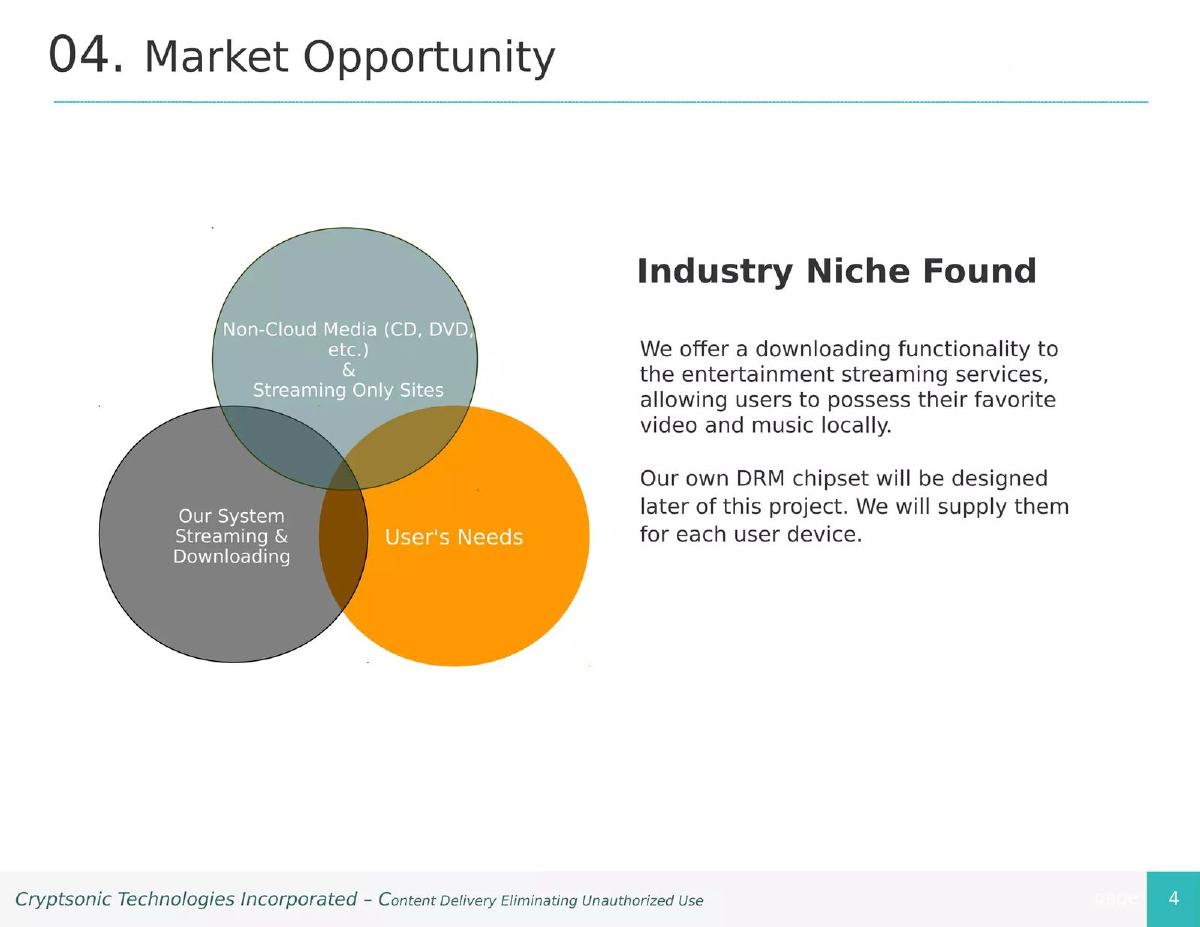
Slide 4: Market Opportunity
Cryptsonic identifies an "Industry Niche Found" at the intersection of streaming services and user needs. The slide claims that streaming sites hesitate to let users store content because there is no "unbreakable DRM." Cryptsonic proposes to offer downloading functionality that allows users to possess video and music locally, secured by their proprietary DRM chipset.
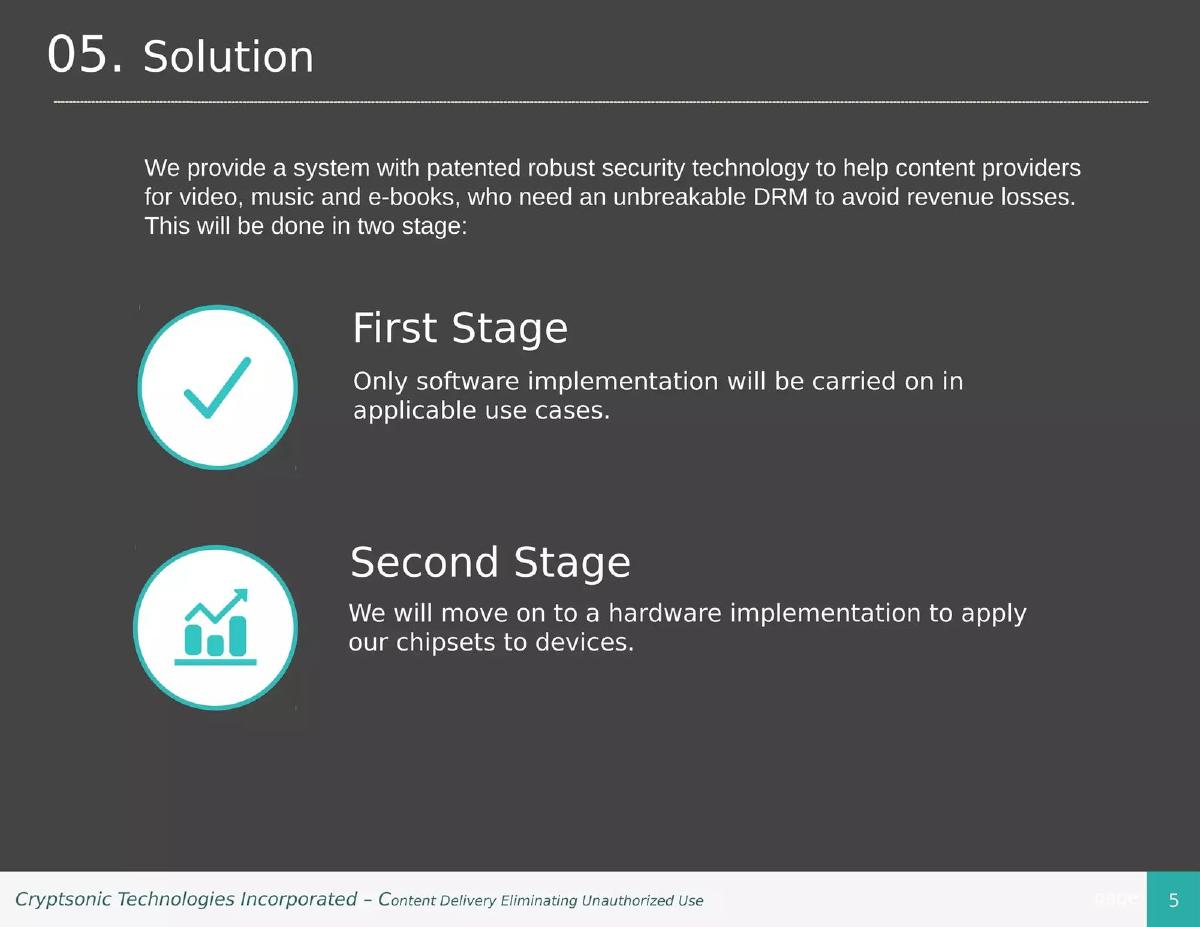
Slide 5: The Solution
The solution is presented in two distinct stages. The "First Stage" involves software-only implementation for applicable use cases. The "Second Stage" involves moving to a hardware implementation by applying their custom chipsets directly to devices. The goal is to provide an "unbreakable DRM" to avoid revenue losses for content providers.
Slide 6: Competitive Advantage
The company lists two primary advantages. The first is the use of "Open Quantum Safe" encryption algorithms, which they believe will remain secure even against quantum computers. The second is their authentication methods, which allow users to be granted specific rights for various types of content use.
Slide 7: Business Model
Cryptsonic operates as an OEM (Original Equipment Manufacturer) on a B2B contract basis. Revenue sources are broken down as follows: 60% from software IP licensing, 30% from hardware IP licensing, and 10% from consulting. The slide also lists potential licensing partners including Netflix, Hulu, Amazon, Apple, Sony, and Microsoft, as well as chip manufacturers like Intel, NVIDIA, and AMD.
Slide 8: Financial Projections
The Profit and Loss Statement projects a rapid scale-up. Year 1 sales are listed at $580,700 with a net loss of $1,433,580. Year 2 sales grow to $4,425,100 with a net profit of $347,460. Year 3 targets $57,557,000 in sales and a net profit of $44,593,000. A footnote explains that Cost of Goods Sold (COGS) is $0 because the company focuses exclusively on IP licensing.
Slide 9: Timeline
The timeline shows a long development history starting with marketing analysis in January 2005. Key milestones include software prototyping in December 2016 and device prototyping in July 2017. The "We are here" marker is placed between the Seed Round (July 2020) and approaching partners (September 2020). Future steps include chipset design in October 2020 and chipset embedding in October 2021.
Slide 10: Funding Needs
The total ask is $1.3 million. The first $800,000 (Seed) is allocated for company establishment, prototyping, software development, and patent filing. The subsequent $500,000 (Seed Plus/Series A) is earmarked for chipset design, IP establishment for the chipset, and integrated system prototyping. The slide notes that funds may come from financing rounds beyond just equity issuance.
Slide 11: Team
The team slide features four individuals. Seiji Eto (Founder/CEO) is a software engineer formerly with Netscape and Adobe, and the owner of USPTO patent #8,291,219. Dr. Rajesh Pendurkar (Co-Founder/Technical) holds a PhD from Georgia Tech and was a design scientist at Intel. Advisors Jim Jackson and Thomas Chow bring experience from companies like CloudLinux, PubMatic, and Parallels.
Slide 12: Contact Info
The final slide provides social media links (Facebook, Twitter), the company website, and direct contact information for Seiji Eto via email and Skype.
What Works Well
Quantified Problem: The deck uses specific, large-scale figures ($250 billion) to establish the high stakes of the piracy problem, which helps justify a hardware-level solution. · Technical Credibility: The team slide is a strong point. Having a founder with a specific USPTO patent number and a co-founder with a PhD and Intel background provides necessary weight to the claim of "unbreakable" encryption. · Phased Approach: Distinguishing between a software rollout and a hardware rollout shows a logical progression that manages risk and allows for earlier market entry via software.
What Is Missing
Traction Data: While the timeline mentions prototyping was "successfully done," there are no metrics regarding pilot programs, letters of intent (LOIs) from the listed partners, or results from the software prototyping phase. · Competitor Analysis: The deck mentions that streaming sites "hesitate" to allow downloads, but it does not name or analyze existing DRM competitors like Widevine (Google), FairPlay (Apple), or PlayReady (Microsoft). · Unit Economics: While the P&L shows high-level projections, it does not explain the pricing model for the IP licenses or the expected margins for the hardware component beyond the $0 COGS claim.
Founder Takeaways
Be Specific with Patents: Listing the actual USPTO patent number (as seen on Slide 11) is a highly effective way to prove intellectual property ownership to investors. · Clarify the COGS: If you claim $0 Cost of Goods Sold for a hardware-related business (Slide 8), you must clearly explain that you are licensing the design rather than manufacturing the physical chips yourself to avoid confusion. · Bridge the Gap: The timeline (Slide 9) shows a 12-year gap between the initial marketing analysis (2005) and the next major milestone (2017). Founders should be prepared to explain such long periods of inactivity or slow development during a pitch.
Frequently asked questions
- What is the core technology behind Cryptsonic?
- Cryptsonic utilizes patented Digital Rights Management (DRM) technology. According to Slide 6, their primary technical advantage lies in 'Open Quantum Safe' encryption algorithms, which they claim are secure even against future quantum computers. They also utilize unique authentication methods to control user rights for various media types.
- How does the company plan to make money?
- The business model is primarily B2B IP licensing. Slide 7 breaks down revenue into three streams: 60% from software IP licensing for movie and music portals, 30% from hardware IP licensing for their special DRM chipset, and 10% from consulting services for e-commerce and distribution sites.
- What is the specific funding request in this deck?
- Slide 10 outlines a total need of $1.3 million. This is divided into an initial $800,000 Seed round for company establishment, software development, and device prototyping, followed by a $500,000 Seed Plus or Series A round specifically for chipset design and integrated system prototyping.
- Who are the key members of the leadership team?
- The team features Seiji Eto (Founder/CEO), a former Netscape and Adobe engineer who owns USPTO patent #8,291,219. He is joined by Dr. Rajesh Pendurkar (Co-Founder/Technical), a Georgia Tech PhD and former Intel design scientist. The board includes advisors Jim Jackson and Thomas Chow, both with backgrounds in global tech operations and legal services (Slide 11).
- What are the projected financials for the first three years?
- Slide 8 projects significant growth. Year 1 shows sales of $580,700 with a net loss of $1,433,580. By Year 2, sales are expected to reach $4,425,100 with a small profit. Year 3 projections are aggressive, targeting $57,557,000 in sales and a net profit of $44,593,000, assuming $0 cost of goods sold due to the IP licensing focus.