Crypto Currency Corporation (CCC) aims to disrupt traditional corporate financing by introducing 'Crpcred,' a digital currency backed by the creditworthiness of investment-grade corporations and banks. The deck, dated May 2018, positions the product as a stable alternative to both volatile cryptocurrencies like Bitcoin and government-controlled FIAT currencies. By leveraging private and public blockchain technologies, CCC proposes a system where major buyers (e.g., Walmart or Tesco) can issue interest-free credit via tokens to pay suppliers instantly. The business model relies on fees from co…
Key takeaways
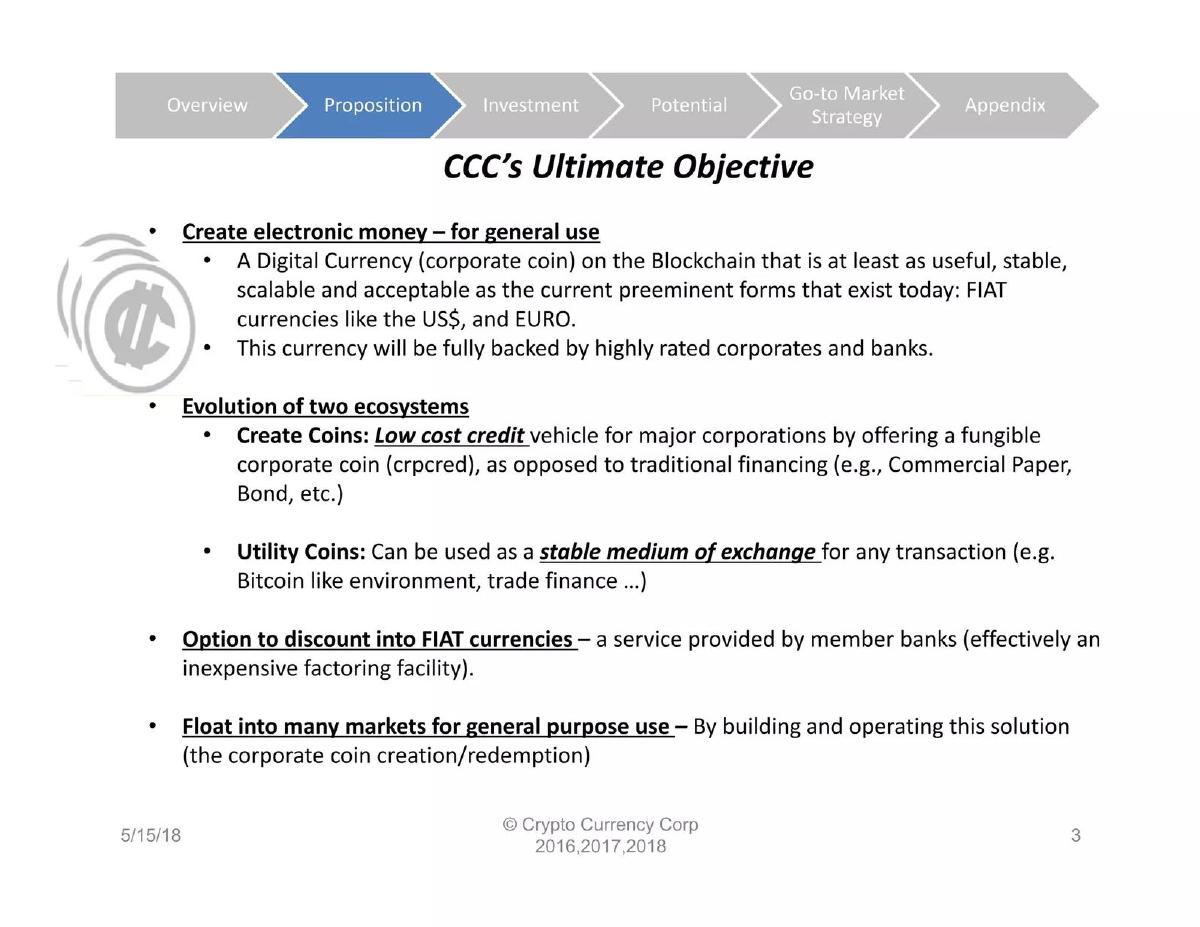
- The company positions its 'Crpcred' as a low-cost credit vehicle for major corporations, intended to replace traditional commercial paper or bonds (Slide 3).
- CCC identifies a total global addressable payment market of $33 trillion, with a specific $100 billion target for its initial credit product (Slide 7).
- The revenue model is built on three pillars: coin creation/generation, conversion/discounting to FIAT, and transaction settlement/mining (Slide 7).
- A significant portion of the initial strategy is dedicated to legal and regulatory hurdles, including establishing the validity of credit-backed instruments (Slide 9).
- The deck explicitly states that the currency will be fully backed by 'highly rated corporates and banks' to ensure stability (Slide 3).
- The competitive landscape slide notes that while Bitcoin relies on scarcity, CCC relies on regulated corporate credit for value (Slide 15).
- The advisory team includes former executives from Pershing (BNY Mellon), JPMorgan, and Orbian (a Citibank/SAP venture) (Slide 19).
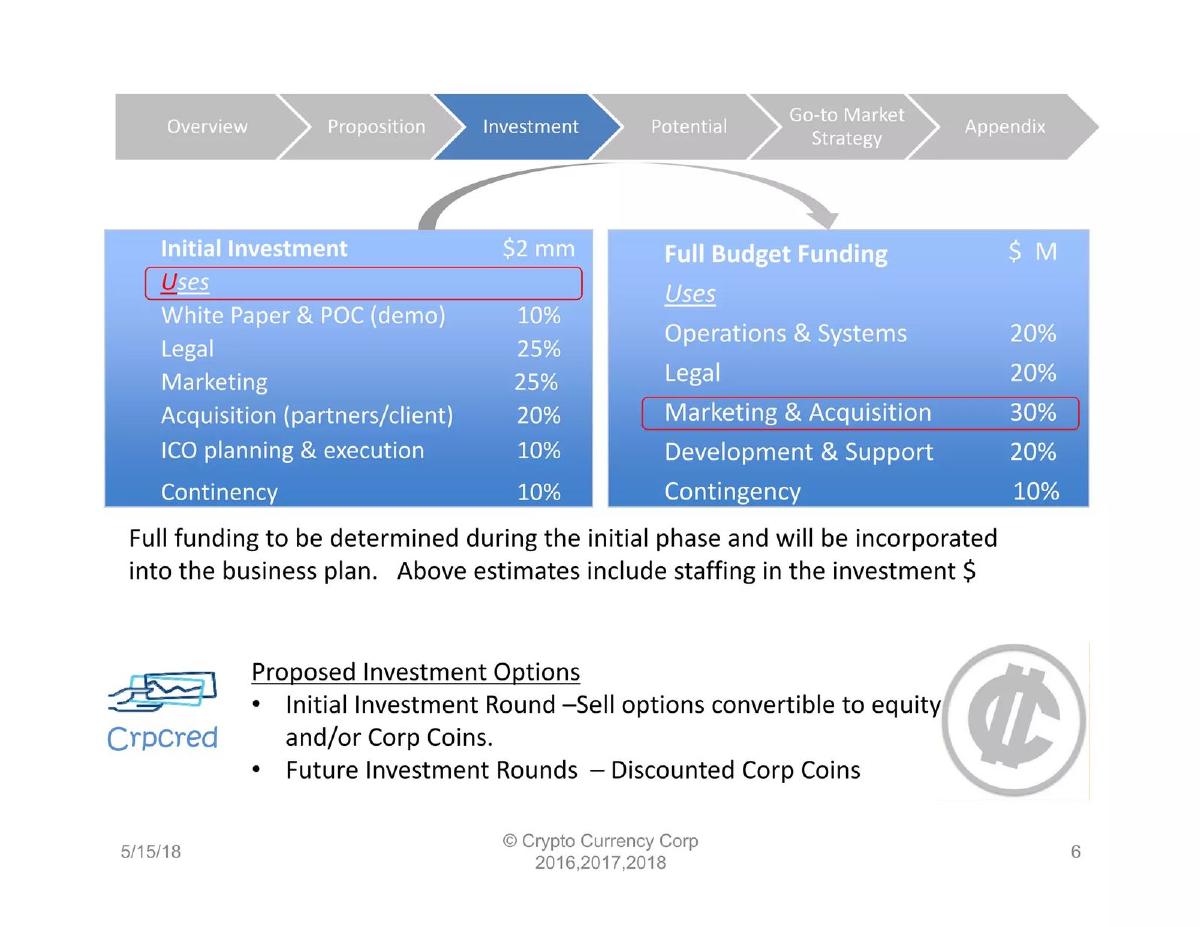
- The deck lacks a specific 'Ask' slide detailing the amount of capital being raised or the valuation sought (Omitted).
Crypto Currency Corporation: The B2B Credit Blockchain Vision
The Crypto Currency Corporation (CCC) pitch deck, dated May 15, 2018, represents a specific era of blockchain development where the focus shifted from consumer-facing cryptocurrencies to enterprise-grade 'stablecoins' and supply chain finance. The deck presents a sophisticated, if early-stage, plan to digitize corporate credit. It attempts to bridge the gap between traditional banking (factoring and commercial paper) and decentralized ledger technology.
Slide 1: Title and Confidentiality
The cover slide introduces the company as 'Crypto Currency Corporation' with the tagline 'The Corporate Crypto Coin.' It is explicitly marked as 'Strictly Confidential' and an 'In-progress Investor Deck.' The copyright dates span 2016 to 2018, suggesting the concept had been in development for at least two years prior to this specific iteration of the deck. The logo uses a interlocking 'CCC' design, emphasizing the corporate nature of the project.
Slide 3: CCC’s Ultimate Objective
This slide defines the core value proposition. The objective is to create 'electronic money' for general use that is as stable and scalable as FIAT currencies like the USD and EURO. The key differentiator mentioned is that this currency is 'fully backed by highly rated corporates and banks.' The slide introduces two ecosystems: Crpcred (a low-cost credit vehicle for corporations) and Utility Coins (a stable medium of exchange for trade finance). The slide also mentions an 'option to discount into FIAT currencies,' describing it as an 'inexpensive factoring facility.'
Slide 5: Legal and Marketing Focus
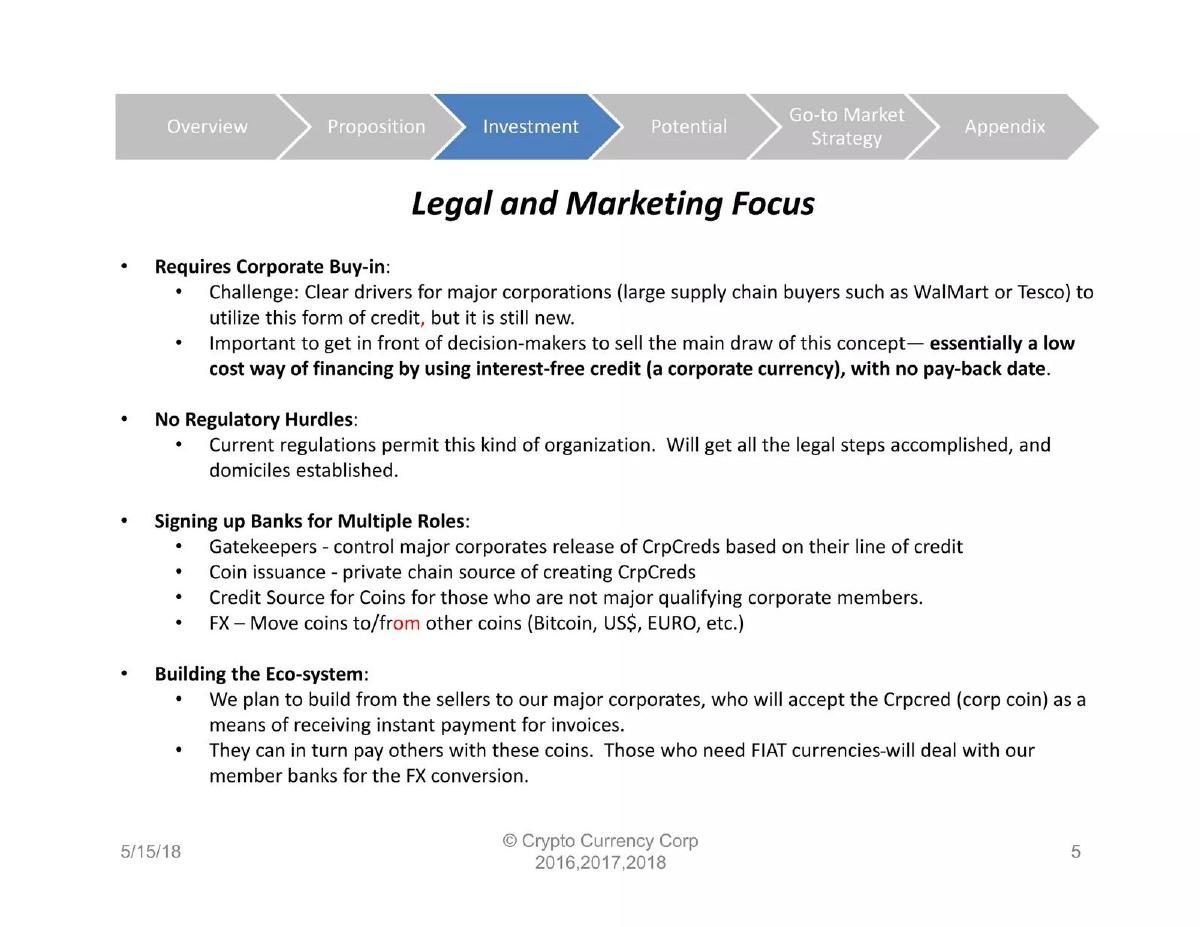
CCC acknowledges the high barrier to entry in enterprise finance. The 'Challenge' listed is obtaining buy-in from major corporations like Walmart or Tesco. The draw for these giants is 'interest-free credit' with 'no pay-back date.' The slide claims there are 'No Regulatory Hurdles' because current regulations permit this kind of organization, though this is later tempered by the need for legal domicile establishment. It also details the roles of member banks: gatekeepers, coin issuers, credit sources, and FX providers.
Slide 7: Addressable Payment Market and Potential
Using a standard inverted pyramid, CCC illustrates the market size. The 'Global' market is cited at $33 Trillion, the 'US' market at $5 Trillion, and the specific target for 'Crpcred' is $100 Billion. The right side of the slide breaks down the 'proposed income stream,' which includes Coin Creation, Conversion/Discounting to FIAT, and Settlement of Transactions (Mining). This is the only slide that addresses the business model directly, though it lacks specific pricing or margin projections.
Slide 9: Go-to-Market Strategy and Timeline
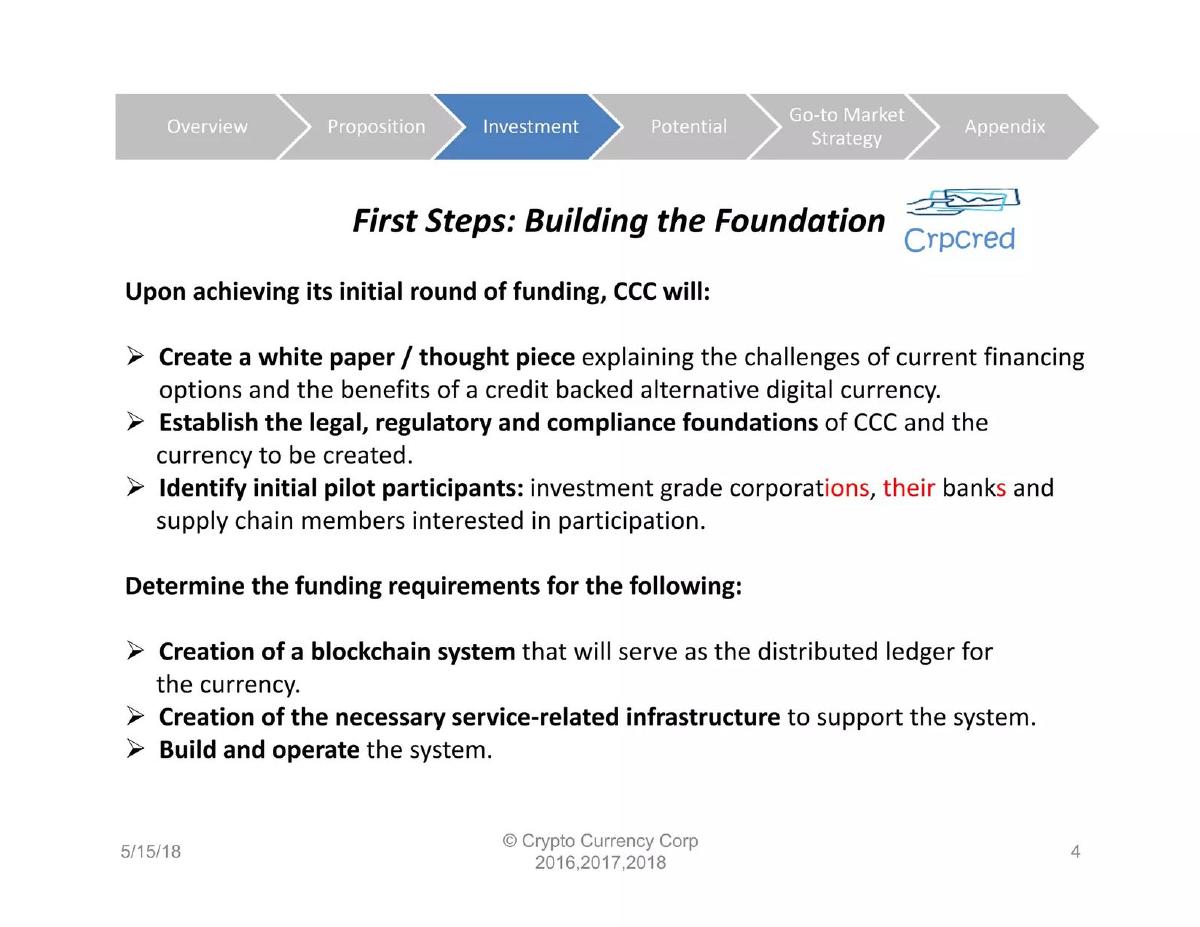
This slide outlines the immediate next steps under a vertical banner labeled 'EST 3 MONTHS.' The tasks include securing initial funding from 'strategic banks and major buyers,' writing a white paper to demonstrate utility, and addressing legal domicile and accounting treatments. The final goal in this phase is the 'Creation of a Proof of Concept'—a blockchain system that enables credit-backed transactions between participating members.
Slide 11: Appendix Introduction
A simple transition slide listing the contents of the appendix. It promises information on 'What is Blockchain,' 'Competitive Landscape,' and 'Founding Team.' This structure suggests the main deck is intended to be a high-level summary, with the technical and biographical details relegated to the back.
Slide 13: Proposition – Supporting Information
This slide dives deeper into the 'Value System' of Crpcred. It defines the token as a 'fungible asset' backed by the 'credit worthiness of multiple investment grade corporations.' It contrasts this against Bitcoin (which it claims has no intrinsic value) and FIAT (which it claims is at the 'whim of government needs'). The stability of Crpcred is attributed to the fact that corporate credit is 'controlled by regulatory limits.' It also notes the technology will be a 'combination of systems built upon private and public blockchain technologies.'
Slide 15: Competitive Landscape
CCC categorizes its competition into three groups: Other Virtual Coins, FIAT Currencies, and Payment Products. It dismisses Bitcoin and other cryptos for lacking underlying value. Interestingly, it mentions FIAT currencies might become virtual (citing Ecuador as an example). For payment products, it names Orbian and Paypal , noting that while these facilitate B2B payments, a blockchain-based fungible currency would be 'more powerful.' It poses a strategic question: 'or can we co-op them?'
Slide 17: Digital Currency Explanation
This slide is purely educational, defining the foundational properties of money: Medium of Exchange, Unit of Account, and Store of Value. It cites the 'European Central Bank – Virtual Currency Schemes 2012' as a source. This slide appears intended to ground the investor in monetary theory before asserting that CCC's coin meets all these criteria better than existing digital alternatives.
Slide 19: Advisory Team
The final slide in the provided set lists three advisors. Margit Mason (Former MD at Pershing/BNY Mellon and VP at JPMorgan), Jonathan Walden (CEO of Rithmic and former President of Omnesys Technologies), and Karl Rotstan (Product Specialist at Orbian and former VP at TrueChoice Solutions). The inclusion of an advisor from Orbian is significant, as Orbian is a direct competitor/precursor in the B2B credit space mentioned on Slide 15.
What Works in This Deck
The deck excels at identifying a specific, high-value pain point: the cost and complexity of corporate credit and supply chain finance. By targeting 'interest-free credit' for giants like Walmart, the founders are speaking a language that CFOs understand. The 'Proposed Income Stream' on Slide 7 is clear and logical, showing that the company isn't just a technology provider but a financial intermediary with multiple ways to capture value. Furthermore, the advisory board is exceptionally well-aligned with the product; having a former MD from Pershing and a product specialist from a Citibank/SAP venture (Orbian) lends significant credibility to a project that is otherwise in the 'Proof of Concept' stage.
What Is Missing from the Deck
The most glaring omission is the 'Ask.' There is no slide detailing how much money the company is looking to raise, what the valuation is, or how the funds will be specifically allocated beyond a vague '3-month' timeline for a Proof of Concept. Additionally, while the deck mentions a 'Founding Team' in the appendix list (Slide 11), the actual slide for the founders is missing from this set, leaving the reader only with the advisors. There are also no unit economics or financial projections. While the $33 trillion market size is impressive, the deck fails to explain how the company gets from $0 to its first $1 million in revenue. The technical architecture is also left as a 'black box,' described only as a combination of private and public blockchains without further detail.
Founder Takeaways: What to Copy
Founders building in the B2B or Fintech space should look at Slide 3 and Slide 13 as examples of how to define a 'Value System.' Instead of focusing on the 'how' (the blockchain), CCC focuses on the 'what' (the creditworthiness of the backers). This is a crucial distinction for enterprise sales. The use of a 'Competitive Landscape' slide that doesn't just list logos but explains the philosophical difference between the startup and the incumbents (Slide 15) is also a strong move. Finally, the 'Legal and Marketing Focus' slide (Slide 5) is a refreshing bit of honesty; acknowledging that 'Corporate Buy-in' is the primary challenge shows that the founders understand the market dynamics of their industry.
Frequently asked questions
- What exactly is the 'Crpcred' token?
- According to Slide 13, Crpcred is a fungible digital asset formed from a combined source of credit. It is backed by the creditworthiness of multiple investment-grade corporations and financial institutions. Unlike Bitcoin, which relies on scarcity, Crpcred's value is derived from the underlying corporate credit, which the founders argue is more stable than national currencies because it is strictly regulated by corporate limits.
- How does Crypto Currency Corporation plan to make money?
- Slide 7 outlines a three-part income stream. First, they charge for 'Coin Creation/Generation' when a corporation issues credit. Second, they earn from 'Conversion/Discounting to FIAT,' which functions like a factoring facility where member banks discount the coins for cash. Third, they collect fees for the 'Settlement of Transactions,' which the deck refers to as 'Mining' within their specific ecosystem.
- Who is the target customer for this platform?
- The deck targets two main groups: 'Major Corporates' and 'Sellers.' Slide 5 specifically mentions large supply chain buyers like Walmart or Tesco as the ideal issuers of this interest-free credit. The sellers (suppliers) are the ones who accept the Crpcred as instant payment for invoices, which they can then use to pay their own suppliers or convert to FIAT through member banks.
- What is the current stage of the company according to the deck?
- The deck is labeled as an 'In-progress Investor Deck' (Slide 1). Slide 9 indicates that the company is in the 'Initial Funding' phase with an estimated 3-month timeline to establish a business plan, white paper, legal domicile, and a Proof of Concept (PoC). There is no evidence in the slides of a live product or existing revenue at the time of the presentation.
- What are the primary risks identified in the deck?
- The primary challenges are 'Corporate Buy-in' and 'Legal/Regulatory' hurdles. Slide 5 notes the difficulty of getting large buyers to adopt a new form of credit. Slide 9 highlights the need to establish the legal validity of a credit-backed instrument and determine how it will be treated from an accounting and compliance perspective across different jurisdictions.