Rocket Internet’s 2014 deck, presented at the Kinnevik Capital Markets Day, is less of a startup pitch and more of an industrial blueprint. Spanning 42 slides (21 analyzed here), the company argues that innovation is secondary to execution. They showcase a massive portfolio across eCommerce, Marketplaces, and FinTech, emphasizing a 'Low Risk Investment Approach' through the systematic cloning of proven business models. The deck relies heavily on geographical dominance, citing presence in over 100 countries and 9 of Facebook's top 10 user cities. By quantifying their 'Company Building' process…
Key takeaways
- The deck explicitly prioritizes execution over innovation, highlighting a 'Structured Selection Process' for proven models (Slide 21).
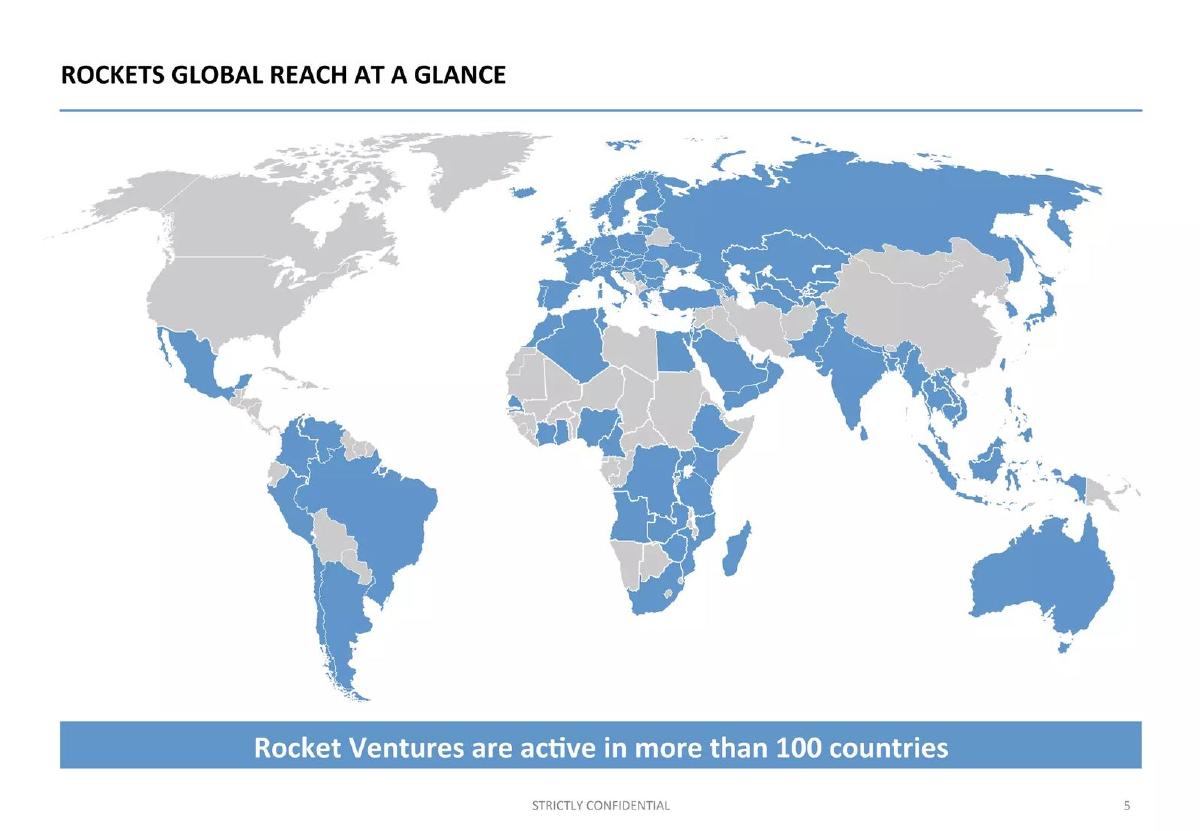
- Rocket Internet claims a presence in more than 100 countries, positioning themselves as the primary gateway to emerging market internet growth (Slide 5).
- The 'Company Building' timeline is highly aggressive, aiming for venture launch in <100 days and operational independence in <200 days (Slide 23).
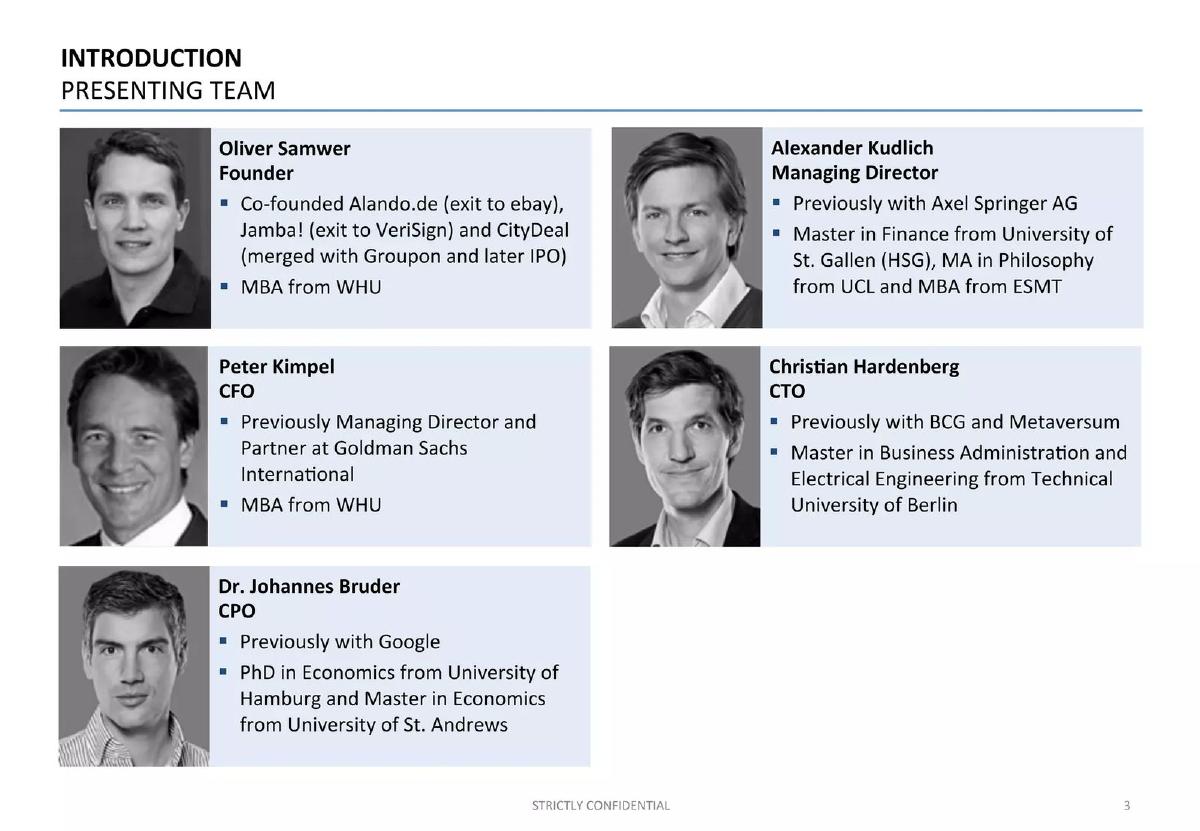
- The leadership team is presented as a mix of serial exit-founders and former high-level executives from Goldman Sachs and Google (Slide 3).
- They use a 'Macro-Economic Market Opportunity' slide to estimate a $1.6 - $1.8 Trillion public market cap potential in their target countries (Slide 11).
- The deck demonstrates a 'Data-Driven Optimization' case study where they reduced CAC by 20% while doubling revenue in one month (Slide 25).
- A massive 'Proprietary Core Platform' is showcased, integrating external partners like AWS and Adyen with internal warehouse and fleet management modules (Slide 31).
- Traction is visualized through a steep growth curve showing total visits to Rocket ventures increasing from 118M in 2011 to 2.3B in 2013 (Slide 35).
The Industrialization of the Startup: A Rocket Internet Teardown
This deck, presented at the Kinnevik Capital Markets Day in 2014, represents Rocket Internet at the height of its powers. It is not a pitch for a single idea, but a pitch for a machine that generates companies. The overarching theme is predictability . In a sector usually defined by 'black swan' successes and high failure rates, Rocket Internet presents a factory-like model for global domination.
The Leadership and Global Footprint
Slide 3: Introduction - Presenting Team . The deck opens with a heavy-hitting team slide. It features Oliver Samwer, whose track record includes Alando.de (exit to eBay), Jamba! (exit to VeriSign), and CityDeal (merged with Groupon). The supporting cast is equally institutional: a CFO from Goldman Sachs, a CPO from Google, and a CTO from BCG. This signals to investors that the 'adults are in the room' and the company is run with corporate discipline rather than garage-startup chaos.
Slide 5: Rocket's Global Reach at a Glance . This map is a core part of the value proposition. By highlighting activity in more than 100 countries, Rocket positions itself as the only player capable of executing a truly global rollout. The blue-shaded regions cover almost every continent, emphasizing their reach into 'The Rest of the World' outside the US and China.
Slide 7: Three Key Sectors . The portfolio is categorized into eCommerce, Marketplaces, and Financial Technology. Notable names like HelloFresh, Lazada, Zalora, and Jumia are listed. This slide serves as a 'wall of logos' to prove the model's versatility across different verticals. It is important to note the footnote: 'Note: Above venture list is not comprehensive,' suggesting even greater scale.
The Macro Opportunity
Slide 9: Rocket's Local Footprint Includes 9 of Facebook's Top 10 User Cities . This is a clever use of third-party data to validate their geographic choices. By showing that their 'Active Proven Winners' (like Lazada and Dafiti) are dominant in cities with the highest Facebook user counts (Bangkok, Jakarta, Sao Paulo), they link their success to the broader trend of global internet adoption.
Slide 11: Macro-Economic Market Opportunity . This slide is the 'Why Now' and 'How Big' combined. It uses a 'Value Ratio' (GDP divided by Market Cap) to show that the US and China are relatively saturated. It then points to Rocket's target countries, which have a combined GDP of $41.3 Trillion but a disproportionately small public internet market cap. They estimate a 'Public Market Cap Potential' of $1.6 - $1.8 Trillion, framing Rocket as the primary vehicle to capture this value.
The Infrastructure and Process Moat
Slide 13 & 19: Our Infrastructure / Unique Execution Processes . Rocket uses a circular diagram to explain their four-pillar model: Infrastructure, Process, Technology, and Portfolio Pipeline. They emphasize 'Centralized IP with regional execution' and 'Predictable and repeatable' returns. This is the 'secret sauce'—a claim that they have turned company building into a science.
Slide 15: Rocket's Team - Functional Experts, Regional Leaders & Entrepreneurs . This slide breaks down the organizational structure. It shows a matrix where 'Functional Experts' (CRM, BI, Legal, etc.) support 'Regional Leaders' who in turn manage the 'Entrepreneurs' on the ground. This structure explains how they maintain quality control across 100+ countries.
Slide 17: Regional Leadership Teams . To further prove their local execution capabilities, they showcase the Co-CEOs for Europe, Latin America, Africa, Asia Pacific, and the Middle East. The pedigrees are consistent: McKinsey, Harvard, Stanford, Goldman Sachs, and INSEAD. This reinforces the 'elite talent' narrative.
The Execution Blueprint
Slide 21: Early Days of Execution: From Idea to Global Rollout . This slide outlines their 'Structured Selection Process.' It starts with identifying suitable models by a central scouting team, followed by a 2-3 month test period, and then a global roll-out. The key takeaway is the final bullet: 'Rocket Employs a Low Risk Investment Approach.' This is a direct challenge to the traditional VC view that startups are inherently high-risk.
Slide 23: Company Building at Rocket . This is perhaps the most famous slide in the deck. It provides a 200-day timeline from 'Kickoff' to 'Independence.' It details exactly what the central team does (MVP, Marketing channels, Data-Warehouse) versus the local team (Sales, Customer Care). The claim of being able to launch a venture in under 100 days is the core metric of their operational efficiency.
Slide 25: Examples for Data-Driven Optimization . This case study shows a 'Problem' (CAC increased by 20% in March 2014) and a 'Solution' (Efficiency Attack using a proprietary tool called 'Romeo'). The 'Impact' is a 20% reduction in CAC and a 100% increase in revenue by April 2014. This slide is designed to prove that their centralized tools provide a tangible competitive advantage to their portfolio companies.
Slide 27: Example - Launching Helpling in 80 Days . This is a 'receipt' for the claims made on Slide 23. It shows the chronological timeline for Helpling, from the decision to launch on Jan 10th to being live in Austria by May 21st. It serves as proof that their 100-day launch target is not just theoretical.
Technology and Traction
Slide 29: Key Principles for Building Technology at Rocket . Rocket addresses the 'tech' part of their name by focusing on four metrics: Speed (response times), Stability ( Slide 31: Core Platform Integration . This slide shows their 'Proprietary Core Platform' (Frontend, Mobile, Backend) surrounded by 'Platform Partners' like AWS, Salesforce, and Adyen. It illustrates how they don't reinvent the wheel for basic services but focus their proprietary efforts on 'Warehouse Management,' 'Fleet Management,' and 'Marketing Controlling.'
Slide 33: Recruiting, Training and Monitoring . This slide emphasizes the scale of their HR operation, claiming 240 engineers hired in the last 2 years and 253 sites monitored in real-time. The grid of faces at the bottom humanizes the '28 tech teams' mentioned.
Slide 35: 4BN+ Total Visits to Rocket Ventures Since 2011 . This is the primary traction slide. It shows an exponential growth curve of monthly visits, growing from 118 million in 2011 to 2.33 billion in 2013. The sheer volume of traffic is intended to overwhelm any doubts about their market reach.
Slide 37: A Strong Ecosystem of Commercial and Strategic Partners . To conclude the 'moat' argument, Rocket lists their strategic partners, including Kering, MTN, Millicom, and Tesco. They highlight Tesco's investment in Lazada as a specific success story. This shows that they have the backing of major global corporations, not just financial investors.
Conclusion and Summary
Slide 41: Why Invest in Rocket Internet? . The final slide is a checklist of their value propositions: massive market opportunity, 1 billion internet users, successful blueprint, and a disciplined KPI-driven approach. It is a summary of the 'Industrialized VC' pitch.
What Works in This Deck
The 'Execution as a Moat' Narrative : Most decks try to prove a unique insight. Rocket tries to prove a unique process. By focusing on the 'how' (Slide 23) rather than the 'what,' they make their success seem inevitable and repeatable.
Pedigree and Scale : The constant mention of 100+ countries, 2.3B visits, and Ivy League/McKinsey backgrounds creates an aura of institutional inevitability. It is very hard for an investor to bet against a team that has already scaled dozens of companies to this level.
Quantified Efficiency : Using specific numbers like 'Launch in Unit Economics per Venture : While the deck shows massive traffic (Slide 35) and revenue growth (Slide 25), it is notably silent on the profitability or 'burn' of individual ventures. In 2014, Rocket was often criticized for high cash burn, and this deck does little to dispel that, focusing instead on 'Market Cap Potential.'
Competitive Analysis : The deck assumes a vacuum. It doesn't address local competitors in these 100+ countries or how Rocket ventures will defend themselves once the 'incumbent' (like Amazon or Uber) eventually enters the market.
Exit Details : While Slide 41 mentions a 'Proven Track Record of Successful Exits,' the deck doesn't provide a detailed breakdown of the returns generated for previous investors, which is a standard requirement for a 'Later Stage' fundraise.
What a Founder Should Copy
The 'Blueprint' Slide : Every founder should have a version of Slide 23. Even if you aren't an incubator, showing that you have a standardized, repeatable process for acquiring customers or launching in new cities is incredibly persuasive.
Macro-Economic Framing : Slide 11 is a masterclass in 'TAM' (Total Addressable Market). Instead of just saying 'the market is big,' they use GDP and Market Cap ratios to prove there is an 'under-served' gap that they are uniquely positioned to fill.
The Case Study Format : Slide 25 (Problem/Solution/Impact) is the perfect way to present data. It doesn't just show a graph; it tells a story of an operational challenge and how the company's specific tools solved it. This is much more effective than a raw data dump.
Frequently asked questions
- What is Rocket Internet's core business model according to the deck?
- Rocket Internet describes itself as an incubator and investor that identifies, builds, and scales market-leading online companies. Unlike traditional VCs, they use a highly standardized, centralized process to launch ventures based on business models already proven in other markets (like the US or China), focusing on eCommerce, Marketplaces, and FinTech.
- How does Rocket Internet justify its focus on emerging markets?
- On Slide 11, they compare the 'Value Ratio' (GDP to Market Cap) of the US and China to their target countries. They argue that while the US and China have high internet market caps relative to GDP, their target markets represent a $41.3 Trillion GDP opportunity with a massive untapped public market cap potential of up to $1.8 Trillion.
- What are the specific stages of their 'Company Building' process?
- As shown on Slide 23, the process is divided into three phases: Kickoff (Day 0), Launch (Day 100), and Independence (Day 200). During these phases, central teams handle Product, Engineering, and Marketing, while local teams focus on Operations, Sales, and Customer Care, eventually handing over full control to the local venture.
- How does the deck address the risk of cloning business models?
- The deck frames cloning as a 'Low Risk Investment Approach' (Slide 21). By selecting business models that have already succeeded elsewhere, they eliminate 'product-market fit' risk and focus entirely on 'execution risk,' which they mitigate through their standardized infrastructure, centralized IP, and regional leadership teams.
- Who are the key people behind Rocket Internet in this deck?
- The deck highlights Founder Oliver Samwer, known for exits like Alando (to eBay) and CityDeal (to Groupon). He is supported by a 'Presenting Team' (Slide 3) including CFO Peter Kimpel (ex-Goldman Sachs), MD Alexander Kudlich (ex-Axel Springer), CTO Christian Hardenberg (ex-BCG), and CPO Dr. Johannes Bruder (ex-Google).