The ROHO pitch deck is a masterclass in brevity, perhaps to a fault. With only 8 slides, the deck relies heavily on two massive figures: a 100 million person audience for sermons and a $15 billion spend on religious media in the USA. The presentation avoids dense text, opting instead for large-font declarations and single-image backgrounds. While it successfully establishes a large TAM (Total Addressable Market) and impressive early engagement—claiming 250,000 monthly users—it completely omits standard investor requirements such as a team slide, a business model, or a specific financial ask.…
Key takeaways
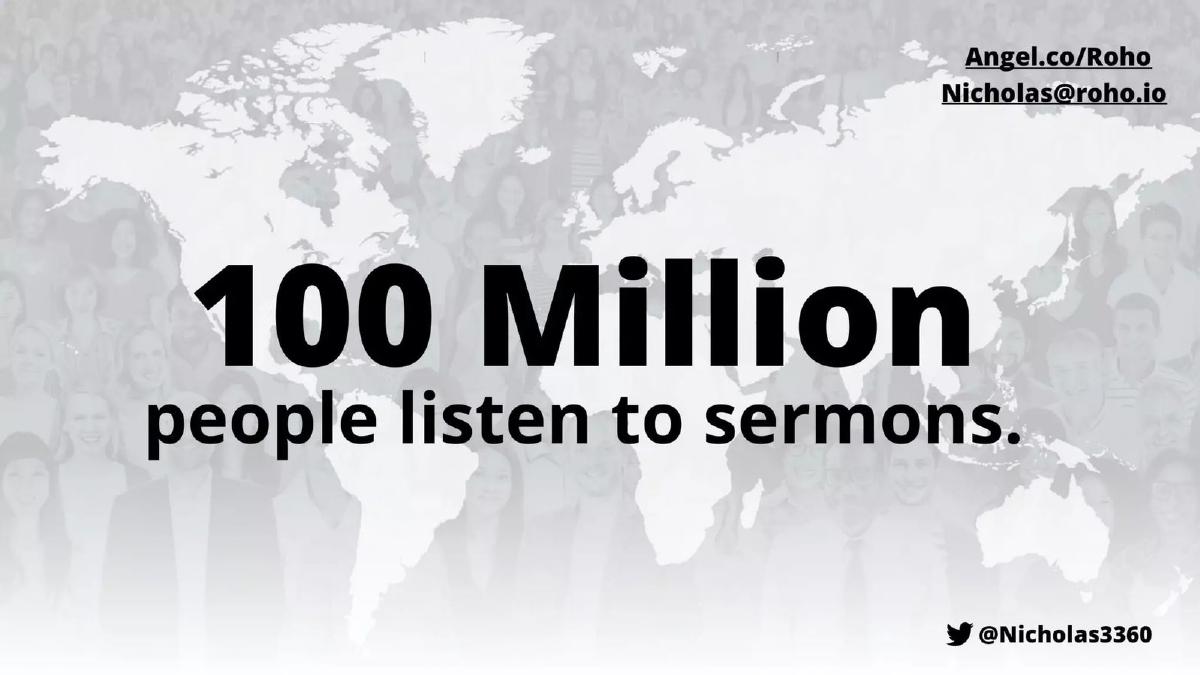
- The deck identifies a massive target audience of 100 million people who listen to sermons (Slide 2).
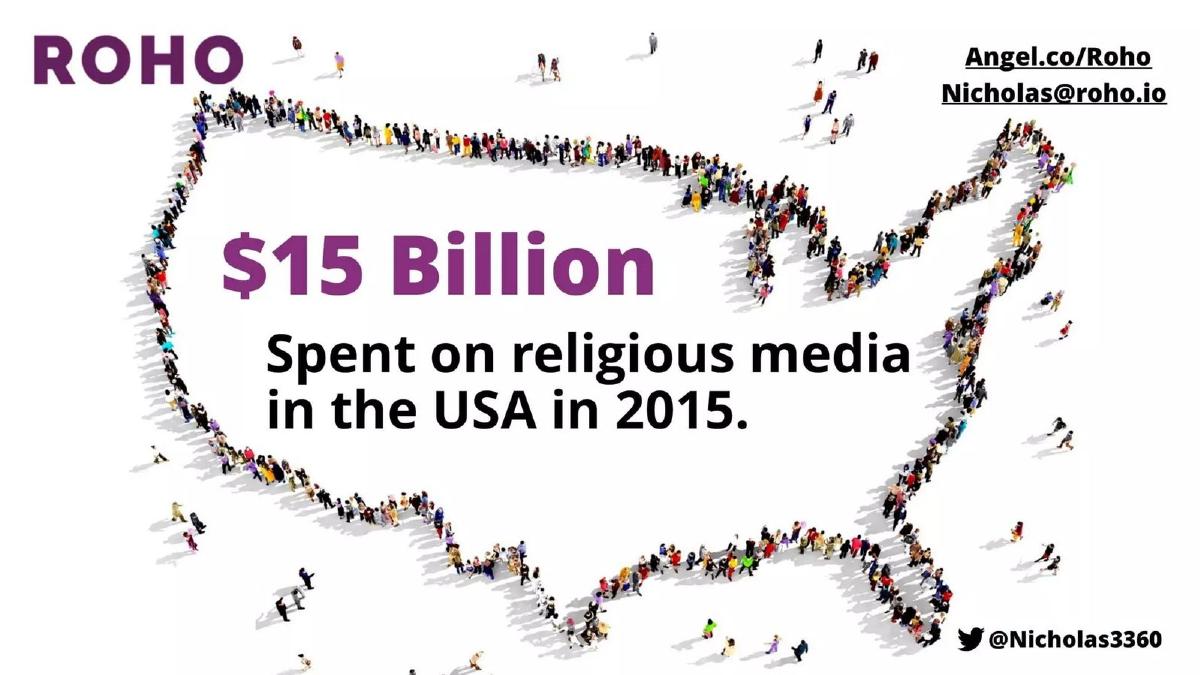
- It quantifies the market opportunity at $15 billion spent on religious media in the USA in 2015 (Slide 3).
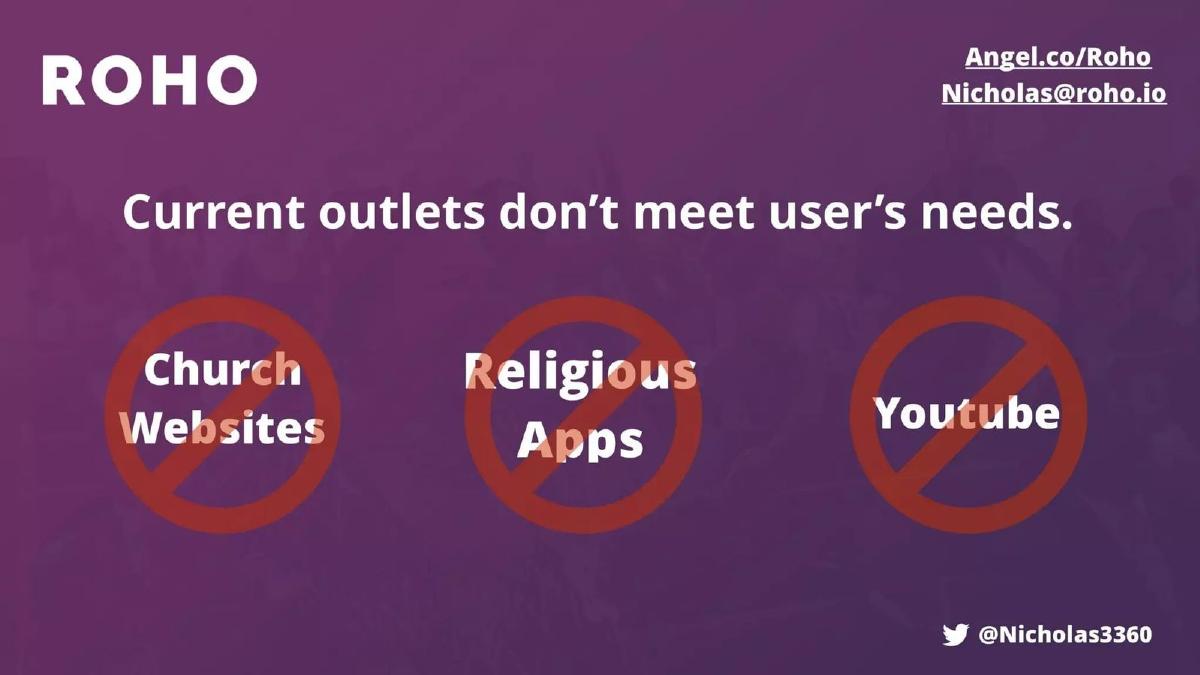
- The product is positioned as a solution to the failure of current outlets like church websites, religious apps, and YouTube (Slide 5).
- ROHO claims high engagement with users watching 17 minutes of video per session (Slide 7).
- The platform reached a scale of 250,000 monthly users at the time of the deck's creation (Slide 7).
- The deck is missing a dedicated team slide, leaving the founders' backgrounds unknown to the reader.
- There is no mention of a business model or how the platform intends to generate revenue from its content.
- The final slide simply states 'Seed Round Closed,' indicating this version of the deck was likely used for post-raise updates or secondary marketing (Slide 8).
The Minimalist Strategy of ROHO
ROHO’s 2016 seed deck is an exercise in extreme minimalism. At only eight slides, it avoids the typical pitfalls of over-explanation and data-dumping. Instead, it uses high-impact visuals and large-scale numbers to paint a picture of a massive, underserved market. The company, which describes itself as an online platform for curated religious content, raised $125,000 using this visual narrative. However, the brevity of the deck means that much of the operational 'meat'—the team, the tech, and the money—is left to the imagination or the live pitch.
The Opening Hook and Market Scale
Slide 1: Title Slide The deck opens with the company name, ROHO, in large white block letters against a purple-tinted background showing a congregation with raised hands. The tagline is simple: 'On-Demand Religion.' This immediately positions the startup within the 'Netflix for X' or 'Spotify for X' category, which was a dominant pitch framework in 2016. Contact information for Nicholas (presumably the founder) is present, including a Twitter handle and Angel.co link.
Slide 2: The Audience Slide 2 presents a single, massive number: '100 Million people listen to sermons.' The background is a faded map of the world overlaid with silhouettes of people. This slide is designed to establish the 'Total Addressable Market' (TAM) in terms of human behavior. It doesn't cite a source for this figure, but the scale is intended to stop an investor from thinking of religion as a niche or 'small' hobbyist market.
Slide 3: The Financial Opportunity Following the audience count, Slide 3 attaches a dollar value to the behavior: '$15 Billion Spent on religious media in the USA in 2015.' The visual uses a silhouette of the United States made up of tiny people. By moving from 100 million listeners to a $15 billion spend, the deck establishes that there is not just interest, but significant capital already flowing through this sector.
Identifying the Friction
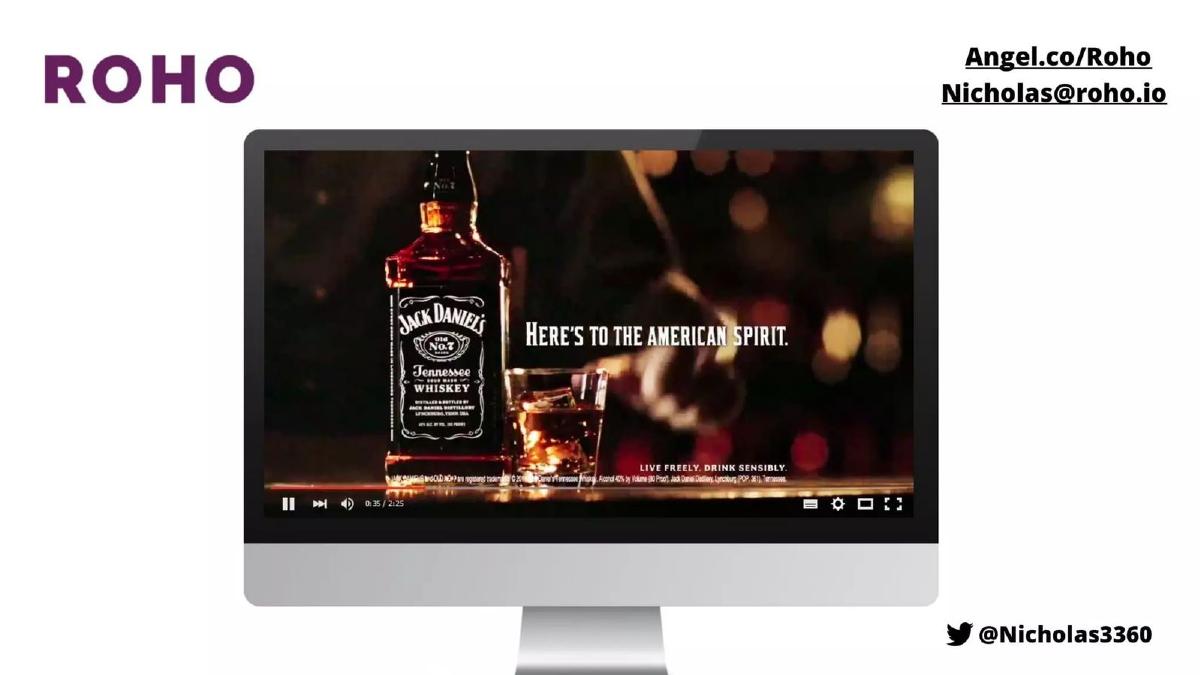
Slide 4: The Visual Metaphor Slide 4 is an unusual choice for a professional deck. It shows a computer monitor displaying a Jack Daniel’s whiskey advertisement with the text 'Here’s to the American Spirit.' This appears to be a commentary on the type of content or advertising users encounter on general platforms. It sets up the 'problem' slide that follows, suggesting that religious content is currently surrounded by secular or inappropriate context.
Slide 5: The Problem The deck explicitly identifies the competition and why they fail. Slide 5 lists 'Church Websites,' 'Religious Apps,' and 'YouTube,' all crossed out with red 'no' symbols. The headline reads, 'Current outlets don’t meet user’s needs.' This is a bold claim, especially regarding YouTube, but it sets the stage for ROHO to present itself as a curated, 'safe,' and specialized alternative.
The Solution and Traction
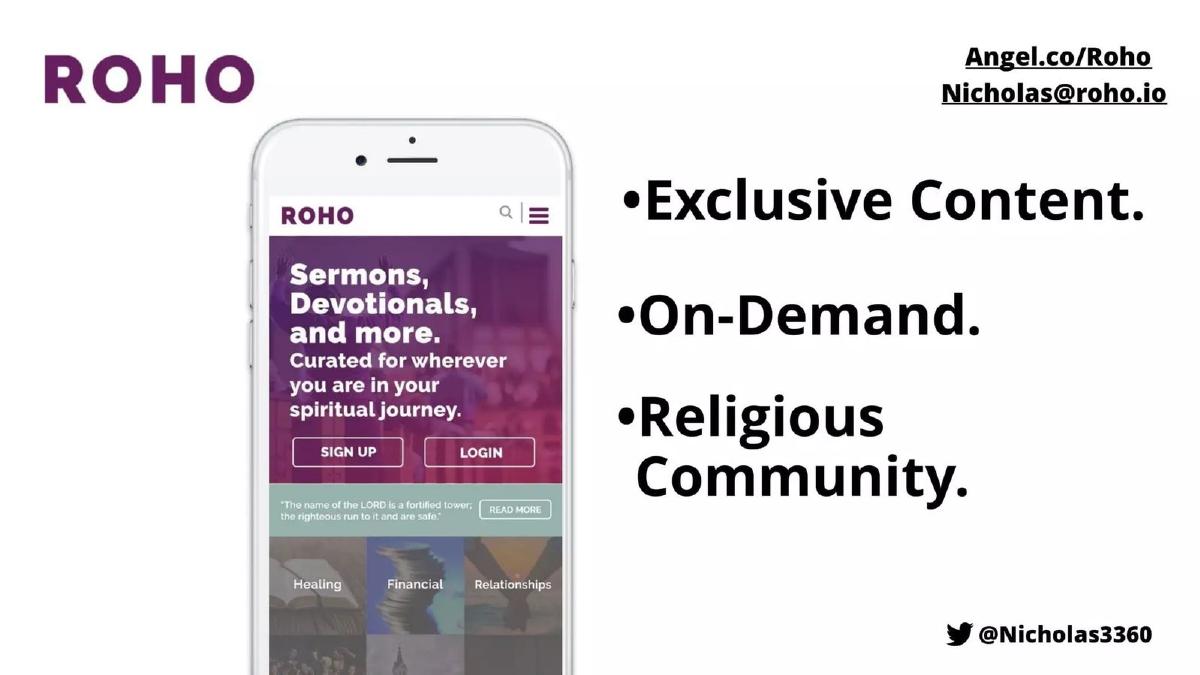
Slide 6: The Product Slide 6 introduces the ROHO mobile interface. The screen shows categories like 'Healing,' 'Financial,' and 'Relationships.' The text highlights three pillars: 'Exclusive Content,' 'On-Demand,' and 'Religious Community.' This is the first time the deck explains what the app actually does—it curates sermons and devotionals into a spiritual journey format.
Slide 7: Traction and Engagement This is the 'proof' slide. It claims '250k users every month' and 'Watching 17mins of video each session.' For a seed-stage startup, 250,000 monthly users is a significant figure. The 17-minute session length is particularly strong, as it suggests the content is engaging enough to hold attention far longer than a typical social media clip. This slide validates that the 'On-Demand Religion' concept has found an initial audience.
Slide 8: The Conclusion The final slide simply says 'Seed Round Closed.' This indicates that this specific version of the deck was likely used as a 'victory lap' or for follow-up conversations after the $125,000 was secured. It maintains the same purple-tinted congregational background as the title slide, providing visual bookends to the presentation.
What Works in the ROHO Deck
The primary strength of this deck is its clarity of vision . By using the phrase 'On-Demand Religion,' the founders leverage a mental model that every investor in 2016 understood. They didn't need to explain how a streaming platform works; they only needed to explain why religion needed one.
The focus on big numbers is also effective. In a seed round, investors are looking for 'venture scale.' By leading with 100 million people and $15 billion, ROHO removes the 'is this big enough?' question from the table immediately. The traction slide (Slide 7) then proves that they aren't just dreaming about those numbers—they have already captured a quarter-million users.
Finally, the visual consistency is high. The use of the purple brand color and consistent font choices makes the deck feel professional despite its extreme brevity. It looks like a brand that understands its identity.
What is Missing
The omissions in this deck are significant and would usually be considered 'red flags' if this were a cold-email deck sent without a live meeting.
The Team: There is no mention of who is building this. Investors at the seed stage are primarily investing in people. Without a team slide, we don't know if the founders have a background in ministry, media, or technology. · Business Model: How does ROHO make money? Is it a subscription (SaaS), ad-supported, or a donation-based model? With $15 billion being spent in the market, an investor needs to know how ROHO plans to capture a piece of that pie. · Competition: While Slide 5 mentions YouTube and church websites, it doesn't address other startups or established media giants in the Christian space (like YouVersion or TBN). A 'Competitor Matrix' is a standard expectation that is absent here. · The Ask: A pitch deck usually ends with a request for a specific amount of money and a breakdown of how that money will be spent (e.g., 50% engineering, 30% marketing). This deck has no 'Ask' slide, likely because Slide 8 indicates the round was already finished.
What Founders Should Copy
Founders can learn a lot from ROHO’s economy of words . Most pitch decks are far too wordy. ROHO proves that you can communicate a market, a problem, and traction with fewer than 10 words per slide. This forces the audience to listen to the presenter rather than reading the slides.
The use of 'Anchor Metrics' is another great takeaway. Slide 2 and Slide 3 provide the 'anchor' for the entire business case. If you can find one or two massive, undeniable statistics that define your industry, make them the stars of your early slides.
Lastly, the mobile-first product shot on Slide 6 is a good example of showing, not telling. Instead of listing features, they show a clean UI that implies the features (search, categories, sign-up). For any consumer app, a high-quality mock-up is worth more than a dozen bullet points.
Final Thoughts
The ROHO deck is a 'teaser' deck. It is designed to generate excitement and prove that a market exists, rather than to provide a deep dive into unit economics. While it lacks the technical and financial detail required for a Series A, its simplicity was clearly enough to move the needle for a $125,000 seed round. It serves as a reminder that sometimes, a big idea and a little bit of traction are more powerful than a 30-page business plan.
Frequently asked questions
- What is the primary value proposition of ROHO?
- ROHO positions itself as 'On-Demand Religion,' providing a centralized platform for curated religious content including sermons and devotionals. According to Slide 6, the value lies in offering exclusive content and a dedicated religious community that is accessible on-demand, contrasting itself against fragmented church websites and general-purpose platforms like YouTube.
- How does ROHO define its market size?
- The deck uses two primary metrics to define its market. Slide 2 states that 100 million people listen to sermons, establishing the user base. Slide 3 provides the financial context, noting that $15 billion was spent on religious media in the USA in 2015. This suggests a large, high-intent market with significant existing spending.
- What traction does the deck show?
- Traction is highlighted on Slide 7, where the company claims to have 250,000 monthly users. More importantly for a media platform, it highlights engagement depth, stating that these users watch an average of 17 minutes of video per session, which is a significant metric for retaining a digital audience.
- What essential pitch deck elements are missing?
- This deck is missing several critical components: a team slide (founders and advisors), a business model (revenue streams), a competitive landscape analysis, a roadmap, and a specific 'ask' or use of funds. Because it is only 8 slides, it functions more as a high-level teaser than a comprehensive business plan.
- Who is the target user for ROHO?
- Based on Slide 6, the target user is someone on a 'spiritual journey' looking for curated content related to healing, finances, and relationships. The platform aims to serve those who find current religious apps or church websites insufficient for their daily spiritual needs.