Rogo's 10-slide seed deck is a masterclass in positioning. Rather than competing with the broad AI market, Rogo defines a specific niche: 'Bespoke Generative AI for Financial Services.' The deck identifies three critical failures of general AI—lack of context, inaccuracy, and poor integration—and uses direct side-by-side comparisons with ChatGPT to prove its value. By showcasing a team with pedigrees from Citadel, Lazard, and J.P. Morgan, Rogo establishes immediate domain authority. While the deck lacks traditional financial projections or a specific 'ask' slide, its focus on product-market f…
Key takeaways
- Rogo positions itself as a 'bespoke' solution to differentiate from general-purpose AI tools like ChatGPT (Slide 2).
- The team slide emphasizes financial domain expertise, listing former employers such as Citadel, Lazard, J.P. Morgan, and Barclays (Slide 2).
- The problem is framed as three specific gaps in existing AI: too general, often wrong, and not integrated (Slide 3).
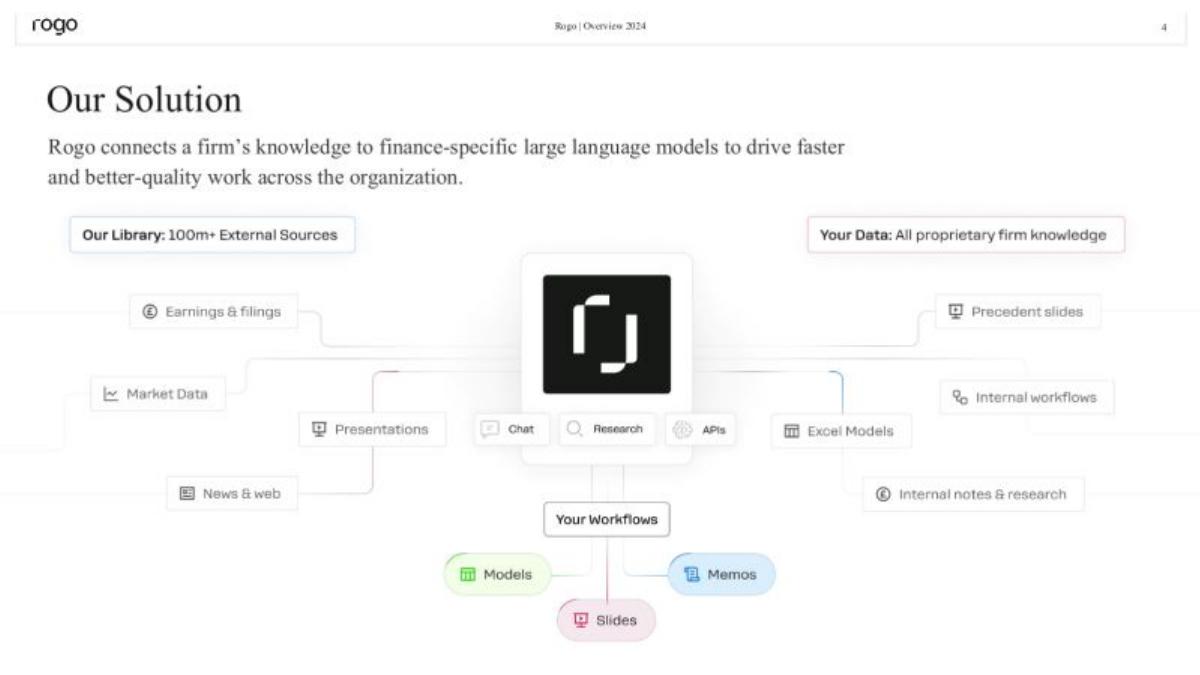
- The solution architecture shows a dual-data approach, combining 100M+ external sources with a firm's proprietary internal knowledge (Slide 4).
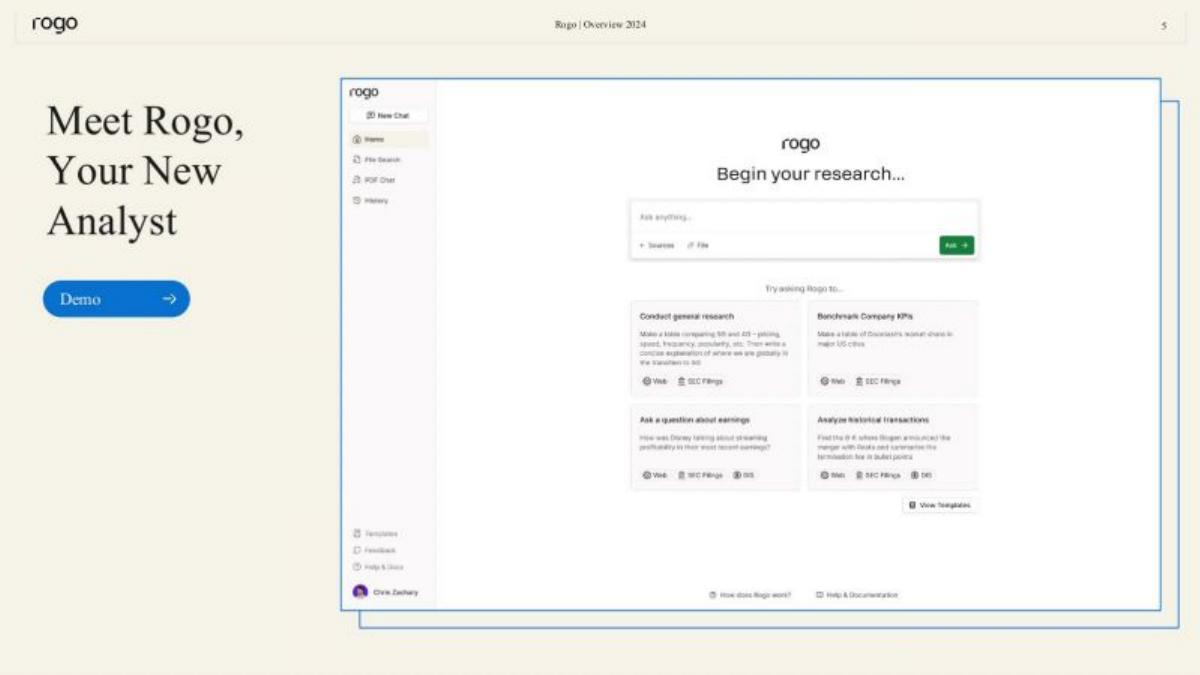
- Rogo includes a direct product UI screenshot, positioning the tool as a 'New Analyst' for the user (Slide 5).
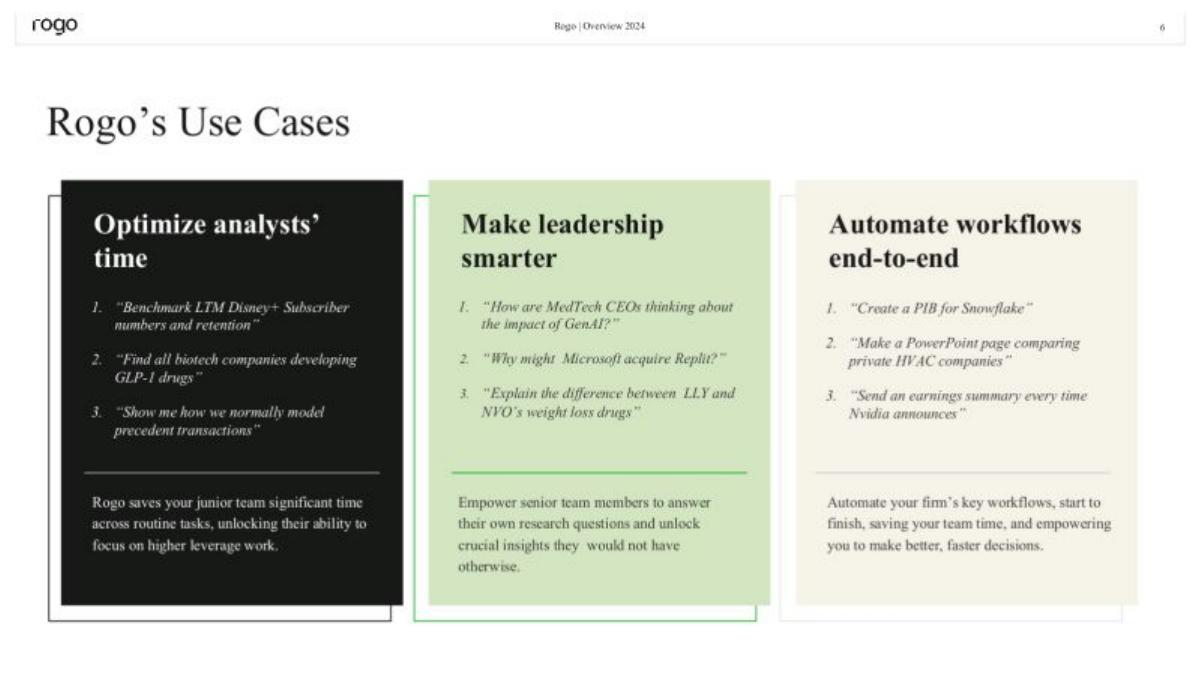
- Use cases are segmented by user level, from optimizing junior analyst time to making senior leadership smarter (Slide 6).
- Side-by-side performance comparisons (Slides 7 and 8) show Rogo providing citations and tables where ChatGPT provides text summaries or refers users to other tools.
- The deck omits a formal 'Ask' slide, market sizing (TAM), and financial projections, focusing entirely on product and team (Slides 1-10).
The Strategic Lean: Rogo's $7M Seed Deck Analysis
Rogo entered the market in early 2024 with a clear mission: to solve the 'hallucination' and 'context' problems of generative AI for the world's most demanding data users—bankers and investment funds. Their 10-slide deck is a study in focused positioning. It does not try to be everything to everyone; instead, it leans heavily into the 'bespoke' nature of its solution, contrasting it sharply with the general-purpose tools that dominated the early AI hype cycle.
Slide 1: Title and Contact
The deck opens with a minimalist black background featuring the Rogo logo. It includes a date of January 2024 and a team contact email. This sets a professional, understated tone consistent with the high-end financial services industry it serves.
Slide 2: Background and Team Pedigree
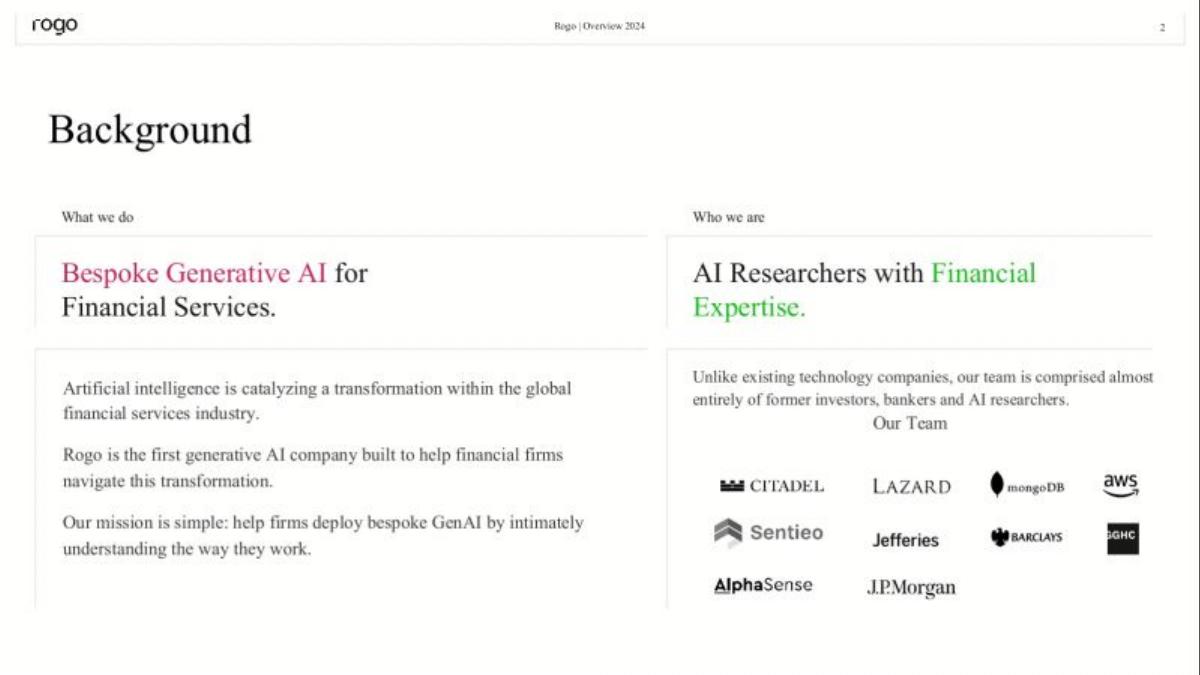
Slide 2 is divided into two sections: 'What we do' and 'Who we are.' The company defines itself as "Bespoke Generative AI for Financial Services." The text explicitly states that Rogo is the first company built to help financial firms navigate the AI transformation by intimately understanding their workflows.
The 'Who we are' section is a powerful credibility builder. It claims the team is comprised almost entirely of former investors, bankers, and AI researchers. The slide displays logos from Citadel, Lazard, MongoDB, AWS, Sentieo, Jefferies, Barclays, GGHC, AlphaSense, and J.P. Morgan. This is a strategic move to show that the founders aren't just technologists—they are industry insiders who have felt the pain points they are now solving.
Slide 3: The Problem with General AI
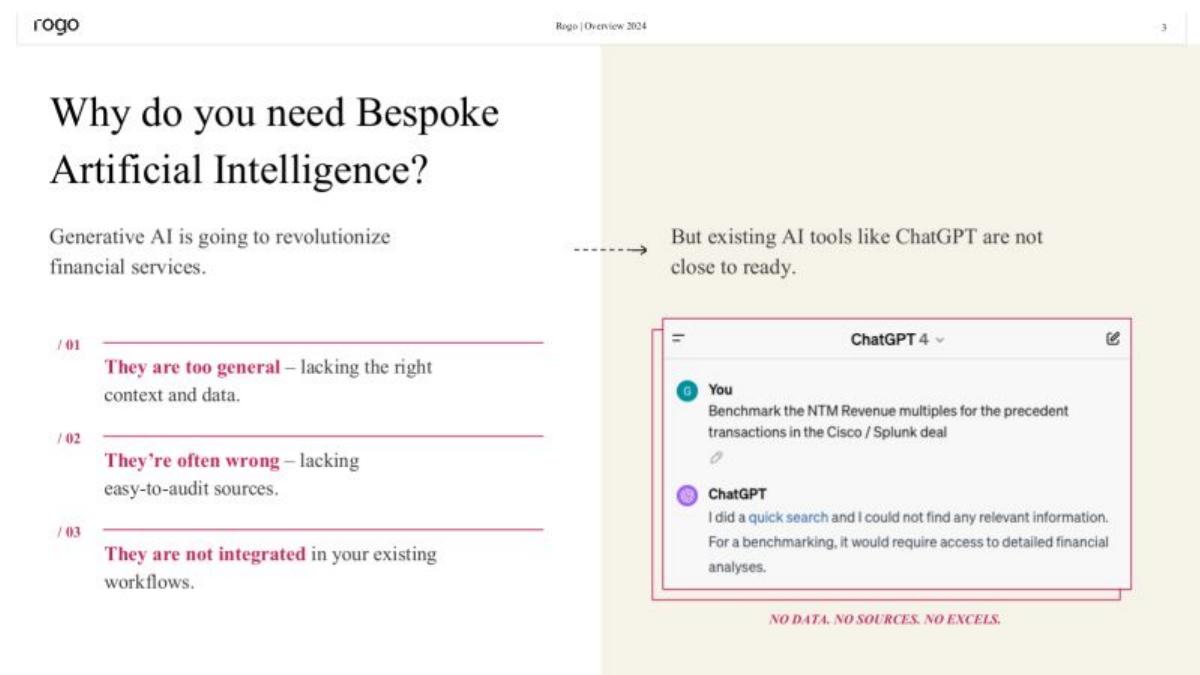
Slide 3 addresses the elephant in the room: Why not just use ChatGPT? Rogo identifies three specific failures of general AI tools in a financial context:
They are too general: Lacking the right context and data. · They're often wrong: Lacking easy-to-audit sources. · They are not integrated: Failing to fit into existing workflows.
The slide includes a screenshot of ChatGPT 4 failing to benchmark revenue multiples for a specific deal, with a red caption stating: "NO DATA. NO SOURCES. NO EXCELS."
Slide 4: The Solution Architecture
This slide provides a visual map of how Rogo works. It positions the Rogo engine at the center of three data streams: "Our Library" (100M+ external sources like earnings, filings, and market data), "Your Data" (proprietary firm knowledge like precedent slides and internal notes), and "Your Workflows" (models, memos, and slides). The value proposition is clear: Rogo connects external truth with internal intelligence to drive faster work.
Slide 5: Product Interface
Titled "Meet Rogo, Your New Analyst," this slide shows a clean, dashboard-style UI. The interface features a search bar that allows users to ask questions and toggle between sources like 'Web' and 'SEC Filings.' It lists suggested tasks such as 'Conduct general research,' 'Benchmark Company KPIs,' and 'Analyze historical transactions.' This reinforces the idea of the AI acting as a functional replacement or supplement for a human junior analyst.
Slide 6: Use Cases by User Level
Optimize analysts' time: Finding biotech companies or modeling precedent transactions. · Make leadership smarter: Answering strategic questions about CEO thoughts or acquisition logic. · Automate workflows end-to-end: Creating PIBs (Public Information Books), PowerPoint pages, and earnings summaries.
This slide is crucial because it demonstrates that the tool provides value across the entire hierarchy of a financial firm, not just at the bottom.
Slide 7: Performance Comparison - Earnings
This is a 'show, don't tell' slide. It compares Rogo and ChatGPT on the task of summarizing analyst questions from a CAVA Q3 2023 earnings call. Rogo produces a clean table with specific analyst names, question summaries, and clear citations . ChatGPT produces a generic text summary that, according to the slide, "fails to answer the question and doesn't link to any sources."
Slide 8: Performance Comparison - Filings
Similar to the previous slide, this one tasks both tools with finding 'Snowflake NRR in filings.' Rogo extracts a table with specific dates and percentages (e.g., 135% for October 31, 2023) and provides source links. ChatGPT provides a text block explaining how to use the SEC's EDGAR search tool rather than providing the data. The caption notes that ChatGPT "refers the user to a different tool" instead of solving the problem.
Slide 9: Closing Slide
The deck concludes with a 'Thank you' slide that mirrors the cover. It repeats the contact email and the company website. There is no 'Ask' slide detailing the amount of capital sought or the planned use of funds within these 10 slides, though catalogue data confirms a $7M raise resulted from this period.
What Rogo Does Exceptionally Well
The Rogo deck is a masterclass in comparative positioning . In a crowded AI market, the easiest way to explain your value is to show where the market leader (OpenAI) fails. By using specific financial queries—like NRR (Net Revenue Retention) and revenue multiples—Rogo proves that a general tool is insufficient for professional financial work. This creates a 'must-have' narrative for firms that cannot afford inaccuracies.
Furthermore, the team-market fit is undeniable. The collection of logos on Slide 2 acts as a proxy for trust. In finance, where data security and accuracy are paramount, knowing the founders came from Citadel and J.P. Morgan carries more weight than a purely technical background.
What is Missing from the Deck
Despite its success, the deck omits several standard venture capital components:
Market Size (TAM): There is no attempt to quantify the dollar value of the financial services AI market. · Business Model: The deck does not explain how Rogo charges—whether it is per seat, per query, or an enterprise license. · Traction: There are no mentions of current revenue, number of users, or logos of existing pilot customers. · The Ask: The deck does not state how much money they are raising or what the milestones for the next 18 months are.
The omission of these slides suggests that Rogo was likely raising on the strength of their team and the immediate, obvious utility of their product in a high-value sector, rather than a traditional metrics-based pitch.
Founder's Playbook: What to Copy
Founders building in vertical AI should take notes on Rogo's approach to demonstrating accuracy . If your product's main selling point is that it is better than a LLM, you must show the side-by-side failure of that LLM on a task your target customer performs daily. Rogo's choice of 'Earnings' and 'Filings' as the comparison points was perfect because those are the bread and butter of investment banking.
Additionally, the clean, high-contrast design of the deck reflects the brand of a premium financial tool. It avoids the 'tech-bro' aesthetic of many AI startups, opting instead for a look that would feel at home in a boardroom at Goldman Sachs. This alignment between visual brand and target customer is a subtle but powerful way to reduce friction during the pitch.
Final Thoughts
Rogo's deck is proof that you don't need 20 slides to raise a significant seed round if your team and product positioning are airtight. By focusing entirely on why general AI is 'broken' for finance and how their 'bespoke' solution fixes it, they created a compelling reason for investors to move quickly. The $7M raise, led by AlleyCorp, suggests that the market was hungry for a specialized alternative to the 'black box' of general-purpose LLMs.
Frequently asked questions
- What is the core value proposition of Rogo?
- Rogo positions itself as a bespoke generative AI platform specifically for the financial services industry. According to slide 4, it connects a firm's proprietary knowledge with finance-specific large language models and 100M+ external sources. The goal is to drive faster, higher-quality work by automating research, modeling, and memo creation within existing banking and investment workflows.
- How does Rogo differentiate itself from ChatGPT?
- Rogo uses slides 3, 7, and 8 to highlight ChatGPT's failures in finance. Specifically, slide 3 notes that general AI lacks context, easy-to-audit sources, and workflow integration. Slides 7 and 8 show Rogo successfully pulling specific data from earnings calls and SEC filings with clear citations, whereas ChatGPT either provides summaries without sources or fails to find the data entirely.
- Who is the target audience for Rogo's product?
- The deck identifies two primary user groups on slide 6. First, it targets junior analysts by automating routine tasks like benchmarking and finding biotech companies. Second, it targets senior leadership by providing quick answers to strategic questions, such as why a specific acquisition might occur or the differences between competing drug products.
- What information is missing from the Rogo pitch deck?
- The deck is notably lean on business metrics. It lacks a slide for Total Addressable Market (TAM), financial projections, unit economics, or a specific funding 'ask.' There is also no mention of current traction, revenue, or specific pilot customers by name, though the team's background suggests deep industry connections.
- Why did Rogo emphasize their team's background so heavily?
- In the highly regulated and complex world of finance, domain expertise is a defensive moat. Slide 2 highlights that the team is 'comprised almost entirely of former investors, bankers and AI researchers,' listing logos from top-tier firms like Citadel and Goldman Sachs. This builds trust that the founders understand the nuances of financial data that general AI companies might miss.