Cardiolyse is a B2B health-tech company offering a cloud-based API for ECG processing. Their platform takes raw 1-lead ECG data from wearables and generates over 100 parameters, including stamina, emotional state, and cardiovascular disease forecasts. The deck positions the company as a technical partner for fitness tracker manufacturers, life insurance companies, and professional sports teams. While the deck succeeds in demonstrating technical validation—citing a screening of 20,000 people and 27 lives saved—it lacks critical business information. There is no mention of business model, prici…
Key takeaways
- The platform processes 1-lead ECG data to define over 100 different parameters for heart health (Slide 3).
- Cardiolyse claims to have performed the largest cardiac screening in Eastern Europe, covering 20,000 people and saving 27 lives (Slide 7).
- The technology provides a middle-term forecast of up to 6 months for serious cardiovascular events (Slide 8).
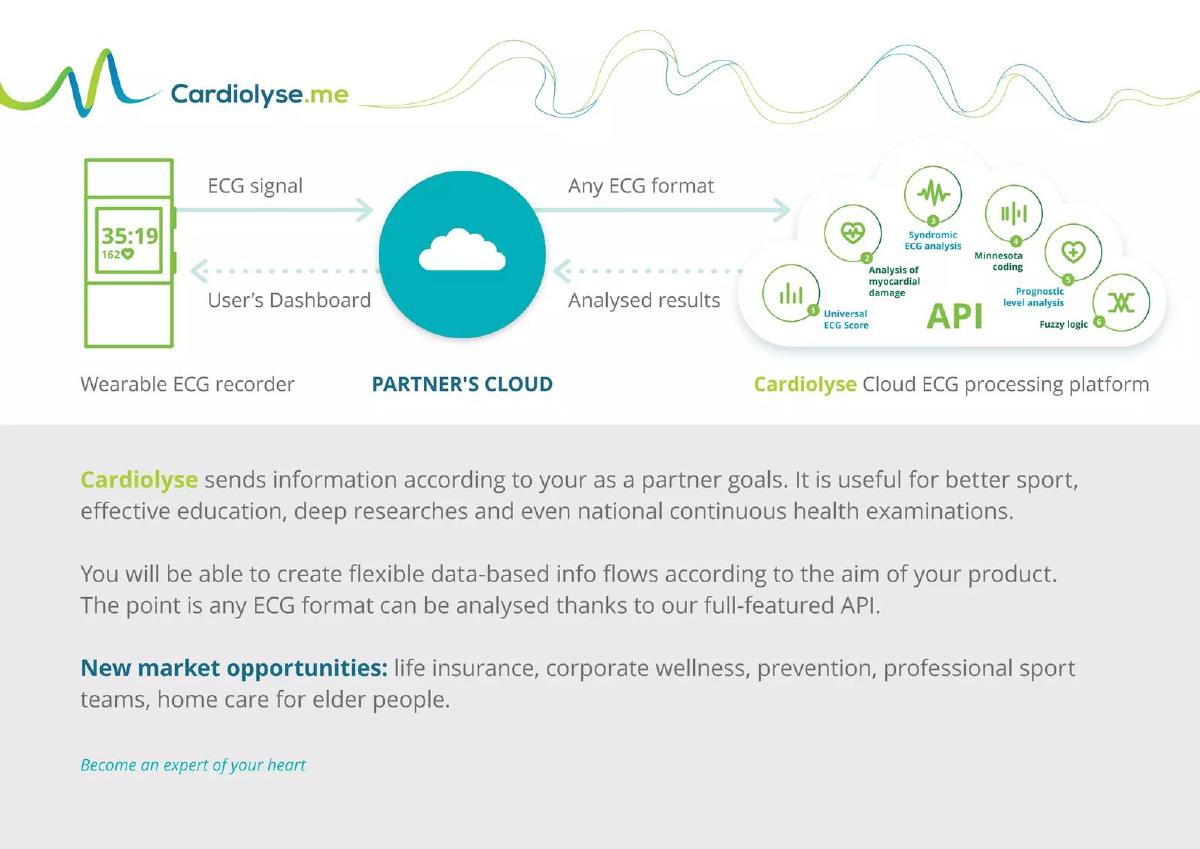
- The company utilizes a full-featured API to integrate with partner clouds and wearable devices (Slide 6).
- Validation includes contracts with the University of Oxford and China Kadoori Biobank for research purposes (Slide 7).
- The team includes specialized roles for regional expansion, specifically a UK CEO and a Business Development lead for India (Slide 9).
- The deck completely omits financial projections, business model details, and the specific investment amount being sought.
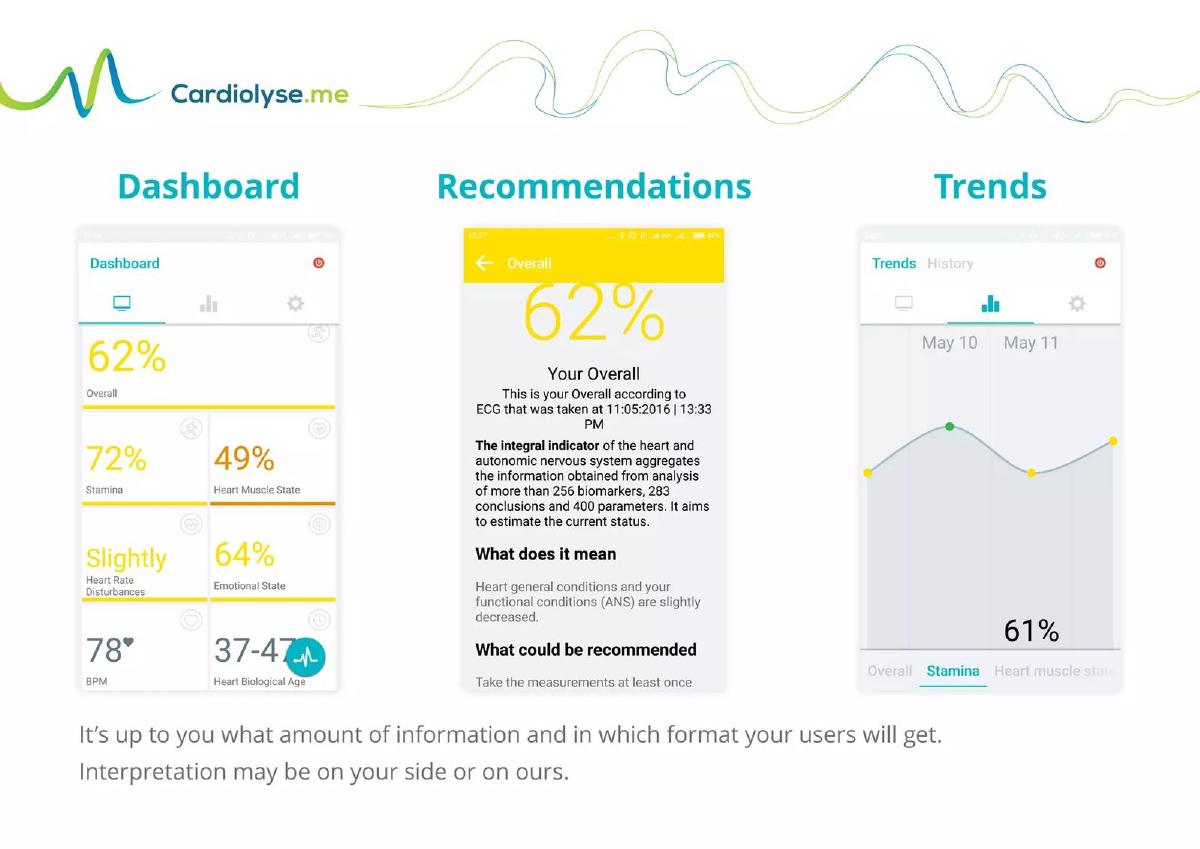
- The product offers a 'Heart Biological Age' metric as part of its user dashboard (Slide 5).
Cardiolyse Pitch Deck Analysis
Cardiolyse presents a highly technical, product-focused deck that emphasizes the efficacy of its algorithms over the mechanics of its business. The deck is structured to convince the reader of the company's scientific validity and the versatility of its API-driven cloud platform.
Slide 1: Title Slide
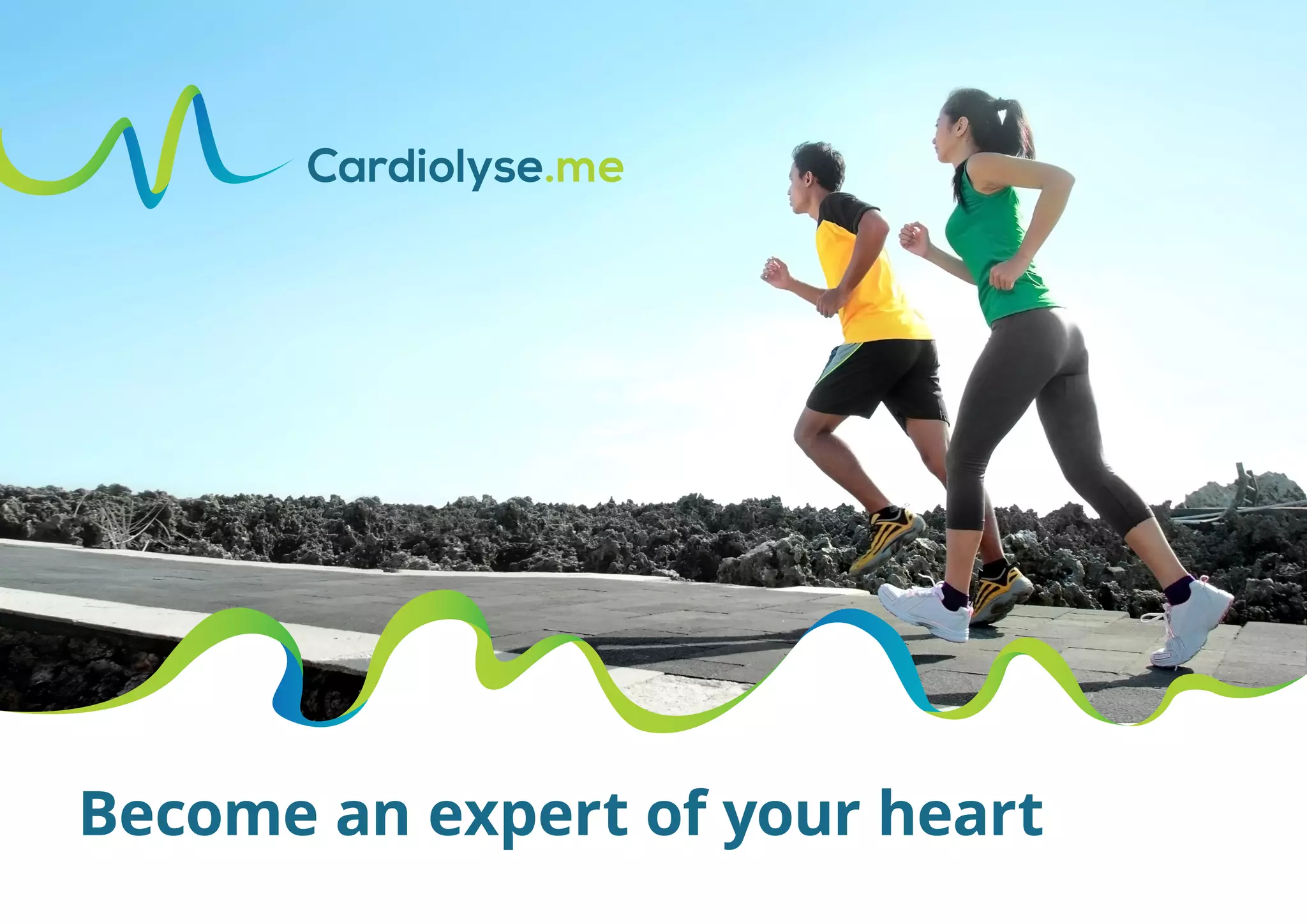
The cover slide features the Cardiolyse.me logo and the tagline "Become an expert of your heart." The imagery of two people running suggests a primary focus on the fitness and active lifestyle market, though later slides broaden this scope.
Slide 2: Future of Fitness Trackers
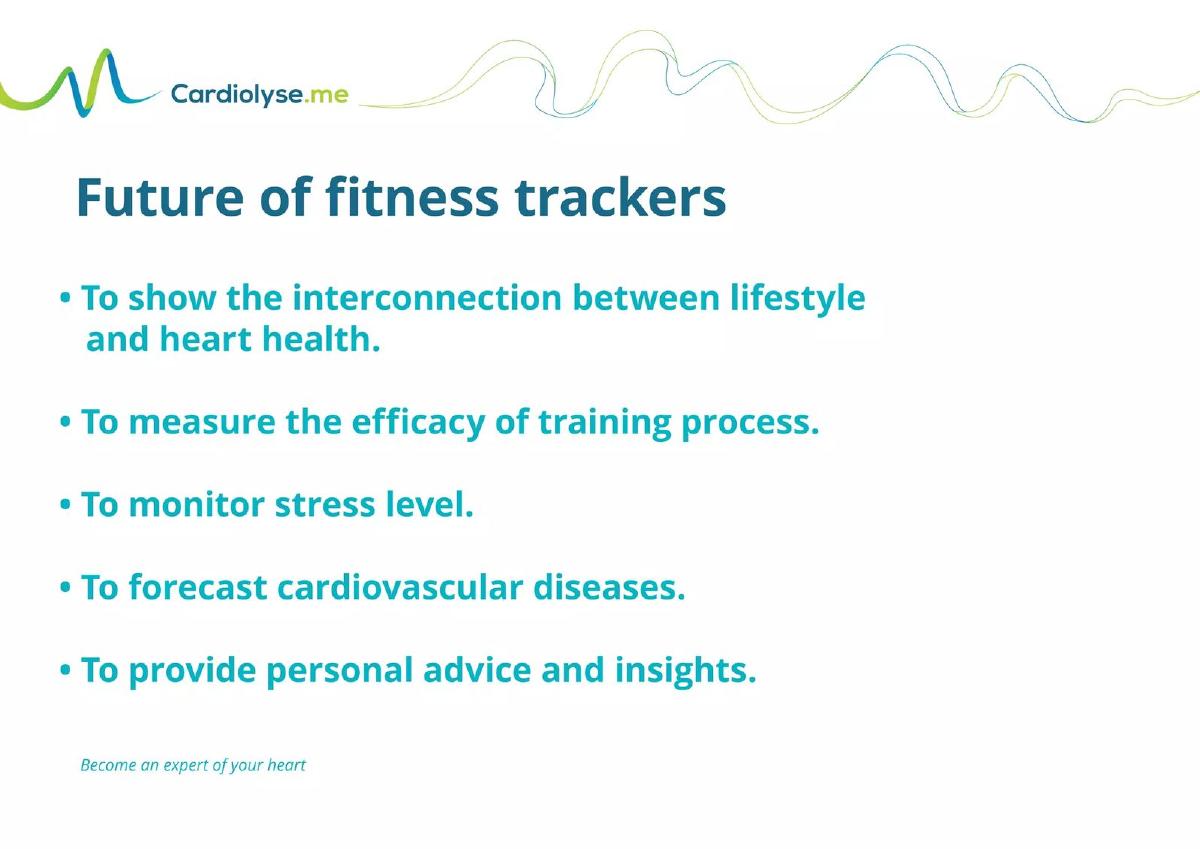
This slide serves as a high-level vision statement. It outlines five goals: showing the connection between lifestyle and heart health, measuring training efficacy, monitoring stress, forecasting cardiovascular diseases, and providing personal insights. It sets the stage for a product that moves beyond simple step-counting into predictive health analytics.
Slide 3: The Solution
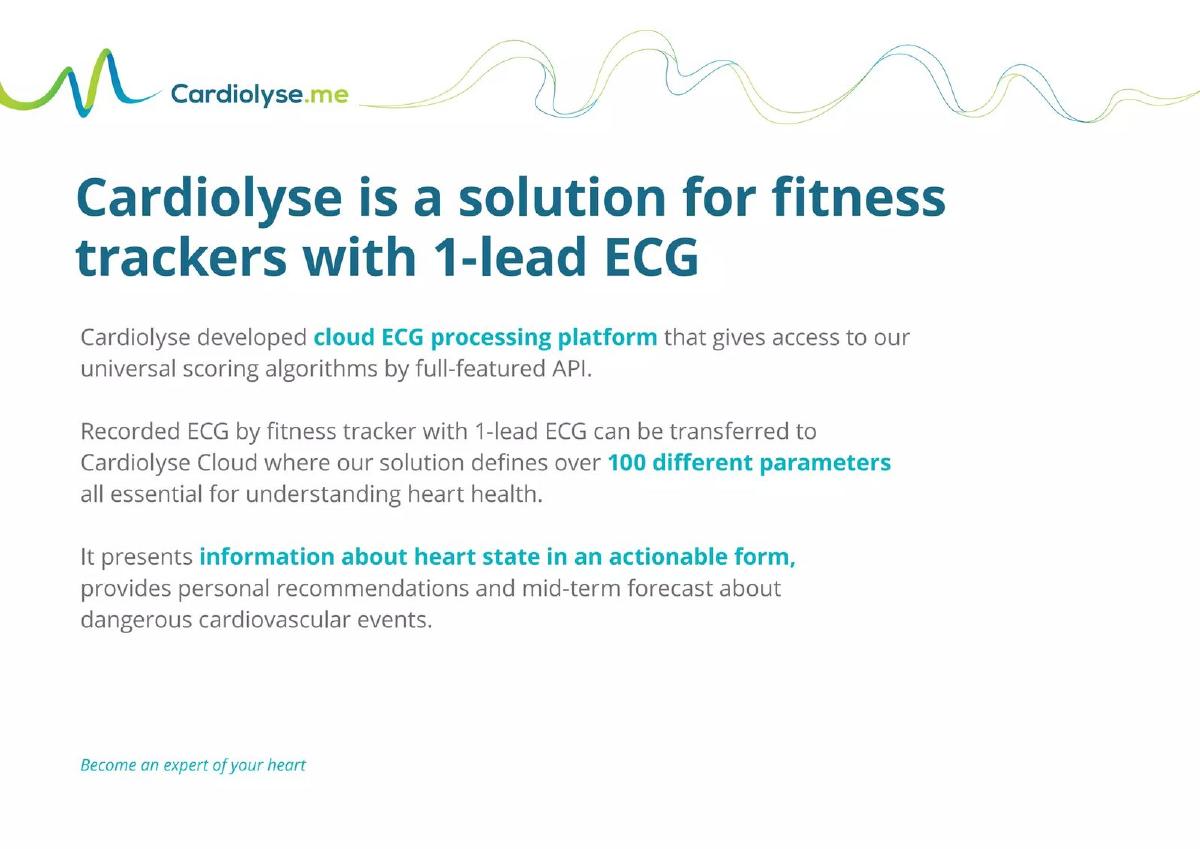
Slide 3 defines Cardiolyse as a "solution for fitness trackers with 1-lead ECG." It introduces the "cloud ECG processing platform" and the "universal scoring algorithms" accessed via API. A key metric is introduced here: the solution defines over 100 different parameters from a single ECG recording. This slide establishes the company as a B2B infrastructure provider rather than a hardware manufacturer.
Slide 4: Measurement Categories
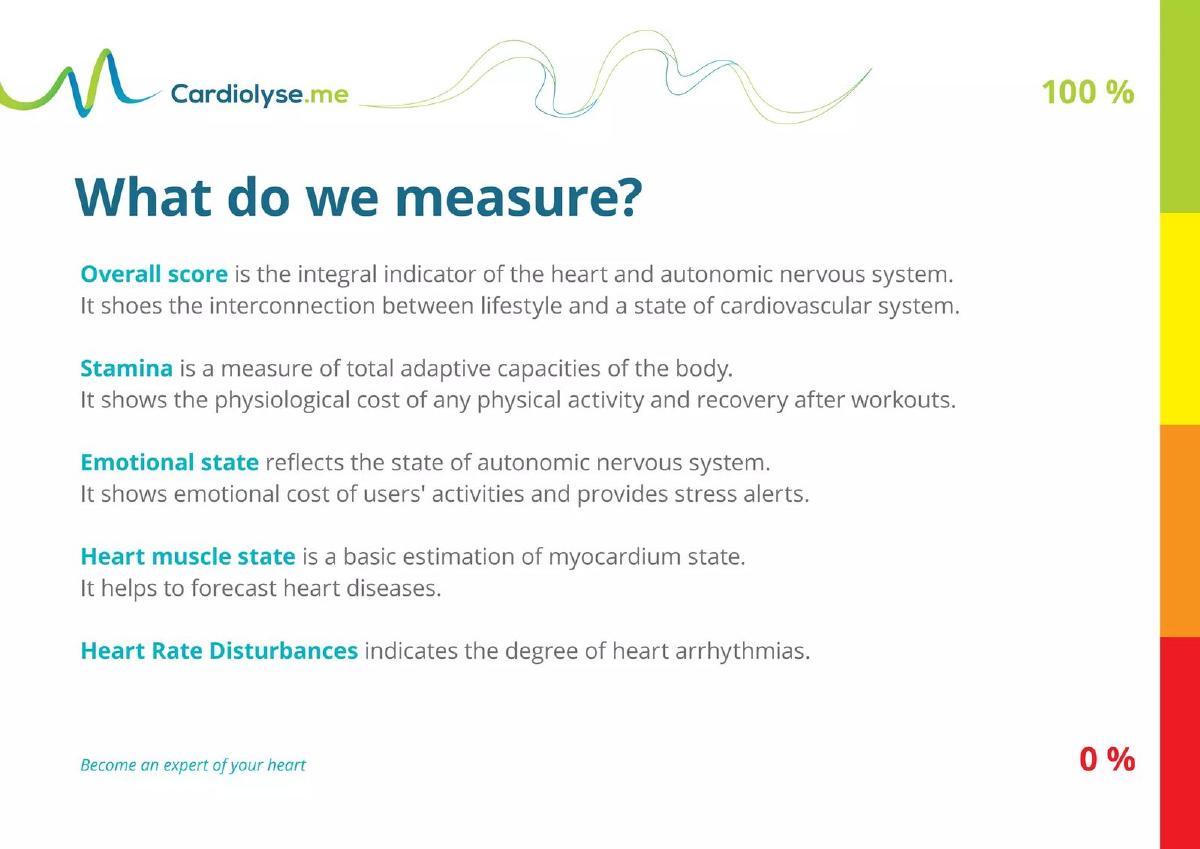
This slide breaks down the "100 parameters" into five digestible categories:
Overall score: An indicator of the heart and autonomic nervous system. · Stamina: A measure of adaptive capacity and recovery. · Emotional state: Reflects stress levels via the autonomic nervous system. · Heart muscle state: An estimation of the myocardium to forecast disease. · Heart Rate Disturbances: Indicates the degree of arrhythmias.
Slide 5: User Interface and Experience
Slide 5 showcases the mobile interface, displaying a Dashboard, Recommendations, and Trends. Notable data points visible in the mockups include "Heart Biological Age" (shown as 37-47) and an "Overall" health percentage (62%). The text at the bottom emphasizes flexibility: "It’s up to you what amount of information and in which format your users will get." This reinforces the B2B, white-label nature of the platform.
Slide 6: System Architecture
This technical diagram illustrates the data flow. A wearable ECG recorder sends a signal to a "Partner's Cloud," which then passes "Any ECG format" to the Cardiolyse Cloud via API. The analyzed results are then sent back to the user's dashboard. The slide lists "New market opportunities" including life insurance, corporate wellness, and home care for the elderly, indicating a pivot or expansion beyond just fitness.
Slide 7: Validation and Efficacy
This is the strongest slide in the deck for building credibility. It lists three major achievements:
A cardiac screening of over 20,000 people in Eastern Europe where 27 lives were saved through immediate hospitalization. · Contracts with the University of Oxford and China Kadoori Biobank . · Approval from professional sports teams (logos for Lokomotiv Kharkov and others are shown).
Slide 8: Technology Uniqueness
This slide attempts to define the competitive advantage. It highlights the use of "individual benchmark electrocardiograms" for better accuracy and the ability to deliver a middle-term forecast (up to 6 months) for serious cardiovascular events. This predictive capability is a significant claim that differentiates the product from reactive health monitors.
Slide 9: The Team
The "Dream team" slide features seven individuals. Key leadership includes Anna Starynska (COO), Illya Chaikovsky (CSO, MD, PhD), and Andrei Karol (CTO). The team is geographically distributed, with dedicated leads for the UK and India. The slide also mentions "more than 15 top level professionals" supporting the core team.
Slide 10: Contact Information
The final slide provides direct email addresses for the COO and CTO, along with the website URL. It lacks a summary of the investment opportunity or a final "why now" statement.
What Cardiolyse Does Well
The deck excels at establishing technical and clinical authority. By citing a 20,000-person study and partnerships with Oxford, the founders bypass the typical skepticism faced by health-tech startups regarding algorithm accuracy. The clear explanation of the API-based B2B model (Slide 6) makes it easy for potential partners to understand how the technology integrates into existing ecosystems without requiring new hardware development.
What is Missing from the Deck
From a fundraising perspective, this deck is incomplete. It functions more like a sales presentation for a B2B partner than an investor pitch. The following elements are entirely absent:
The Ask: There is no slide stating how much capital is being raised, the valuation, or the intended use of funds. · Business Model: The deck does not explain how Cardiolyse makes money. Is it a per-API-call fee, a per-user subscription, or a licensing model? · Market Size: There is no mention of the Total Addressable Market (TAM). While "life insurance" and "fitness" are mentioned, the financial scale of these opportunities is not quantified. · Competition: The deck does not acknowledge other ECG analysis players (like AliveCor or specialized hospital-grade software), leaving a gap in the strategic analysis. · Financials: There are no historical revenue figures or future projections.
Recommendations for Founders
Founders should look to Slide 7 as a gold standard for "Traction and Validation." Using specific numbers (20,000 people) and high-authority logos (Oxford) is the most effective way to build trust in a regulated or scientific field. However, founders should avoid the mistake of omitting the business mechanics. A pitch deck must answer not just "does it work?" but also "is it a viable business?" Adding a slide on unit economics and a clear roadmap for the next 18-24 months of funding would transform this from a product overview into a professional investment deck.
Frequently asked questions
- What is the core product of Cardiolyse?
- Cardiolyse is a cloud-based ECG processing platform. It uses universal scoring algorithms accessible via API to analyze 1-lead ECG data from fitness trackers. It translates raw signals into actionable insights such as stamina, stress levels, and cardiovascular disease forecasts, providing over 100 parameters to end-users or partners.
- Who are the primary target customers for this technology?
- The deck identifies several B2B market opportunities. These include fitness tracker manufacturers, life insurance companies, corporate wellness programs, professional sports teams, and home care providers for the elderly. It is designed to be a white-label or integrated solution where the partner decides how much information to show the end-user.
- What clinical or real-world validation does Cardiolyse provide?
- Cardiolyse cites three main points of validation: a mass screening of 20,000 people in Eastern Europe that resulted in 27 immediate hospitalizations, research contracts with the University of Oxford and China Kadoori Biobank, and adoption by professional sports teams to monitor athlete recovery and performance.
- How does the technology differ from standard heart rate monitors?
- Unlike basic heart rate monitors, Cardiolyse uses 1-lead ECG to form individual benchmark electrocardiograms. This allows for more accurate, individualized recommendations. It also claims to provide a 'middle-term' forecast of up to 6 months for cardiovascular events, which standard fitness trackers typically do not offer.
- What is missing from the Cardiolyse pitch deck?
- The deck is missing several standard investment slides. There is no 'Ask' slide detailing how much money is being raised or how it will be used. It also lacks a business model slide (pricing/revenue), a market size (TAM/SAM/SOM) analysis, a competitive landscape, and any financial projections or current traction metrics beyond clinical numbers.