Bravo Multinational’s October 2016 investor presentation outlines a business model centered on the acquisition and operation of gaming machines in Latin America, specifically Nicaragua, El Salvador, and Colombia. As a publicly traded entity on the OTCQB, the company reports a market capitalization of $6.0 million and trailing twelve-month (TTM) revenue of $9.8 million (Slide 2). The core operational thesis relies on purchasing gaming machines at a discount ($4,500) versus a market rate of $7,000, while retaining 50% of the monthly 'take' from machines in operation (Slide 3). While the deck pr…
Key takeaways
- The company is publicly traded on the OTCQB under the ticker BRVO, with a $6.0 million market cap as of October 2016 (Slide 2).
- Bravo reports $9.8 million in TTM revenue but only $0.3 million in TTM net income, indicating thin margins (Slide 2).
- Operations are concentrated in Managua (Nicaragua), San Salvador (El Salvador), and San Andreas (Colombia) (Slide 2).
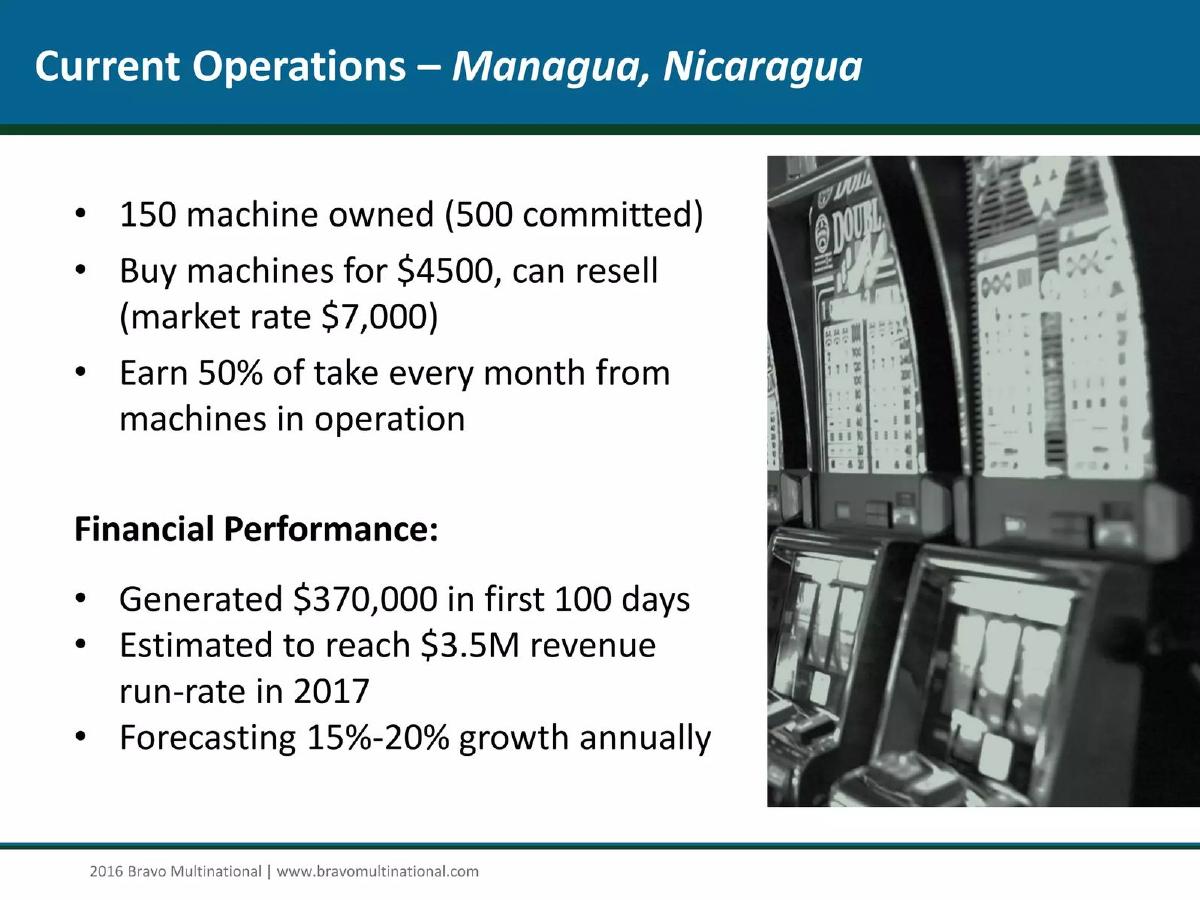
- The Nicaraguan unit owns 150 machines with 500 committed, generating $370,000 in its first 100 days (Slide 3).
- The business model includes an arbitrage component, buying machines for $4,500 that have a market value of $7,000 (Slide 3).
- The deck forecasts 15%-20% annual growth and a $3.5 million revenue run-rate for 2017 (Slide 5).
- Debt levels are stated to be less than $400,000, suggesting a relatively clean balance sheet for a micro-cap (Slide 5).
- The presentation omits a team slide, board of directors, or any specific details on the 'diversification' opportunities mentioned (Slide 4).
Executive Summary: The Micro-Cap Gaming Play
Bravo Multinational, Inc. (OTCQB: BRVO) presents a specialized investment case centered on the Latin American gaming market. This 2016 deck is designed for the public markets, specifically the OTCQB, where the company trades at a micro-cap valuation of $6.0 million. The narrative focuses on the tangible acquisition of physical assets—gaming machines—and the high-margin 'take' from their operation in regions like Nicaragua. While the top-line revenue of $9.8 million is substantial for a company of this size, the net income of $0.3 million suggests a high-cost environment or significant reinvestment. The deck serves as a high-level overview of their operational footprint and financial standing rather than a deep dive into technology or proprietary IP.
Slide 1: Title and Branding
The cover slide establishes the company's identity and public trading status. It prominently features the ticker OTCQB: BRVO and the date October 2016 . The background imagery of a roulette wheel immediately identifies the sector as gambling/gaming. The logo for Bravo Multinational Incorporated uses a globe motif, reinforcing the 'Multinational' aspect of the name.
Slide 2: Corporate Overview and Public Metrics
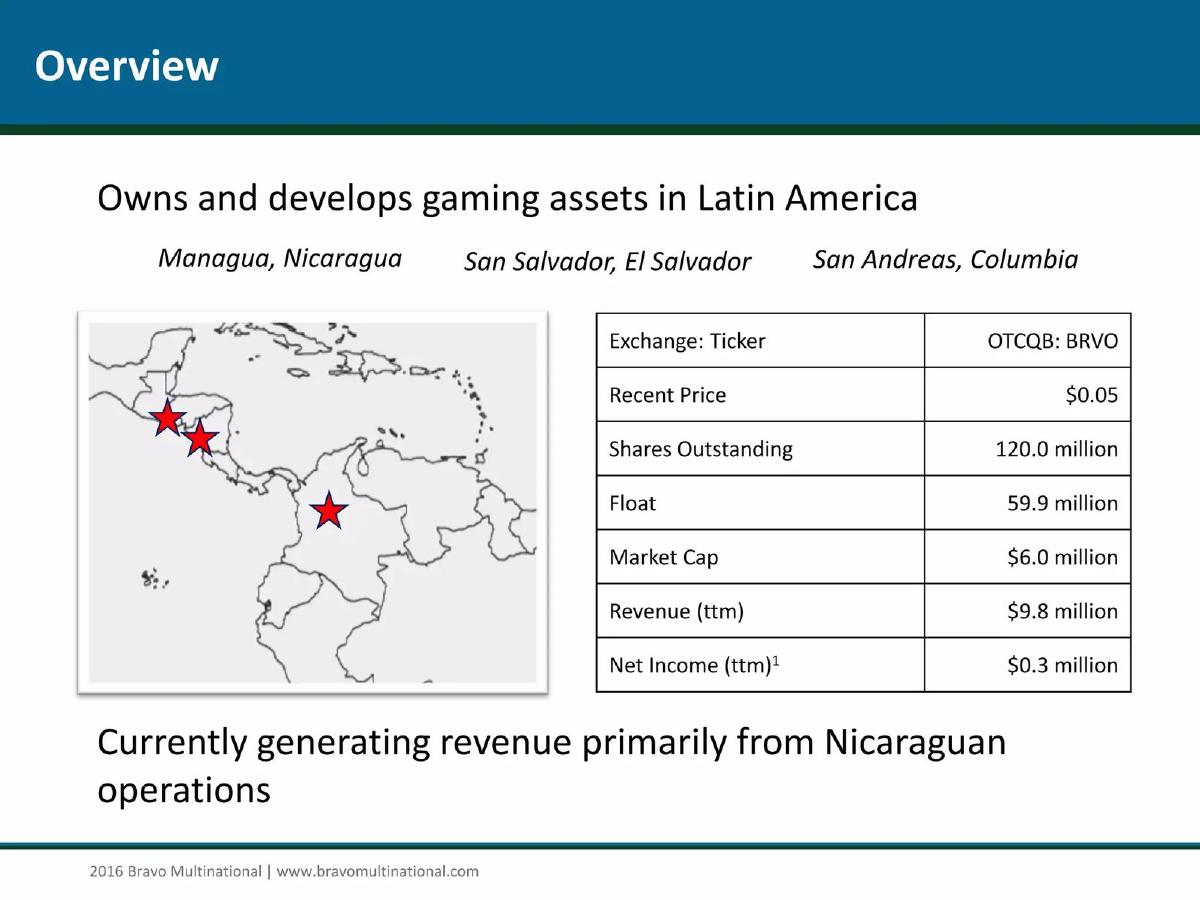
This slide provides a snapshot of the company's geographic footprint and capital structure. It explicitly states that Bravo "Owns and develops gaming assets in Latin America," specifically in Managua (Nicaragua), San Salvador (El Salvador), and San Andreas (Colombia). A table provides critical investor data:
Recent Price: $0.05 · Shares Outstanding: 120.0 million · Market Cap: $6.0 million · Revenue (ttm): $9.8 million · Net Income (ttm): $0.3 million
The slide notes that revenue is currently generated "primarily from Nicaraguan operations," suggesting the other two locations may be in earlier stages of development or acquisition.
Slide 3: Current Operations – Managua, Nicaragua
Slide 3 drills down into the core business model in their most active market. The company reports owning 150 machines with 500 committed . The unit economics are presented as a two-pronged value play: first, an asset arbitrage where they "Buy machines for $4,500" that can be resold at a "market rate $7,000" ; second, an operational play where they "Earn 50% of take every month from machines in operation." Financial performance for this specific region includes $370,000 generated in the first 100 days and an estimated $3.5M revenue run-rate in 2017 , with a forecasted 15%-20% annual growth.
Slide 4: Market Opportunity and Diversification
The company attempts to broaden its appeal by citing "Attractive Market Trends in Latin America," such as high-growth economies and an expanding middle class. Interestingly, the slide introduces the concept of "Exploring Opportunities Beyond Gaming Industry." While it mentions adding to shareholder value, it lacks specific details on what these industries might be, though the footer images show construction equipment and warehouse shelving. This suggests a conglomerate-style ambition that is not yet backed by operational data in the deck.
Slide 5: Investment Highlights
This slide serves as the summary of the bull case. It reiterates the $3.5M revenue run-rate and the 15%-20% growth forecast . A new and important piece of information is disclosed here: the company has "Less than $400K in debt." It also highlights "Low overhead & expenses," which contrasts slightly with the $9.8M revenue vs. $0.3M net income ratio shown on Slide 2, implying that 'overhead' might be low but 'cost of goods sold' or 'operational takes' by partners might be high.
Slide 6: Contact and Administration
The final slide provides the administrative layout of the company. It lists three entities: Bravo Multinational, Inc. (based in Niagara On The Lake, Ontario), GameTouch, LLC (based in Hallandale, Florida), and RedChip Companies, Inc. (Investor Relations). This indicates a cross-border structure between Canada and the US to manage Latin American assets.
What Bravo Multinational Does Well
The deck is exceptionally clear about its unit economics. By stating the exact purchase price of a machine ($4,500) versus its resale value ($7,000) and the monthly revenue split (50%), the founders give investors a concrete way to model the business. This transparency is often missing in early-stage decks. Furthermore, the inclusion of public market data (float, shares outstanding, TTM revenue) on a single slide makes it very easy for a retail investor to perform a quick valuation check against the $6.0 million market cap.
What is Missing from the Deck
The most glaring omission is a Team Slide . There is no mention of the CEO, the board, or the operational managers on the ground in Latin America. For a company operating in high-regulation sectors like gaming across multiple international jurisdictions, the pedigree and experience of the leadership team are paramount. Additionally, there is no Competition Slide . The deck implies a vacuum in which Bravo is the only player buying and operating these machines, which is unlikely in the competitive Latin American gaming market. Finally, the "Opportunities Beyond Gaming" section is far too vague; without a specific plan or existing asset, it feels like filler that distracts from the core gaming story.
Founder Takeaways: Lessons from the BRVO Deck
Founders should emulate the "Current Operations" slide (Slide 3). Breaking down a complex business into simple, repeatable units—in this case, the cost and yield of a single gaming machine—is the best way to build investor confidence. However, founders must avoid the mistake of omitting the team. Investors, especially in the micro-cap or venture space, invest in people first and assets second. If you are moving into multiple geographic regions, you must demonstrate that you have the local expertise to navigate those specific legal and cultural landscapes. Lastly, if you are a public company, always include your debt levels and share structure as Bravo did; it shows a level of maturity and respect for the investor's need to understand dilution and solvency.
Frequently asked questions
- What is the primary revenue driver for Bravo Multinational?
- According to Slide 2, revenue is primarily generated from Nicaraguan operations. Specifically, Slide 3 details that the company earns 50% of the monthly 'take' from gaming machines in operation. They currently own 150 machines in Managua and have committed to an additional 500. The company also mentions a secondary value driver in the ability to purchase machines at $4,500 and resell them at a market rate of $7,000.
- What are the company's key financial metrics as of the deck date?
- Slide 2 lists the following: a recent stock price of $0.05, 120.0 million shares outstanding, a float of 59.9 million shares, and a market cap of $6.0 million. Financially, they report $9.8 million in TTM revenue and $0.3 million in TTM net income. Slide 5 adds that the company has less than $400,000 in debt.
- Where does Bravo Multinational operate?
- The company focuses on Latin America. Slide 2 identifies three specific locations: Managua, Nicaragua; San Salvador, El Salvador; and San Andreas, Colombia. A map on the same slide indicates these locations with red stars, though the text notes that revenue is currently coming primarily from the Nicaraguan segment.
- What is the company's growth strategy beyond gaming?
- Slide 4, titled 'Market Opportunity,' mentions 'Exploring Opportunities Beyond Gaming Industry.' However, the slide is vague, listing only 'Initially focused on Nicaragua' and the goal to 'Add to bottom-line earnings & shareholder value.' The slide includes stock photos of heavy machinery and warehouses, hinting at industrial or logistics sectors, but provides no concrete plans or existing assets in those areas.
- Who is managing the company and its investor relations?
- The deck does not include a team slide or biographies for executives. Slide 6 provides contact information for Bravo Multinational in Ontario, Canada, and GameTouch, LLC in Hallandale, Florida. Investor relations are handled by RedChip Companies, Inc., specifically naming Michael Sully as a specialist.