When Your Real Competitor Is Excel or Doing Nothing
Many startups lose deals to spreadsheets, paper, in-house tools or inertia, not to rival startups.
When Your Real Competitor Is Excel or Doing Nothing: Name It, Size It, Show Customers Leaving It
Ask founders who they lose deals to and many will say the same thing: nobody. The prospect kept their spreadsheet, their paper forms, their in-house script or their patchwork of old tools. That is the status quo, and for a lot of early companies it is the main competitor. Yet most competition slides still show a grid of other startups and leave the status quo out, or mention it in one line under the logos. This guide looks at four founders who did name it, and at what each one did with it: put it in a tagline, used it to claim an empty category, measured how often it wins, or tested against it directly.
TL;DR
Name the specific workaround your buyers use today, say how often you meet it in sales, and show evidence that customers who switch away from it are better off. Put it on the comparison itself rather than in a footnote. Airbase's Series B memo does the sizing well: 'nine times out of ten, prospects we engage with are using point solutions like Bill.com, Expensify and a corporate card. This status quo approach... is the primary competition we face.' Depict.ai shows the evidence: a '270% increase in revenue from recommendations when A/B tested against in-house system' at one named customer.
Four pages that present the status quo as competition
Each page is read at full size. Quotes are exact.
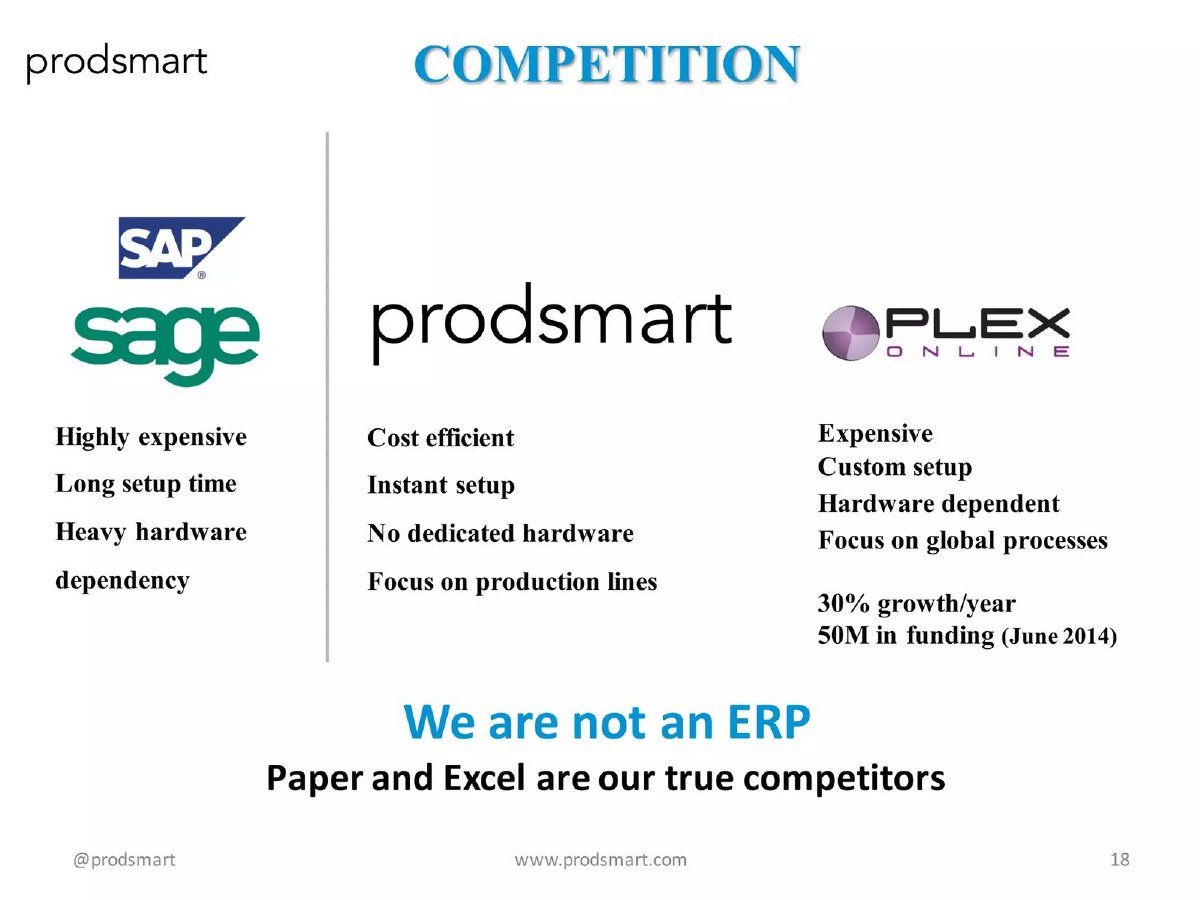
Prodsmart competition slide — slide 18
Production-tracking software for factories. Competition slide.
Prodsmart deck, slide 18. Exact stored slide matched to this analysis.
Our analysis: Honest about the real competitor, then compares against the wrong ones.
Evidence and limitation: Status quo named in a closing line; no column or criteria for it. Plex's growth and funding shown, Prodsmart's own figures not.
What a founder can adapt: Give paper and Excel the first column, scored on cost, errors and time.
Supporting analysis
What the deck claims: SAP/Sage, Prodsmart and Plex Online compared; "We are not an ERP"; "Paper and Excel are our true competitors".
Presentation choice: Shows the plainest statement of the status quo in the set.
When it does not fit: Naming the main competitor only in a caption.
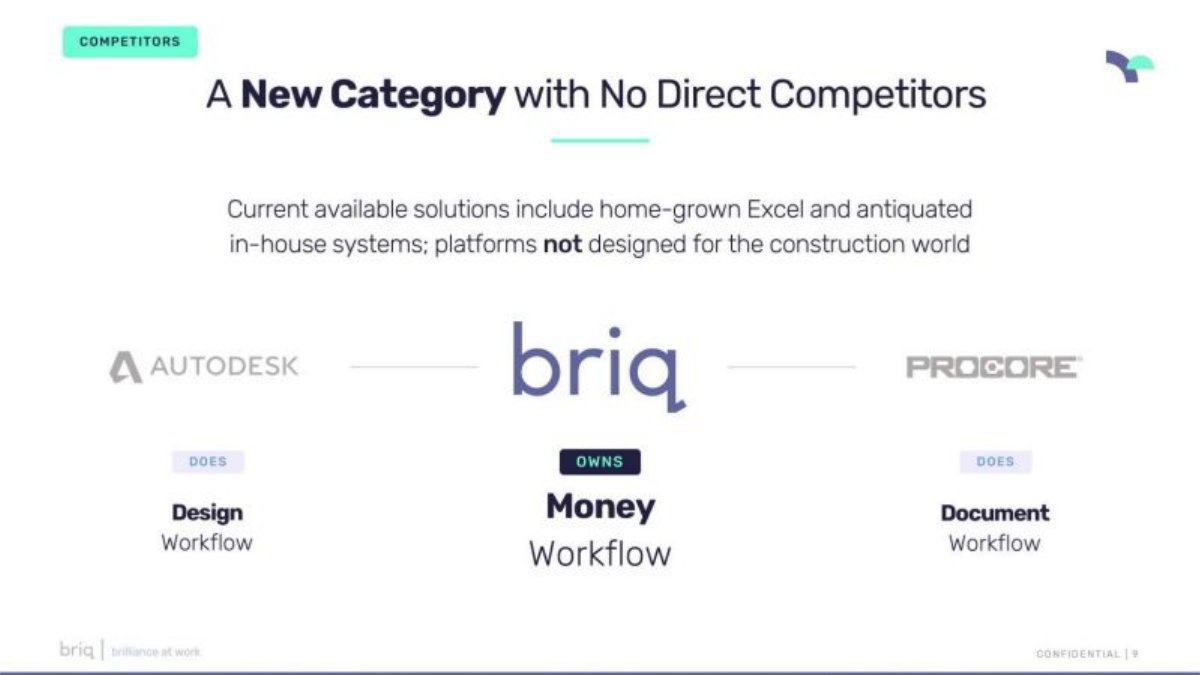
Financial planning software for construction. Competitors slide.
Briq deck, slide 9. Exact stored slide matched to this analysis.
Our analysis: Clear positioning, undermined by a 'no competitors' heading.
Evidence and limitation: Workaround named in the subtitle; diagram shows only Autodesk and Procore.
What a founder can adapt: Retitle around Excel and place it on the diagram.
Supporting analysis
What the deck claims: "A New Category with No Direct Competitors"; "Current available solutions include home-grown Excel and antiquated in-house systems".
Presentation choice: Shows the status quo used to claim an empty category.
When it does not fit: 'No direct competitors' above a list of alternatives.
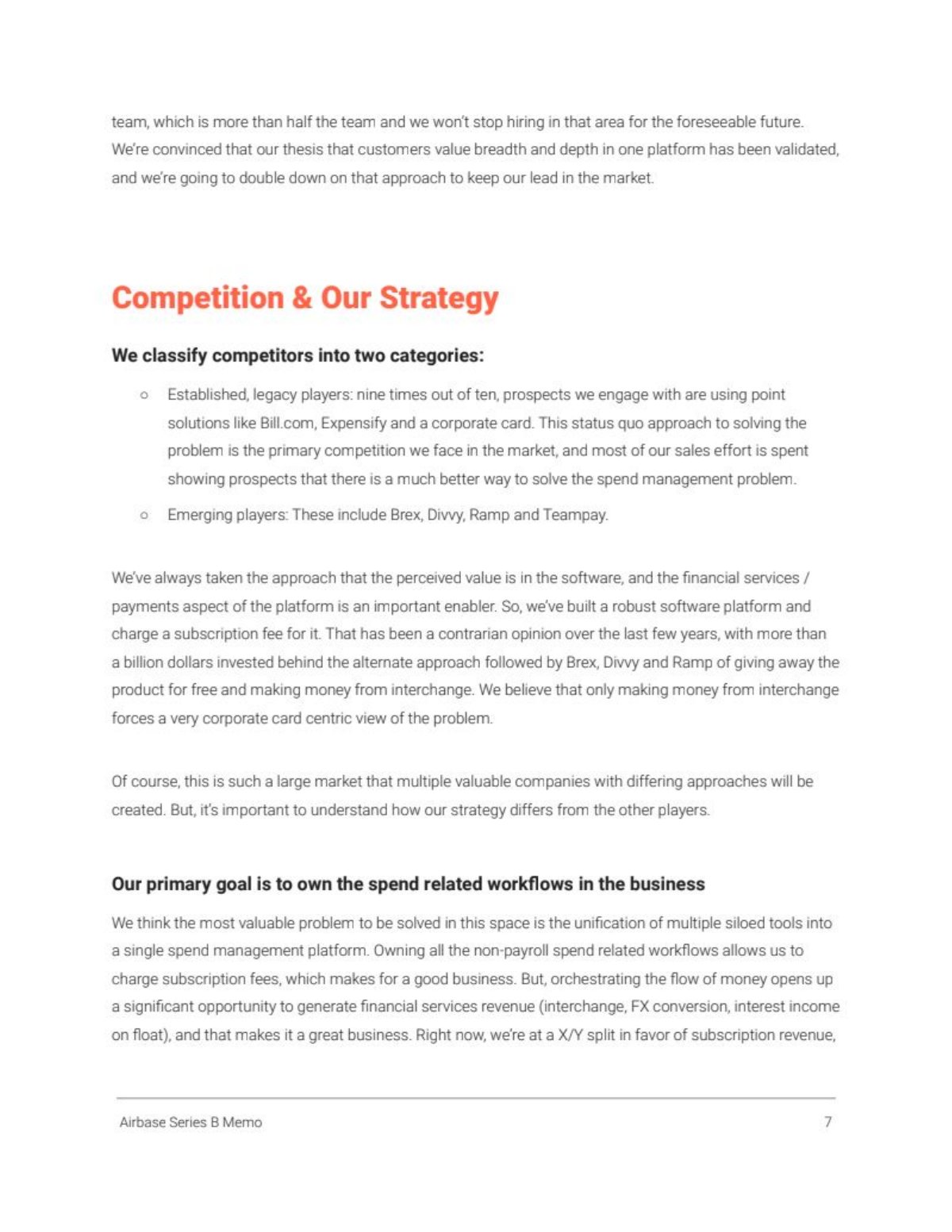
Spend management software. Series B memo page (a written document, not a slide).
Airbase deck, slide 7. Exact stored slide matched to this analysis.
Our analysis: The most specific and sized status quo statement in the set.
Evidence and limitation: Status quo named and sized; sales consequence stated; no deal count, period or win rate.
What a founder can adapt: Give the deal count, period and win rate against it.
Supporting analysis
What the deck claims: "nine times out of ten, prospects we engage with are using point solutions like Bill.com, Expensify and a corporate card. This status quo approach... is the primary competition".
Presentation choice: Shows how to measure the status quo in the pipeline.
When it does not fit: A rounded impression standing in for pipeline data.
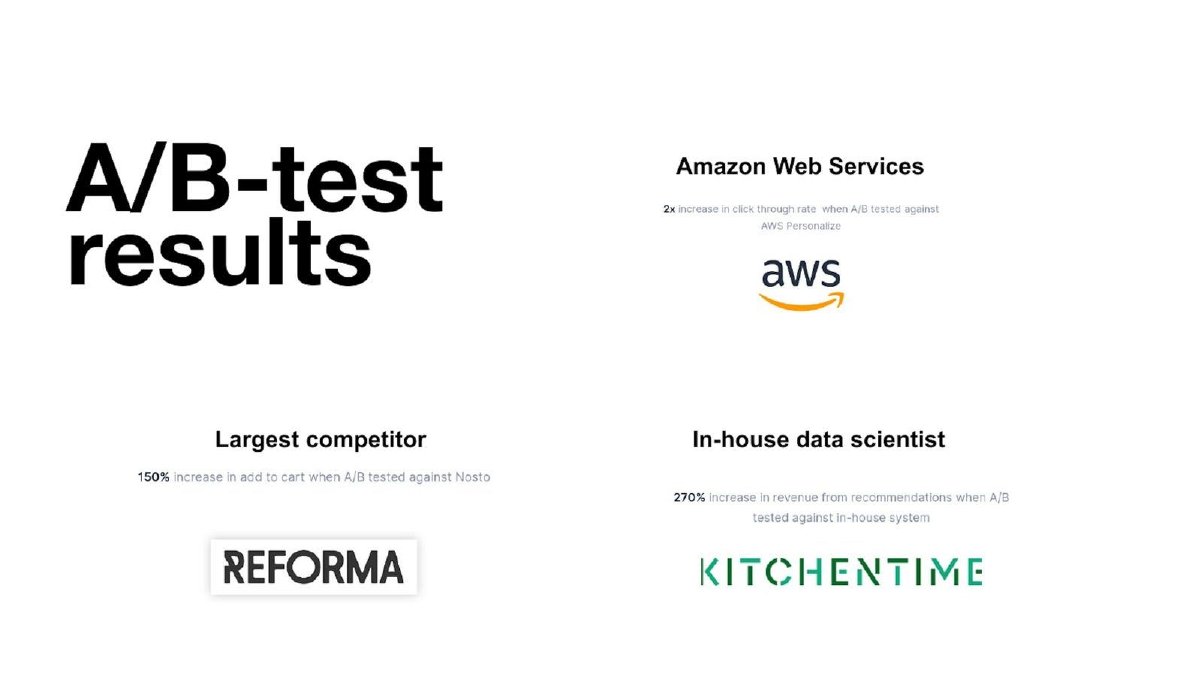
Product recommendations for online shops. A/B test results slide.
Depict.ai deck, slide 8. Exact stored slide matched to this analysis.
Our analysis: Gives the in-house option equal weight and answers it with a test.
Evidence and limitation: One customer per result; no test length, traffic or date; three different measures.
What a founder can adapt: Add test length, sample and date, and how many tests were run.
Supporting analysis
What the deck claims: "270% increase in revenue from recommendations when A/B tested against in-house system" (Kitchentime); also results against AWS Personalize and Nosto.
Presentation choice: Shows evidence that beats the status quo.
When it does not fit: Single-customer results presented as general.
Named, placed on the comparison, sized, and backed by evidence.
Example
Status quo named
On the comparison
Sized
Evidence of switching
Prodsmart
Paper and Excel
No (caption only)
No
No
Briq
Home-grown Excel, in-house systems
No (subtitle only)
No
No
Airbase
Bill.com + Expensify + corporate card
Yes (first category)
'Nine times out of ten'
No
Depict.ai
In-house system
Yes (own panel)
No
One A/B test
Key Takeaways
Name the exact workaround: which tool, process or habit.
Say how often you meet it in deals.
Put it on the comparison, not in a caption.
Explain why buyers stay with it: cost, familiarity, no budget.
Show what happened when a customer switched away from it.
Don't use the status quo to claim 'no competitors'.
Prepare your status quo
Answer these before writing the slide.
Workaround. What exactly do prospects use today: which tool, process or habit?
Frequency. In how many of your recent deals was that the alternative?
Why they stay. Is it free, already paid for, familiar, or has nobody got budget?
Switch. Which customer left it, and what changed, measured how?
Rivals. Which products will you still show beside it?
Copyable framework: "Our main competitor is [workaround] ([x] of [n] recent deals). [Customer] replaced it: [metric] from [a] to [b] in [period]."
Illustrative example 1 — written by us
Before: "We are not an ERP. Paper and Excel are our true competitors"
After: "Paper and Excel: our competitor in [x] of [n] factory deals. [Customer] moved off paper: reporting time from [a] to [b]."
What improved: Our illustrative rewrite of Prodsmart's line. Bracketed details are not stated on the slide.
The question this guide answers
This guide answers one founder question: most of my prospects don't use a competitor at all; they use spreadsheets, paper, an internal tool or nothing. How do I show that on my competition slide without looking as if I've ignored real rivals?
Our main competition slide guide says, in a paragraph, that the status quo belongs on the slide. Our customer switching guide covers evidence that customers moved from a named rival product to you. Our developer tools competition guide covers the build-versus-buy comparison for technical buyers. Our incumbent response guide covers what a large company will do when you succeed. None of them explains how to present the do-nothing or do-it-yourself option as the main competitor: how to name it, how to show its weight in your pipeline and what evidence beats it. That is this guide's subject.
How we chose and read the examples
We searched extracted text across the library for 'status quo', 'spreadsheet', 'Excel', 'paper', 'manual process' and 'in-house', and kept pages where the company itself presented one of these as competition. Many matches were problem slides describing spreadsheets as the pain, not as a competitor, and several came from listed companies or merger vehicles; we set those aside. We also set aside Nanonets' build-versus-buy slide, because our developer tools guide already covers that comparison, and Contur's two-axis map, which labels one axis 'Manual Processes' but places only software on it.
We kept four private-company pages that treat the status quo in clearly different ways: Prodsmart's competition slide, Briq's competitors slide, a page of Airbase's Series B memo (a written document, not a slide) and Depict.ai's A/B test results slide. Each was rendered from the source deck and read at full size. Any calculations are ours. We did not check any claim against outside sources.
Why investors care about the status quo
It decides the sales cycle. Replacing a rival product means winning a comparison. Replacing a spreadsheet means persuading a buyer to change habits, find budget and accept a project, often with no line item to take the money from. Investors want to know which kind of sale you are making, because the second is usually slower.
It shapes the market size. If most buyers use nothing, the market may be large but undeveloped; the company will have to create demand rather than capture it. That is not a weakness, but it changes what traction and spending a reader should expect.
It tests whether the founder knows the customer. A founder who can say 'eight of our last ten lost deals stayed on Excel' sounds as if they run a real pipeline. A founder who shows only startup logos may be describing the market from the outside.
It explains 'no competitors'. Investors distrust slides that say there is no competition. Naming the status quo is the honest version of that claim: there may be no direct rival, but there is always an alternative.
The status quo as a tagline: Prodsmart
Prodsmart, a Portuguese production-tracking software company, has a slide headed 'COMPETITION'. It shows three columns. On the left, SAP and Sage logos with 'Highly expensive', 'Long setup time', 'Heavy hardware dependency'. In the middle, Prodsmart: 'Cost efficient', 'Instant setup', 'No dedicated hardware', 'Focus on production lines'. On the right, Plex Online: 'Expensive', 'Custom setup', 'Hardware dependent', 'Focus on global processes', '30% growth/year', '50M in funding (June 2014)'. Below the columns, in large blue type: 'We are not an ERP', and under it in bold: 'Paper and Excel are our true competitors'.
Saying it plainly is the lesson. The last line is the most useful sentence on the slide. It tells an investor what Prodsmart actually replaces in a factory, and it reframes the three columns above: SAP, Sage and Plex are what a buyer might compare against, but most target customers apparently haven't bought any of them.
The weakness is that the slide then compares Prodsmart only with the software it says it doesn't compete with. Paper and Excel get one line and no column. A reader learns that Prodsmart is cheaper and faster to set up than SAP, but not why a production manager would stop using paper sheets, what that switch costs, or how often Prodsmart wins it. A stronger version would give paper and Excel the first column, with what they cost the factory (errors, hours of data entry, late reporting) and what Prodsmart changes. The slide also states Plex's growth and funding but none of Prodsmart's own figures, which leaves the comparison one-sided.
The status quo used to claim an empty category: Briq
Briq, which builds financial planning software for construction companies, has a slide tagged 'COMPETITORS' and headed 'A New Category with No Direct Competitors'. Under the heading: 'Current available solutions include home-grown Excel and antiquated in-house systems; platforms not designed for the construction world'. Below, Briq's logo sits in the middle with 'OWNS Money Workflow', between Autodesk ('DOES Design Workflow') and Procore ('DOES Document Workflow').
Naming the workaround in the subtitle is the strength. 'Home-grown Excel and antiquated in-house systems' tells a reader what a construction finance team actually uses today, and 'platforms not designed for the construction world' hints at a third alternative, general finance software. The layout also makes a clear claim about position: the two big construction platforms each own a different workflow, and Briq says money is the one left.
The heading works against the subtitle. 'No Direct Competitors' is the phrase investors trust least, and the slide's own text then lists three alternatives a buyer could choose instead. The Excel and in-house systems are the real competition, but they get no place on the diagram, while Autodesk and Procore, which the slide says do something else, get logos. A reader also can't tell whether Autodesk or Procore could add finance features, which is the obvious next question. A stronger heading would be 'Our competitor is Excel', with Excel and in-house systems drawn on the diagram and one line on why construction firms haven't adopted general finance tools.
The status quo measured in the pipeline: Airbase
Airbase's example is a page of its Series B investment memo, a written document rather than a slide; we include it because it shows the sizing a slide can borrow. Under 'Competition & Our Strategy' and 'We classify competitors into two categories', the first bullet reads: 'Established, legacy players: nine times out of ten, prospects we engage with are using point solutions like Bill.com, Expensify and a corporate card. This status quo approach to solving the problem is the primary competition we face in the market, and most of our sales effort is spent showing prospects that there is a much better way to solve the spend management problem.' The second bullet names 'Emerging players: These include Brex, Divvy, Ramp and Teampay.'
Three things make this the strongest status quo statement in the set. It is specific: the status quo isn't 'spreadsheets' but a named combination of three tools. It is sized: 'nine times out of ten' tells a reader how often Airbase meets it. And it states the consequence: 'most of our sales effort' goes into displacing it, which tells an investor what kind of sale this is. Here the status quo is not doing nothing but a patchwork of separate products, which is common in software: the alternative to an all-in-one tool is several single-purpose ones the buyer already pays for.
Its limit is evidence. 'Nine times out of ten' is a rounded impression with no period or count of deals behind it, and the memo doesn't say how often Airbase wins against the patchwork or why it loses when it does. On a slide, the same claim would be stronger as '[n] of [m] opportunities last quarter were using Bill.com + Expensify + a card; win rate against that setup: [x]%.'
Evidence against the in-house option: Depict.ai
Depict.ai, which sells product recommendations to online shops, has a slide headed 'A/B-test results' with three panels. 'Amazon Web Services': '2x increase in click through rate when A/B tested against AWS Personalize', with the AWS logo. 'Largest competitor': '150% increase in add to cart when A/B tested against Nosto', with the logo of the shop Reforma. And 'In-house data scientist': '270% increase in revenue from recommendations when A/B tested against in-house system', with the logo of the shop Kitchentime.
Treating the in-house option as a competitor and testing against it is the lesson. Many online shops build their own recommendations, so 'our own data scientist' is a real alternative that a buyer will raise. Depict gives it the same weight as a big cloud provider and the leading specialist rival, and answers it with a test result at a named customer. That is the kind of evidence that persuades a buyer to drop the status quo, and it shows an investor the company has already won that argument at least once.
The limits are in what each panel leaves out. Each result comes from one customer, with no test length, traffic size or date. The three panels use three different measures, click-through rate, add-to-cart and revenue from recommendations, so they can't be compared with one another. '270% increase in revenue from recommendations' measures only the recommendation revenue, not total shop revenue, which is a much smaller effect for the business. And one shop doesn't show how often Depict beats in-house systems in general. Adding '(4-week test, [n] sessions, [month year])' under each result, and saying how many tests the company has run, would make the slide much harder to dismiss.
What to put on the slide
Name the exact workaround. 'Paper and Excel' (Prodsmart), 'home-grown Excel and antiquated in-house systems' (Briq), 'Bill.com, Expensify and a corporate card' (Airbase), 'in-house system' (Depict). The more specific, the more credible.
Give it a place on the comparison. A column, a row or a position on the map, scored on the same criteria as rival products. Only Depict gives the status quo equal space.
Size it. How often you meet it in deals, or the share of target customers using it. Only Airbase gives a figure.
Explain why buyers stay. It is free, already paid for, familiar, or nobody owns the budget. Saying why is what lets you explain your sales approach.
Show a switch. A customer who left the spreadsheet or the internal tool, and what changed, with how it was measured.
Keep real rivals too. The status quo should be added to the comparison, not replace it. Airbase and Depict show both.
Where the status quo goes in the deck
On the competition slide, as the first column or row. That is where an investor looks for alternatives.
Echo it on the problem slide. If the problem slide describes the pain of spreadsheets, the competition slide should name spreadsheets as the main alternative, and the two should match.
Connect it to go-to-market. If most deals replace the status quo, your go-to-market slide should show how you create demand: education, free trials, a first use case that pays back quickly. Airbase's 'most of our sales effort' line is the bridge between the two.
Templates
Naming: 'Our main competitor is [workaround]. [x] of our last [n] prospects were using it.'
Why they stay: 'Buyers keep [workaround] because [reason]; we win when [trigger].'
Evidence: '[Customer] replaced [workaround]: [metric] changed from [a] to [b] over [period].'
What these examples can and cannot show
These four pages show how founders presented the status quo as competition. They can't show whether the claims were accurate, how often the companies actually won against spreadsheets or in-house tools, or how their markets developed afterwards. We did not check any claim against outside sources.
Treat them as patterns. Prodsmart says plainly that paper and Excel are its real competitors but compares itself only with ERP vendors. Briq names Excel and in-house systems but heads the slide 'No Direct Competitors'. Airbase names and sizes the status quo and says what it costs in sales effort, without win rates. Depict tests against an in-house system and wins, at one customer, on one measure.
Common mistakes
Caption only. The main competitor named under the slide, not on the comparison.
'No competitors'. Claiming an empty market while listing alternatives.
Vague workaround. 'Manual processes' instead of the actual tool or habit.
Unsized. No sense of how often the status quo wins deals.
No proof of switching. No customer shown leaving the workaround.
Diagnostic checklist
Exact workaround named.
Placed on the comparison.
Share of deals given.
Reason buyers stay explained.
One measured switch shown.
Frequently asked questions
If my real competitor is Excel, should I still show rival startups?
Yes. Investors will look them up anyway. Show Excel first, then the rivals, and say how often you actually meet each in deals.
Doesn't admitting most buyers use nothing make the market look weak?
Not if you explain it. It tells an investor you will create demand, which affects sales cycle and spend. Hiding it only makes them ask later.
How we chose these examples
Corpus: published pitch deck teardowns on StartupFundraising.com. Founder-uploaded private decks are excluded.
Selection (2026-10-01): we searched extracted text for status quo, spreadsheet, Excel, paper, manual process and in-house phrases, set aside problem-slide mentions, listed-company and merger-vehicle decks, a build-versus-buy slide covered elsewhere and a map with no status quo entry, and kept four private-company pages that present the status quo differently.
Review: the four pages were rendered from the source decks on 2026-10-01 and read in full at full size against company, deck and page number (editorial model review, with AI assistance in drafting; not human-reviewed). Airbase's page is from a written memo, not a slide. No claim was checked against outside sources.