Proof Technology's Series A deck is a masterclass in identifying a 'boring' but lucrative niche: legal process serving. By highlighting the archaic nature of the current market—where lawyers still rely on faxes and paper affidavits—Proof positions itself as the necessary digital layer for a $4.1 billion industry. The deck effectively balances the legal requirement for physical delivery with the efficiency of a mobile marketplace. With revenue growing from $542k in 2019 to a projected $53.8M by 2024, the financial trajectory provided a compelling case for their $7M raise. While the deck lacks…
Key takeaways
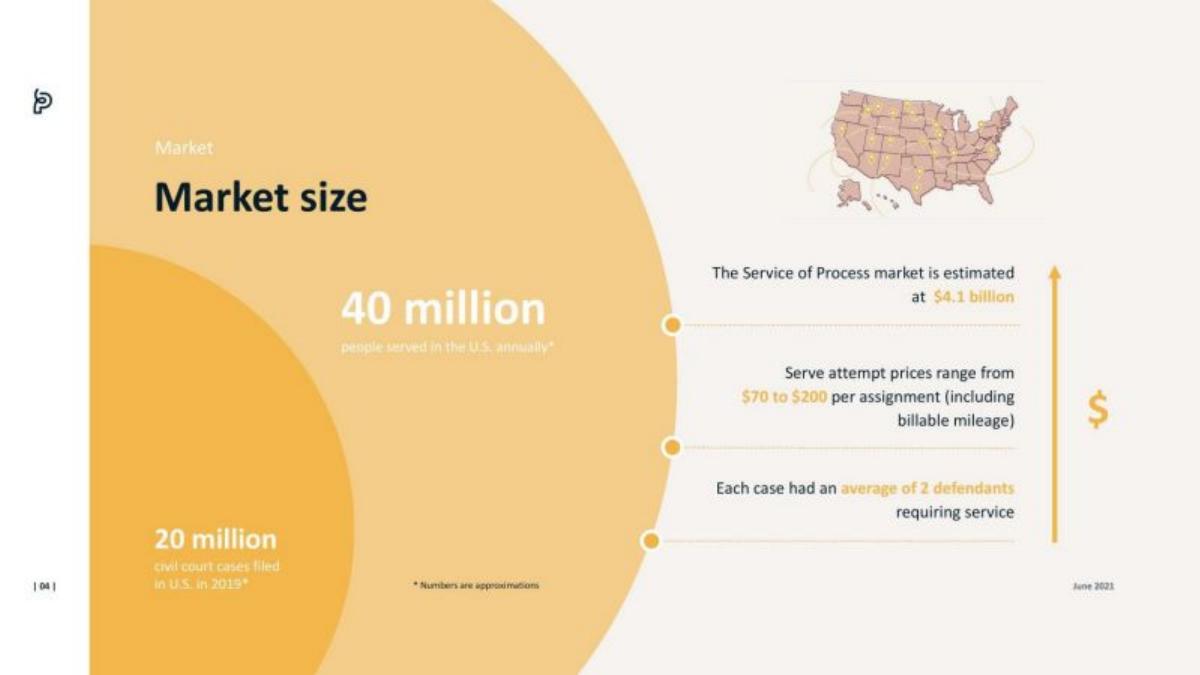
- The Service of Process market is estimated at $4.1 billion, with 40 million people served in the U.S. annually (Slide 04).
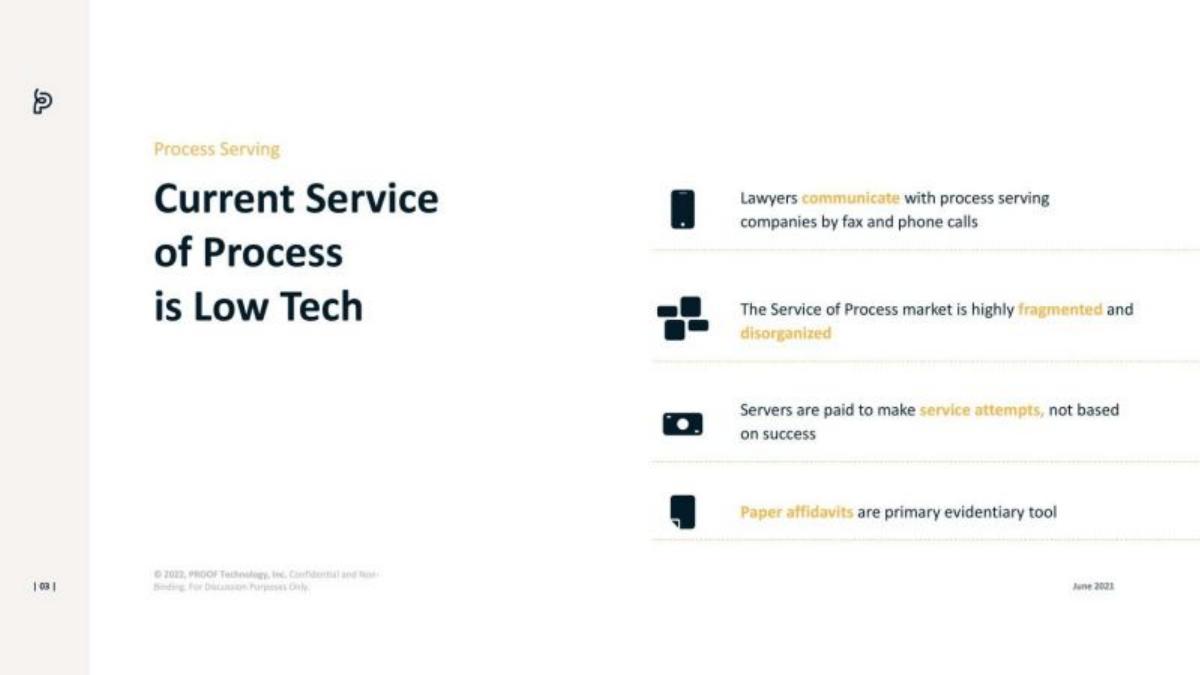
- Current industry methods are archaic, relying on faxes, phone calls, and paper affidavits as the primary evidentiary tool (Slide 03).
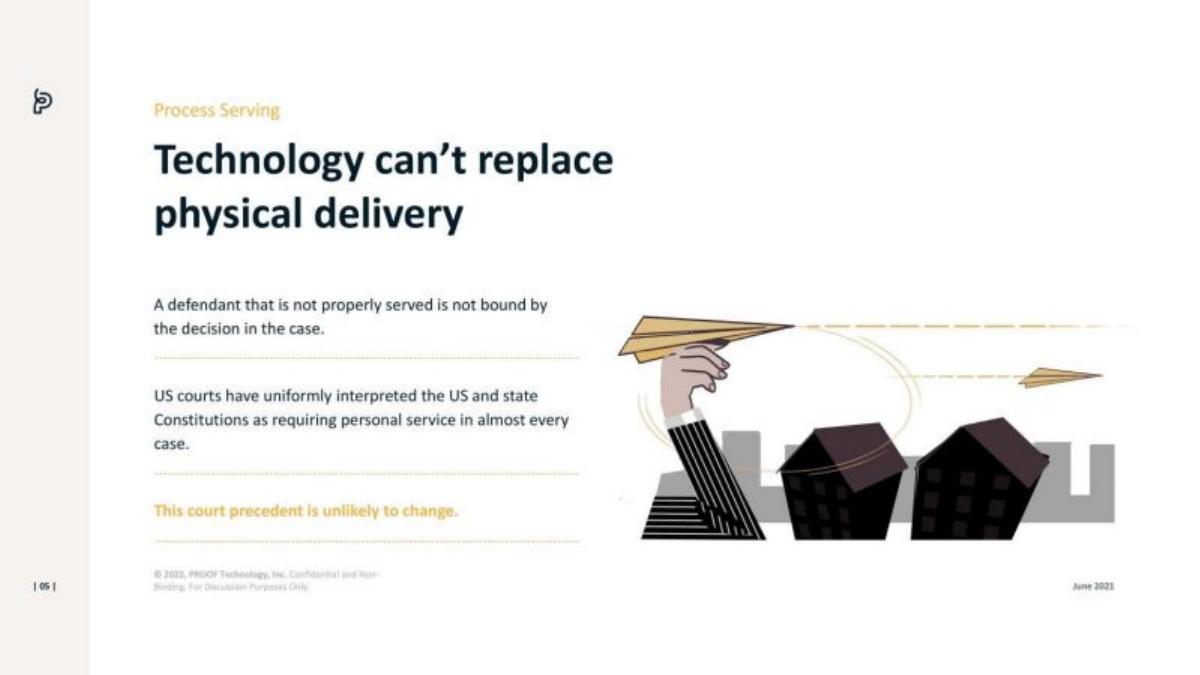
- Legal precedent requires physical delivery, meaning technology cannot replace the human element, only optimize the logistics (Slide 05).
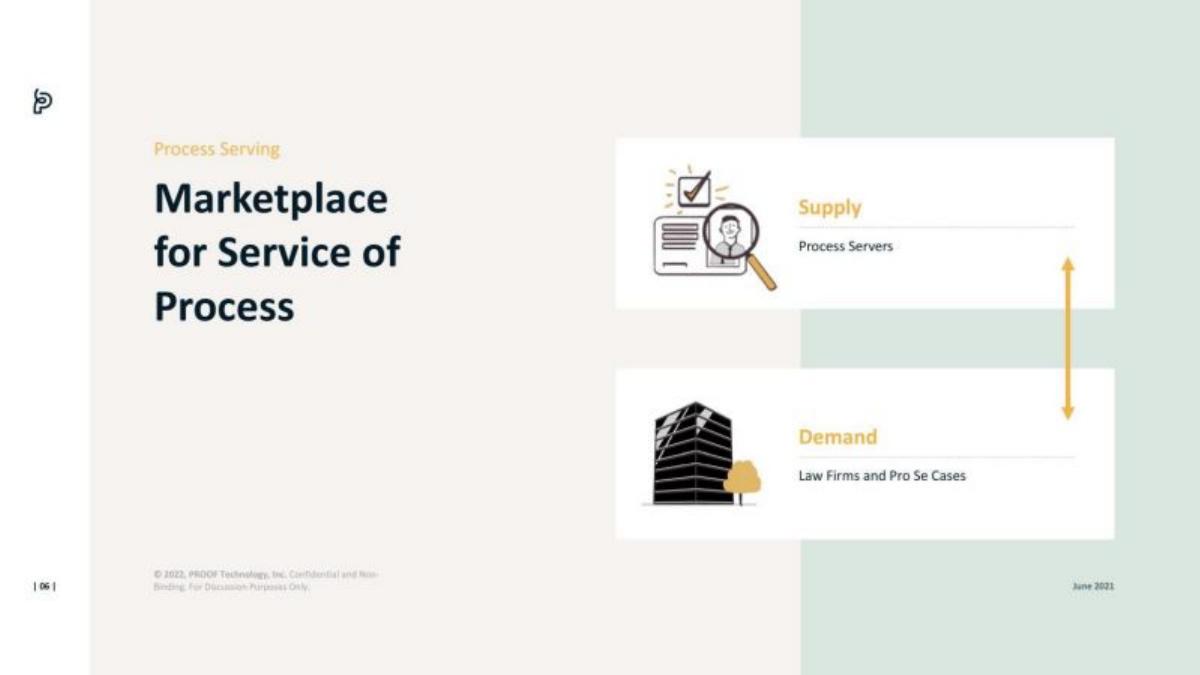
- Proof operates a two-sided marketplace connecting law firms (demand) with approximately 30,000 process servers (supply) (Slides 06 and 07).
- Revenue grew significantly from $212.7k in Q4 2019 to a projected $1.48M in Q1 2022 (Slide 12).
- The company projects scaling from 52,387 serves in 2021 to over 653,000 serves by 2024 (Slide 13).
- Gross profit margins appear healthy, scaling from $1.55M in 2021 to a projected $25.2M in 2024 (Slide 13).
- The deck omits a specific 'Ask' slide detailing the exact terms of the round or the planned allocation of the $7M capital.
Proof Technology: Digitizing the Last Mile of Legal Logistics
Proof Technology’s Series A deck, used to raise $7M in 2022, is a clinical example of how to pitch a marketplace in a legacy industry. The deck focuses heavily on the 'why now'—the transition from paper-based, fragmented systems to a centralized digital platform. By emphasizing the legal necessity of their service, they remove the risk of technological obsolescence.
Slides 1-3: The Problem and Industry Context
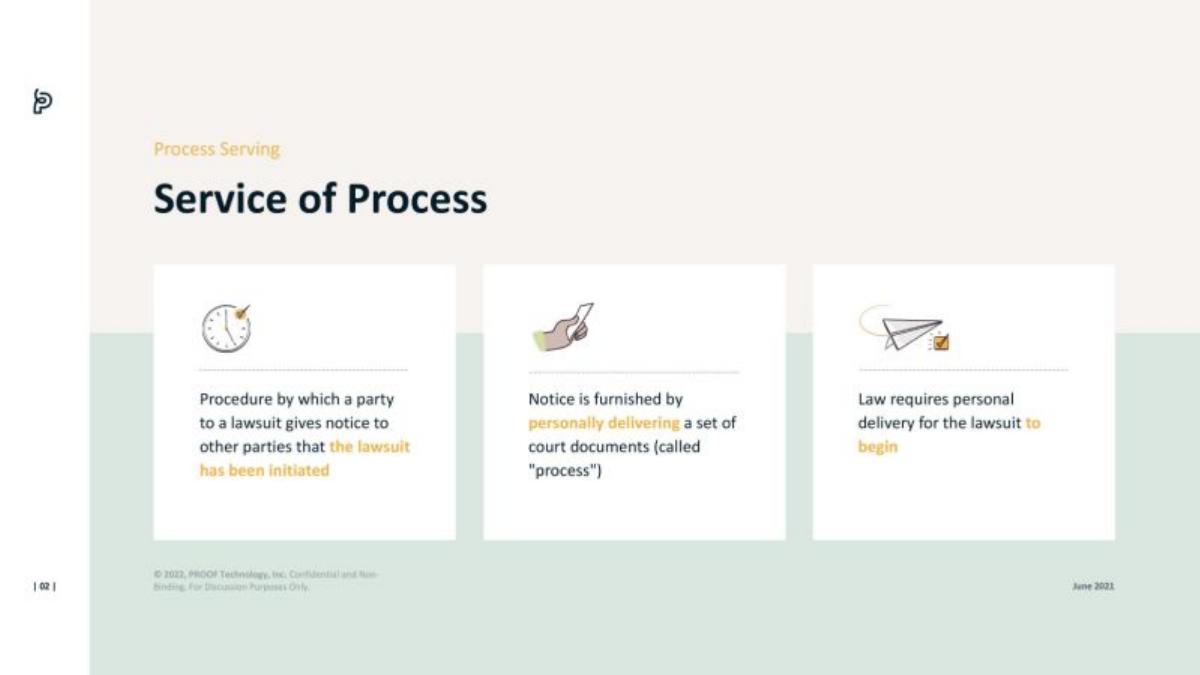
The deck opens with a standard title slide (Slide 01) and immediately moves into an educational phase. Slide 02 defines 'Service of Process' for investors who may not be familiar with the legal niche, noting that law requires personal delivery for a lawsuit to begin. This sets the stage for the problem presented on Slide 03: 'Current Service of Process is Low Tech.' The slide lists four critical pain points: communication via fax/phone, market fragmentation, payment for attempts rather than success, and the reliance on paper affidavits. This is a classic 'Old Way vs. New Way' setup.
Slides 4-5: Market Size and the Physical Moat
Slide 04 quantifies the opportunity. It cites 20 million civil cases and 40 million serves annually in the U.S., valuing the market at $4.1 billion. The inclusion of the average ticket price ($70 to $200) helps investors do the mental math on revenue potential. Slide 05 is perhaps the most strategic in the deck. Titled 'Technology can’t replace physical delivery,' it argues that court precedents requiring personal service are unlikely to change. This reassures investors that a purely digital competitor cannot disrupt the business model through software alone; the physical marketplace is a requirement.
Slides 6-7: The Marketplace Dynamics
Slides 06 and 07 describe the two-sided marketplace. The supply side consists of approximately 30,000 process servers, while the demand side comprises law firms and pro se cases. Slide 07 highlights a key value proposition for the supply side: 'Process Servers make more money as Proof contractors vs employed workers.' This is a critical point for marketplace liquidity—if the supply side earns more, they will migrate to the platform, naturally bringing the demand with them.
Slides 8-10: The Product and Value Add
Slide 08 provides a glimpse of the 'Proof Mobile Process Serving App,' showing a clean interface for job details and attempts. Slide 09 introduces 'SaaSification' through bundling premium services like skip traces and video verification. This indicates an expansion of the average order value (AOV). Slide 10 focuses on 'Incentivizes and Verifies Success,' mentioning a 'bounty system' that rewards successful serves and the use of geolocation links and photographs to verify service. This directly addresses the 'payment for attempts' pain point mentioned earlier in the deck.
Slide 11: The Executive Team
The team slide features seven individuals, including CEO Eric Voogt and CTO Marty Wachocki. While the slide includes titles, it lacks the 'logos' of previous companies or specific career highlights often seen in high-growth decks. However, the breadth of roles—including a Chief Revenue Officer and an EVP of Territory Management—suggests a team built for scaling operations rather than just building software.
Slides 12-13: Traction and Financial Projections
Slide 12 is the 'money slide,' showing quarter-over-quarter revenue growth. It tracks revenue from $212.7k in Q4 2019 to an estimated $1.48M in Q1 2022. The growth is consistent, with a notable 104% jump in Q1 2020. Slide 13 provides a detailed table of historical and projected financials. It shows the company scaling from 6,133 serves in 2019 to a projected 653,707 serves in 2024. The revenue projection of $53.8M by 2024 represents a significant scale-up, supported by a stable average ticket price of approximately $82.44.
What Works in This Deck
Market Education: For a niche industry like process serving, the deck does an excellent job of explaining the legal requirements and why the current system is broken. · Defensibility: By citing court precedents on Slide 05, they turn a potential weakness (the need for physical labor) into a moat. · Clear Traction: The QoQ growth chart on Slide 12 is visually compelling and shows a clear upward trajectory without significant plateaus. · Financial Transparency: Slide 13 provides actual numbers for serves, revenue, and profit, rather than just vague percentages.
What Is Missing
The Ask: There is no slide stating how much they are raising or the terms of the round. While we know from catalogue facts it was a $7M Series A, the deck itself is silent on this. · Use of Funds: There is no explanation of how the $7M will be deployed—whether for engineering, sales, or geographic expansion. · Unit Economics: While they show gross profit, they don't break down Customer Acquisition Cost (CAC) or Lifetime Value (LTV), which are vital for marketplace businesses. · Competition: There is no slide addressing direct competitors or how Proof wins against other legal tech platforms.
Founder Takeaways
Embrace the 'Boring' Industry: Proof proves that investors are interested in unsexy, legacy industries if the market is large ($4.1B) and the current technology is archaic (faxes). Don't be afraid to pitch a business that requires 'boots on the ground' if the legal or structural environment mandates it.
Focus on Incentives: Slide 07 and 10 show that Proof understands its users. By making servers more money and rewarding success via a bounty system, they solve the core incentive misalignment of the industry. Founders should always highlight how their platform makes life better/more profitable for the supply side of their marketplace.
Project with Granularity: Instead of just showing a revenue line, Slide 13 breaks down the number of 'serves' and 'average ticket.' This allows investors to see the underlying drivers of growth. If you can show that your revenue growth is tied to a specific, repeatable unit of value, your projections become much more believable.
Conclusion
Proof Technology’s deck is a straightforward, professional presentation that relies on market logic and clear traction rather than hype. It successfully identifies a massive, fragmented market and presents a digital solution that respects the physical constraints of the legal system. While it lacks some of the finer details of a Series A (like unit economics and a clear ask), the sheer growth in 'serves' and revenue provided enough momentum to secure a $7M round in 2022.
Frequently asked questions
- What is the core problem Proof Technology is solving?
- Proof is addressing the 'low tech' nature of the legal process serving industry. According to slide 03, the market is highly fragmented and disorganized, with lawyers still communicating via fax and phone calls. The industry relies on paper affidavits, and servers are often paid for attempts rather than successful serves, creating inefficiency and lack of transparency for law firms.
- How large is the market opportunity for process serving?
- Slide 04 estimates the Service of Process market at $4.1 billion. This is based on 20 million civil court cases filed in the U.S. in 2019, resulting in approximately 40 million people being served annually. With serve attempt prices ranging from $70 to $200 per assignment, the volume creates a significant total addressable market.
- Can technology eventually replace the need for physical process servers?
- No, and the deck explicitly addresses this as a moat. Slide 05 states that 'Technology can’t replace physical delivery' because U.S. courts require personal service in almost every case to bind a defendant to a court decision. This legal precedent is unlikely to change, ensuring that Proof’s marketplace for physical servers remains relevant.
- What are Proof's historical and projected financial metrics?
- Proof showed strong historical growth, moving from $542,489 in total gross revenue in 2019 to $4,094,073 in 2021 (Slide 13). Looking forward, they projected a massive jump to $53,891,566 in revenue by 2024. Their gross profit is projected to reach $25,259,413 in that same year, though they remained cash flow negative through 2022.
- What is missing from the Proof Technology pitch deck?
- The deck is missing a clear 'Ask' slide, which usually details how much money is being raised and how it will be spent. It also lacks a detailed slide on unit economics (CAC/LTV) and a specific competitive matrix comparing them to other digital legal service providers. Finally, there is no 'Use of Funds' breakdown for the $7M Series A.