Fintech Product Slides: 7 Real Pitch Deck Examples
How fintech startups present their product: loan terms tables, API scope, money-flow steps and product portfolios.
Fintech Product Slides: Real Pitch Deck Examples
Seven product slides from fintech decks (lending, payments, banking APIs, personal finance and investment products), shown in full. The strongest ones state the money terms or show how money moves; the weakest list features or product names without saying what the customer gets.
TL;DR
A fintech product slide should show what happens to the customer's money: the terms they get, or the steps money moves through. Diamond Finance puts the full loan terms in a table ("MNT 250,000,000 (US$175,000)", "1 - 24 months", "3.1% - 3.7% per month", collateral and disbursement). Now Account shows four steps ending in "Get Paid within 1 day!". TrueLayer (Finport) states its API scope and names the products it resembles ("Like Yodlee", "Like SOFORT", "Like GoCardless"). Grayscale shows the four-step path each product takes toward an ETF. Maybe and NXGH list features or services without terms or a customer, and MOL's portfolio names five brands before saying what links them; these are the weaker examples here.
Fintech product slides
Each example shows the exact stored slide above its analysis and links to the full teardown. Stronger examples first. Claims and terms are as shown on the slides; we have not verified them.
Diamond Finance product slide — slide 4
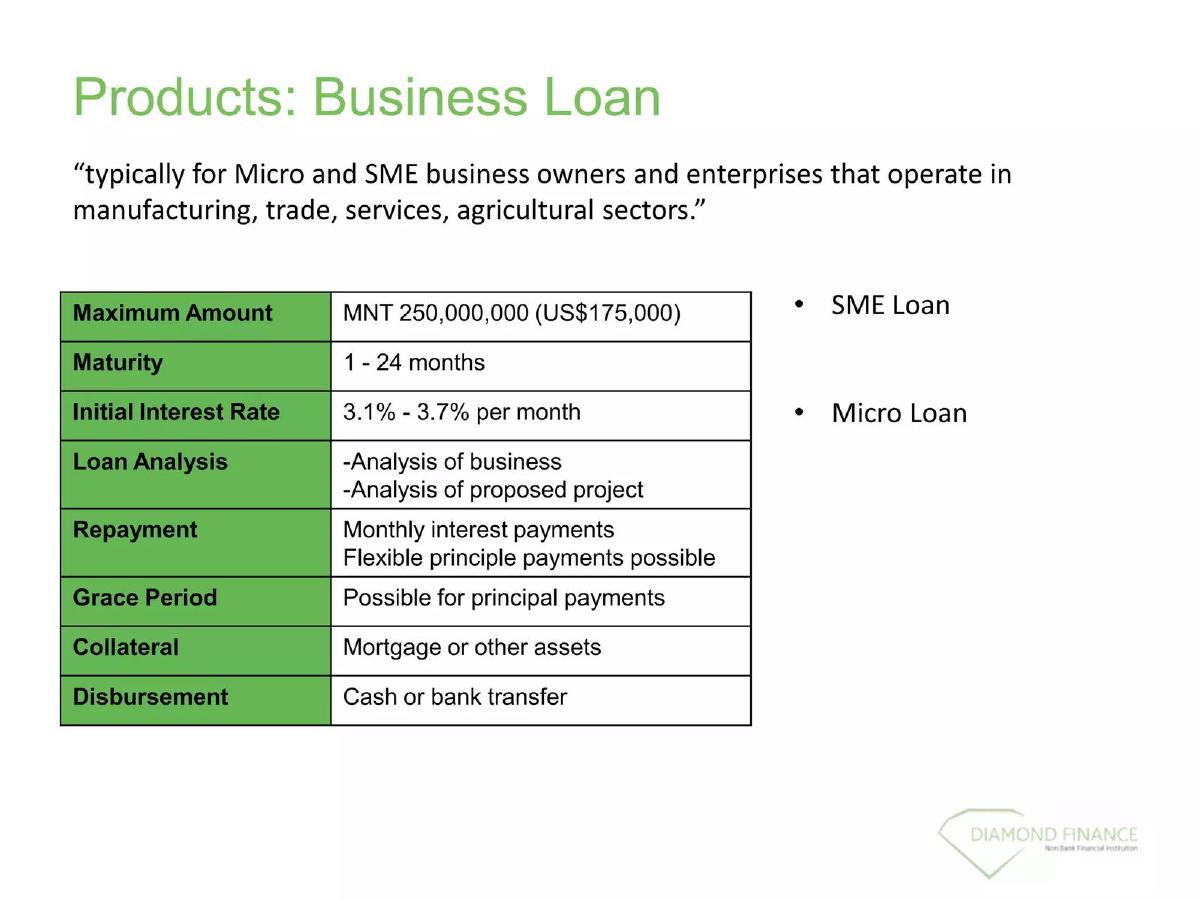
Lending, Mongolia. Business loan terms table.
Diamond Finance deck, slide 4. Exact stored slide matched to this analysis.
Our analysis: The clearest fintech product slide here: an investor can price the loan, see the borrower and see the security.
Evidence and limitation: Full product terms; no volume or default figures on this slide.
What a founder can adapt: If your product has terms (rate, fee, limit, duration), put them in a small table with the target customer above it.
Supporting analysis
What the deck claims: "Products: Business Loan" "typically for Micro and SME business owners and enterprises that operate in manufacturing, trade, services, agricultural sectors." Table: "Maximum Amount: MNT 250,000,000 (US$175,000)", "Maturity: 1 - 24 months", "Initial Interest Rate: 3.1% - 3.7% per month", "Repayment: Monthly interest payments, Flexible principle payments possible", "Collateral: Mortgage or other assets", "Disbursement: Cash or bank transfer". Side list: "SME Loan", "Micro Loan".
Presentation choice: For a lender, rate, duration and collateral are what investors assess first; putting them in one table saves a round of questions.
When it does not fit: Monthly rates of 3.1%–3.7% invite questions about risk; add default or repayment data nearby.
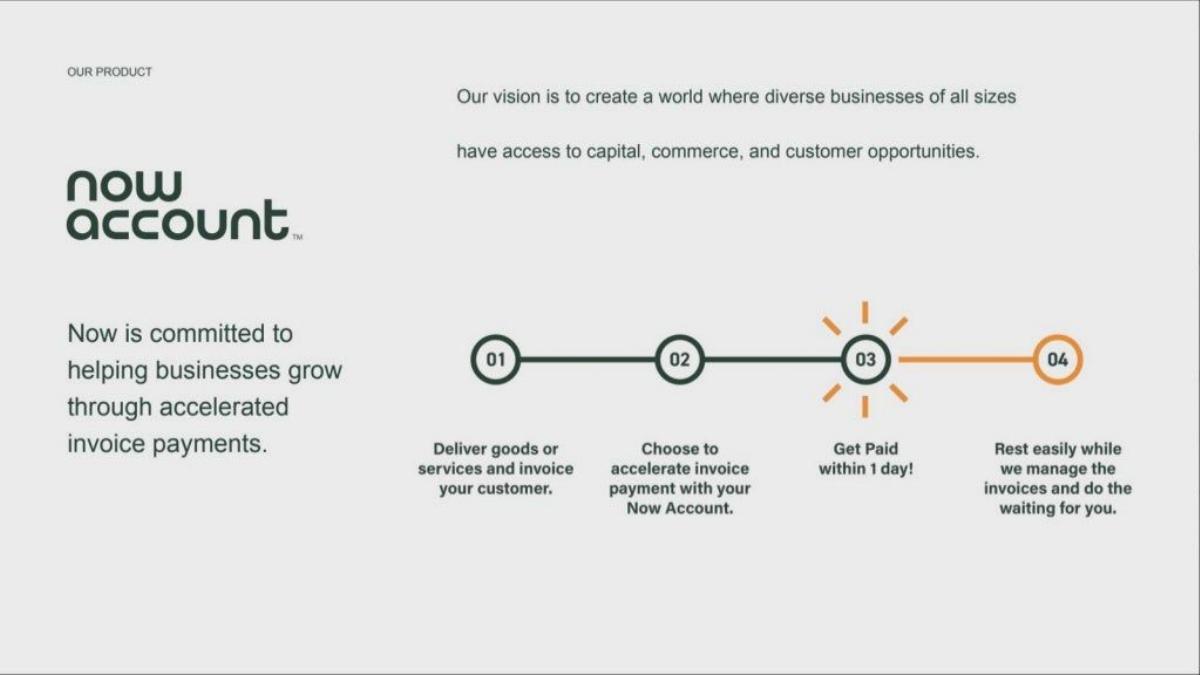
Series A. Invoice payments for small businesses. Four-step flow.
Now Account deck, slide 5. Exact stored slide matched to this analysis.
Our analysis: Shows who does what and when cash arrives; step 3 is highlighted as the payoff.
Evidence and limitation: A four-step flow with one timing claim; no fee or volume shown.
What a founder can adapt: Show the money flow in three or four steps and emphasise the moment the customer gets paid or saves.
Supporting analysis
What the deck claims: "Now is committed to helping businesses grow through accelerated invoice payments." Steps: "01 Deliver goods or services and invoice your customer." "02 Choose to accelerate invoice payment with your Now Account." "03 Get Paid within 1 day!" "04 Rest easily while we manage the invoices and do the waiting for you."
Presentation choice: "Within 1 day" turns an abstract financing product into a concrete outcome for the customer.
When it does not fit: The price is missing; add the fee (for example a percentage of the invoice) so investors can judge the margin.
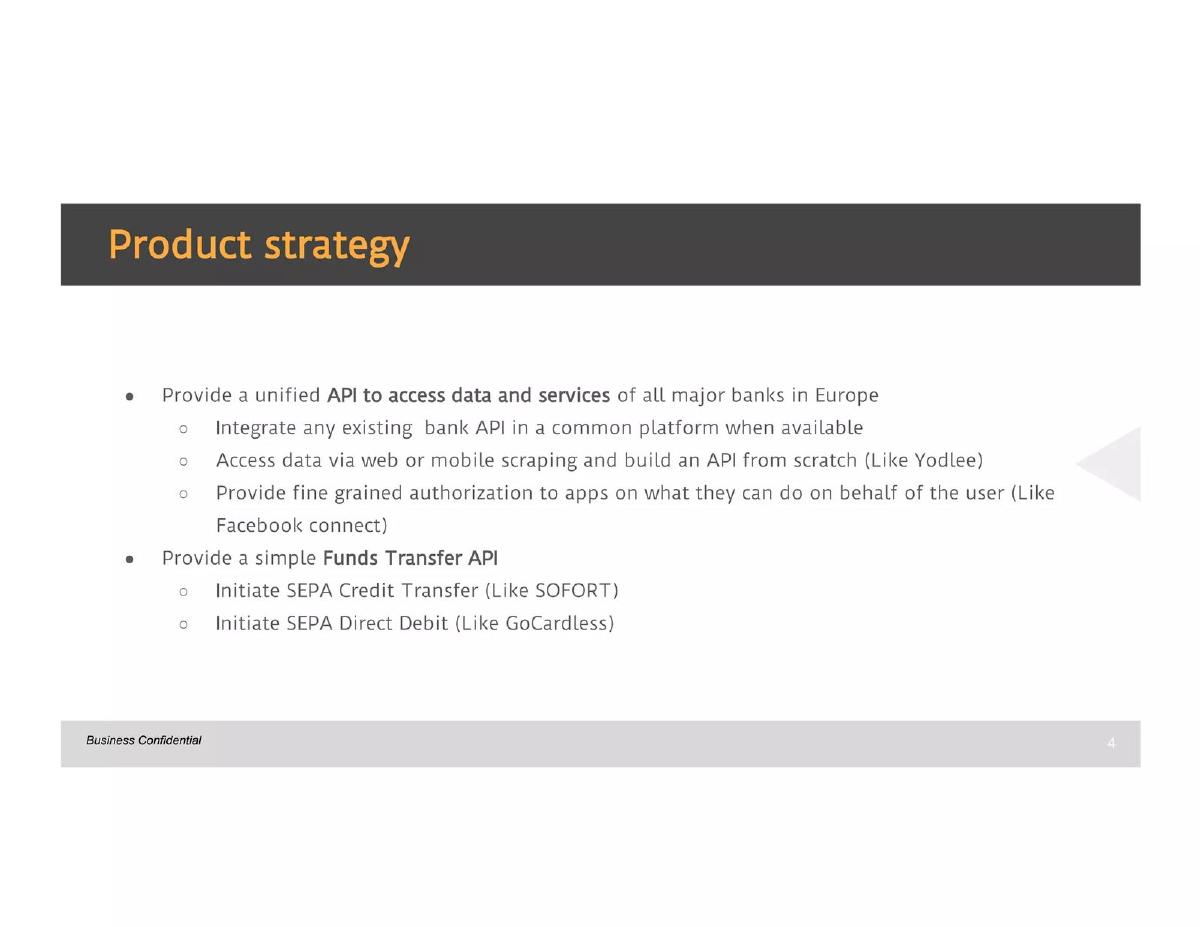
Early banking-API deck. Product strategy in two parts.
TrueLayer (Finport) deck, slide 4. Exact stored slide matched to this analysis.
Our analysis: Explains an invisible infrastructure product by stating its scope and naming a known product for each part.
Evidence and limitation: Scope and method of the API; no bank count or customers.
What a founder can adapt: For infrastructure, state what it connects to, how, and name a known product for each capability.
Supporting analysis
What the deck claims: "Product strategy." "Provide a unified API to access data and services of all major banks in Europe": "Integrate any existing bank API in a common platform when available", "Access data via web or mobile scraping and build an API from scratch (Like Yodlee)", "Provide fine grained authorization to apps on what they can do on behalf of the user (Like Facebook connect)". "Provide a simple Funds Transfer API": "Initiate SEPA Credit Transfer (Like SOFORT)", "Initiate SEPA Direct Debit (Like GoCardless)".
Presentation choice: The "Like Yodlee" and "Like GoCardless" references let investors place each capability quickly.
When it does not fit: Text-only and small; one diagram (apps → API → banks) would be read faster.
Grayscale deck, slide 5. Exact stored slide matched to this analysis.
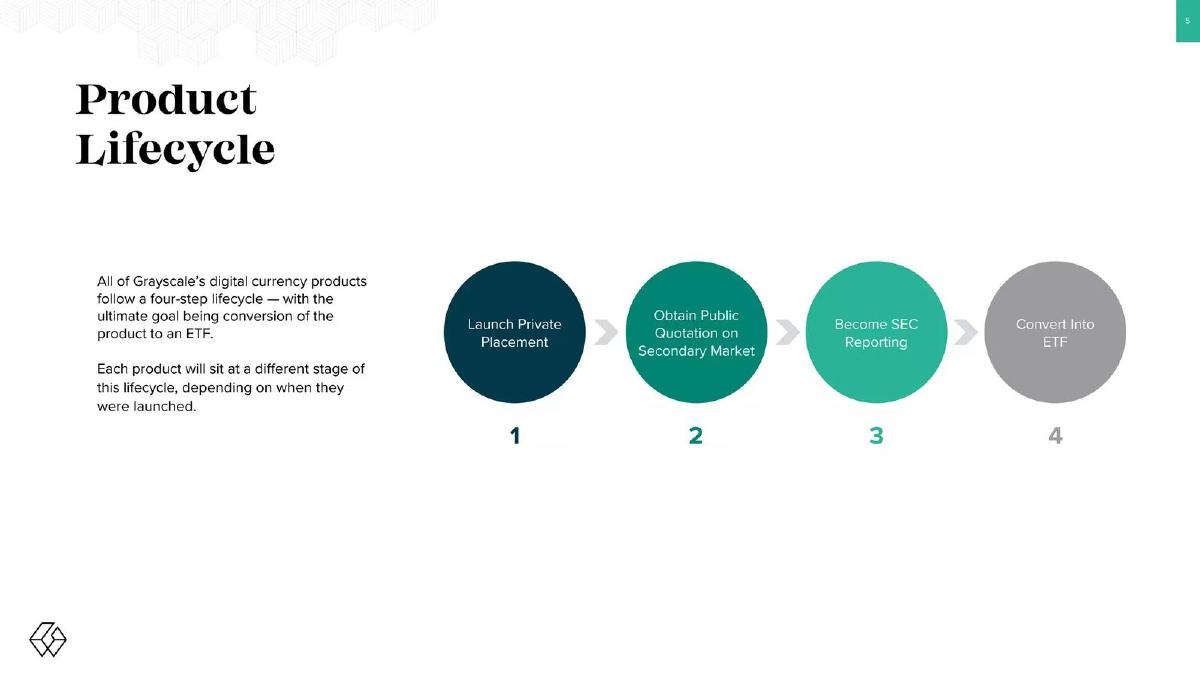
Our analysis: Shows how every product matures, using regulatory milestones as the steps.
Evidence and limitation: A regulatory path; no product-by-stage status or assets shown.
What a founder can adapt: If your product depends on approvals or licences, show the stages and where you are.
Supporting analysis
What the deck claims: "Product Lifecycle." "All of Grayscale's digital currency products follow a four-step lifecycle — with the ultimate goal being conversion of the product to an ETF." Steps: "1 Launch Private Placement", "2 Obtain Public Quotation on Secondary Market", "3 Become SEC Reporting", "4 Convert Into ETF". "Each product will sit at a different stage of this lifecycle, depending on when they were launched."
Presentation choice: For a regulated product, the path to approval is part of the product; this makes it one visual.
When it does not fit: It says each product sits at a different stage but doesn't show which; mark each product on the path.
MOL deck, slide 4. Exact stored slide matched to this analysis.
Our analysis: The distribution line at the bottom is the real message; the five brands above it are harder to follow.
Evidence and limitation: Distribution figures (970,000 locations, 11 countries, 100+ banks); no revenue per product.
What a founder can adapt: With several products, lead with what they share (network, customers) and then list them.
Supporting analysis
What the deck claims: "Our Product Portfolio." zGold ("An online micropayment platform to purchase digital products and services"), MOLReloads ("An electronic distribution application for variety of applications"), MOLPay ("An integrated e-commerce payment gateway solutions"), mmog.asia ("An integrated web and mobile game publisher/portal"), One2pay ("An e-wallet application for real world payments of products and services"). "Diverse, yet synergistic product portfolio." "Our physical distribution network comprises more than 970,000 locations in over 11 countries across 4 continents." "...accepts major credit cards and online banking from over 100 banks."
Presentation choice: The location and bank counts show reach, which is what connects the products.
When it does not fit: "Synergistic" is asserted, not shown; say which customers use more than one product.
Growth-stage prepaid and remittance services. Service list with photos.
NXGH deck, slide 6. Exact stored slide matched to this analysis.
Our analysis: A weaker example: many unrelated services, with only one price shown and no customer named.
Evidence and limitation: Seven services and one price range; no volumes.
What a founder can adapt: Name the customer the services share and show the one or two that bring most revenue.
Supporting analysis
What the deck claims: "Products & Service Offering." "Available Mobile App, Online & Kiosk." "Cash-to-Plastic: (GPR) General Purpose Reloadable Cards", "Prepaid cellular Plans: $7-$65 per month", "Wholesale Long Distance Service", "Digital Currency Exchange", "Global Remittance Service", "Bill Payments", "Instant Issue Prepaid Gift Cards and Debit Cards". Photos of a phone, a kiosk and cash.
Presentation choice: Included for contrast: the channels (app, online, kiosk) are the useful part and are easy to miss.
When it does not fit: Seven services with stock photos spread attention; group them or cut to the main ones.
How the product is presented, whether terms or price are shown, and whether the customer is named.
Example
Fintech type
Presented as
Terms or price
Customer named
Diamond Finance
Lending
Terms table
Yes (amount, rate, term)
Yes
Now Account
Invoice payments
Four-step money flow
Timing only
Yes
TrueLayer (Finport)
Banking API
Scope + comparables
No
Apps (implied)
Grayscale
Investment products
Regulatory lifecycle
No
No
MOL
Payments portfolio
Brand list + reach
No
No
Maybe
Personal finance
Feature list
No
Consumers (general)
NXGH
Prepaid / remittance
Service list
One range
No
Key Takeaways
Show the terms (amount, price, time) or the money flow, not a feature list.
Lending: a terms table answers the investor's first questions.
Payments: show the steps and the moment the customer is paid.
Infrastructure: state the scope and name the products it replaces.
Several products: say what links them before listing brand names.
Build your fintech product slide
Start from what happens to one customer's money, then pick the format that shows it.
Customer. Who uses it (SME borrower, consumer, developer, merchant).
Terms. Amount, price or fee, duration, and any security or limit.
Money flow. The 3–4 steps money moves through, and when the customer is paid or saves.
Rails. What it runs on (banks, card networks, licences) and a known product it resembles.
Copyable framework: For [customer]: [amount/price/term]. [Step 1] → [step 2] → [paid/saved in X]. Runs on [rails], like [known product].
Illustrative example 1 — written by us
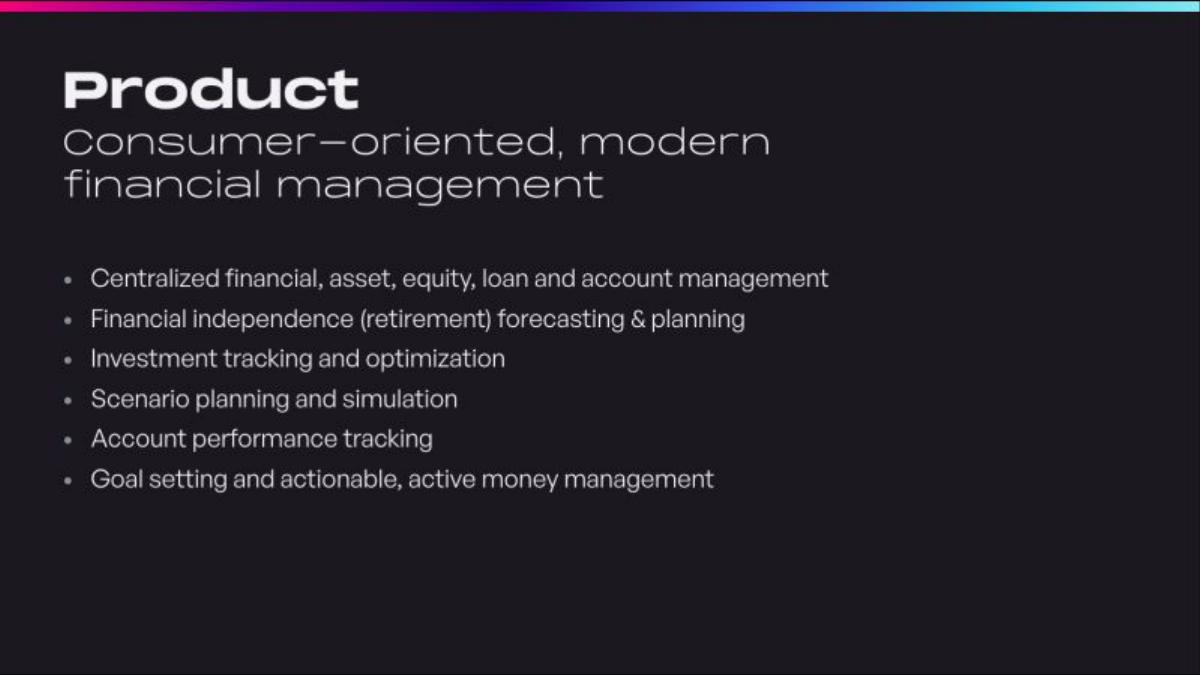
Before: Centralized financial, asset, equity, loan and account management. Investment tracking and optimization.
After: A household links its bank, brokerage and loan accounts and sees net worth and retirement date on one screen. [Add a real screen and one figure, e.g. accounts linked per user].
What improved: Our illustrative rewrite; not Maybe's wording. It names the user and the outcome and leaves a marked place for a real screen and figure.
What this guide adds
The library already has a general product slide guide and a product-by-stage guide. This page looks only at fintech decks, where the product is a financial service and investors want to see its terms, its money flow and the rails it runs on.
Sector labels come from the sector recorded for each published teardown, all high confidence. The seven decks span lending (Diamond Finance), invoice payments (Now Account), banking APIs (TrueLayer's early Finport deck), investment products (Grayscale), personal finance (Maybe), payments portfolios (MOL) and prepaid and remittance services (NXGH). None of these decks appears in another guide.
Four ways fintech decks show the product
Terms table (Diamond Finance): amount, duration, rate, collateral, repayment and disbursement on one slide. It reads like the product itself because, for a loan, the terms are the product.
Money-flow steps (Now Account): what the business does, what Now does, and when cash arrives. The payoff step (paid within one day) is visually emphasised.
Scope and comparables (TrueLayer/Finport, Grayscale): what the infrastructure covers or the path each product follows, with familiar names or regulatory stages as reference points.
Lists and portfolios (Maybe, MOL, NXGH): features or product names. These are easy to make but leave the investor asking what the customer pays, receives or saves.
Common mistakes
Features without terms. Show price, rate, fee or limit.
No money flow. Show when the customer is paid or saves.
Brand list first. Lead with what links several products.
Unnamed customer. Say who the product is for.
High rates without risk data. Put repayment or default data nearby.
Diagnostic checklist
One named customer.
Terms or price on the slide.
Money flow or approval path, in 3–4 steps.
Rails or a known comparable named.
No list longer than five items.
Frequently asked questions
How we chose these examples
Corpus: published pitch deck teardowns on StartupFundraising.com. Founder-uploaded private decks are excluded.
Selection (2026-09-25): we took teardowns whose recorded sector is fintech with high confidence and found slides whose text begins with Product (9 decks qualified). We excluded decks already used in another guide (Freetrade, KoinX) and kept only slides with a stored image, leaving seven, all used here. Maybe and NXGH are included as weaker examples for contrast.
Sector is the category recorded for each teardown. Stages are shown only where recorded with high confidence (Now Account, Series A) or medium confidence (Grayscale, MOL, NXGH shown as growth-stage).
Review: stored slide text and images were checked on 2026-09-25 and matched to company, deck and slide number (editorial model review). No person has yet completed an editorial review of this page.
Claims and terms are as shown on the slides; we have not verified them. We make no claim that any slide caused a fundraising outcome.