TriplePulse entered the competitive sports nutrition market with a hybrid subscription model designed to solve two problems: the daily need for essential vitamins and the desire to discover new performance supplements. By combining private-label 'essentials' with third-party 'discoveries,' the company aimed to capture high-margin recurring revenue while acting as a marketing channel for established brands. The deck, dating back to late 2012, highlights a beta product built on a customized WordPress platform and a roadmap that included B2B whitelabeling. While the deck excels at visualizing th…
Key takeaways
- The product is a hybrid subscription box containing a month's worth of custom vitamins plus curated samples like energy shots and protein bars (Slide 3).
- TriplePulse utilizes a 'TriplePulse-Branded' private label strategy for its essential vitamin components to capture higher margins (Slide 3).
- The company identifies four competitive pillars: progressive voice, replenishment, curated discoveries, and expert content (Slide 10).
- Acquisition strategy relies heavily on a 'Fitness Trainer Affiliate Network' and athlete endorsements to drive activation (Slide 6).
- The beta web app was built using a customized WordPress site with a subscription e-commerce plugin (Slide 13).
- A B2B revenue stream was tested through a whitelabel partnership with FITist (Slide 13).
- The deck omits a team slide, financial projections, and a specific funding ask (All Slides).
- Product personalization is driven by a mobile onboarding flow that asks users about fitness goals and 'problem areas' (Slide 17).
TriplePulse Pitch Deck Analysis
TriplePulse represents an early-2010s approach to the subscription box craze, specifically targeting the sports nutrition and wellness vertical. The deck focuses heavily on product composition and market positioning, attempting to carve out a niche between traditional retailers like GNC and discovery-focused boxes like Bulu Box. By branding their own vitamins while sampling others, they aimed to build a high-margin recurring business supported by third-party marketing dollars.
Slide 1: Title and Value Proposition
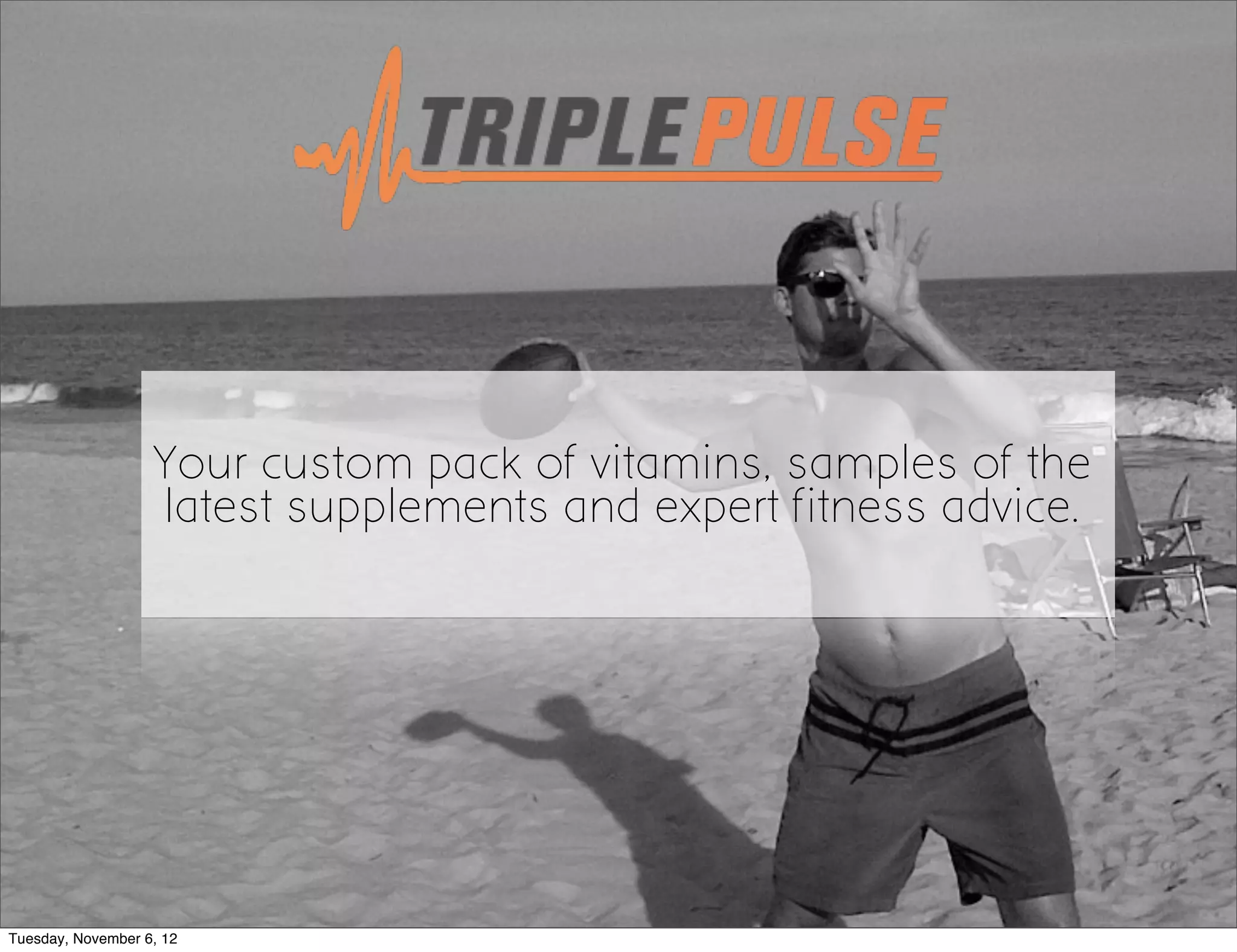
The cover slide introduces the brand with an orange pulse-line logo. The subtitle defines the business clearly: "Your custom pack of vitamins, samples of the latest supplements and expert fitness advice." The imagery of a man playing football on a beach suggests a target demographic of active, everyday athletes rather than hardcore bodybuilders. A date stamp at the bottom indicates the deck was last updated around November 6, 2012.
Slide 3: Beta Product for Initial Customer Set
This slide is the core of the product explanation. It breaks the subscription box into two distinct parts. On the left, "Discover Curated Samples" includes functional categories like Sleep aids (ZzzQuil, Dream Water), Energy (B-12 patches, 5-hour Energy), Hangover Recovery (Milk Thistle, Zico), and "Healthy Cheats" (protein bars). On the right, "Replenish Personalized Essentials" features TriplePulse-branded custom vitamins. The equation shows that these two components equal the final physical box. This is a strategic move: the samples provide variety and 'delight,' while the private-label vitamins provide the high-margin 'anchor' that ensures the customer stays subscribed for their daily health needs.
Slide 6: DTC Customer Acquisition
TriplePulse presents a comprehensive, if somewhat generic, honeycomb diagram of their growth strategy. The Acquisition phase relies on a mix of content (blogs, PR) and direct partnerships. Notably, they highlight an "Affiliate Network of Fitness Trainers" and "Athlete Endorsements" as primary drivers. This suggests a B2B2C approach where trainers act as the trusted gateway to the consumer. The Referral section mentions an ambassador program, while Retention is tied to "Curated Expert Content" and "System Events," implying a software-led engagement strategy to keep users from canceling their subscriptions.
Slide 8: Beta Web App
This slide provides social proof that the product exists. It shows screenshots of the beta website, which was hosted at triplepulse.com/beta . The interface allows for subscriptions and the purchase of full-size products, which the slide notes are "dropshipped from supplier." Two specific packs are visible: the "#alpha" for those who "Work hard. Live harder," and the "#wkndwarrior" for the "Johnny workout guy." This segmentation shows an early attempt to tailor the product to different fitness personas.
Slide 10: Competition
The competitive matrix uses a dumbbell icon to indicate feature parity. TriplePulse compares itself to Bulu Box, JackedPack, GNC, and Men's Health . The slide argues that while competitors handle one or two aspects of the fitness journey—such as GNC handling replenishment or Men's Health providing content—only TriplePulse offers the full stack: Progressive targeted voice, Replenishment of essentials, Curated discoveries, and Content by fitness experts. By positioning themselves at the intersection of a retailer, a subscription box, and a media company, they attempt to show a unique market advantage.
Slide 13: Timeline & Milestones
This slide tracks progress from August 2012 through a projected Phase II launch in November 2013. Key achievements listed include:
Product Testing: Market research through events and surveys, and a whitelabel agreement with FITist (fitist.com) to test B2B revenue. · Web Development: Building the beta app on WordPress with a subscription plugin and hiring a lead developer. · Procurement: Securing a U.S.-based supplier for all-organic private label vitamins and a 3PL (third-party logistics) provider for fulfillment.
The timeline shows the First shipment was scheduled for November '12, coinciding with the date of the deck.
Slide 17: Mobile App Beta
The final slide in this set shows mockups of a mobile onboarding process. The goal is personalization . The screens ask users to identify their fitness goals (strength, cardio, etc.), tap on "problem areas" on a human silhouette, and list what supplements they are currently taking. This data collection is vital for the "personalized essentials" promise made on Slide 3, ensuring the vitamin pack feels bespoke to the user's specific physiology and goals.
Slide 18: Closing Imagery
The deck ends with a high-action shot of two men running on a winter road. It reinforces the brand identity—TriplePulse is for the active individual who persists regardless of conditions. There is no contact information or "Thank You" text on this specific slide, though it serves as a visual bookend to the beach imagery on Slide 1.
What Works in the TriplePulse Deck
The TriplePulse deck is effective at visualizing the physical product . Subscription businesses often struggle to explain the value of a "box," but Slide 3 does an excellent job of separating the high-margin essentials from the high-interest samples. This clear distinction helps an investor understand the unit economics potential even without a dedicated finance slide.
The milestone slide (Slide 13) is also a highlight. It shows that the founders didn't just have an idea; they actually built a MVP (Minimum Viable Product) using cost-effective tools like WordPress, secured a supply chain, and even tested a B2B partnership. This demonstrates operational execution , which is often more important than the idea itself in the e-commerce space.
What is Missing from the TriplePulse Deck
The most glaring omission is the Team Slide . In early-stage fundraising, investors are betting on the founders. Without knowing who is running TriplePulse, their background in nutrition, or their experience in e-commerce, it is impossible to assess the risk of the venture. A deck without a team slide is rarely successful in a professional setting.
Furthermore, the deck lacks a Financial Ask and Use of Funds . We do not know if they are looking for $50,000 or $5,000,000. There are no projections for subscriber growth, churn rates, or margins. For a subscription business, unit economics (CAC vs. LTV) are the most important metrics, and their absence here suggests this may have been a pitch for a partnership or a very early "friends and family" presentation rather than a formal VC pitch.
Founder Takeaways
Founders should emulate the clear product equation found on Slide 3. If your business model involves multiple value streams, breaking them down into a simple "A + B = Product" visual is highly effective. It removes ambiguity and allows the viewer to focus on the strategy rather than trying to figure out what is in the box.
However, founders must avoid the "Feature Checklist" trap seen on Slide 10. While TriplePulse uses it to show they do "everything," investors often view a company that tries to be a retailer, a magazine, and a subscription box simultaneously as one that lacks focus. It is usually better to show how you dominate one specific category before expanding into others. Finally, always include your team and your ask; a pitch deck is a sales document, and you cannot close a sale without a price and a person to sign the contract.
Frequently asked questions
- What exactly is the TriplePulse product?
- TriplePulse is a subscription box service for fitness enthusiasts. According to Slide 3, each box contains a 'Month's worth of custom vitamins' which are TriplePulse-branded, combined with 'Curated Samples' from other brands. These samples are categorized into functional needs such as Sleep aids, Energy, Hangover Recovery, and 'Healthy Cheats' like protein bars. The goal is to provide daily essentials while allowing users to discover new products.
- How does TriplePulse plan to acquire customers?
- The company outlines a multi-channel DTC acquisition strategy on Slide 6. Key pillars include an 'Affiliate Network of Fitness Trainers,' athlete endorsements, and partnerships with health and fitness clubs. They also plan to use traditional digital marketing like SEO, SEM, and social networks, alongside 'Email Bartering' and media partnerships. Retention is driven by curated expert content and time-based system alerts.
- Who are the primary competitors identified in the deck?
- Slide 10 compares TriplePulse against four distinct types of competitors. Bulu Box and JackedPack are cited for curated discoveries. GNC is listed as the incumbent for replenishment of essentials. Men's Health is positioned as the competitor for fitness expert content. TriplePulse claims to be the only player that combines all four attributes: targeted voice, replenishment, discovery, and expert content.
- What is the technical state of the product in this deck?
- At the time of the deck, the product was in beta. Slide 13 reveals that the web app was developed using 'Customized Wordpress w/subscription e-commerce plugin.' Slide 8 shows the beta site at triplepulse.com/beta, which supported dropshipping full-size products from suppliers. Slide 17 shows mockups for a mobile app beta focused on the user onboarding and personalization process.
- What crucial fundraising information is missing from this deck?
- This deck is missing several standard components required for a professional investment round. There is no 'Team' slide introducing the founders or their expertise. There is no 'Ask' slide detailing how much capital is being raised or the valuation. Most importantly, there are no financial metrics, such as Customer Acquisition Cost (CAC), Lifetime Value (LTV), or revenue projections.