Triller’s 10-slide SPAC deck from 2023 presents a company attempting to move beyond the 'TikTok clone' label by positioning itself as an integrated ecosystem for creators. The narrative centers on an 'open-garden' philosophy, contrasting itself with 'Big Tech' platforms that capture >99% of value while creators take <1%. Key strengths include massive top-line metrics—350M+ organic downloads and a jump from $49M to $100M+ revenue between 2021 and 2022. However, the deck relies heavily on a complex web of acquired brands (Verzuz, BKFC, FITE) and speculative future tech like the 'METAVERZ.' Whil…
Key takeaways
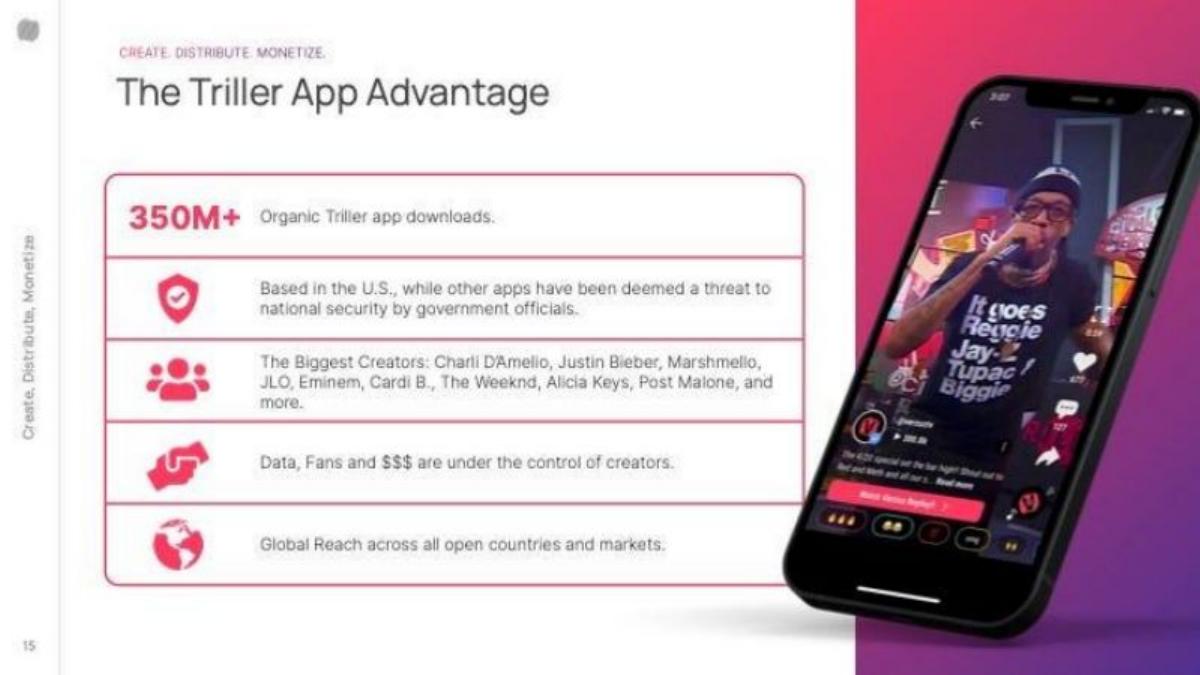
- Triller claims over 350 million organic app downloads as of slide 6.
- The company positions itself as a U.S.-based alternative to apps deemed a 'threat to national security' on slide 6.
- Revenue grew from $49 million in 2021 to over $100 million in 2022, according to slide 9.
- Social media actions per quarter saw a massive spike from 1.6 billion in 2021 to 175 billion in 2022 (slide 9).
- The ecosystem includes several acquired or partnered brands such as Verzuz, BKFC, FITE, and Amplify.ai (slide 4).
- Triller's sports vertical achieved the 'No.1 Digital PPV Event Ever' with Tyson v. Jones in November 2020 (slide 7).
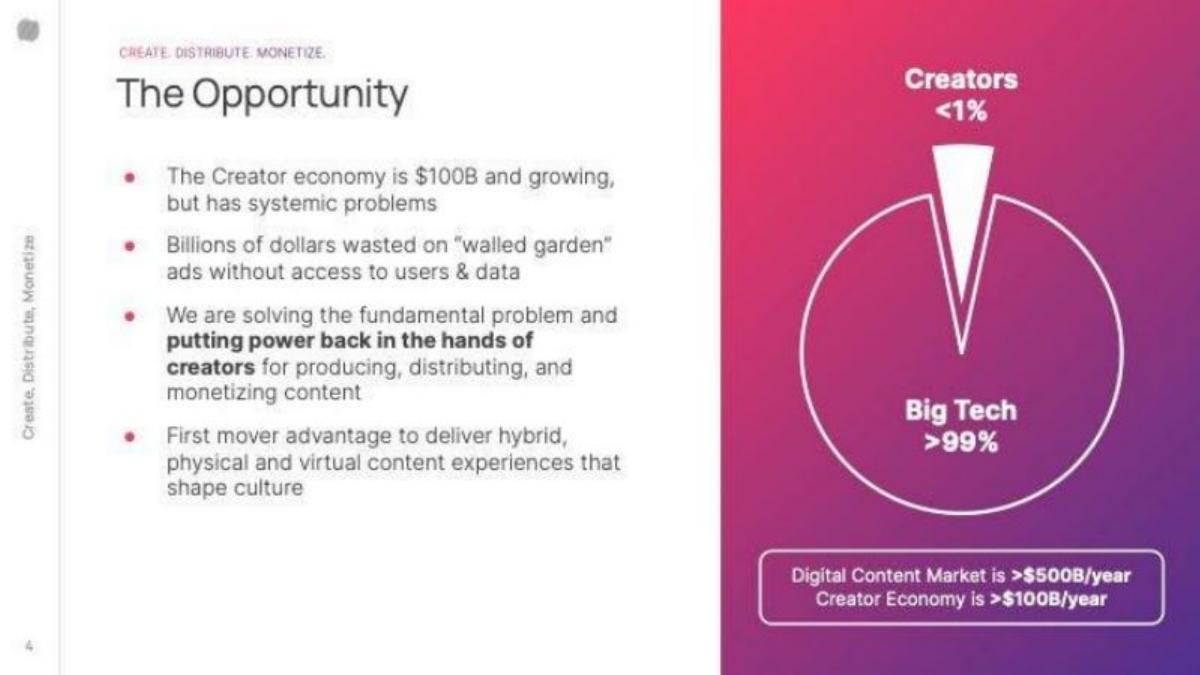
- The deck identifies a $500B+ annual digital content market and a $100B+ creator economy on slide 3.
- The 'METAVERZ' strategy includes virtual events, blockchain gaming, and digital/physical fashion (slide 8).
The Triller SPAC Deck: Aggregating the Creator Economy
Triller’s 2023 pitch deck is a study in ecosystem narrative. Rather than presenting as a single app, the company presents itself as a 'Creator Engine'—a conglomerate of media, technology, and live entertainment properties. This teardown examines how the company used its SPAC-era presentation to justify a $500M raise by leaning into high-growth metrics and the geopolitical vulnerabilities of its competitors.
Slide 1: Title Slide
The deck opens with a bold vision: "Where Creators Shape Culture, Content, and Commerce." The subtitle, "Superpowers for Creator and Brands," establishes the dual-sided nature of their marketplace. Notably, the slide includes the ticker "NASDAQ: ILLR," signaling the company's intent or status regarding public markets at the time of the presentation.
Slide 2: Disclaimers
A standard, text-heavy legal disclaimer slide. It specifies that the information is for Triller Hold Co LLC and emphasizes the speculative nature of the investment and the lack of a secondary market for interests at that time.
Slide 3: The Opportunity
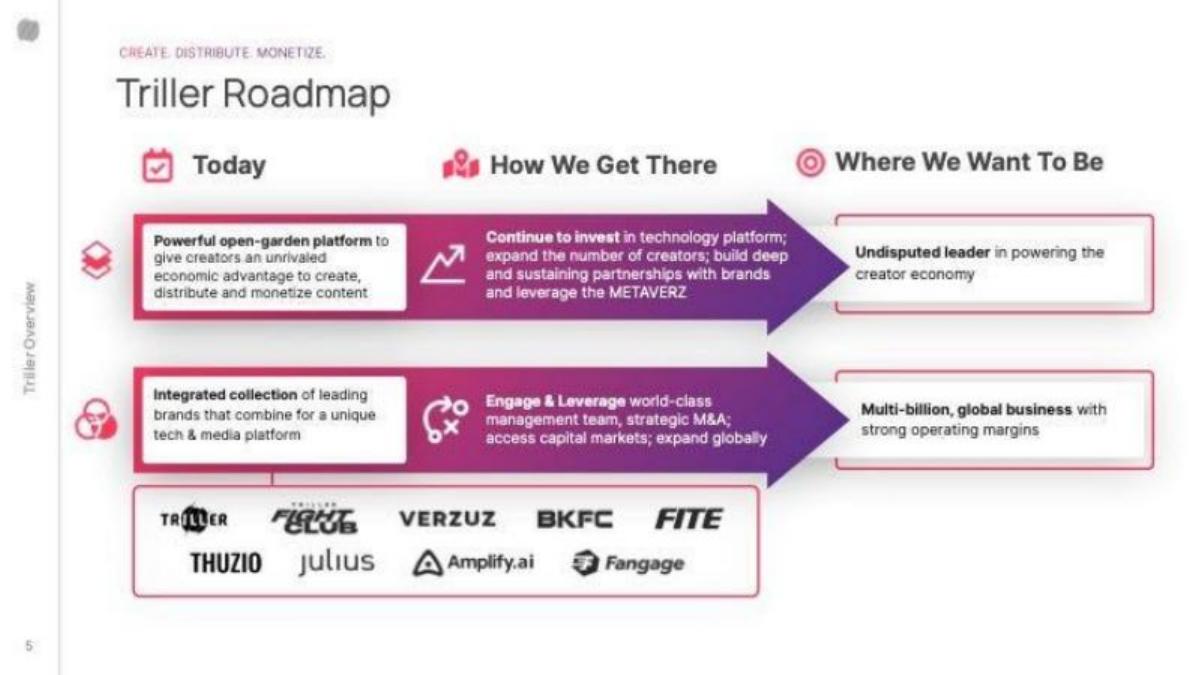
Triller frames the market problem as a lopsided distribution of wealth. They state the Creator Economy is worth over $100B and the Digital Content Market is over $500B per year. The visual centerpiece is a pie chart showing "Big Tech" capturing >99% of the value, while "Creators" receive This slide outlines the transition from an "integrated collection of leading brands" to an "undisputed leader." It lists several key subsidiaries and partners: Verzuz, BKFC, FITE, Thuzio, Julius, Amplify.ai, and Fangage. The goal is stated clearly: to become a "multi-billion, global business with strong operating margins" by leveraging strategic M&A and the "METAVERZ."
Slide 5: Triller Creator Engine
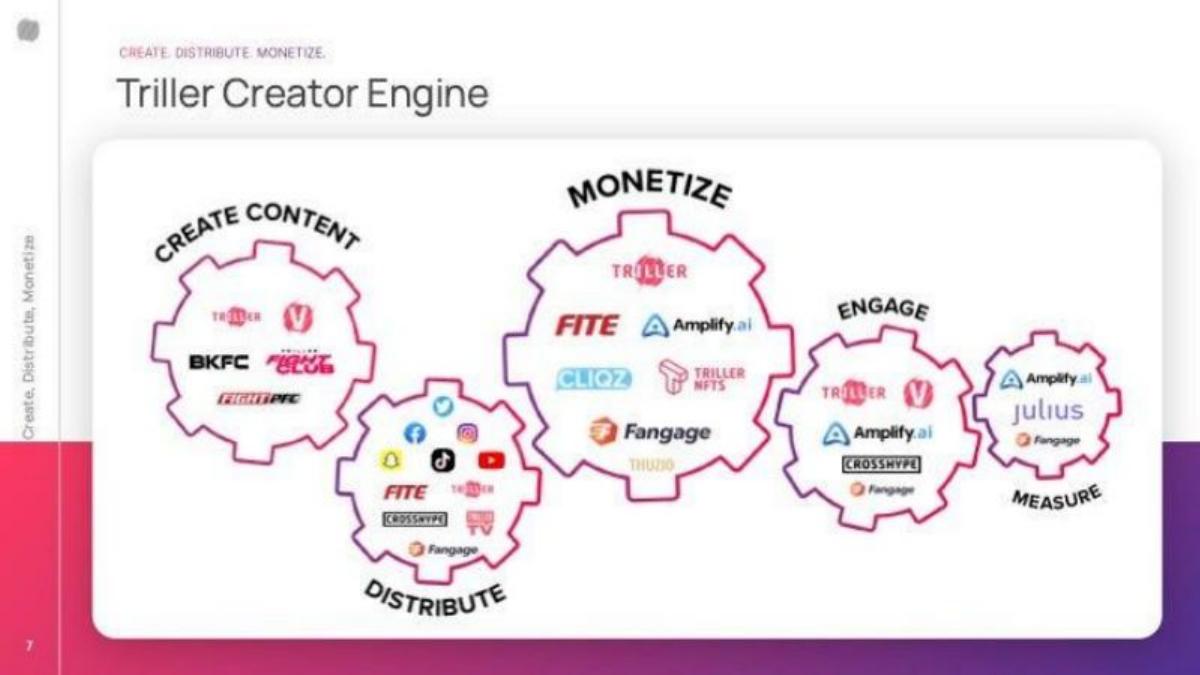
This is the functional heart of the deck. It uses a series of interlocking gears to show how their various acquisitions fit together. The gears are labeled: Create Content (Triller, Verzuz, BKFC), Distribute (TikTok, Instagram, and YouTube icons are shown here, suggesting Triller acts as a distribution hub to other platforms), Monetize (FITE, Triller NFTs, Fangage), Engage , and Measure (Julius, Amplify.ai). It is a visual argument for a full-stack creator platform.
Slide 6: The Triller App Advantage
Here, the deck provides its most significant user metric: 350M+ Organic Triller app downloads . It also leans into a geopolitical narrative, stating it is "Based in the U.S., while other apps have been deemed a threat to national security." The slide lists high-profile creators associated with the platform, including Justin Bieber, Marshmello, and Cardi B, and reiterates that fans and data are under creator control.
Slide 7: Triller SPORTS
Focusing on the sports vertical, this slide highlights the success of the Tyson v. Jones event in November 2020, calling it the "No.1 Digital PPV Event Ever." Metrics include 5M+ registered FITE users, 2B+ BKFC social media impressions, and 1K+ live events streaming per year. It shows a progression from pre-event content to live event monetization and post-event engagement.
Slide 8: METAVERZ
This slide introduces the "METAVERZ" strategy, divided into six pillars: Virtual Events, Socialization, Gamification, Theater, Fashion District, and Monetization. It mentions blockchain gaming and "Watch parties with friends," though it lacks specific screenshots or user data for these features, suggesting they are future-looking or in early stages.
Slide 9: Key KPIs
The deck concludes its data presentation with a series of dramatic growth charts comparing 2021 to 2022:
Social Media Actions/Qtr: 1.6B to 175B. · Content Engagements/Qtr: 1.6B to 2.3B. · Revenue/Year: $49M to $100M+. · Events on Platform: 1,100 to 2,000. · Creators Tracked/QTR: 10,000 to 2,100,000. · Brands Tracked/QTR: 275 to 25,000.
The right side of the slide lists monetization methods, including revenue share, PPV, and platform fees.
Slide 10: Closing / External Link
The final slide is a promotional page for the platform hosting the deck, providing no further company information but offering a link to browse other examples.
What Triller Does Well
The deck excels at narrative positioning . By framing the struggle as "Creators vs. Big Tech," Triller aligns itself with the zeitgeist of the creator economy. They successfully move the conversation away from being a "TikTok alternative" to being a comprehensive infrastructure provider. The use of the "Creator Engine" gear graphic (Slide 5) is an effective way to show how disparate acquisitions like FITE (streaming) and Julius (influencer marketing) create a unified value proposition.
The growth metrics on Slide 9 are also designed to impress. A jump from 1.6 billion social actions to 175 billion in a single year suggests a platform that has reached a massive inflection point. Furthermore, citing the Tyson v. Jones fight as the "No. 1 Digital PPV Event Ever" provides a concrete "win" that proves the platform's ability to handle scale and generate significant transactions.
What is Missing from the Triller Deck
The most glaring omission is a Team Slide . In a SPAC or late-stage round, investors expect to see the pedigree of the leadership team, especially when the strategy relies so heavily on complex M&A and global expansion. While Slide 4 mentions a "world-class management team," no names or backgrounds are provided.
Additionally, the deck lacks Unit Economics . While revenue is shown to be growing (Slide 9), there is no mention of Customer Acquisition Cost (CAC), Lifetime Value (LTV), or burn rate. Given the high costs associated with live sports rights and celebrity partnerships, the absence of profitability timelines or margin details is a significant gap. The "METAVERZ" slide (Slide 8) also feels speculative, lacking any evidence of current traction or technical feasibility compared to the more established sports and video metrics.
What a Founder Should Copy
Founders should emulate Triller's ecosystem visualization . If your company is more than just an app—if it’s a platform that connects multiple stakeholders—using a "gears" or "engine" visual (Slide 5) is a powerful way to explain how different product features or acquisitions work together to create a flywheel effect.
Another takeaway is the competitive framing . Triller doesn't just say they are better than their competitors; they frame the competitors' business models as fundamentally exploitative to the user (Slide 3). By positioning your startup as the "pro-user" or "pro-creator" alternative to an established incumbent, you create a moral and economic argument for your existence that goes beyond simple feature comparisons.
Frequently asked questions
- What is Triller's core value proposition to creators?
- Triller positions itself as an 'open-garden' platform that gives creators control over their data, fans, and monetization. Unlike 'Big Tech' platforms that Triller claims take over 99% of the value, Triller's 'Creator Engine' (slide 5) is designed to help creators create, distribute, and monetize content through a suite of integrated tools and brands.
- How does Triller differentiate itself from TikTok?
- On slide 6, Triller explicitly highlights its U.S. base as a competitive advantage, noting that 'other apps have been deemed a threat to national security by government officials.' It also emphasizes a 'creator-first' model where data and revenue are under the control of the users rather than the platform's walled garden.
- What role does live sports play in Triller's business?
- Sports is a major pillar of the 'Triller Sports' vertical (slide 7). The company leverages live events (1K+ per year), social media engagement (2B+ impressions for BKFC), and pay-per-view (PPV) models. They claim the top digital PPV event ever with the Tyson v. Jones fight in 2020.
- What are the primary revenue streams mentioned in the deck?
- According to slide 9, Triller's monetization model includes revenue sharing, ticket sales, PPV, subscriptions, merchandise, sponsors, advertising, and platform fees. This multi-pronged approach is supported by their acquisition of platforms like FITE and Fanage.
- Is there a management team listed in the pitch deck?
- No. This 10-slide version of the deck omits a traditional team slide featuring executives or founders. It instead focuses on the 'world-class management team' as a conceptual driver for M&A and capital market access on the roadmap slide (slide 4).