Treefera’s Series B deck is a study in high-level strategic positioning for a growth-stage AI company. By focusing on the 'first-mile'—the point where nature and supply chains converge—Treefera identifies a critical blind spot for global enterprises facing strict ESG regulations like EUDR. The deck successfully bridges the gap between technical AI capabilities (satellite imagery and ground truth data) and tangible business outcomes, such as minting 50,000 carbon credits in seven weeks for a client. While the deck lacks a traditional team slide or detailed unit economics, it compensates with s…
Key takeaways
- The deck identifies a specific 'first-mile' problem where 60% of supply chain risks originate (Slide 2).
- Treefera positions its product as a 'data fabric' that integrates satellite, land, and regulatory data into a proprietary moat (Slide 4).
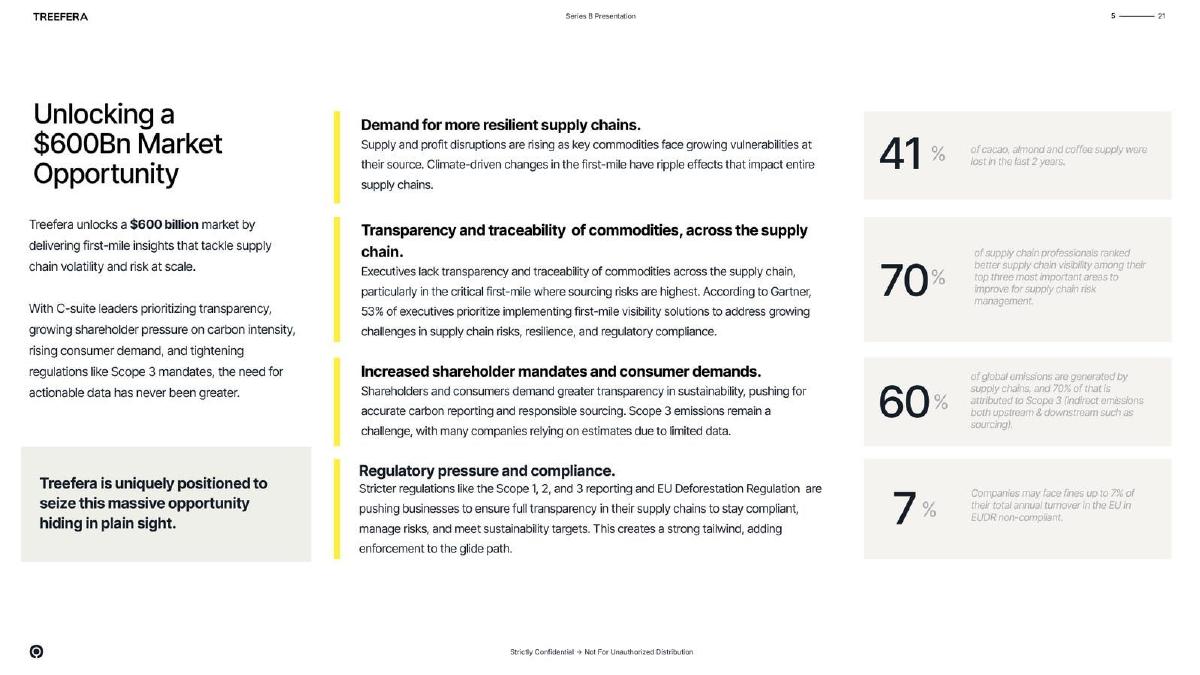
- The market opportunity is quantified at $600 billion, driven by C-suite prioritization of transparency (Slide 5).
- Regulatory pressure is a key catalyst, citing potential fines of up to 7% of annual turnover for EUDR non-compliance (Slide 5).
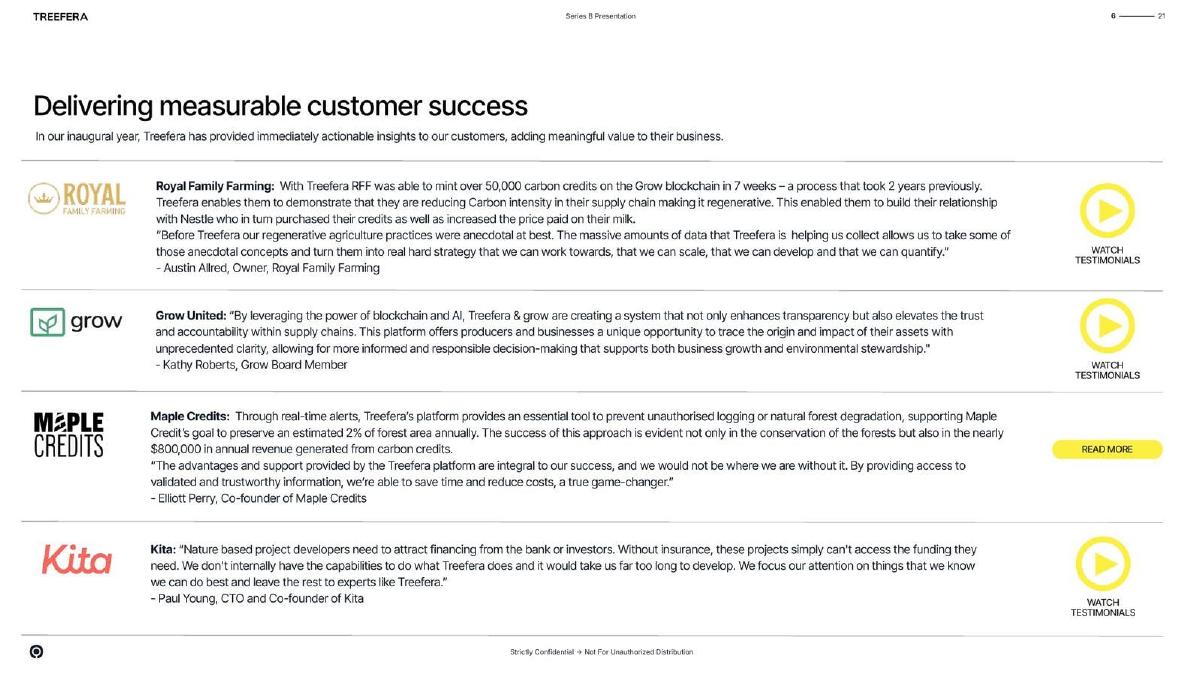
- Customer success is proven through high-velocity carbon credit minting, reducing a 2-year process to 7 weeks (Slide 6).
- The roadmap moves from a carbon-focused 'launchpad' to an industry-agnostic framework for all commodities (Slide 8).
- The funding ask was $25 million for sales operations and R&D, though the round eventually closed at $30 million (Slide 9).
- The deck omits a team slide, relying instead on the strength of the product and existing customer testimonials to carry the narrative.
The Strategic Positioning of First-Mile Visibility
Treefera’s Series B deck, used to secure a $30 million round in 2024, is a masterclass in identifying a specific, high-stakes niche within a broad market. While many ESG startups focus on general reporting, Treefera zeroes in on the 'first-mile' of the supply chain. As stated on Slide 2 , this is where 'nature, environmental shifts, and resource use converge,' and where 'over 60% of the risks and issues arise.' By defining the problem this way, they transform a vague environmental goal into a critical supply chain resilience and risk mitigation requirement.
Slide 1-2: Setting the Stage and Defining the Problem
The deck opens with a minimalist title slide and moves immediately into the problem statement. Slide 2 highlights a significant gap in the market: while 53% of executives prioritize first-mile visibility, current systems fall short, leaving 'significant blind spots.' The slide uses a clean layout to explain that changes at the source ripple through the entire supply chain, creating global impact. This framing is essential for a Series B; it moves beyond 'saving the planet' and into 'securing the business.'
Slide 3-4: The Solution and the Moat
Slide 3 introduces Treefera as an 'AI-enabled data fabric.' The use of the term 'data fabric' is a deliberate choice to suggest a more integrated, foundational technology than a simple dashboard. They list key capabilities: satellite and sensor data, solutions for sourcing and compliance, and 'plot-level' traceability. Slide 4 goes deeper into their 'strategic moat.' It visualizes the data fabric as layers of insights—from sourcing and risk to compliance and carbon metrics. By labeling this as 'proprietary' and 'AI-enabled,' they are signaling to investors that their competitive advantage is technical and difficult to replicate.
Slide 5: Quantifying the $600 Billion Opportunity
Market slides are often dismissed as 'top-down' fluff, but Treefera grounds Slide 5 in specific, painful statistics. They cite that 41% of cacao, almond, and coffee supply was lost in the last 2 years due to volatility. More importantly, they highlight the regulatory stick: companies may face fines up to '7% of their total annual turnover in the EU' for EUDR non-compliance. By connecting the $600 billion market size to these specific risks, the opportunity feels urgent rather than theoretical.
Slide 6: Measurable Customer Success
This is arguably the strongest slide in the deck. Slide 6 provides four concrete examples of the platform in action. The standout metric is from Royal Family Farming, which 'minted over 50,000 carbon credits... in 7 weeks,' compared to a previous timeline of 2 years. Another testimonial from Maple Credits mentions the platform helped generate 'nearly $800,000 in annual revenue generated from carbon credits.' These are not just happy quotes; they are hard ROI figures that prove the platform pays for itself.
Slide 7-8: Scaling and Future Innovation
Slide 7 acts as a transition, stating 'Now... we’re ready to scale up.' Slide 8 outlines the roadmap, moving from their 'launchpad' in carbon to an 'industry-agnostic framework' for all commodities. They emphasize building a 'world-class risk engine' to forecast vulnerabilities. This tells investors that while they are winning in carbon today, the ultimate goal is to be the data layer for the entire global commodity market.
Slide 9-10: The Ask and Conclusion
Slide 9 states the Series B raise is for '$25 million USD.' Interestingly, publisher reports indicate they successfully raised $30 million, suggesting the round was oversubscribed. The funds are earmarked for two areas: 'Resource for future growth sales operations and distribution' and 'R&D to deliver product scope expansion.' The deck concludes on Slide 10 with a simple thank you, maintaining the high-end, minimalist aesthetic established at the start.
What Treefera Does Exceptionally Well
The deck excels at narrative focus . By centering every slide around the 'first-mile,' they avoid the trap of trying to be everything to everyone in the ESG space. They are the 'first-mile experts.' This specificity makes their 'data fabric' story much more believable. Furthermore, the regulatory alignment is perfect. They don't just mention regulations; they quantify the cost of failure (7% of turnover), which is a powerful motivator for the C-suite buyers they are targeting.
The visual language of the deck also deserves praise. The use of wireframe landscapes (representing satellite data/topography) creates a consistent brand identity that feels both high-tech and grounded in nature. It reinforces the 'AI + Agriculture' sector mix without needing to show cluttered photos of farms on every page.
What is Missing from the Treefera Deck
The most glaring omission is a Team Slide . In a Series B, investors are backing the leadership's ability to scale a global organization. While the deck mentions a 'best in class team' on Slide 9, it doesn't name them or their backgrounds. For a public teardown, this is a significant gap, though it may have been removed for confidentiality or presented in a separate document.
Additionally, there is no Competitor Analysis . The deck claims an 'unparalleled' and 'proprietary' moat, but it doesn't acknowledge other players in the satellite analytics or supply chain traceability space (like Planet Labs or SourceTrace). Investors at this stage usually want to see how a company differentiates itself from incumbents and other well-funded startups.
Finally, the deck lacks Unit Economics . While it shows customer success, it doesn't show the company's internal efficiency—CAC (Customer Acquisition Cost), LTV (Lifetime Value), or burn rate. For a $25-30M round, these metrics are usually scrutinized heavily.
Founder Lessons: What to Copy
The 'Stick' and the 'Carrot': Follow Treefera’s lead on Slide 5. Show the massive upside (the market) but also the devastating downside of inaction (the 7% regulatory fine). · ROI-Driven Testimonials: Don't just get a quote saying your software is 'great.' Get a quote that says your software 'reduced a 2-year process to 7 weeks' or 'generated $800k in revenue.' · Define a New Category: Instead of being another 'ESG platform,' they are a 'First-Mile Data Fabric.' This makes them the leader of a category they defined themselves. · Visual Consistency: Use a recurring visual motif (like the wireframe terrain) to tie technical concepts back to the brand identity. It makes the deck feel professional and cohesive.
Frequently asked questions
- Why does the deck focus so heavily on the 'first-mile'?
- Treefera argues that the first-mile is where nature, environmental shifts, and resource use converge, yet it remains a massive blind spot for enterprises. According to Slide 2, over 60% of risks arise here. By solving for the most difficult and opaque part of the supply chain, Treefera creates a high-value entry point that makes their data indispensable for compliance and decarbonization.
- What is the 'Treefera data fabric' mentioned in the slides?
- As described on Slide 4, the data fabric is their strategic moat. It is an AI-enabled platform that synthesizes multiple disparate datasets—including satellite imagery, land records, ground truth data, and socio-economic datasets—into integrated dashboards. This allows them to provide 'commodity agnostic insights' that are more granular than traditional broad-stroke environmental reporting.
- How does Treefera handle regulatory tailwinds?
- Slide 5 explicitly calls out the EU Deforestation Regulation (EUDR) and Scope 3 mandates. They use a 'fear and greed' approach: the 'fear' of fines up to 7% of annual turnover for non-compliance, and the 'greed' (or efficiency) of capturing a share of a $600 billion market. This positions the software as a mandatory compliance tool rather than a discretionary spend.
- What evidence of product-market fit is provided?
- Slide 6 provides four detailed case studies. The most compelling is Royal Family Farming, which used Treefera to mint 50,000 carbon credits in 7 weeks—a process that previously took two years. Other testimonials from Grow United, Maple Credits, and Kita emphasize transparency, revenue generation from carbon, and the ability to attract project financing.
- Is the missing team slide a red flag for a Series B?
- In a Series B, the team is often already known to the lead investors or the company has enough momentum that the product metrics and customer list speak for themselves. While unusual for a general pitch, Treefera likely used this deck for investors who were already familiar with the founders' pedigree, focusing instead on the 'scale-up' narrative.