Thinaire’s deck focuses on the intersection of mobile engagement, NFC technology, and retail commerce. The presentation positions the company as a middleware layer—providing APIs, SDKs, and a PaaS platform—to connect physical retail environments (stores, venues) with digital back-office systems. While the deck successfully identifies a significant market opportunity, citing a $12 billion omnichannel retail sales figure on slide 2, it struggles with visual clarity. Many slides are dominated by dense, interlocking hexagonal diagrams and intricate flowcharts that may overwhelm a generalist inves…
Key takeaways
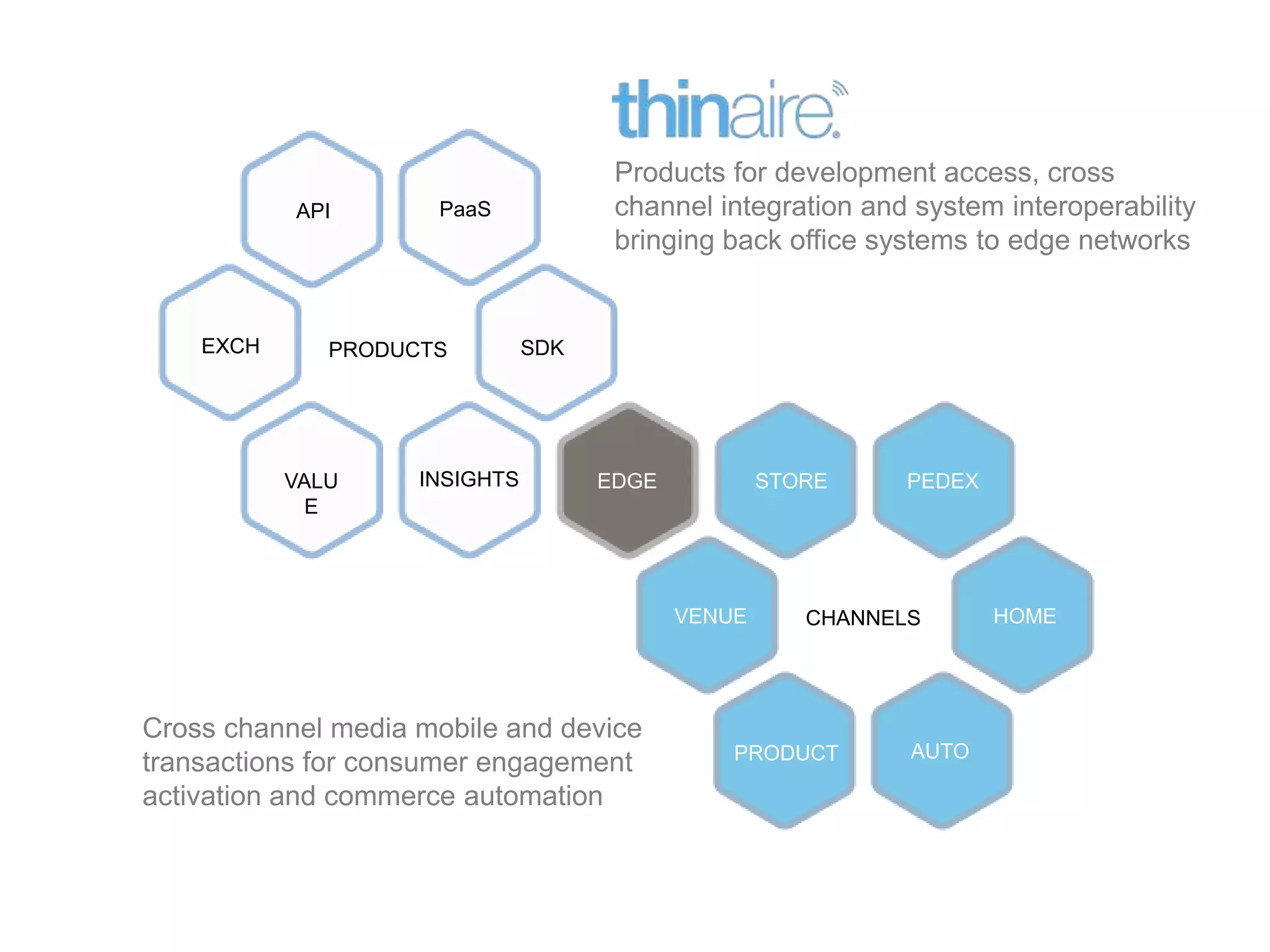
- The company positions itself as a provider of 'Products for development access' including API, PaaS, and SDK offerings on slide 1.
- Thinaire targets a $12 billion omnichannel retail sales market, citing an MIT Report titled 'Beyond the Checkout Cart' on slide 2.
- The technology stack is designed to facilitate 'NFC to beacon activation' and 'cross channel attribution' as detailed in the process flow on slide 3.
- A concrete use case is presented for the Verizon NFL Mobile App, featuring brand discovery and offer redemption for sponsors like Fritos and Pepsi on slide 4.
- The platform architecture is highly complex, involving integrations with MNOs, OEMs, and MVPDs across the automotive and video sectors on slide 5.
- Market research from eTail/WBR Digital (November 2014) indicates that 89% of respondents prioritize integrating mobile technologies in-store, supporting the company's mission on slide 6.
- The 'Line of Business Value Chain' on slide 7 attempts to map the flow from advertiser to checkout, highlighting 'persistent wallet presence' as a key outcome.
- The final slide (slide 8) introduces 'Cognitive computing and machine learning' into an already dense technical map featuring IBM Bluemix, Hadoop, and Watson.
Slide-by-Slide Analysis
Slide 1: Cover and Product Overview
The deck opens with the Thinaire logo and a high-level value proposition: "Products for development access, cross channel integration and system interoperability bringing back office systems to edge networks." The visual uses a hexagonal grid to categorize their offerings into two groups. The "Products" group includes API, PaaS, SDK, Insights, Value, and Exch. The "Channels" group includes Store, Pedex, Home, Auto, Product, and Venue. This slide establishes Thinaire as a middleware or infrastructure play rather than a consumer-facing app.
Slide 2: Market Opportunity
This slide uses a full-bleed image of a Peapod virtual grocery store at a transit station to illustrate the concept of omnichannel retail. The core metric presented is "$12 billion in omnichannel retail sales on mobile," attributed to an MIT Report titled "Beyond the Checkout Cart." This slide serves to validate the size of the problem Thinaire is solving, though it does not specify what portion of that market Thinaire expects to capture.
Slide 3: Process Flow and Features
Slide 3 is a highly technical flowchart titled "Purchase incentive offers distributed through cross channel and mobile integrated with back office systems for seamless redemption." It maps a 9-step journey from "Create Coupon Object" to "Redemption at POS." A list of features on the right includes NFC to beacon activation, cross-channel attribution, and clearance authentication. The slide uses screenshots of the Kroger app to demonstrate a real-world application of the flow.
Slide 4: Case Study - Verizon NFL Mobile App
This slide provides a specific "Story Case" dated 09.26.14. It details how the Thinaire platform works within the Verizon NFL Mobile App for brand discovery and promotion. The sequence shows a user watching a game, seeing a Fritos sponsor ad with a Pepsi offer, and then "clipping" that offer directly to a retailer loyalty card (such as Kroger, Giant Eagle, or Supervalu). This is the most effective slide for explaining the actual user experience.
Slide 5: Ecosystem Architecture
This slide returns to the hexagonal grid format but with significantly more complexity. It maps "Attributable automotive video, cross channel and mobile advertising." It connects various stakeholders including Auto Makers, Studios, MNOs (Mobile Network Operators), OEMs, and MVPDs (Multichannel Video Programming Distributors). The diagram is intended to show how Thinaire sits at the center of a fragmented ecosystem, but the density of the text makes it difficult to parse quickly.
Slide 6: Consumer Sentiment and Trends
Slide 6 focuses on "Innovative Digital Shopping Experiences for Consumers." It features a background image of a vehicle's dashboard diagnostics screen. The key data points come from an eTail/WBR Digital survey from November 2014. It lists what percentage of respondents are prioritizing different technologies: 89% for integrating mobile technologies in-store, 36% for virtual stores, and 21% for Augmented Reality. This slide reinforces the "why now" aspect of the pitch.
Slide 7: The Value Chain
Titled "To know them is to love them," this slide attempts to map the "Line of Business Value Chain." It moves from Advertiser to Publisher, Consumer, Exchange, and Vendor. Below this, a complex 3D-style grid maps various functions like "Social Network," "Inventory," "Attribution," and "Value Exch." The bullet points on the right highlight outcomes like "earned media," "programmatic," and "persistent wallet presence."
Slide 8: Technical Map - Cognitive Computing
The final slide in the set is a dense technical schematic titled "Cognitive computing and machine learning." It includes a header indicating it is an "Occasions Map V6" factoring in "IBM Bluemix." The diagram shows how data flows through various nodes like Hadoop, NoSQL, Watson, and CRM systems to result in "Brand Data Out." This slide is likely intended for a technical due diligence audience rather than a general pitch.
What Works Well
Specific Use Cases: The inclusion of the NFL/Verizon case study on slide 4 is vital. It takes the abstract concepts of "edge networks" and "omnichannel integration" and turns them into a recognizable scenario involving major brands like Pepsi and Fritos. This helps investors visualize the product in the wild.
Third-Party Validation: By citing the MIT Report and eTail/WBR Digital survey, Thinaire grounds its claims in external research. This builds credibility for the market need, especially in the then-emerging field of NFC and beacon technology.
What is Missing
The Team: There is no mention of the founders, their backgrounds, or why they are the right people to build this complex infrastructure. In early-stage fundraising, the team is often as important as the technology.
Business Model: While the deck explains what the product does, it does not explain how the company makes money. Is it a per-transaction fee, a SaaS subscription for retailers, or a percentage of ad spend? This is a significant omission.
Competition: The deck operates in a vacuum. There is no mention of other mobile engagement platforms or how Thinaire differentiates itself from existing retail tech incumbents.
The Ask: The provided slides do not include a funding request. There is no information on how much capital is needed, what the milestones for that capital are, or the current stage of the company's fundraising efforts.
Founder Takeaways
Simplify Complex Diagrams: Slides 5, 7, and 8 are visually overwhelming. While they demonstrate technical depth, they risk losing the audience. Founders should aim for one primary message per slide. If a diagram requires a five-minute explanation, it should probably be moved to an appendix.
Connect Tech to Revenue: Thinaire does a good job of showing the technical flow of a coupon, but it fails to show the financial flow to the company. Always ensure that the "how it works" slides are eventually balanced by "how we get paid" slides.
Maintain Visual Consistency: The deck jumps between hexagonal grids, standard flowcharts, and 3D-perspective grids. Maintaining a consistent visual language helps the viewer process information faster and makes the brand feel more professional.
Frequently asked questions
- What exactly does Thinaire sell?
- Based on slide 1, Thinaire sells a suite of developer-focused products including an API, SDK, and a Platform-as-a-Service (PaaS). These tools are designed for 'cross channel integration and system interoperability,' specifically aimed at bringing back-office retail and commerce systems to 'edge networks' like physical stores and mobile devices.
- Which industries is Thinaire targeting?
- The deck indicates a broad target market. Slide 1 lists Store, Venue, Home, and Auto as primary channels. Slide 4 shows a specific application in sports media (NFL), while slide 5 details a complex web of automotive and video programming distribution partners, including studios, agencies, and cable providers.
- How does the technology work for a consumer?
- Slide 3 illustrates a 9-step process where a consumer discovers a product, receives a purchase incentive, and uses NFC or beacon activation to trigger an offer. This leads to an 'opt-in authorization' and eventually a 'redemption at POS' (Point of Sale) using a mobile device or alternate identifier.
- What market data supports Thinaire's business model?
- Thinaire cites two external sources. Slide 2 references an MIT Report stating there are $12 billion in omnichannel retail sales on mobile. Slide 6 cites eTail/WBR Digital from November 2014, noting that 89% of retail respondents are focused on integrating mobile technologies in-store.
- What is missing from this pitch deck?
- The provided slides lack several critical fundraising components. There is no team slide, no slide detailing the business model or pricing, no financial history or projections, and no 'Ask' slide specifying how much capital is being raised or what the valuation is.