Tulu's 12-slide Series A deck centers on the transition from a 'Buy It Now' culture to a 'Use It Now' economy. By placing smart rental units in high-traffic residential and office buildings, Tulu provides residents with on-demand access to high-end appliances, electronics, and tools. The deck effectively uses brand logos and specific usage metrics—such as 3,000 monthly Dyson vacuum uses and 130,000 miles on Unagi scooters—to prove product-market fit. While the deck excels at establishing a vision for the 'Usage Economy' and showcasing a strong leadership team with backgrounds at Uber, Lime, a…
Key takeaways
- Tulu frames its market opportunity as a generational shift where Millennials and Gen Z value accessing needs over owning things (Slide 2).
- The company utilizes a 'last foot' solution, placing physical kiosks directly in residential and office buildings to ensure hyper-convenience (Slide 3).
- Slide 3 provides granular usage data for brand partners, including 70,000 printing jobs for HP and 12,000 photoshoot hours for GoPro.
- The business model leverages a flywheel effect where more data attracts more brands, which in turn attracts more buildings and users (Slide 5).
- The leadership team features deep operational experience, including a former GM at Uber and RGM at Lime, critical for a logistics-heavy business (Slide 6).
- Tulu has secured backing from strategic corporate investors like Bosch and Kärcher, who are also listed as product partners (Slide 6).
- The deck emphasizes a B2B2C approach, noting that landlords are willing to pay for these units as amenities to attract tenants (Slide 3).
- The visual evidence of the 'Smart Rental Store' (Slide 4) shows a high-end, branded physical presence that includes everything from VR headsets to ice cream.
The Vision: Powering the Usage Economy
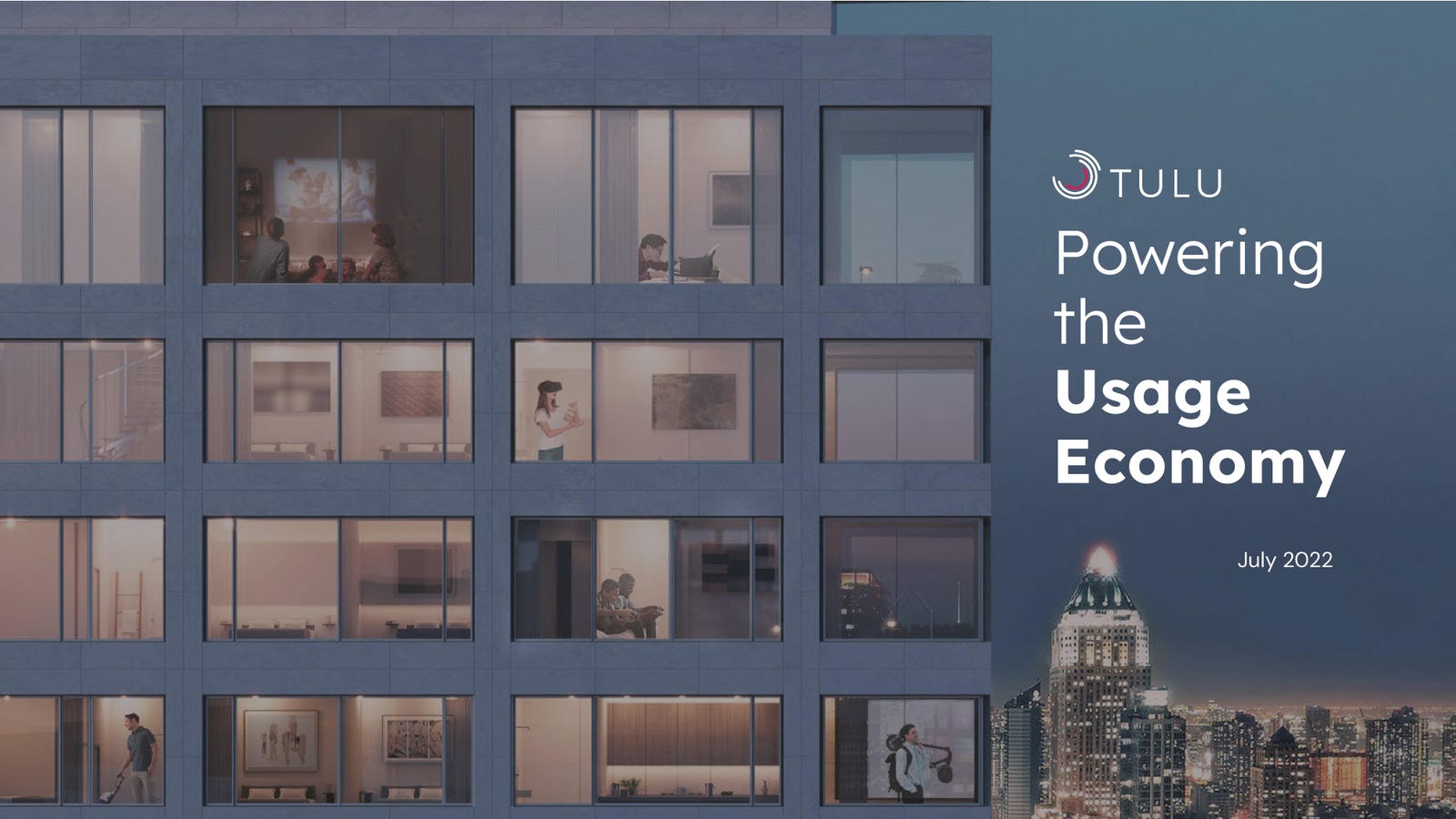
Tulu’s Series A deck, dated July 2022, opens with a clear and evocative title slide. The tagline, "Powering the Usage Economy," immediately positions the company within a broader macroeconomic trend rather than just a vending machine business. The background image of an apartment building at night, with different residents visible in their windows using various products (a projector, a vacuum, a VR headset), visually communicates the company's value proposition: these items are being used inside the home, but they don't necessarily need to be owned by the resident.
Slide 2: The Generational Shift
Slide 2 sets the stage for the 'Why Now?' argument. It contrasts the 'Buy It Now' mentality of Baby Boomers and Gen X—associated with acquisition, possession, and status—against the 'Use It Now' mentality of Millennials and Gen Z. Tulu defines the latter as valuing "Accessing What They Need" through experience, convenience, and fit. This slide uses lifestyle photography to bridge the gap between traditional ownership (a man in a luxury car) and modern access (a woman carrying a Rent the Runway bag). This framing is essential for a Series A round, as it suggests Tulu is riding a permanent wave of behavioral change.
Slide 3: The Go-To-Market Strategy and Proof Points
This is arguably the most important slide in the deck. It combines a high-level strategy with granular, impressive metrics. Tulu outlines four pillars of their strategy:
"Last foot" solution: Hyper-convenience by being where people live. · Centralized demand: Yielding operational efficiency. · Landlord demand: Buildings are willing to pay for amenities. · Brand exposure: Collecting objective usage data.
The left side of the slide overlays specific usage stats onto a city skyline. These figures provide the 'meat' for investors: 70,000 printing jobs for HP, 130,000 miles for Unagi electric scooters, 5,000 first-time users for Oculus VR headsets, and 3,000 uses a month for Dyson cordless vacuums. By citing these specific numbers, Tulu proves that their kiosks aren't just decorative amenities—they are high-utilization hubs.
Slide 4: The Physical Product
Slide 4 provides a full-bleed photograph of a Tulu 'Smart Rental Store.' This is a critical inclusion for a hardware-enabled service. It shows a sleek, black, modular kiosk system. Visible items include Dyson vacuums, Catan board games, Nintendo Switch consoles, printers, and a 'Tulu Shop' section with beverages and Ben & Jerry's ice cream. The branding is professional and 'premium,' which aligns with their strategy of targeting 'first-tier' buildings. The presence of a digital screen for onboarding ('Welcome to the TULU launch party!') suggests a seamless user interface.
Slide 5: The Flywheel and Social Proof
Slide 5 focuses on the scalability of the model. On the left, it features a testimonial email from a user who moved buildings and actively tried to recruit her new landlord to install Tulu. This is powerful 'organic' social proof. On the right, a flywheel diagram illustrates how More Buildings lead to More Users , which generates More Data , which attracts More Brands , which improves the Offering , and so on. The text at the bottom reinforces their focus on 'first tier' assets, signaling to investors that they are capturing high-value real estate markets.
Slide 6: The Team and Backers
The final slide in the provided set introduces the leadership team. The pedigree here is significant for a Series A company. CEO Yishai Lehavi is a two-time founder and former captain in an elite intelligence unit. CCO Yael Shemer has a background in sustainable living and environmental science. Crucially, the VP of Operations, Yaniv Goder, is a former GM at Uber and RGM at Lime—roles that require managing complex, distributed physical assets and logistics. The 'Backed By' section includes notable names like Newera Capital Partners, Bosch, Kärcher, and Ground Up , showing that Tulu has already secured buy-in from both traditional VCs and strategic industrial partners.
What Works in the Tulu Deck
Specific Usage Data: Many early-stage decks rely on vague 'engagement' metrics. Tulu wins by providing hard numbers on Slide 3. Telling an investor that people have cooked 3,000 dinners with a Philips Air Fryer or cleaned 1,800 sofas with a Kärcher cleaner makes the utility of the platform undeniable.
Strategic Framing: By calling it the 'Usage Economy,' Tulu elevates the business from 'vending machines in lobbies' to a 'data and logistics platform for the circular economy.' This is a much more venture-backable narrative.
Operational Pedigree: The team slide is exceptionally strong. For a company that involves physical hardware, maintenance, and logistics, having executives from Uber and Lime (Slide 6) provides investors with confidence that the company can handle the 'messiness' of the physical world.
Brand Partnerships: The sheer volume of household names (Dyson, Sony, HP, Bosch) featured on Slide 3 and 4 suggests that Tulu has successfully navigated the difficult path of enterprise brand partnerships, which usually have long sales cycles.
What is Missing from the Tulu Deck
Unit Economics: While the usage data is great, the deck (as provided) does not explain the cost side. How much does a kiosk cost to build and install? How long does it take to pay back that capital expenditure? What is the maintenance cost per unit? For a Series A, these are the questions that determine the size of the check.
The 'Ask': There is no slide in this set detailing how much capital is being raised or how it will be allocated. While the publisher reports a $5M raise, a standard deck should explicitly state the funding goal and the milestones that funding will achieve.
Competitive Landscape: Tulu isn't the only company trying to solve the 'amenity' problem in buildings. A slide addressing competitors (like traditional vending, building-managed libraries, or other rental startups) and Tulu's specific moat would have been beneficial.
Financial Projections: There is no mention of current ARR (Annual Recurring Revenue) or projected growth. Investors need to see the path from $5M in funding to a $100M+ revenue business.
Founder Takeaways
Use your partners' logos to your advantage: If you have big-name customers or partners, don't just list them. Show what they are doing on your platform. Tulu’s Slide 3 is a masterclass in using partner logos to validate a business model.
Visualise the 'Why Now': Slide 2 uses simple imagery to explain a complex cultural shift. If your startup relies on a change in consumer behavior, don't just write about it—show the contrast between the old way and the new way.
Highlight relevant 'failure' or 'scale' experience: The mention of a VP of Operations coming from Lime and Uber is a massive signal. If your team has worked in high-growth, operationally intense environments, make sure that is the first thing an investor sees on the team slide.
Modularize your hardware: Slide 4 shows a very clean, modular design. For hardware startups, showing that your product looks 'finished' and professional is key to overcoming the 'hardware is hard' bias among software-focused VCs.
Frequently asked questions
- What is the core problem Tulu is solving?
- Tulu addresses the inefficiency of individual ownership for items that are used infrequently, such as power drills, vacuum cleaners, or VR headsets. By providing these items via on-site kiosks, they solve the 'last foot' convenience gap, allowing urban residents to access high-quality goods without the cost or storage requirements of full ownership.
- How does Tulu generate revenue based on the deck?
- While the deck does not provide a specific pricing table, Slide 3 notes that 'buildings need and are willing to pay for better amenities,' suggesting a B2B subscription or placement fee from landlords. Additionally, the 'Usage Economy' framing and the presence of a 'Tulu Shop' in the kiosk photos imply transaction-based revenue from rentals and consumable purchases.
- Which brands are currently partnering with Tulu?
- Slide 3 and Slide 4 showcase a wide range of top-tier brands including Dyson (vacuums), Sony (PlayStation), HP (printers), Bosch (power drills), DJI (drones), GoPro (action cameras), and even food brands like Ben & Jerry's. Some of these, like Bosch and Kärcher, are also listed as financial backers on Slide 6.
- What is Tulu's geographic focus?
- Slide 5 states that Tulu works in 'first tier cities, with first tier landlords, within first tier buildings.' While specific cities aren't listed in the text, the background imagery on Slide 3 features the New York City skyline, and the publisher reports the company is headquartered in North America.
- What is missing from this pitch deck?
- The provided 12-slide deck is missing several standard Series A components: a detailed financial forecast, a breakdown of unit economics (cost to build/service a kiosk vs. revenue generated), a competitive landscape analysis, and a specific 'Ask' slide detailing how the $5M will be spent.