Barn & Willow’s 2015 pitch deck is a lean, metric-driven presentation that prioritizes financial health over narrative fluff. With only 12 slides, the company successfully communicated a complex vertically integrated supply chain and impressive unit economics, including a $900 Average Order Value and 50% gross margins. By leading with traction—specifically $40k in monthly revenue and 30% month-over-month growth—the deck bypasses the need for extensive market education. While it lacks a traditional team slide or a specific 'Ask' for the $1.5M round, the clarity of its LTV ($450) versus CAC ($8…
Key takeaways
- The deck highlights an exceptionally high Average Order Value (AOV) of $900 on slide 4.
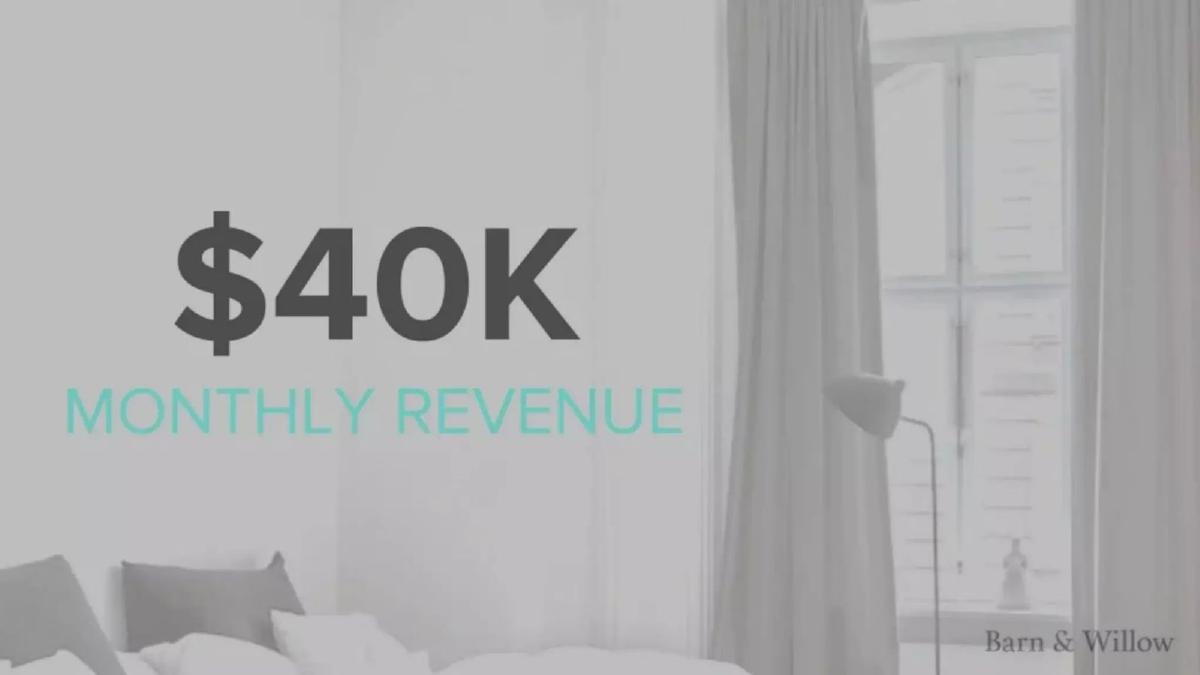
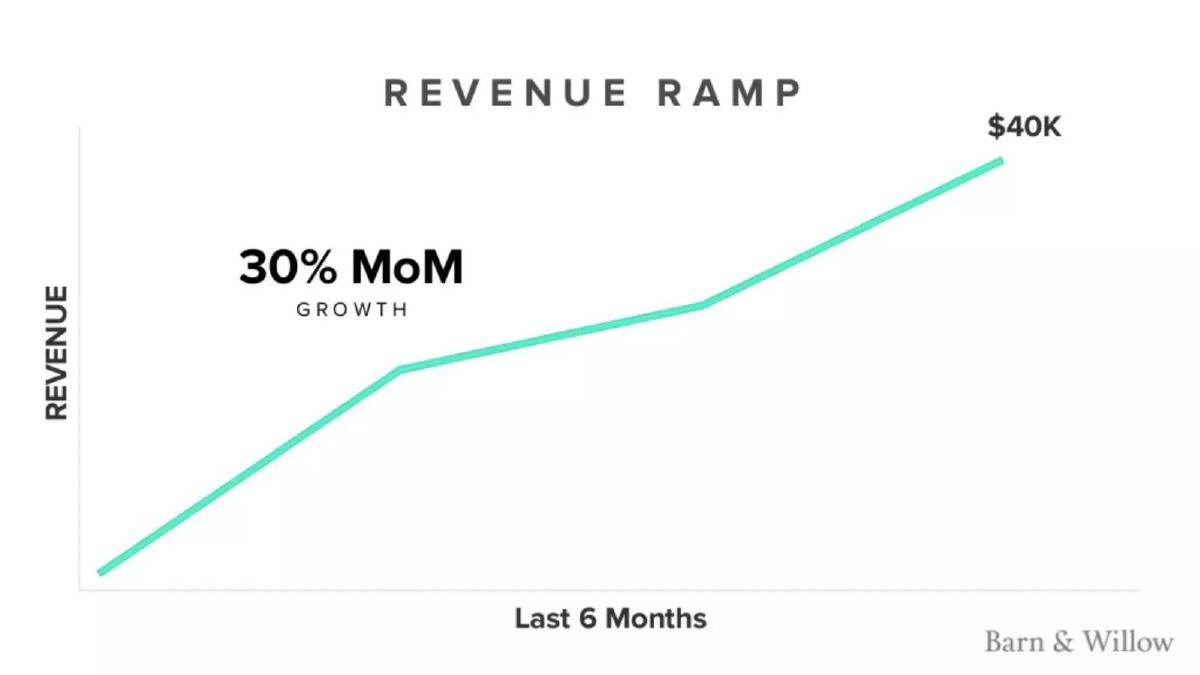
- Traction is demonstrated through a $40k monthly revenue figure on slide 5 and 30% MoM growth on slide 6.
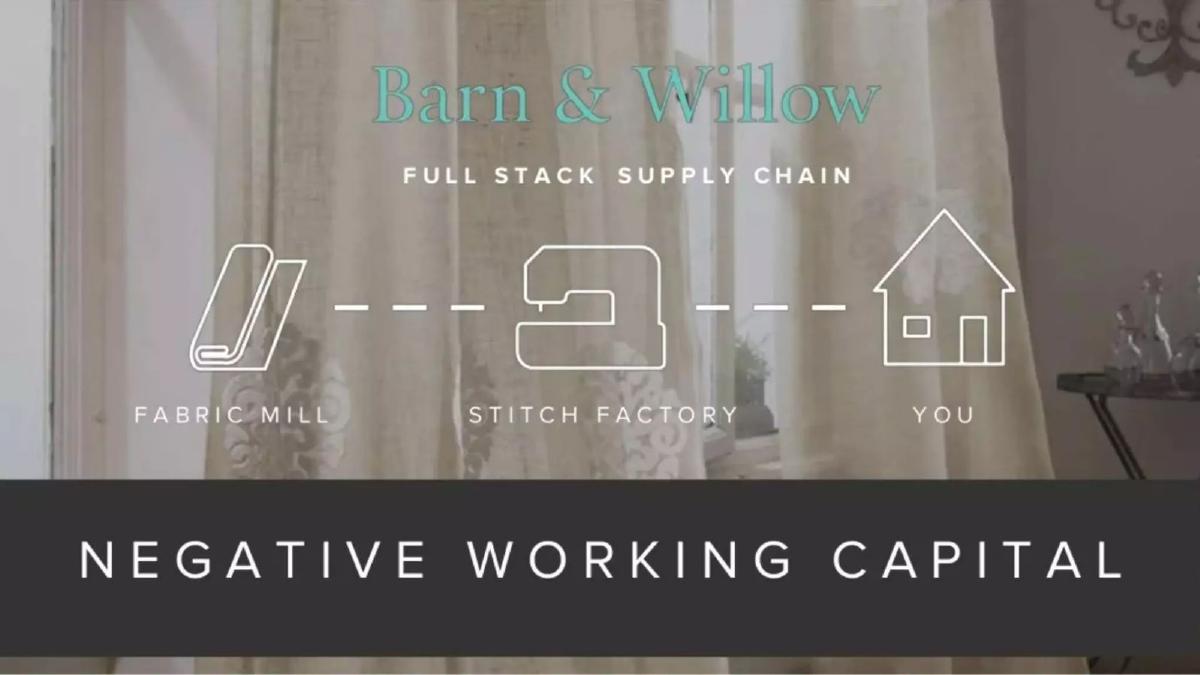
- The business model is built on a 'Full Stack Supply Chain' that enables negative working capital, as shown on slide 3.
- Unit economics are highly favorable, with an $82 Customer Acquisition Cost (CAC) against a $450 Lifetime Value (LTV) on slide 12.
- The market opportunity is defined as a $6B window treatment niche within a broader $50B home decor market on slide 9.
- The product solves three specific friction points: measurement, selection, and price point, as detailed on slide 10.
- The deck omits a dedicated team slide, relying instead on a single founder contact on the final slide.
- Gross margins are consistently stated at 50% on slides 7 and 12, signaling strong product profitability.
Barn & Willow: The Metric-First E-Commerce Play
In 2015, Barn & Willow set out to disrupt the window treatment industry, a segment of home decor notorious for high markups and complex ordering processes. This 12-slide deck is a study in brevity. It avoids the common mistake of over-explaining the 'why' and instead focuses almost entirely on the 'how'—specifically, how the company generates high-margin revenue through a vertically integrated supply chain.
The Hook and the Business Model (Slides 1-3)
Slide 1: Title The deck opens with a clean lifestyle image of a modern living room featuring their product. The tagline is simple: "The Easiest Way To Buy Window Treatments." It establishes the brand as a solution-oriented e-commerce player immediately.
Slide 2: In Context Selection This slide shows a hand holding a tablet displaying a room visualizer. It suggests a technology-first approach to the 'selection' problem in home decor, allowing users to see products in a digital environment before purchasing.
Slide 3: Full Stack Supply Chain This is arguably the most important strategic slide in the deck. It outlines a three-step flow: Fabric Mill to Stitch Factory to 'You' (the consumer). By removing intermediaries, Barn & Willow claims "Negative Working Capital." This implies they collect payment from customers before paying their suppliers, a holy grail for e-commerce scaling.
The Traction and Financials (Slides 4-7)
Slide 4: Average Order Value The deck moves immediately into hard numbers. Slide 4 features a large, bold "$900" labeled as the "Average Order Value." In e-commerce, a high AOV is a massive advantage as it allows for higher customer acquisition costs while remaining profitable.
Slide 5: Monthly Revenue Continuing the transparency, Slide 5 states "$40K Monthly Revenue." For a 2015-era seed or 'later' stage startup (as categorized), this is a solid baseline that proves product-market fit.
Slide 6: Revenue Ramp This slide provides the growth context for the $40k figure. It shows a line graph of the "Last 6 Months" with a "30% MoM Growth" rate. The upward trajectory is clear and consistent, suggesting that the $40k is a milestone on a fast-moving path rather than a plateau.
Slide 7: Margins and Cash Flow The company doubles down on its financial health here, stating a "50% Gross Profit Margin" and the fact that they are "Cash Flow Positive." Being cash-flow positive while growing at 30% MoM is a rare combination that likely made the $1.5M raise significantly easier.
The History and Market Opportunity (Slides 8-9)
Slide 8: The Origin A simple photo dated "2010" shows two women working with textiles. This provides a subtle 'founder story' without a wall of text, suggesting the founders have deep, long-standing expertise in the manufacturing side of the business.
Slide 9: Market Size Barn & Willow uses a classic TAM/SAM visualization. They identify a "$50B Home Decor" market and a "$6B Window Treatments" market. By focusing on the $6B niche, they show they are targeting a large, addressable segment that is often overlooked by broader furniture retailers.
The Problem and the Solution (Slides 10-11)
Slide 10: Friction Points This slide breaks down the three barriers to buying custom curtains: "Measurement," "Selection," and "Price Point." It uses three distinct images to represent the manual, frustrating nature of the traditional process.
Slide 11: Reimagining the Experience This slide serves as the 'Solution' counterpart to Slide 10. It shows the Barn & Willow web interface on a tablet, highlighting a price of "$129.00" and a simple measurement input field. It promises to turn the friction points into a seamless digital experience.
The Unit Economics and Contact (Slide 12)
Slide 12: The Final Tally The deck concludes with a summary of its most impressive metrics: a "50% Gross Margin," an "$82 CAC" (Customer Acquisition Cost), and a "$450 LTV" (Lifetime Value). The LTV/CAC ratio of 5.4x is the 'mic drop' moment of the deck. It ends with contact info for "Trisha - Founder" and a link to their AngelList profile.
What Works in the Barn & Willow Deck
The primary strength of this deck is its unapologetic focus on unit economics . Many e-commerce decks spend too much time on brand 'vibe' and not enough on the math. Barn & Willow does the opposite. By putting the $900 AOV and 50% margins front and center, they answer the investor's most pressing question: "Is this a real business or just a marketing experiment?"
The visual simplicity is also a major asset. There are no complex tables or dense paragraphs. Each slide delivers exactly one high-impact message. This makes the deck highly readable and ensures that the key figures ($40k revenue, 30% growth, $82 CAC) are impossible to miss.
Finally, the supply chain explanation on Slide 3 is masterful. It uses simple icons to explain a complex logistical advantage. Investors love vertical integration because it creates a moat against competitors who are just reselling the same wholesale products.
What is Missing from the Barn & Willow Deck
The most glaring omission is a Team Slide . While Slide 8 hints at their history and Slide 12 names the founder, there is no detail on the professional backgrounds of the leadership team. In a $1.5M raise, investors usually want to see a 'Why Us' slide that highlights previous successes or specific industry pedigree.
There is also no Competitive Landscape slide. The deck assumes the investor knows that the current alternatives are either expensive custom designers or low-quality ready-made options. Explicitly mapping out where Barn & Willow sits relative to West Elm, Restoration Hardware, or local blind installers would have strengthened the 'Price Point' argument.
Lastly, the deck lacks a Formal Ask . It doesn't state how much they are raising (though we know from catalogue facts it was $1.5M) or what they plan to do with the money. Are they hiring? Buying inventory? Scaling ad spend? The deck leaves the 'Use of Funds' entirely to the imagination.
What a Founder Should Copy
The 'Metric Per Slide' Rule: If you have a killer metric like a $900 AOV, give it its own slide. Don't bury it in a bulleted list. Barn & Willow’s use of large-format numbers makes the traction feel undeniable.
LTV/CAC Transparency: If your unit economics are good, lead with them. Showing an $82 CAC against a $450 LTV (Slide 12) is the most efficient way to prove that your business is a 'money printer' that just needs more capital to grow.
Supply Chain Visualization: If your business model relies on a logistical advantage, use a simple flow chart like Slide 3. It’s much more effective than a long-winded explanation of 'disintermediation.'
High-Quality Product Imagery: Since this is a physical product, the lifestyle photography on Slide 1 and Slide 10 does a lot of heavy lifting to establish the brand's aesthetic without needing a dedicated 'Brand' slide.
Frequently asked questions
- What was the primary value proposition of Barn & Willow?
- Barn & Willow positioned itself as 'The Easiest Way To Buy Window Treatments' (Slide 1). They achieved this by vertical integration, connecting the fabric mill directly to the 'stitch factory' and then to the consumer (Slide 3). This 'Full Stack' approach allowed them to solve traditional industry pain points like complex measurements and high price points while maintaining a 50% gross margin.
- How did the deck demonstrate market traction?
- Traction was the centerpiece of the deck. Slide 5 explicitly states '$40K Monthly Revenue,' followed by Slide 6, which shows a 'Revenue Ramp' with 30% month-over-month growth over the preceding six months. This data-heavy approach proved that the business model was already functioning and scaling before the $1.5M investment.
- What were the key unit economics shared in the deck?
- The deck is highly transparent about its efficiency. Slide 12 lists a $82 Customer Acquisition Cost (CAC) and a $450 Lifetime Value (LTV). This represents a 5.4x LTV/CAC ratio, which is excellent for e-commerce. Combined with a $900 Average Order Value (Slide 4) and 50% gross margins (Slide 7), the deck presented a very low-risk financial profile to investors.
- How did Barn & Willow define their market size?
- On Slide 9, the company used a nested circle graphic to illustrate the opportunity. They identified a $50B total market for Home Decor, with a specific $6B sub-market for Window Treatments. This helped investors understand that while they were starting in a niche, that niche alone was large enough to support a venture-scale business.
- What is missing from the Barn & Willow pitch deck?
- The deck is notably missing a traditional Team slide, which usually highlights the founders' backgrounds. It also lacks a 'Competition' slide and a 'Use of Funds' slide. While the catalogue facts state they raised $1,500,000, the deck itself does not specify the amount being sought or the milestones they intended to hit with the capital.