Whatsgon is a social discovery and coordination platform designed to help users find activities and invite friends in 'less than 10 seconds.' The deck, dated around early 2017, positions the app as a solution to the friction of group planning, leveraging a hyper-local go-to-market strategy centered on Stanford University. While the deck highlights a massive $710 billion food and beverage market and a 19 billion digital coupon opportunity, it lacks specific unit economics or a clear monetization model beyond the implication of coupon integration. The team brings relevant experience in event pr…
Key takeaways
- The platform claims to allow users to set up a plan in less than 10 seconds (Slide 2).
- The market opportunity is anchored by a $710 billion US food and beverage revenue figure from 2015 (Slide 4).
- Market validation is based on the 19 billion digital coupons redeemed worldwide in 2015 (Slide 5).
- The go-to-market strategy is exclusively focused on Stanford University, targeting fraternities and sports teams starting in February 2017 (Slide 6).
- The deck uses qualitative testimonials from Stanford researchers to validate the pain point of group coordination (Slide 7).
- CEO Diogo Moreira cites 11 years of international business experience and a prior digital coupon partnership with Gold's Gym (Slide 8).
- CTO Rafael Viana claims over 7 years of experience owning a CRM platform with a team of four engineers (Slide 8).
- The deck lacks a specific financial 'Ask' slide or a detailed breakdown of how the funds will be allocated among the 8 slides provided.
Slide-by-Slide Analysis
Slide 1: Title Slide
The deck opens with a minimalist black background featuring the Whatsgon logo—a stylized 'W' in a blue square. The tagline 'YOU’LL NEVER WALK ALONE' suggests a focus on social connection and group activity. Contact information is provided for a Palo Alto address, signaling proximity to the Silicon Valley ecosystem and Stanford University. The simplicity of the slide is professional, though the tagline is a well-known sports anthem, which might create unintended brand associations.
Slide 2: Solution
This slide outlines the core value proposition: connecting people with shared interests to discover activities. It breaks the product down into five functional pillars: Discover (finding activities), Create (interacting with users), Let's Go (setup in under 10 seconds), Live Chat (activity-specific messaging), and Notification (network updates). The '10 seconds' claim is a specific, measurable promise that addresses the 'friction' problem inherent in social planning.
Slide 3: Competitive Advantage
Despite the title, this slide functions more as a product demo or user flow walkthrough. It shows three iPhone mockups: an activity selection screen, a friend invitation list (featuring placeholder names like Kevin Hart and Stephen Curry), and a chat interface. The 'Competitive Advantage' is framed as the ease of use—'Send a notification... Choose your friends... And that’s it!' However, it fails to explain why this is better than existing solutions like WhatsApp groups or Facebook Events, which is a significant omission for a slide with this heading.
Slide 4: Market & Opportunity
Whatsgon uses top-down market sizing here. They cite +$710Bn in US Food & Beverage revenue (2015) and 193m people going out per month. While these numbers are large and sourced from the National Restaurant Association and Nielsen, they are 'vanity' metrics. They represent the total spending in the category, not the specific portion of the market Whatsgon can capture (SOM). The slide establishes that people spend money and go out, but it doesn't narrow down the opportunity to social coordination software.
Slide 5: Market Validation
This slide shifts the focus to digital coupons, which seems to be the intended monetization path. It defines the TAM as 19Bn digital coupons redeemed worldwide and the SAM as +120m users in the USA. The 'Target Market' is listed as 130m digital coupons on Whatsgon. This is an ambitious target that lacks a timeline or a clear explanation of how the app will facilitate that volume of transactions. It does, however, signal to investors that the company views itself as a commerce-enablement platform rather than just a social network.
Slide 6: Go-To-Market
The strategy is hyper-local, focusing on Stanford University . The plan involves 'Guerrilla Marketing' starting in February 2017, specifically targeting fraternities and sports teams. The list of tactics includes viral events, influencer sports players, and strategic partnerships. This is a classic 'Facebook-style' launch strategy—owning a high-density, high-frequency social environment before expanding. It is one of the stronger slides in the deck because it shows a clear, actionable starting point.
Slide 7: Testimonials
Instead of user growth charts, the deck provides two qualitative testimonials from Stanford-affiliated researchers. AJ Venkatakrishnan describes group coordination as a 'nightmare,' while Margarida Martins calls the app 'perfect' for knowing what is going on. While these quotes validate the pain point, they appear to be based on the concept or a beta version rather than long-term usage. In a professional pitch, these are 'soft' evidence and should ideally be paired with hard data.
Slide 8: Team
The team consists of two founders. Diogo Moreira (CEO) brings 11 years of international business experience and a background in digital coupons and event promotion. Rafael Viana (CTO) has a computer science degree and 7 years of experience running a CRM platform. The mention of Viana's 'Company with +4 eng.' suggests he has experience managing technical teams. The team appears balanced between business/marketing and technical execution, which is a positive sign for an early-stage startup.
What Works
Specific GTM: The focus on the Stanford campus (Slide 6) provides a clear, measurable testing ground. It avoids the common mistake of trying to launch 'everywhere' at once. · Clear Pain Point: The '10-second' setup promise (Slide 2) and the 'coordination nightmare' testimonial (Slide 7) clearly define the problem the founders are trying to solve. · Balanced Team: The combination of a 'Promoter Planner' CEO and a 'CRM Platform Owner' CTO (Slide 8) covers the two most critical needs for a social/coupon app: user acquisition and technical infrastructure.
What is Missing
The Ask: There is no slide indicating how much capital the company is raising, the valuation, or the specific milestones they intend to reach with the funding. · Monetization Detail: While digital coupons are mentioned (Slide 5), there is no explanation of the take rate, the merchant acquisition strategy, or how the coupons are integrated into the user flow. · Competitive Landscape: Slide 3 claims 'Competitive Advantage' but only shows the product. There is no mention of direct competitors like Eventbrite, Meetup, or indirect competitors like Facebook and WhatsApp. · Unit Economics: There is no mention of Customer Acquisition Cost (CAC) or Lifetime Value (LTV), which is critical for a business model that appears to rely on high-volume coupon redemptions.
Founder Takeaways
Focus on the 'Why Now': This deck establishes that the market is big, but it doesn't explain why 2017 was the right time for this specific solution. Founders should always include a 'Why Now' slide—perhaps citing the rise of mobile couponing or a shift in social habits. Show, Don't Just Tell, the Advantage: If you label a slide 'Competitive Advantage,' you must show a comparison matrix or a unique feature that others cannot easily replicate. Simply showing your own UI is not an advantage. Bridge the Gap Between Social and Commerce: Whatsgon jumps from 'chatting with friends' to '130 million coupons.' A successful deck needs to show the bridge—how does a conversation about a hangout naturally lead to a coupon redemption? Without that link, the business model feels bolted on rather than integrated.
Frequently asked questions
- What is the primary problem Whatsgon is trying to solve?
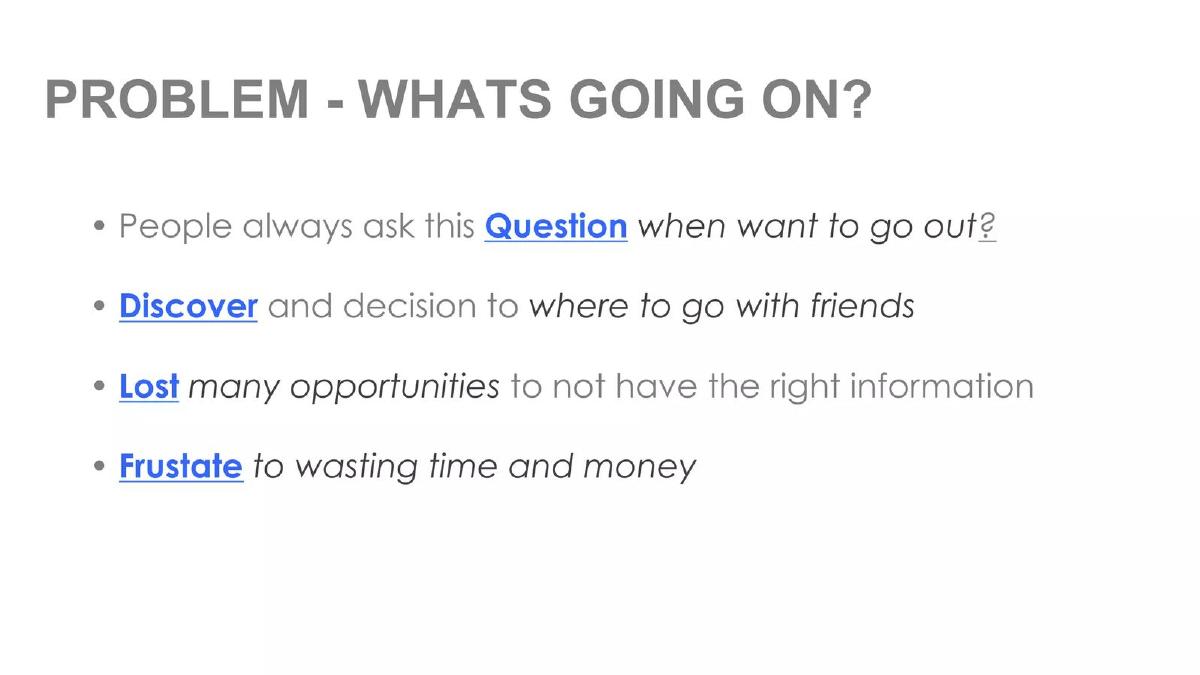
- Whatsgon targets the friction and 'nightmare' of coordinating group activities. According to the testimonials on Slide 7, users find it difficult to pick a place or event and reach a consensus with friends. The app aims to streamline this by allowing users to discover activities, invite friends, and finalize plans in under 10 seconds.
- How does Whatsgon plan to acquire its first users?
- The company employs a hyper-local 'Guerrilla Marketing' strategy focused on Stanford University. As detailed on Slide 6, they intended to launch in February 2017 by partnering with fraternities and 'Cardinals Sports Teams.' They also planned to use viral events, influencer sports players, and social media engagement to generate 'spontaneous media' on campus.
- What is the suggested business model for the app?
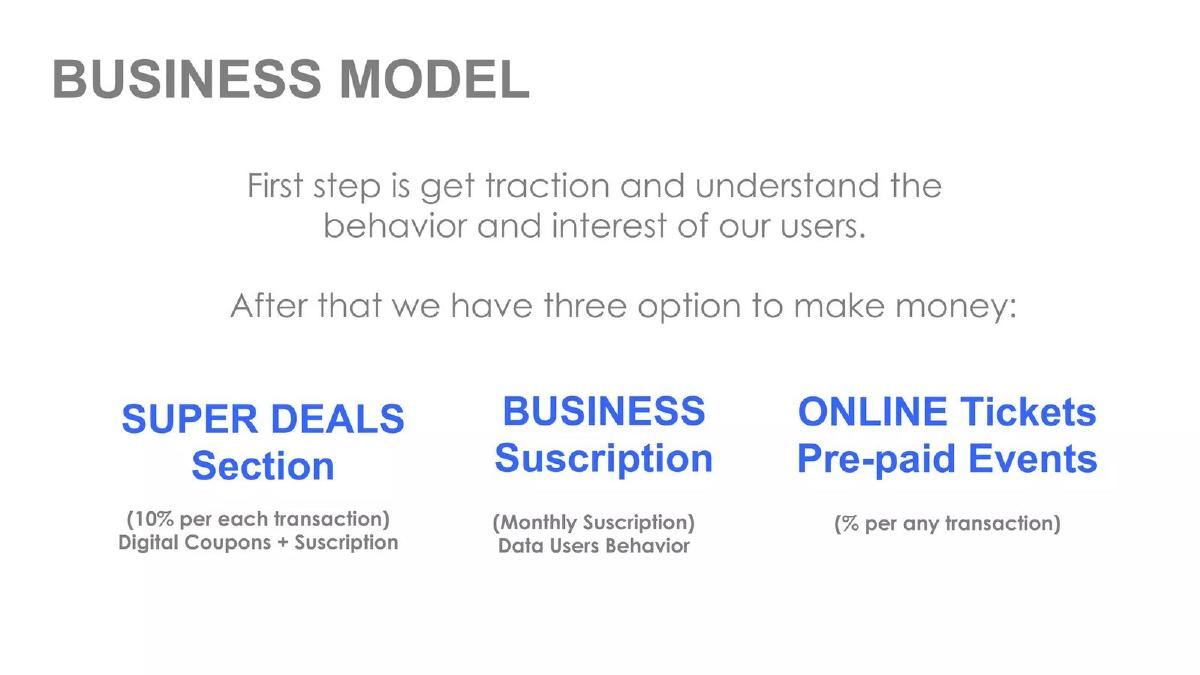
- While a formal business model slide is missing from this selection, Slide 5 (Market Validation) focuses heavily on 'Digital Coupons.' It cites a target market of 130 million digital coupons on Whatsgon. This suggests a revenue model based on lead generation or affiliate fees from local businesses offering discounts to groups using the app to coordinate outings.
- Does the deck provide any evidence of technical feasibility?
- Slide 3 (Competitive Advantage) shows high-fidelity mockups of the user interface, including an 'Explore' screen, an invite list featuring social profiles, and a live chat interface. Additionally, Slide 8 highlights that the CTO, Rafael Viana, has a background in Computer Science and has previously managed a CRM platform with a team of four engineers, suggesting the internal capability to build the product.
- What are the biggest risks identified in this deck teardown?
- The primary risk is the lack of demonstrated traction. The deck relies on 'Target' dates (Feb 2017) and qualitative quotes rather than active user numbers or retention data. Furthermore, the 'Competitive Advantage' slide (Slide 3) describes the user flow rather than a defensive moat, making it unclear how Whatsgon will compete against established social giants or specialized coordination tools.