The mcSquares pitch deck is a refreshingly data-heavy presentation for a consumer goods company. Eschewing the traditional 'problem/solution' narrative, it leads with aggressive growth figures—including a 1,300% revenue increase between 2018 and 2020. The deck excels at proving unit economics, specifically highlighting a $67.68 average order value against a $24.28 customer acquisition cost. It also leans heavily into its defensive moat, citing 14 filed patents and material exclusivity. While the deck lacks a formal 'ask' or detailed use of funds, the strength of its existing traction and clea…
Key takeaways
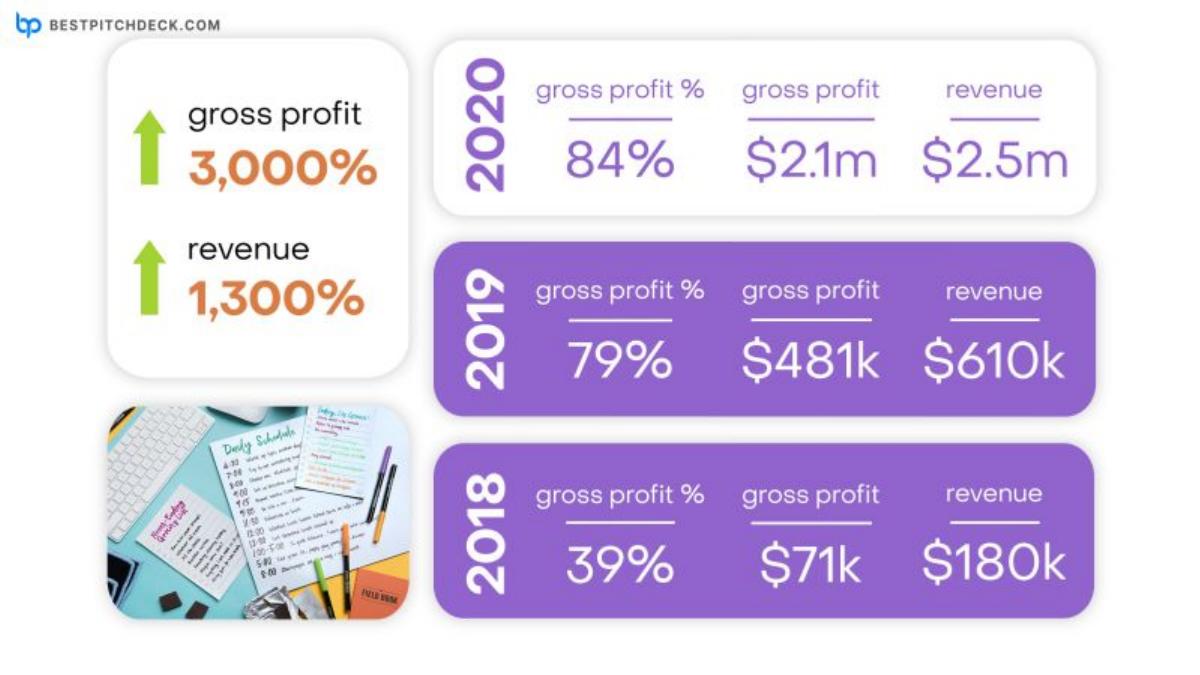
- The company demonstrated massive scaling, with revenue jumping from $180k in 2018 to $2.5m in 2020 (Slide 3).
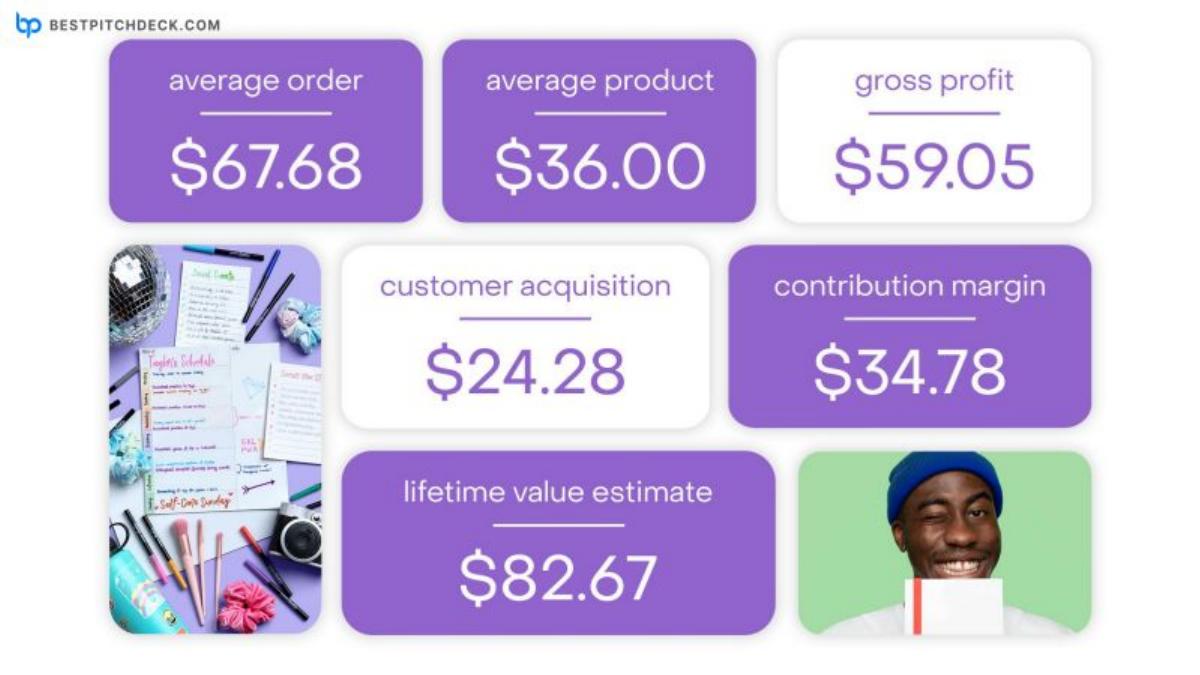
- Unit economics are clearly defined, showing a contribution margin of $34.78 and an estimated LTV of $82.67 (Slide 2).
- Gross profit margins improved significantly over time, rising from 39% in 2018 to 84% in 2020 (Slide 3).
- The brand leverages a strong IP position with 14 patents filed and 7 issued to protect its reusable whiteboard tools (Slide 7).
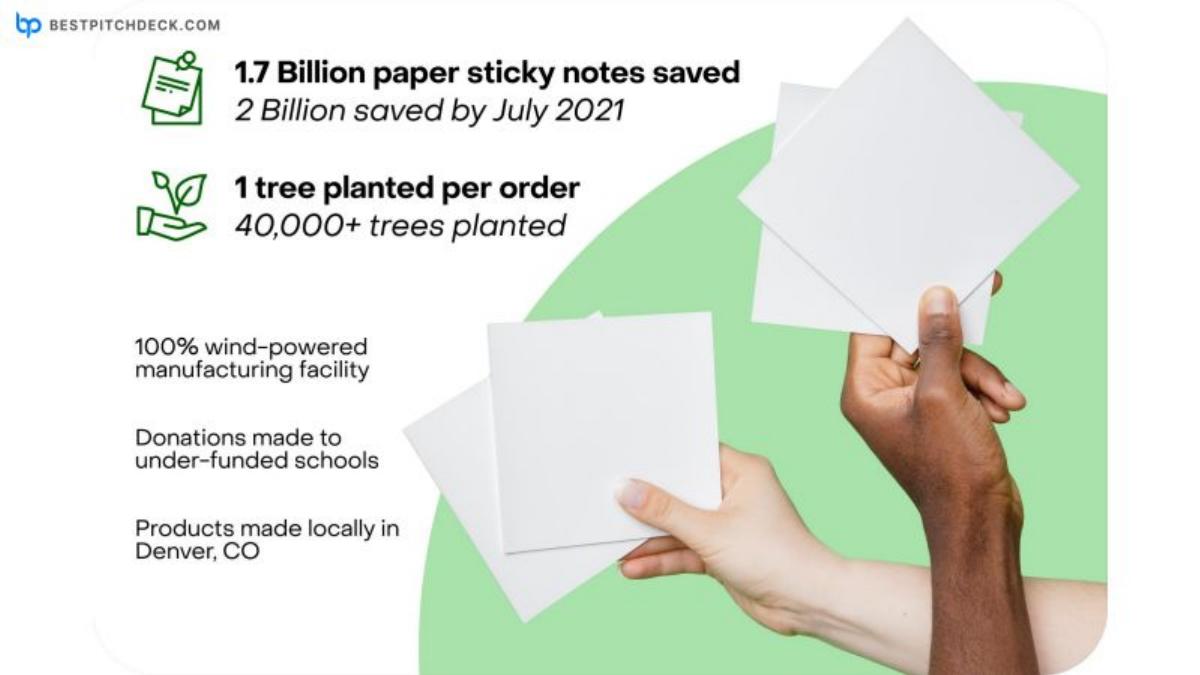
- Environmental impact is a core brand pillar, claiming 1.7 billion paper sticky notes saved and 40,000+ trees planted (Slide 4).
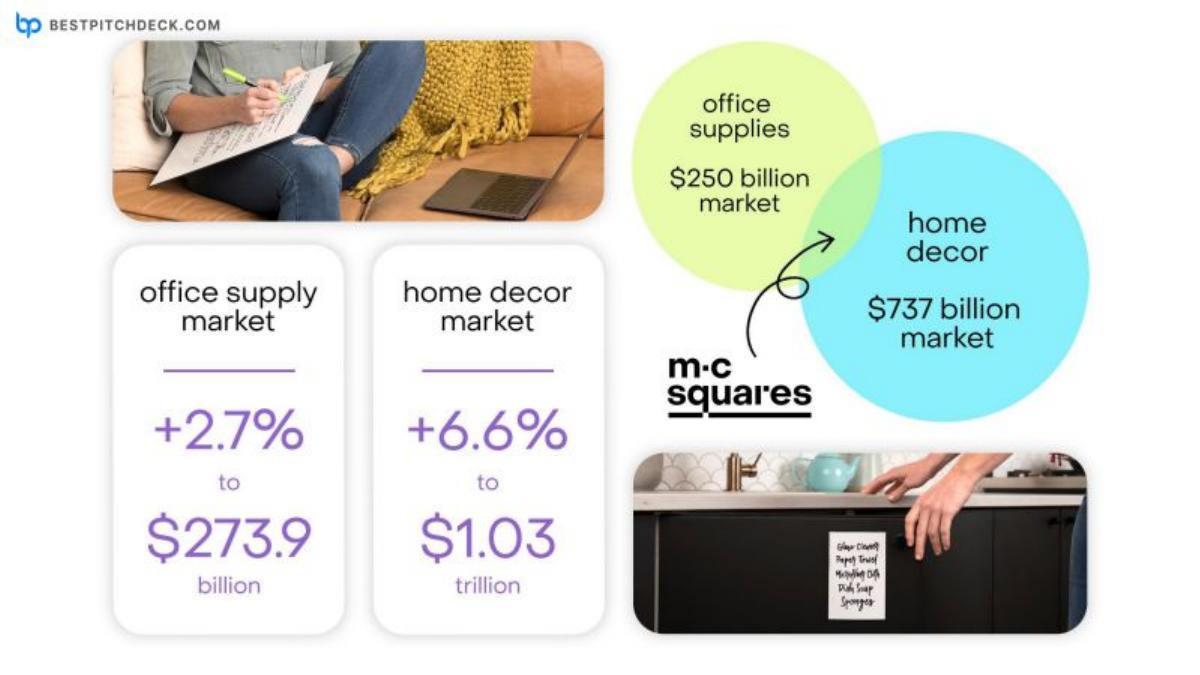
- The market opportunity is framed by the intersection of the $250 billion office supply market and the $737 billion home decor market (Slide 5).
- The deck lists an impressive roster of corporate clients including Google, Microsoft, LEGO, and the U.S. Air Force (Slide 7).
- The team slide features 14 members, including specialized roles like Production Manager and Fulfillment Manager, indicating an in-house manufacturing capability (Slide 8).
Introduction: A Data-First Approach to Physical Goods
The mcSquares pitch deck, used for their 2020 Seed round, is a departure from the typical narrative-heavy decks seen in the startup world. Instead of spending five slides explaining why paper is bad for the environment, mcSquares assumes the investor understands the problem and moves immediately to the proof of business viability. This is a 'traction deck' in the truest sense, designed to show that the company has found product-market fit and has the unit economics to scale profitably.
Slide 1: Visual Identity and Product Context
The deck opens with a high-quality lifestyle photograph rather than a traditional title slide. The image displays various mcSquares products in use: a 'Daily Schedule' whiteboard, a 'Never-Ending Grocery List,' and several 'Tackie' markers. This immediate visual context establishes the brand's aesthetic—clean, colorful, and organized. It signals that this is a consumer-facing brand that fits into a modern, perhaps home-office, lifestyle. There is no text on this slide, allowing the product design to speak for itself.
Slide 2: The Unit Economics Masterclass
Slide 2 is perhaps the most important slide in the deck for a Seed-stage investor. It breaks down the unit economics with granular detail. The company reports an average order of $67.68 and an average product price of $36.00 . This suggests that customers are frequently purchasing more than one item per transaction. The gross profit is listed at $59.05 (presumably per average order), which is exceptionally high for a physical product. The customer acquisition cost (CAC) of $24.28 compared to a contribution margin of $34.78 shows that the company is profitable on the first transaction. Finally, an estimated lifetime value (LTV) of $82.67 provides a healthy LTV/CAC ratio of approximately 3.4x, a key benchmark for venture-scale eCommerce.
Slide 3: Explosive Growth and Margin Expansion
Slide 3 provides a three-year historical view of the company’s performance, showing a trajectory that every investor looks for. In 2018, the company had $180k in revenue with a 39% gross profit margin. By 2019, revenue grew to $610k and margins jumped to 79%. The 2020 figures are the standout: $2.5m in revenue with an 84% gross profit margin . The slide highlights a 3,000% increase in gross profit and a 1,300% increase in revenue over this period. This margin expansion is particularly impressive; it suggests that as the company scaled, it significantly optimized its manufacturing processes or shifted to a higher-margin product mix.
Slide 4: Sustainability as a Competitive Advantage
For a company selling reusable alternatives to disposable products, the environmental impact is both a marketing tool and a mission statement. Slide 4 quantifies this impact: 1.7 billion paper sticky notes saved , with a projection of 2 billion by July 2021. They also highlight their 'one tree planted per order' initiative, resulting in 40,000+ trees planted . Beyond the consumer-facing metrics, the slide mentions operational sustainability: a 100% wind-powered manufacturing facility and the fact that products are made locally in Denver, CO . This local manufacturing likely contributes to the high margins and supply chain agility mentioned in previous slides.
Slide 5: Market Sizing and Positioning
Slide 5 addresses the Total Addressable Market (TAM). Instead of claiming a single vague 'productivity market,' mcSquares identifies two overlapping sectors: the office supply market (growing at +2.7% to $273.9 billion ) and the home decor market (growing at +6.6% to $1.03 trillion ). By positioning themselves at the intersection of these two massive industries, mcSquares justifies a high valuation ceiling. The slide uses a Venn diagram to show how their products bridge the gap between functional office tools and aesthetic home accessories, a trend that accelerated significantly during the 2020 shift to remote work.
Slide 6: Product in the Wild
This is a transition slide featuring a full-bleed photograph of a user placing a mcSquares product into a backpack. It reinforces the portability and 'on-the-go' nature of the product line. While it contains no data, it serves to break up the numbers-heavy sections and reminds the investor of the physical reality of the product—it is slim, durable, and fits into a modern professional's toolkit.
Slide 7: The Defensive Moat and Social Proof
For physical goods, the biggest risk is 'copy-catting' by larger manufacturers or low-cost international competitors. Slide 7 addresses this head-on by listing their Intellectual Property: 14 patents filed (7 issued) and 5 trademarks (3 issued) . They also claim material exclusivity and trade secrets . This slide effectively tells investors that the 84% margins are protected by law and unique manufacturing processes. At the bottom, the slide features a 'wall of logos' including Google, Microsoft, LEGO, Allstate, TED, and the U.S. Air Force . This provides massive B2B validation, proving that their products aren't just for home use but are being adopted by some of the world's largest organizations.
Slide 8: The Team and Internal Capability
The team slide shows a robust organization of 14 people. It is led by Anthony Franco (CEO) , Amanda Rubino (CMO) , and Ian McConville (COO) . What is notable about this team is the depth of the production and fulfillment staff. With roles like Production Manager , Fulfillment Manager , and three dedicated Production staff members, it is clear that mcSquares is not just a marketing shell—they are a vertically integrated manufacturer. This explains their ability to maintain high margins and control their supply chain from their Denver facility.
Slide 9: External Reference
The final slide is a standard placeholder from the hosting platform and does not contain company-specific information. In the original deck, this would typically be a 'Contact Us' or 'Thank You' slide.
What Works in the mcSquares Deck
1. Financial Transparency: Most Seed decks hide their margins or use 'projected' numbers. mcSquares leads with actual, historical data that shows a clear path to profitability and scale. The 84% gross profit margin is a 'wow' metric that immediately differentiates them from typical low-margin eCommerce ventures.
2. IP Focus: By explicitly listing the number of patents and trademarks, the company mitigates the 'Amazon Basics' risk—the fear that a larger player will simply copy the product and undercut them on price.
3. Vertical Integration: The team slide and the mention of the Denver manufacturing facility suggest that the company owns its production. This is a significant advantage in physical goods, as it allows for faster product iteration and better quality control than outsourcing to overseas factories.
What Is Missing
1. The Ask: The deck never explicitly states how much money they are raising or what the terms are. While this information is often handled in the email body or a follow-up call, its absence in the deck makes the 'story' feel unfinished.
2. Use of Funds: Investors want to know exactly how their capital will be deployed. Will it go toward R&D for new products, increasing the marketing spend to lower CAC, or expanding the manufacturing facility? This is a missed opportunity to show strategic thinking.
3. Competitive Landscape: While the IP slide shows how they protect themselves, a slide comparing mcSquares to traditional whiteboards, paper sticky notes, or digital tools (like Miro or Trello) would have helped define their unique value proposition more clearly.
What Other Founders Should Copy
1. The Unit Economics Slide: Every eCommerce founder should have a slide exactly like Slide 2. It answers the four most important questions: What does it cost to get a customer? What do they spend? What do you keep? What will they spend over time?
2. Visual Proof: The use of high-quality, lifestyle photography throughout the deck makes the brand feel premium. It helps investors visualize the product in a real-world context, which is vital for consumer goods.
3. Quantified Impact: If your company has a social or environmental mission, don't just say you're 'green.' Use Slide 4 as a template to quantify that impact with hard numbers (notes saved, trees planted). It turns a 'nice-to-have' feature into a measurable business achievement.
Frequently asked questions
- What is the primary business model of mcSquares?
- Based on the deck and catalogue facts, mcSquares operates as a B2C eCommerce company. It manufactures reusable whiteboard tools and productivity products. The deck highlights a direct-to-consumer approach with an average order value of $67.68 and a customer acquisition cost of $24.28, though it also lists major B2B clients like Google and Microsoft, suggesting a hybrid revenue stream.
- How does mcSquares protect its products from competitors?
- The company relies on a multi-layered defensive moat. Slide 7 explicitly lists 14 patents filed (7 issued) and 5 trademarks (3 issued). Additionally, the company claims 'material exclusivity' and 'trade secrets,' which are critical for a physical goods company to prevent low-cost commoditization in the eCommerce space.
- What are the key financial metrics shown in the deck?
- The deck is very transparent with its financials. As of 2020, it reported $2.5 million in revenue with an 84% gross profit margin. On a per-unit basis, the average product sells for $36.00, yielding a gross profit of $59.05 (likely referring to the average order profit) and a contribution margin of $34.78.
- Is there an environmental angle to the pitch?
- Yes, sustainability is a major theme. Slide 4 notes that the company has saved 1.7 billion paper sticky notes and planted over 40,000 trees (one per order). It also mentions a 100% wind-powered manufacturing facility and local production in Denver, CO, which appeals to the growing segment of eco-conscious consumers.
- What is missing from this pitch deck?
- The deck is notably missing a 'The Ask' slide, which typically details how much capital is being raised and the valuation. It also lacks a 'Use of Funds' slide and a detailed roadmap for future product development. While it shows past growth, it doesn't explicitly state the specific milestones the Seed round will help them achieve.