100Plus is a remote patient monitoring (RPM) platform that enables physicians to manage chronic patients through cellular-connected medical devices. The deck focuses heavily on the 'why now'—specifically the 2019 introduction of a $60B Medicare program for RPM. By offering devices at no cost to the practice or the patient, 100Plus eliminated the primary barriers to adoption in the healthcare sector. The presentation demonstrates exceptional traction, reporting $7M in net ARR booked within a year of launch and a 38% compounded monthly growth rate. The teardown explores how the founders leverag…
Key takeaways
- The company reported a 38% compounded monthly growth rate (CMGR) in enrolled patients since its January 2020 launch (Slide 2).
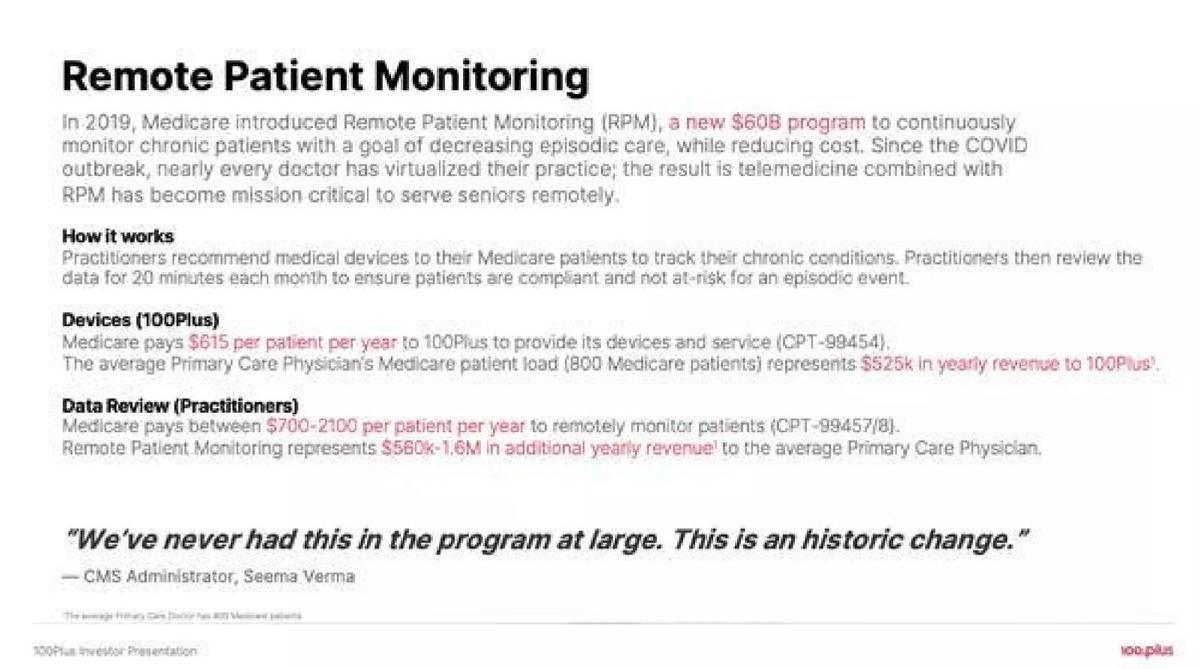
- 100Plus identified a $60B Medicare program introduced in 2019 as the primary market catalyst (Slide 4).
- The business model eliminates upfront costs for doctors, providing devices and setup for free to remove adoption friction (Slide 7).
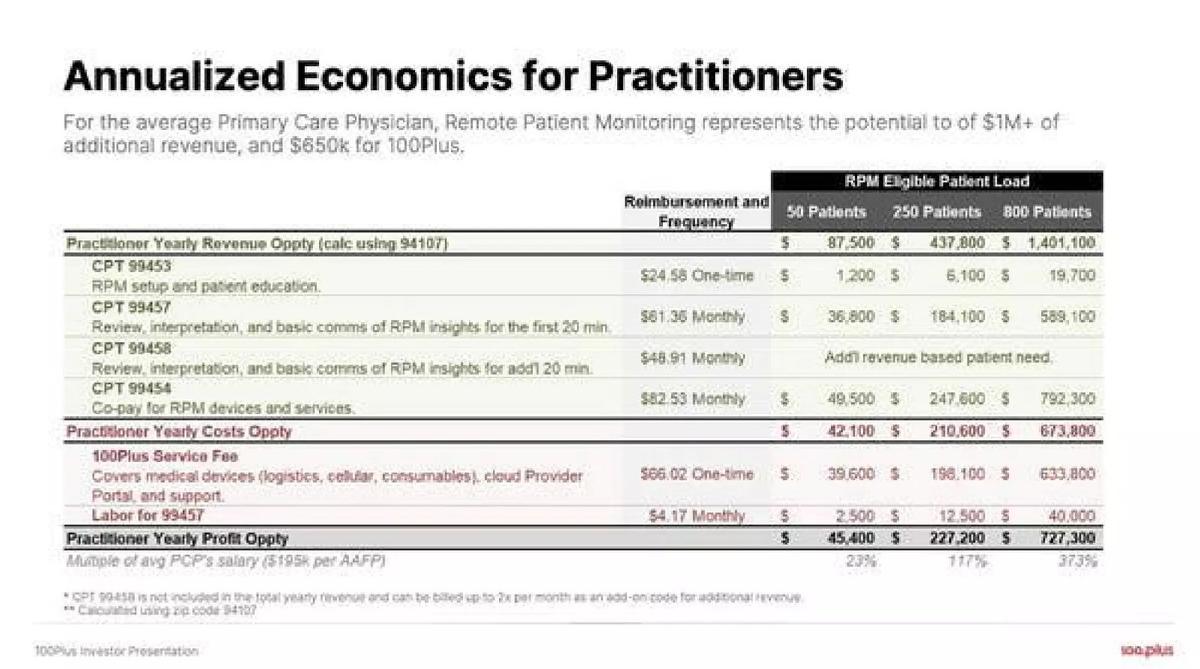
- Practitioners can earn over $1M in additional annual revenue by monitoring a load of 800 patients using the platform (Slide 5).
- The platform integrates with major EHR providers like AthenaHealth and DrChrono to access over 100k practitioners (Slide 2).
- The team is led by Ryan Howard, the founder and former CEO of Practice Fusion, which scaled to $50M in ARR (Slide 2).
- The deck lists high-profile investors including Henry Kravis, George Roberts, and Tony Robbins (Slide 15).
- Financial projections estimated a jump from $2.1M in revenue in 2020 to $35.1M by 2023 (Slide 2).
The Strategy of Regulatory Arbitrage
The 100Plus pitch deck is a textbook example of how to fundraise around a massive regulatory shift. By identifying a specific change in Medicare reimbursement (the 2019 RPM program), the company positioned itself not just as a health-tech startup, but as a distribution engine for a government-subsidized service. The deck focuses less on the 'innovation' of the hardware and more on the 'frictionless' nature of the business model and the massive financial upside for practitioners.
Executive Summary and Traction
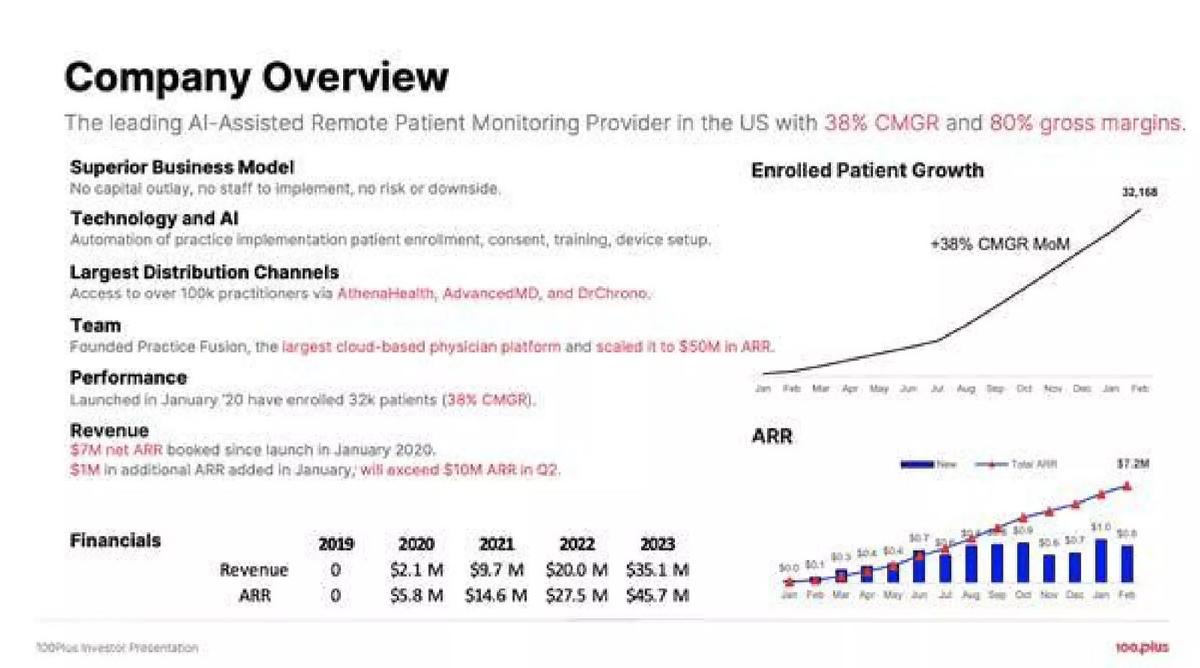
Slide 2, titled Company Overview , is one of the most information-dense slides in the presentation. It immediately establishes credibility by citing 80% gross margins and a 38% Compounded Monthly Growth Rate (CMGR). The slide highlights that the team previously founded Practice Fusion, scaling it to $50M in ARR, which serves as a powerful 'founder-market fit' signal. The financial table on this slide shows a projected revenue growth from $2.1M in 2020 to $35.1M in 2023, while the ARR chart shows a steady climb to $7.2M by February of the launch year.
The Problem: The Sickest Generation
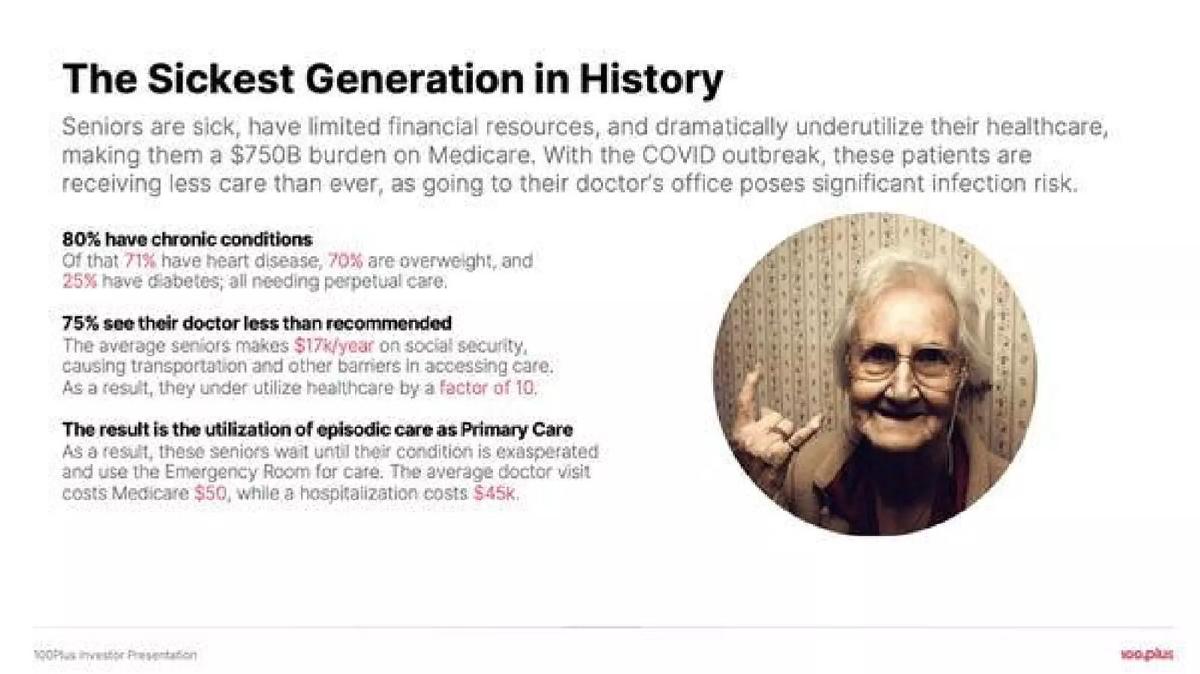
Slide 3, The Sickest Generation in History , defines the target demographic. It notes that seniors represent a $750B burden on Medicare, with 80% having chronic conditions. The slide identifies a critical barrier: the average senior makes only $17k per year, leading to transportation issues and a 'factor of 10' underutilization of healthcare. This sets the stage for a remote solution that removes the need for physical office visits, especially relevant given the 'infection risk' mentioned in the context of the COVID outbreak.
The Opportunity: Medicare's $60B Program
Slide 4 and Slide 5 dive into the mechanics of Remote Patient Monitoring (RPM) . Slide 4 explains that Medicare introduced a $60B program in 2019 to pay for these services. It breaks down the specific CPT codes: 100Plus receives $615 per patient per year (CPT-99454), while practitioners receive between $700 and $2,100 per patient per year (CPT-99457/8). Slide 5, Annualized Economics for Practitioners , provides a detailed table showing that a doctor with 800 eligible patients can generate $1,401,100 in new revenue, resulting in $727,300 in profit after 100Plus fees. This slide is the 'closer' for the business model, proving that the platform is a profit center for its users.
Product Offering and Business Model
The section starting at Slide 6 focuses on the 100Plus Product Offering . Slide 7 reiterates the 'no capital outlay' and 'no staffing resources' model. Slide 8 explains the Patient Enrollment and Setup process, which includes an 'EHR integration' to identify at-risk patients and a 'Complimentary Concierge' that handles consent and training. This is a key differentiator; 100Plus isn't just selling software, they are selling a managed service that handles the administrative burden of healthcare.
Technology and Population Health
Slide 9 introduces Population Health Management . It describes a predictive engine that uses American Diabetic Association and CDC guidelines to flag patients who are 'outside of a safe range.' The slide promises a Q2 feature that will inform doctors when patients will be out of compliance before it happens, using probabilistic algorithms. Slides 10 and 11 showcase the Practitioner Portal and Billing Portal , emphasizing that the system automatically generates Medicare claims to ensure doctors get paid with minimal administrative friction.
Competitive Landscape and Team
Slide 12 and Slide 13 are identical 100Plus Versus the Competition charts. They compare 100Plus against Optimize.health, Fora, Tactio, and Vivify. The chart claims 100Plus is the only vendor offering 'full, no cost, no-risk' solutions, specifically highlighting the 'integrated cellular' devices that don't require a monthly plan or user intervention. Slide 14, The Team , lists 12 key members, led by CEO Ryan Howard. The team includes veterans from Amazon, Facebook, Practice Fusion, and Pandora, suggesting a high level of execution capability. Slide 15, Investors , is a 'who's who' of high-net-worth individuals and VCs, featuring KKR co-founders Henry Kravis and George Roberts, as well as celebrity investor Tony Robbins.
Hardware Specifications
The deck concludes with a deep dive into the Devices (Slides 16-20). Each slide (Blood Pressure Monitor, Blood Glucose Monitor, Digital Weight Scale, Thermometer, and Pulse Oximeter) emphasizes that the devices are 'fully configured and ready to use out of the box' with no smartphone or WiFi required. This addresses the 'tech-illiteracy' risk often associated with senior-focused health tech.
What Works in This Deck
Clarity of the Economic Engine: The deck does a phenomenal job of explaining exactly how money flows from Medicare to the doctor and then to 100Plus. By using specific CPT codes and dollar amounts, they remove the 'black box' of healthcare billing.
Removing Friction: The repeated emphasis on 'no cost,' 'no setup,' and 'no smartphone' addresses the three biggest reasons why remote monitoring usually fails. The deck successfully argues that they have solved the adoption problem.
Traction Front-and-Center: Leading with a 38% CMGR and $7M in booked ARR (Slide 2) makes the rest of the deck a justification for an already successful launch rather than a hypothetical pitch.
What is Missing
Churn and Retention Data: While the deck shows rapid enrollment growth, it does not provide data on patient retention or device usage over time. In a recurring revenue model based on monthly monitoring codes, long-term adherence is critical.
Unit Economics (CAC/LTV): The deck explains the practitioner's profit but omits the company's own Customer Acquisition Cost (CAC) or the Lifetime Value (LTV) of a patient, especially considering they are giving away hardware for free upfront.
Regulatory Risk: The entire business is built on specific Medicare codes. The deck does not address what happens if these codes are reduced or if the 'no-cost' model is challenged by future regulatory changes.
What a Founder Should Copy
The 'Why Now' Slide: Slide 4 is a perfect example of a 'Why Now' slide. It points to a specific, massive market catalyst (the $60B Medicare program) that didn't exist a year prior. Founders should always look for these 'inflection points' to justify their timing.
The ROI Table: If your product helps your customers make money, include a table like Slide 5. Showing a practitioner that they can net $727k in profit by using your tool is a much more powerful sales (and investor) argument than just listing features.
Founder-Market Fit: The way the deck leverages Ryan Howard’s history with Practice Fusion (Slide 2 and 14) is excellent. It tells investors: 'We have done this before, we have the relationships, and we know how to scale in this specific niche.'
Frequently asked questions
- How does 100Plus make money if the devices are free?
- 100Plus generates revenue through Medicare reimbursement codes. Specifically, Slide 4 notes that Medicare pays $615 per patient per year to 100Plus for providing devices and services under code CPT-99454. This allows the company to offer the hardware for free while capturing a recurring service fee from the government-funded program.
- What is the primary value proposition for doctors?
- The primary incentive for doctors is significant incremental revenue with zero capital outlay. Slide 5 details that an average Primary Care Physician can generate $1.4M in yearly revenue from RPM codes, resulting in over $727k in annual profit after paying 100Plus's service fees and accounting for labor costs.
- How does the technology handle patient compliance?
- 100Plus uses cellular-connected devices that stream data automatically to the practitioner portal without requiring a smartphone, app, or Bluetooth pairing (Slide 17). This 'out of the box' functionality is designed to overcome the technical barriers typically faced by the senior population, which the deck describes as the 'sickest generation in history' (Slide 3).
- What role does AI play in the 100Plus platform?
- According to Slide 9, the platform uses a predictive population health management engine. It leverages bio-telemetry datasets and probabilistic algorithms to inform doctors when patients are likely to fall out of compliance before it happens, allowing for proactive rather than episodic care.
- How did the COVID-19 pandemic impact their growth strategy?
- The deck explicitly mentions the COVID outbreak on Slide 3 and Slide 4, noting that seniors faced high infection risks at doctor offices. This made virtualized practices and remote monitoring 'mission critical,' accelerating the adoption of their telemedicine-adjacent services during the 2020 launch period.