Knot Offshore Partners LP (KNOP) utilizes this 2016 investor presentation to highlight its position as a pure-play shuttle tanker operator. The deck is built around the Master Limited Partnership (MLP) model, focusing on 'dropdown' acquisitions from its sponsor, Knutsen NYK. Key metrics include a 99.7% fleet utilization rate since its IPO and a distribution yield of 9.4% at a $22 share price. The company demonstrates a clear growth path through a visible inventory of four potential vessel acquisitions, all backed by long-term contracts with energy majors like Shell and Petrogal. Financially,…
Key takeaways
- The company maintains a modern fleet with an average age of 4.7 years and a revenue backlog of $837 million as of December 2016 (Slide 4).
- KNOP achieved a 99.7% fleet utilization rate since its IPO, demonstrating high operational efficiency in the shuttle tanker niche (Slide 4).
- The 'dropdown' strategy is central to growth, with the Raquel Knutsen acquisition involving a $116.5 million purchase price and a contract through 2025 (Slide 8).
- A visible inventory of four potential acquisitions (Tordis, Vigdis, Anna, and Lena Knutsen) provides a roadmap for fleet expansion through 2030 (Slide 10).
- Shuttle tankers are presented as a high-barrier niche with only 72 vessels globally, compared to 10,500 dry bulk carriers (Slide 13).
- Distribution growth has reached 39% since the IPO, with an annual distribution of $2.08 per unit (Slide 4).
- Oil production in the North Sea and Brazil is projected to grow through 2020, increasing demand for shuttle tanker services (Slide 16).
- The company reports strong liquidity of $62.4 million against a requirement of only $18.5 million as of September 30, 2016 (Slide 25).
Introduction and Strategy
Knot Offshore Partners LP (KNOP) is a Master Limited Partnership focused on the ownership and operation of shuttle tankers. This investor presentation from December 2016 serves as a progress report and a growth roadmap for yield-oriented investors. The deck is characterized by its heavy reliance on technical asset data, long-term contract visibility, and the 'dropdown' mechanism that fuels its expansion.
Slide 1: Title Slide
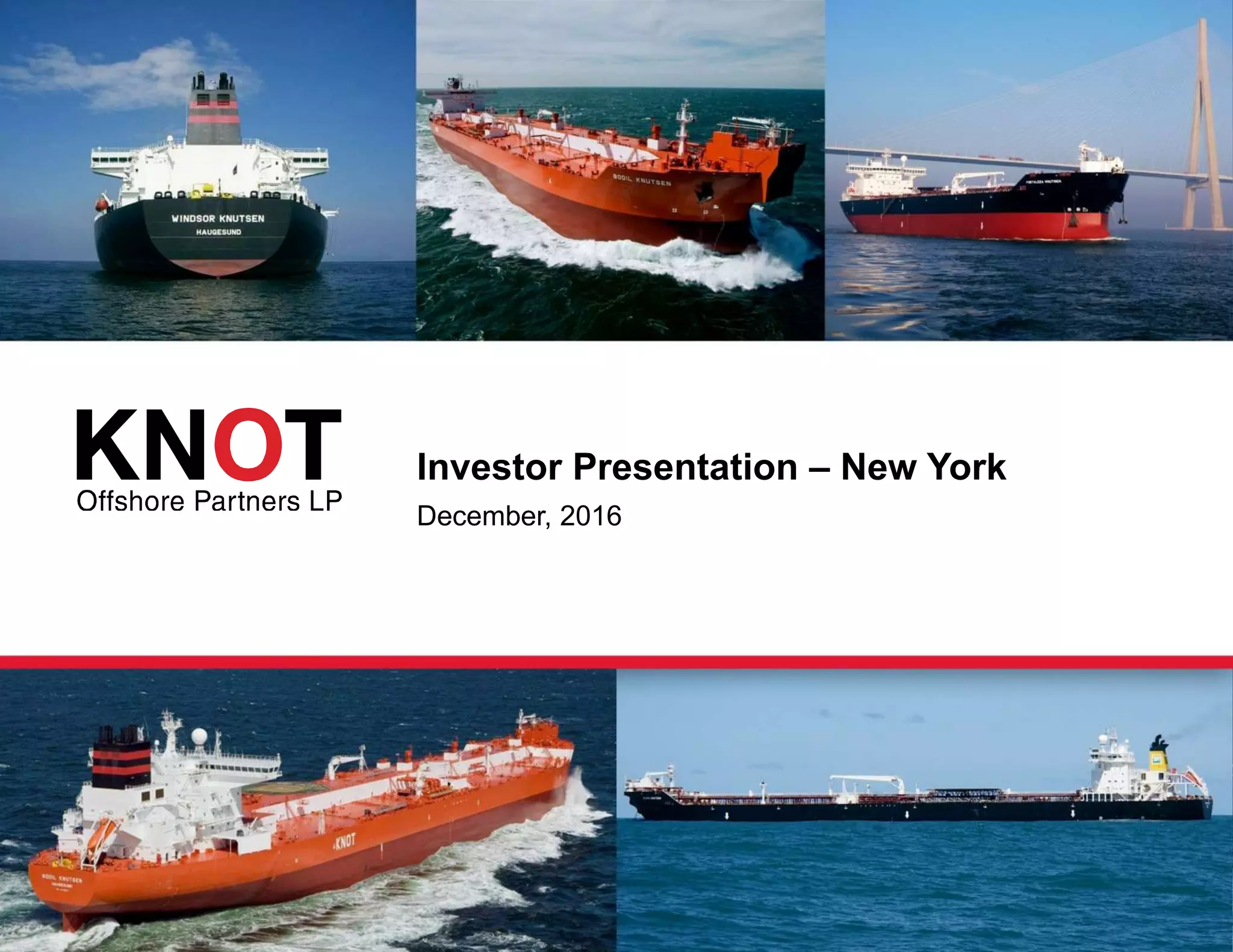
The title slide establishes the company's branding and the specific context of the presentation: New York, December 2016. It features high-resolution imagery of their primary assets—shuttle tankers—emphasizing the industrial and capital-intensive nature of the business. The vessels shown, such as the Windsor Knutsen and Bodil Knutsen, represent the core of the fleet.
Slide 4: Investment Highlights
This slide serves as the executive summary, broken into five pillars. 1. Pure-play shuttle tanker: Highlights a modern fleet (4.7 years average age) and a $837 million revenue backlog. 2. Strong Sponsors: Notes the backing of Knutsen NYK and 29 years of experience. 3. Distribution Growth: Reports a 39% growth since IPO and a 9.4% yield. 4. Favorable Market Fundamentals: Points to high barriers to entry in the niche offshore logistics chain. 5. Strong Balance Sheet: Cites $55.7 million in liquidity and no debt maturities until 2018. This slide is effective because it immediately quantifies the value proposition for an income investor.
Slide 8: Raquel Knutsen Drop-down
This slide provides a granular look at a specific acquisition. The Raquel Knutsen, built in 2015, was acquired for $116.5 million. The slide breaks down the financing: $103.5 million in debt and a $13.0 million equity portion. Crucially, it lists the contract details: a TimeCharter with Repsol Sinopec Brasil through June 2025, with an additional 5-year option. The estimated 2017 EBITDA of $13.0 million provides a clear picture of the asset's contribution to the partnership's cash flow.
Slide 10: Dropdown Inventory
Growth in an MLP is often tied to the 'dropdown pipeline' from the sponsor. This slide visualizes four potential acquisitions: Tordis, Vigdis, Anna, and Lena Knutsen. A Gantt-style chart shows their fixed contract periods (dark blue) and option periods (grey) extending out to 2030. Charterers include major entities like Shell and Petrogal. This slide is vital for proving that the company has a 'visible dowry' of assets to fuel future distribution increases.
Slide 13: Shuttle Tankers vs. Conventional Shipping
To justify the niche focus, KNOP compares shuttle tankers to LNG, conventional tankers, and dry bulk carriers. The slide highlights that shuttle tankers are a 'Specialized Asset Class' with only 72 vessels globally. Unlike conventional tankers, which are often ordered speculatively, shuttle tankers are built 'with contract.' This distinction is meant to reassure investors that the business is less volatile than the broader shipping market.
Slide 16: Oil Production Outlook
This slide addresses the macro demand for the company's services. It provides bar charts for oil production from shuttle tanker operated fields in the North Sea and Brazil. In the North Sea, new fields are expected to add significant output through 2020. In Brazil, despite 'corruption scandals' mentioned in the text, the post-2020 Libra development is expected to require 12-16 additional shuttle tankers. This provides the external validation for the company's internal growth plans.
Slide 19: Performance vs. IPO Guidance
Transparency is a key theme here. The company compares its 'IPO Guidance' to its 'Status 2016.' It shows that it has outperformed on every metric: fleet growth (175% vs 125% potential), distribution growth (39% vs 10-15% target), and coverage ratio (1.35x vs 1.1x forecast). This slide builds significant credibility by proving that management does what it says it will do.
Slide 22: Income Statement
The unaudited income statement for Q3 2016 shows total revenues of $43.587 million, up from $39.284 million in Q3 2015. Net income for Q3 2016 is reported at $19.357 million. A bold footer emphasizes '100% utilization in Q3,' which is the gold standard for asset-heavy businesses. The slide also accounts for realized and unrealized gains on derivative instruments, reflecting the company's active management of interest rate and currency risks.
Slide 25: Balance Sheet
The final slide in this set details the financial position as of September 30, 2016. Total assets stand at $1.186 billion, dominated by 'Net vessels and equipment' at $1.154 billion. Total liabilities are $669.6 million, with the majority being long-term debt ($586.3 million). The slide concludes with a liquidity highlight: $62.4 million in available liquidity against a requirement of $18.5 million, suggesting a comfortable margin for operations and future acquisitions.
What Works in This Deck
Contractual Visibility: The deck excels at showing exactly where the money comes from. By listing specific charterers (Shell, Repsol, Petrogal) and contract end dates (2025, 2030), the company removes the 'guesswork' often associated with startup or growth equity pitches.
Niche Education: Slide 13 is a masterclass in market positioning. By comparing the tiny shuttle tanker fleet (72 vessels) to the massive dry bulk fleet (10,500 vessels), KNOP makes a compelling case for its 'moat' and specialized expertise.
Accountability: The 'Have we delivered on expectation?' slide (Slide 19) is a powerful trust-building tool. It directly addresses the promises made at the time of the IPO and shows that the company has exceeded them.
What Is Missing
Management Team Details: While the 'Strong Sponsors' are mentioned, the specific individuals running the partnership are not detailed in these slides. In an MLP, the technical and financial expertise of the management team is a key risk factor.
Risk Factors: The deck is overwhelmingly positive. While it mentions 'corruption scandals' in Brazil in passing, it does not provide a dedicated slide for risks such as oil price volatility, counterparty risk, or interest rate hikes, which are standard in most public investor presentations.
Environmental and Regulatory Impact: Given the focus on offshore oil, a modern deck would require a section on ESG (Environmental, Social, and Governance) and how the company handles potential spills or changing maritime emissions regulations.
Founder Lessons
Quantify Your Backlog: If your business relies on contracts, show the 'revenue backlog' (Slide 4). It is the most comforting metric you can provide to an investor because it represents 'guaranteed' future income.
Visualize the Pipeline: Don't just say you are going to grow; show the specific assets or customers that will drive that growth. The 'Dropdown Inventory' (Slide 10) is a perfect example of how to visualize a multi-year growth strategy.
Compare to the Standard: If you operate in a niche, don't assume investors understand why it's better than the mainstream. Use a comparison table (like Slide 13) to highlight the specific advantages of your specialized market, such as higher barriers to entry or longer contract terms.
Frequently asked questions
- What is a 'dropdown' acquisition in the context of this deck?
- A dropdown occurs when the parent company (the Sponsor, Knutsen NYK) sells a vessel to the subsidiary partnership (KNOP). Slide 8 details the Raquel Knutsen dropdown, showing how KNOP uses a mix of debt and equity to acquire assets that already have long-term contracts in place, thereby providing immediate, predictable cash flow to the partnership's investors.
- How does KNOP differentiate shuttle tankers from conventional tankers?
- Slide 13 highlights that shuttle tankers are a 'Specialized Asset Class' used for transporting oil from FPSOs to terminals, whereas conventional tankers move product between terminals and refineries. Shuttle tankers operate on long-term contracts (5-15 years) and have much higher barriers to entry due to technical requirements like Dynamic Positioning (DP2) systems.
- What are the key financial metrics for the Raquel Knutsen vessel?
- According to Slide 8, the Raquel Knutsen was purchased for $116.5 million, financed by $103.5 million in debt and $13.0 million in equity. It was estimated to generate $13.0 million in EBITDA and $6.0 million in net income for 2017, supported by a charter with Repsol Sinopec Brasil through June 2025.
- What is the status of KNOP's debt and liquidity?
- Slide 25 shows total assets of $1.186 billion and total liabilities of $669.6 million as of September 2016. The company emphasizes its liquidity position, noting $62.4 million in available funds (cash plus undrawn credit) against a minimum requirement of $18.5 million. Slide 4 also notes that 62% of debt is at a fixed interest rate.
- How has the company performed relative to its IPO guidance?
- Slide 19 compares IPO goals to 2016 status. The fleet grew 175% (exceeding the 125% potential growth cited at IPO), and distributions increased by 39%, far surpassing the initial 10-15% target for the first three years. The coverage ratio also remained healthy at 1.35x, above the 1.1x forecast.