Knowledgehook’s 11-slide Series A deck is a lean, high-impact presentation that successfully navigated the complex EdTech procurement landscape. By identifying a specific gap in the market—the failure of technology to support professional development—Knowledgehook positioned its 'Instructional Guidance System' as a bridge between classroom data and teacher efficacy. The deck highlights a massive $30 billion addressable market and validates its product through a significant partnership with Nasco, granting access to 400+ school districts. While the deck lacks a formal team slide and specific f…
Key takeaways
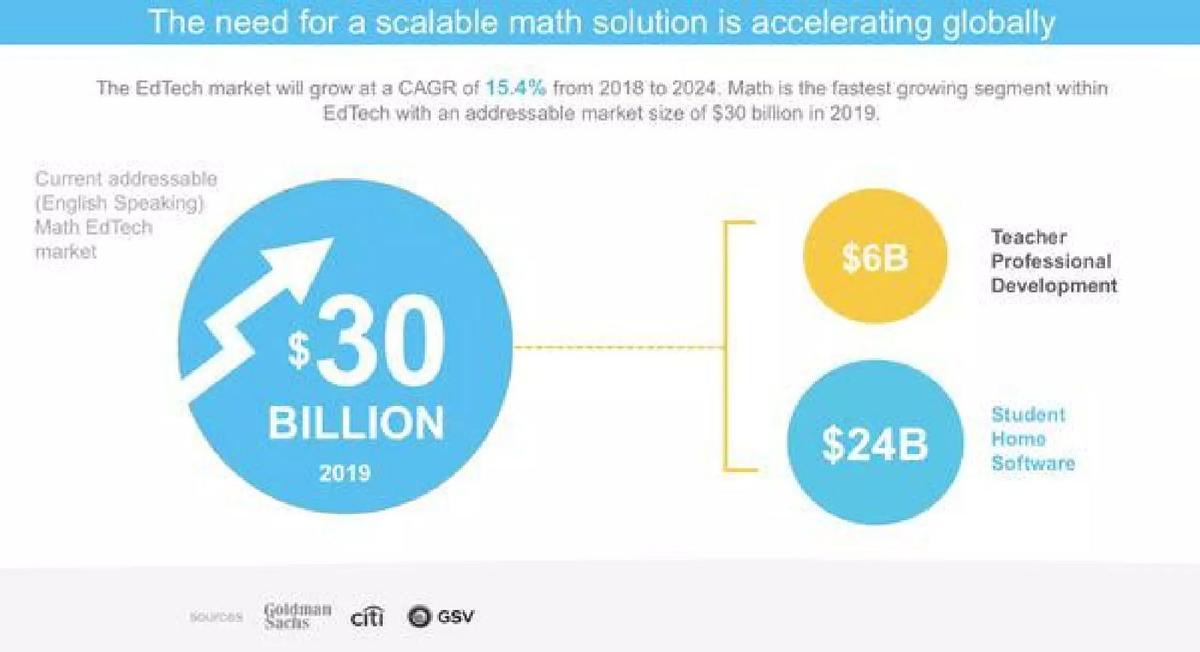
- The deck identifies a $30 billion addressable market in Math EdTech for 2019, citing sources like Goldman Sachs and Citi on slide 4.
- Knowledgehook differentiates itself by focusing on 'teaching the teacher' rather than trying to replace them, a common pitfall noted on slide 3.
- A major strategic partnership with Nasco is highlighted as a key growth lever, providing access to over 400 of the largest school districts (slide 8).
- The platform claims a user base of over 100,000 North American teachers already active within their data-informed ecosystem on slide 8.
- The 'PaperMode' feature addresses the digital divide by allowing participation with only one device per classroom via QR codes (slide 6).
- Competitive analysis on slide 10 positions Knowledgehook as the only solution covering high school, predictive training, and parent insights simultaneously.
- The deck utilizes external validation from the Ontario Minister of Education to establish institutional trust early on slide 2.
- A significant omission is the lack of a dedicated team slide or specific 'Ask' regarding the use of the $22.5 million raised.
The Strategic Lean: Analyzing Knowledgehook's Series A Deck
Knowledgehook’s pitch deck is a study in focused messaging. With only 11 slides, the company managed to secure $22.5 million by addressing the 'why now' and 'how we scale' questions with surgical precision. Instead of a broad EdTech play, they focused on the $30 billion math segment and the specific friction point of teacher adoption. The deck is less about the 'app' and more about the 'ecosystem,' a buzzword that, in this case, is backed by a sophisticated data-loop involving teachers, districts, and parents.
Slides 1-2: Credibility and Institutional Trust
The deck opens with a title slide (Slide 1) that immediately leans on social proof. Logos for Forbes, BNN Bloomberg (Top Disruptor), Google (Game Changer), and the World Education Congress (EdTech Leader) are prominently displayed. This is a standard but effective tactic for a Series A company to signal that they have already passed the 'sniff test' of major industry observers.
Slide 2 doubles down on this credibility. Rather than starting with a problem statement, Knowledgehook leads with a quote from Stephen Lecce, the Minister of Education for Ontario. The quote emphasizes that Knowledgehook is a 'trusted' partner for school districts. For an EdTech company, where procurement cycles are notoriously long and risk-averse, establishing this level of institutional trust on the second slide is a power move. It tells investors that the 'barrier to entry'—government and district approval—has already been breached.
Slides 3-4: The Problem and the $30B Opportunity
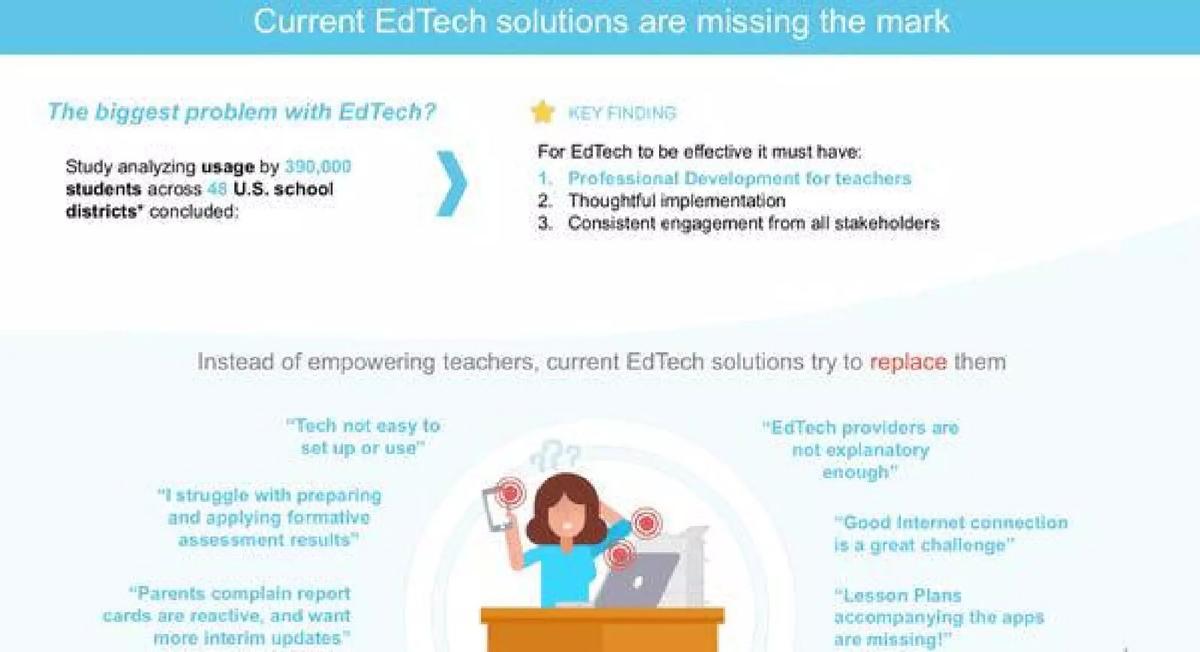
Slide 3 identifies the 'biggest problem with EdTech.' Citing a study of 390,000 students across 48 U.S. districts, the company argues that current solutions try to replace teachers rather than empower them. They list specific pain points: tech is not easy to use, providers aren't explanatory enough, and lesson plans are missing. This sets the stage for Knowledgehook to be the 'teacher-friendly' alternative.
Slide 4 quantifies the opportunity. It claims a $30 billion addressable market for Math EdTech in 2019, with a projected CAGR of 15.4% through 2024. The slide breaks this down into two sub-markets: $6 billion for Teacher Professional Development and $24 billion for Student Home Software. By citing Goldman Sachs, Citi, and GSV, Knowledgehook aligns its growth projections with respected financial institutions, making the numbers harder for a VC to dismiss as 'founder optimism.'
Slides 5-6: The Instructional Guidance System
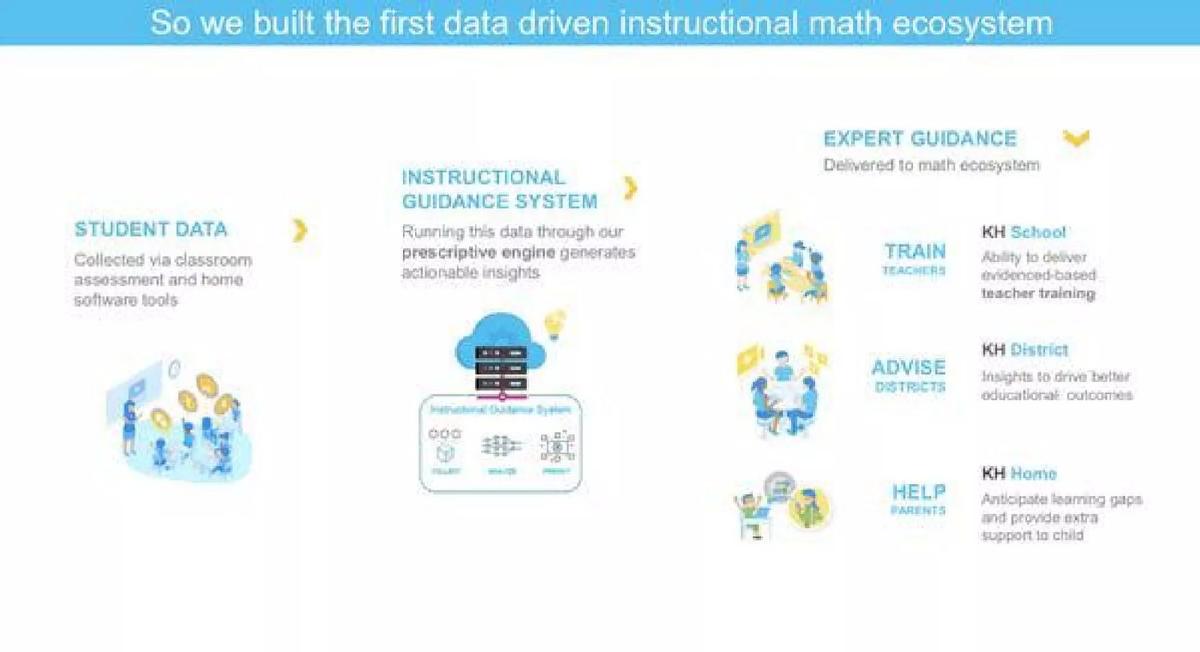
Slide 5 introduces the core product: the 'Instructional Guidance System' (IGS). The visual flow shows student data being fed into a 'prescriptive engine' that then outputs guidance for three distinct groups: KH School (teachers), KH District (administrators), and KH Home (parents). This 'ecosystem' approach is vital because it creates multiple sticky touchpoints within a single school system, increasing the cost of switching to a competitor.
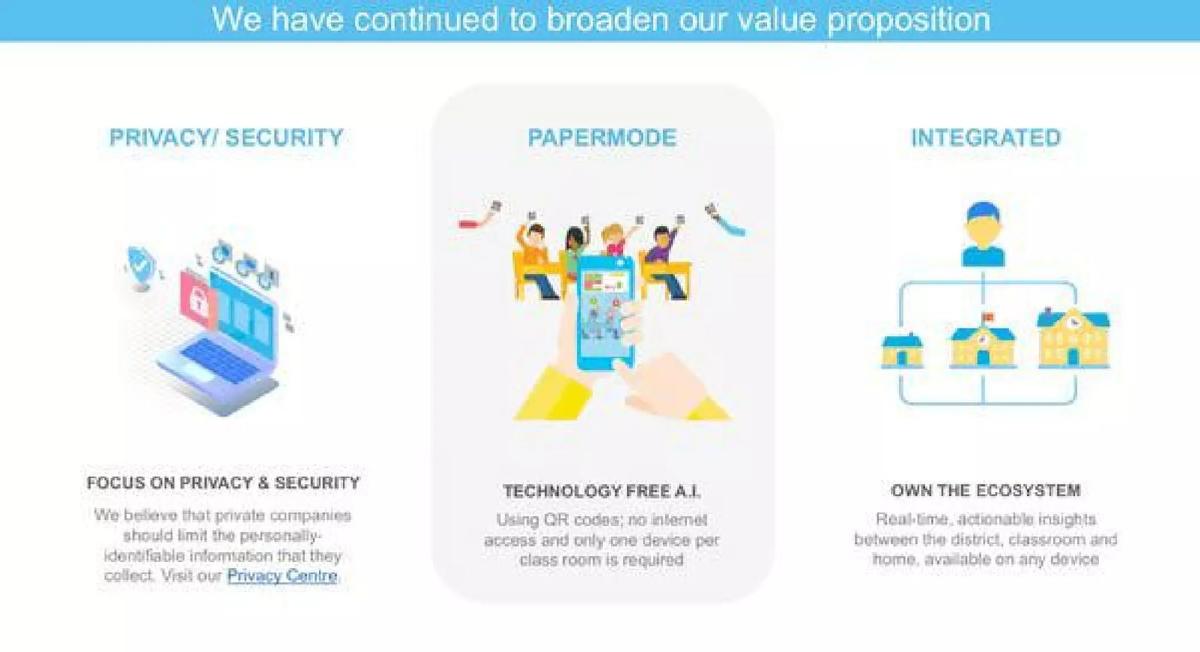
Slide 6 highlights three specific value propositions: Privacy/Security, PaperMode, and Integration. The 'PaperMode' feature is particularly clever. By allowing teachers to use QR codes and a single device, Knowledgehook solves the 'infrastructure gap' that plagues many schools. It demonstrates that the company is building for the reality of the classroom, not just for high-wealth districts with 1:1 iPad ratios.
Slides 7-9: Traction and the Nasco Partnership
Slide 7 focuses on customer satisfaction. It includes a testimonial from the CEO of Nelson Education (Canada's largest education company) and a bar chart showing Knowledgehook outperforming 'other leading EdTech applications' in teacher surveys. The chart uses a scale from 'Not great' to 'Love it!', showing Knowledgehook with the highest 'Love it!' rating.
Slide 8 is arguably the most important slide for the Series A round. It details a partnership with Nasco, a major distributor of educational materials. The slide notes that 100,000+ North American teachers are already on the Knowledgehook ecosystem and that Nasco provides access to 400+ of the largest school districts. This is the 'unfair advantage' slide—it shows a clear, pre-built path to massive scale that doesn't rely solely on a cold-calling sales team.
Slide 9 provides a 'Packaging Mock-up' of the Classpack. This is a physical representation of the digital/physical hybrid model. It makes the product feel 'real' and tangible, which can be a psychological boost for investors who are used to seeing abstract SaaS dashboards.
Slides 10-11: Competition and Conclusion
Slide 10 is a standard competitive matrix. It pits Knowledgehook against Prodigy, Dreambox, Byju's, Renaissance, and IXL. Knowledgehook checks every box, including 'No Tech Mode,' 'Predictive Teacher Training,' and 'Class Insights for Parents.' While these matrices are always biased, this one effectively highlights Knowledgehook's focus on the teacher and parent, whereas many competitors focus solely on the student-as-user.
The deck ends abruptly on Slide 11 with a simple 'THANK YOU' on a yellow background. There is no contact information, no 'Ask' slide, and no closing summary of the vision.
What Works in the Knowledgehook Deck
1. The 'Teach the Teacher' Narrative: The deck successfully identifies a common grievance in education—that technology is often dumped on teachers without support. By positioning their software as a 'Guidance System' for the teacher, they align themselves with the most important stakeholder in the classroom.
2. Strategic Partnerships as Traction: The Nasco and Nelson Education partnerships are the stars of the deck. They prove that Knowledgehook isn't just a startup with an app; it's a company integrated into the existing supply chain of North American education.
3. Addressing the Digital Divide: Including 'PaperMode' (Slide 6) is a brilliant tactical move. It shows investors that the company has a plan for the 'bottom of the pyramid' schools, which are often excluded from high-tech EdTech solutions but represent a massive portion of the market.
What is Missing from the Knowledgehook Deck
1. The Team Slide: This is a glaring omission. For a $22.5 million Series A, the pedigree of the founders and the expertise of the data scientists mentioned in the catalogue description are crucial. Investors fund people as much as products, and this deck leaves the 'who' entirely to the imagination.
2. Financials and Unit Economics: There is no mention of Revenue, Burn Rate, LTV (Lifetime Value), or CAC (Customer Acquisition Cost). While the market size is clear, the company's specific financial performance is absent. This suggests this deck might have been a 'teaser' or a supplement to a more data-heavy dataroom.
3. The Ask: The deck does not state how much money they are looking for or how they plan to spend it. A standard pitch deck should conclude with a clear funding goal and a roadmap of what that capital will achieve (e.g., 'Hiring 20 engineers,' 'Expanding into the UK market').
What a Founder Should Copy
1. Use Third-Party Validation Early: If you have a quote from a government official or a major industry leader, put it on Slide 2. It sets a tone of inevitability and reduces the perceived risk for the investor.
2. Segment Your Market: Don't just say 'Education is a big market.' Break it down like Knowledgehook did on Slide 4. Show exactly which sub-sectors you are targeting and why those specific niches are growing.
3. Visualizing the Ecosystem: Slide 5 is an excellent example of how to visualize a complex product. Instead of showing screenshots of the app, they showed the flow of value between different users. This helps investors understand the business model, not just the features.
Conclusion: Knowledgehook's deck is a masterclass in 'Institutional EdTech.' It avoids the fluff of gamification and instead focuses on the hard metrics of district partnerships and teacher efficacy. While the lack of a team and financial slide is unconventional, the strength of their market positioning and strategic alliances clearly carried the day, resulting in a successful $22.5 million raise.
Frequently asked questions
- What is the primary problem Knowledgehook aims to solve?
- According to slide 3, current EdTech solutions are 'missing the mark' because they try to replace teachers instead of empowering them. The deck cites a study of 390,000 students across 48 U.S. districts concluding that effective EdTech requires professional development, thoughtful implementation, and consistent stakeholder engagement—areas where competitors supposedly fail.
- How does Knowledgehook handle classrooms with limited internet or device access?
- Knowledgehook introduced 'PaperMode,' described on slide 6 as 'Technology Free A.I.' This feature allows teachers to use QR codes, requiring only one device per classroom and no student internet access. This lowers the barrier to entry for underfunded districts and ensures the 'ecosystem' remains inclusive of various infrastructure levels.
- What is the 'Instructional Guidance System' (IGS)?
- As detailed on slide 5, the IGS is a prescriptive engine that processes student data from classroom assessments and home software to generate actionable insights. It delivers expert guidance to three pillars: training teachers (KH School), advising districts (KH District), and helping parents anticipate learning gaps (KH Home).
- Who are Knowledgehook's main competitors and how do they compare?
- Slide 10 lists Prodigy, Dreambox, Byju's, Renaissance Learning, and IXL as competitors. Knowledgehook claims to be the only 'comprehensive' solution, specifically noting that it offers predictive teacher training and class insights for parents, features that most of these competitors lack according to their comparison matrix.
- What is the significance of the Nasco partnership mentioned in the deck?
- The partnership with Nasco, featured on slide 8, is a cornerstone of their go-to-market strategy. It combines Knowledgehook's digital 'Instructional Guidance System' with Nasco's 'Hands-On' interactive learning experiences. Crucially, it gives Knowledgehook a direct channel into the 400+ large school districts that already rely on Nasco's physical products.