How e-commerce and online retail startups present the problem in a pitch deck: name the merchant, brand or shopper.
E-commerce Startup Problem Slide: Real Pitch Deck Examples
Eight problem slides from e-commerce and online retail startups, shown in full, compare whether each slide names who loses (the merchant, the brand or the shopper), the step in selling online where it happens, and whether it measures the loss.
TL;DR
An e-commerce problem slide should name who loses — the merchant, the brand or the shopper — at a specific step of selling online (checkout, launch day, listing on marketplaces, bookkeeping), and give one number. Honey does all three: "In 2014, 163.2 million online shoppers encountered this question while checking out", beside a "Have a promo code?" box, and "Many of them left merchants' sites to search for a coupon, resulting in cart abandonment." Synder names the merchant's back office and prices it: bookkeeping "cost on average $200 USD/week". Kiddo lists three shopper inconveniences with no number and no link to a sale lost, which is the weaker pattern.
E-commerce problem slides from real pitch decks
Each example shows the exact stored slide above its analysis and links to the full teardown. Claims are as shown on the slides; we have not verified them.
Honey problem slide — slide 2
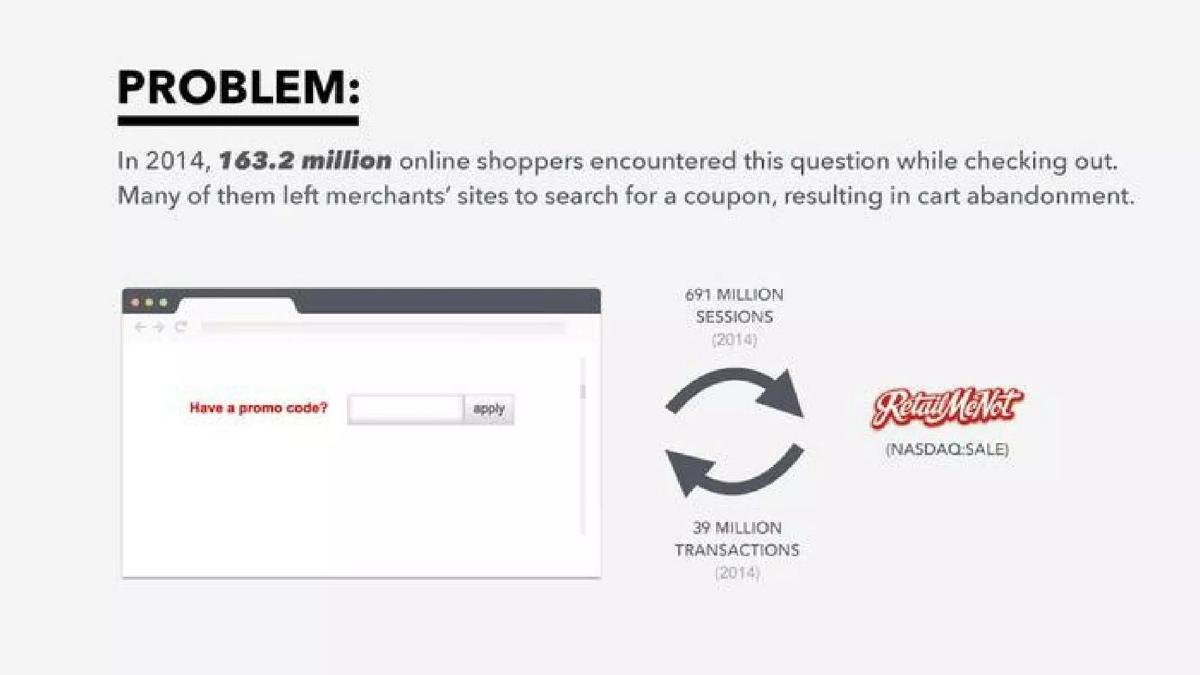
Browser extension that applies coupon codes. One sentence, a checkout screenshot and a competitor's figures.
Honey deck, slide 2. Exact stored slide matched to this analysis.
Our analysis: It shows the exact moment (the promo-code box), who acts (the shopper), who loses (the merchant, through abandonment) and the scale.
Evidence and limitation: 163.2 million shoppers; 691 million sessions and 39 million transactions attributed to RetailMeNot for 2014. No source named.
What a founder can adapt: Screenshot the exact step where the sale leaks and put one number beside it.
Supporting analysis
What the deck claims: "Problem:" "In 2014, 163.2 million online shoppers encountered this question while checking out. Many of them left merchants' sites to search for a coupon, resulting in cart abandonment." Screenshot: "Have a promo code? [apply]". Beside it: "691 million sessions (2014)", "39 million transactions (2014)", RetailMeNot "(NASDAQ:SALE)".
Presentation choice: Everyone recognises the box; the numbers and a listed competitor show the behaviour is large and already monetised.
When it does not fit: Cite where the 163.2 million comes from; add how many of those carts were actually abandoned.
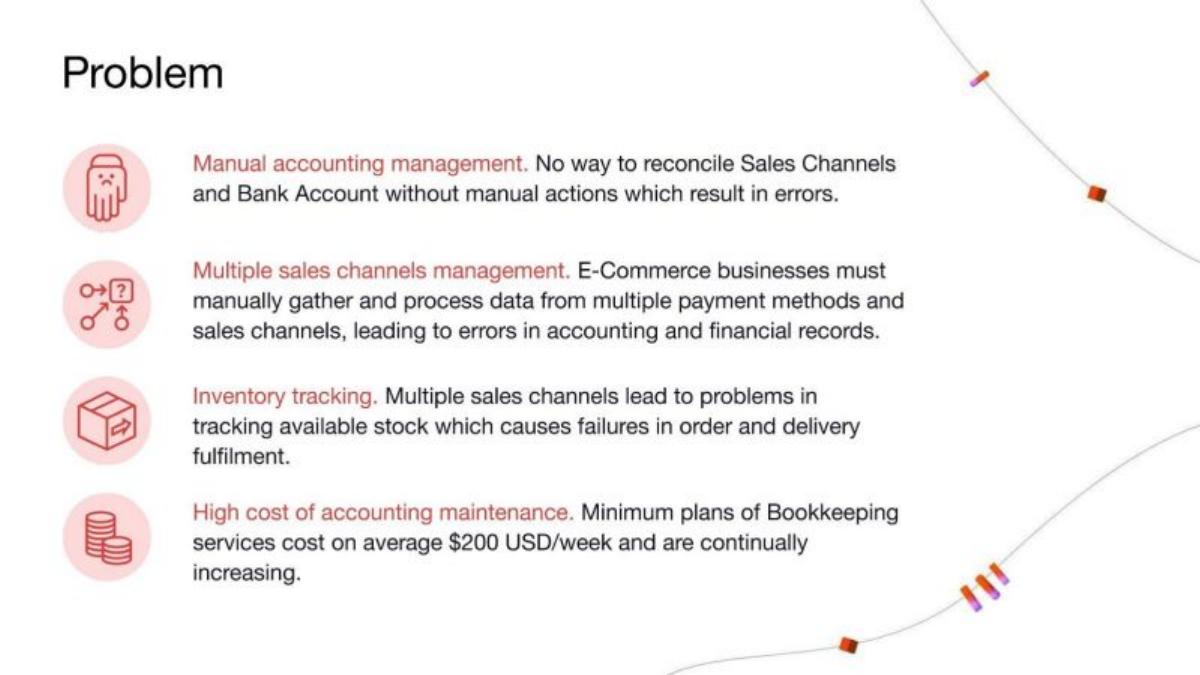
Accounting sync for online sellers. Four icon rows.
Synder deck, slide 3. Exact stored slide matched to this analysis.
Our analysis: It names the merchant and the back-office step, explains the cause (many channels) and prices the current workaround.
Evidence and limitation: $200 a week for bookkeeping; not sourced.
What a founder can adapt: Name what merchants use today to cope, and what it costs per week or month.
Supporting analysis
What the deck claims: "Problem." "Manual accounting management. No way to reconcile Sales Channels and Bank Account without manual actions which result in errors." "Multiple sales channels management. E-Commerce businesses must manually gather and process data from multiple payment methods and sales channels..." "Inventory tracking..." "High cost of accounting maintenance. Minimum plans of Bookkeeping services cost on average $200 USD/week and are continually increasing."
Presentation choice: Pricing what merchants pay today sets the ceiling for what they will pay you.
When it does not fit: Four rows compete; inventory tracking is a separate problem. Source the $200.
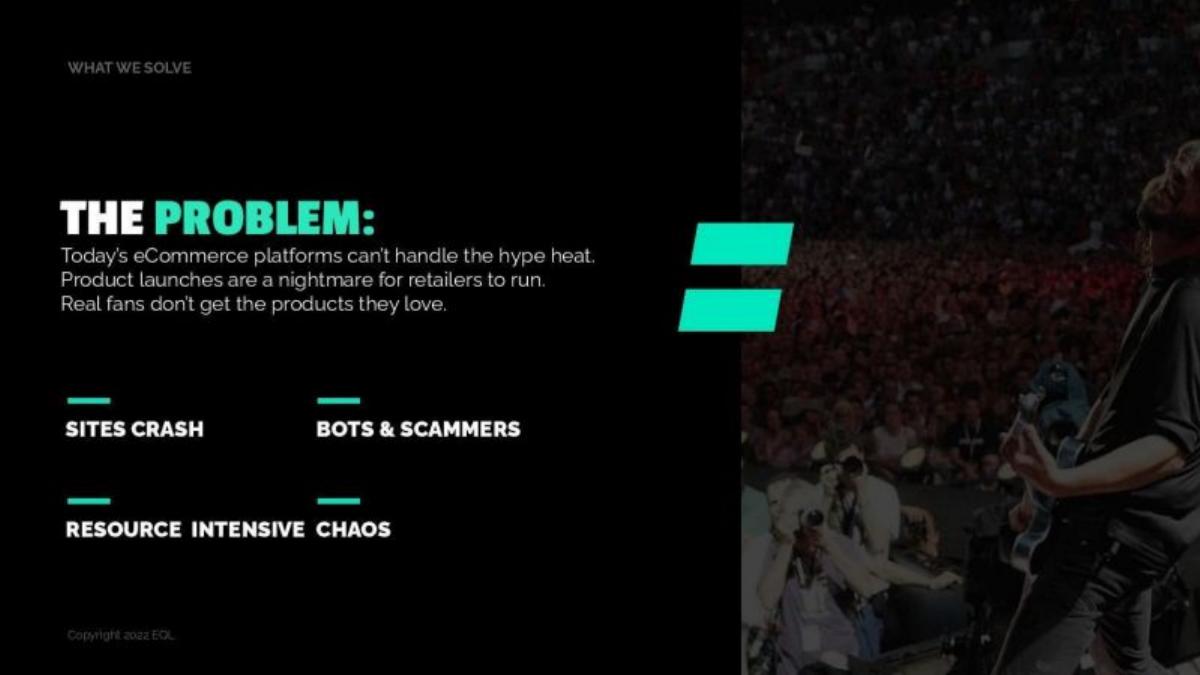
Launch platform for limited-release products. Three sentences and four labels over a concert photo.
EQL deck, slide 5. Exact stored slide matched to this analysis.
Our analysis: It picks one moment (launch day), one sufferer (the retailer) and a second (real fans), with four concrete failures.
Evidence and limitation: No figures.
What a founder can adapt: Name the one moment your merchants dread and list what breaks.
Supporting analysis
What the deck claims: "What we solve." "The problem: Today's eCommerce platforms can't handle the hype heat. Product launches are a nightmare for retailers to run. Real fans don't get the products they love." Labels: "Sites crash", "Bots & scammers", "Resource intensive", "Chaos".
Presentation choice: A narrow, vivid moment is easier to believe than "e-commerce is hard".
When it does not fit: Add a number: share of launch traffic from bots, or minutes of downtime per launch. "Chaos" is not a failure.
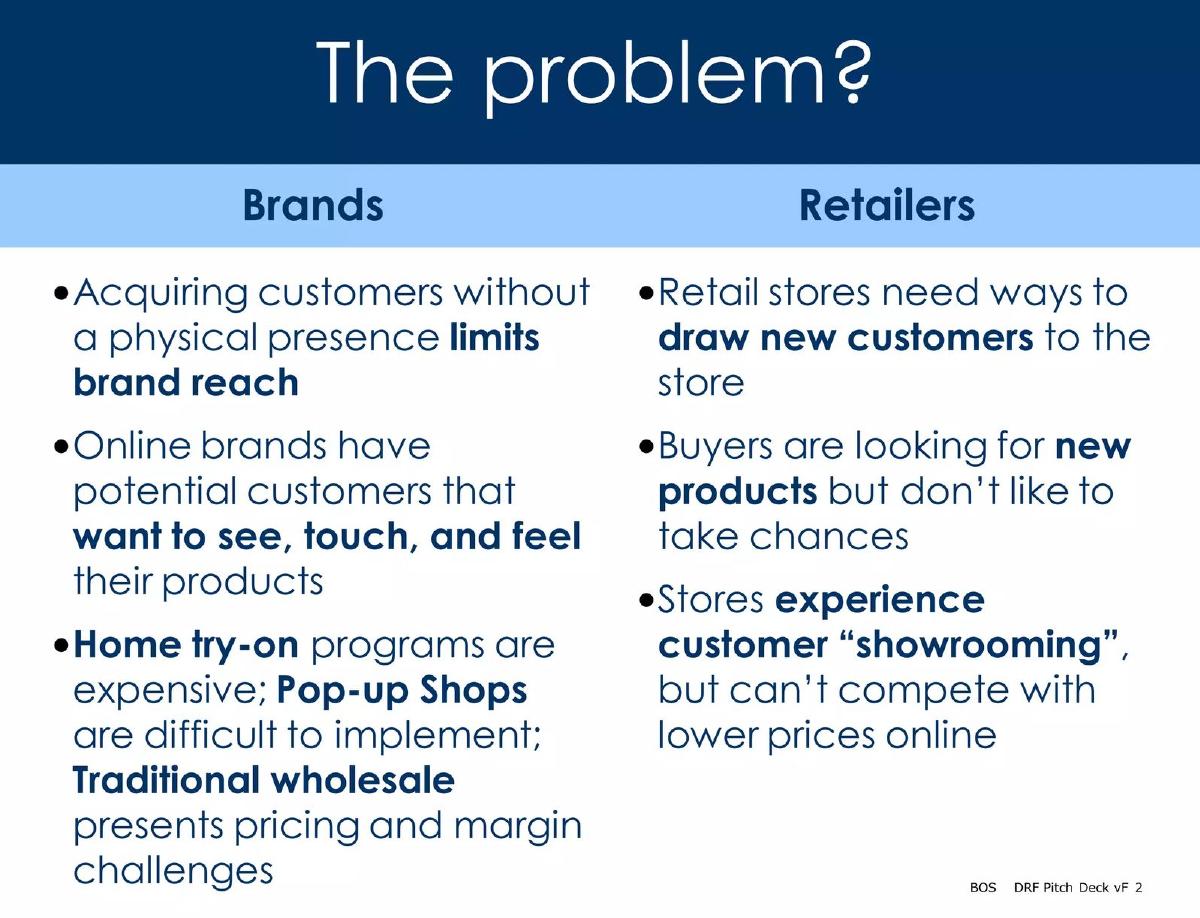
Physical showroom service for online brands. Two columns.
DRF deck, slide 2. Exact stored slide matched to this analysis.
Our analysis: It gives both sides their own column and lists why each current option fails for brands.
Evidence and limitation: No figures.
What a founder can adapt: If you serve two sides, give each its own column and name what they try today.
Supporting analysis
What the deck claims: "The problem?" Brands: "Acquiring customers without a physical presence limits brand reach." "Online brands have potential customers that want to see, touch, and feel their products." "Home try-on programs are expensive; Pop-up Shops are difficult to implement; Traditional wholesale presents pricing and margin challenges." Retailers: "Retail stores need ways to draw new customers to the store." "Buyers are looking for new products but don't like to take chances." "Stores experience customer 'showrooming', but can't compete with lower prices online."
Presentation choice: Listing the alternatives (try-on, pop-ups, wholesale) and why they fail pre-empts "why not just do X".
When it does not fit: Six bullets and a question-mark headline; keep two per side and add one number.
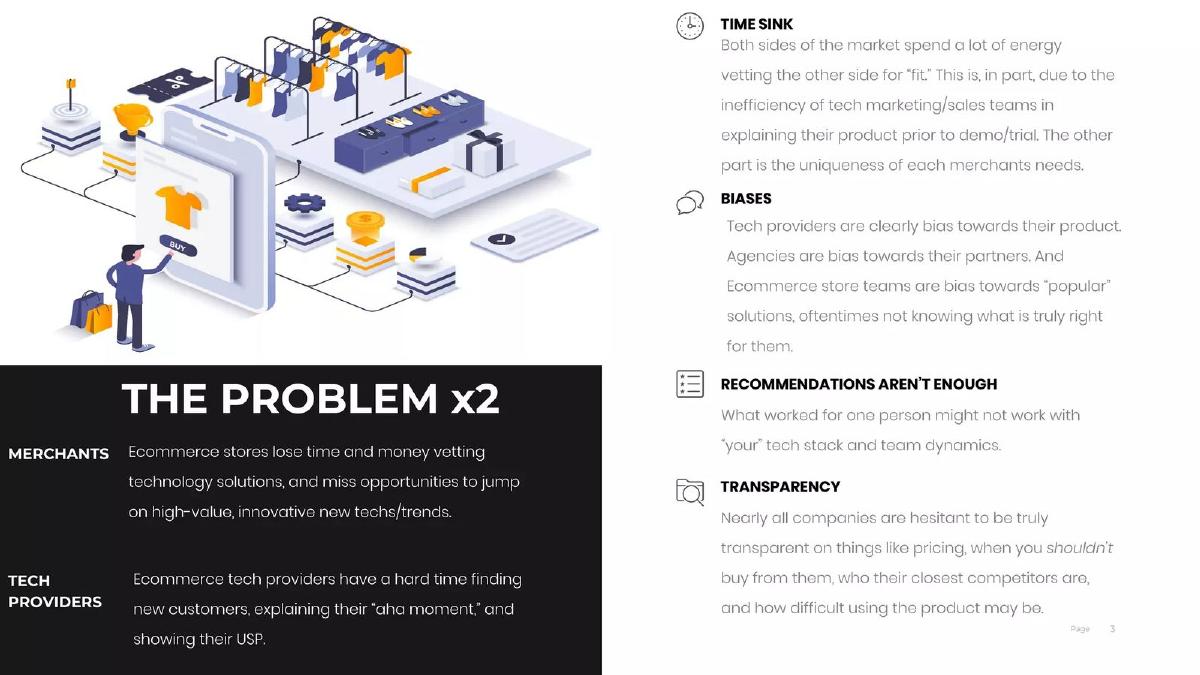
Matching online stores with software vendors. Two sides on the left, four causes on the right.
Ecommerce Technology deck, slide 3. Exact stored slide matched to this analysis.
Our analysis: It names both sides and explains why the problem exists, but "lose time and money" is not measured.
Evidence and limitation: No figures.
What a founder can adapt: Measure one side: hours or months a store spends choosing a tool.
Supporting analysis
What the deck claims: "The problem x2." "Merchants: Ecommerce stores lose time and money vetting technology solutions, and miss opportunities to jump on high-value, innovative new techs/trends." "Tech providers: Ecommerce tech providers have a hard time finding new customers, explaining their 'aha moment' and showing their USP." Causes: "Time sink", "Biases", "Recommendations aren't enough", "Transparency".
Presentation choice: Explaining causes (biased agencies, hidden pricing) makes the problem credible.
When it does not fit: The right column is long, small text; cut it to one line per cause.
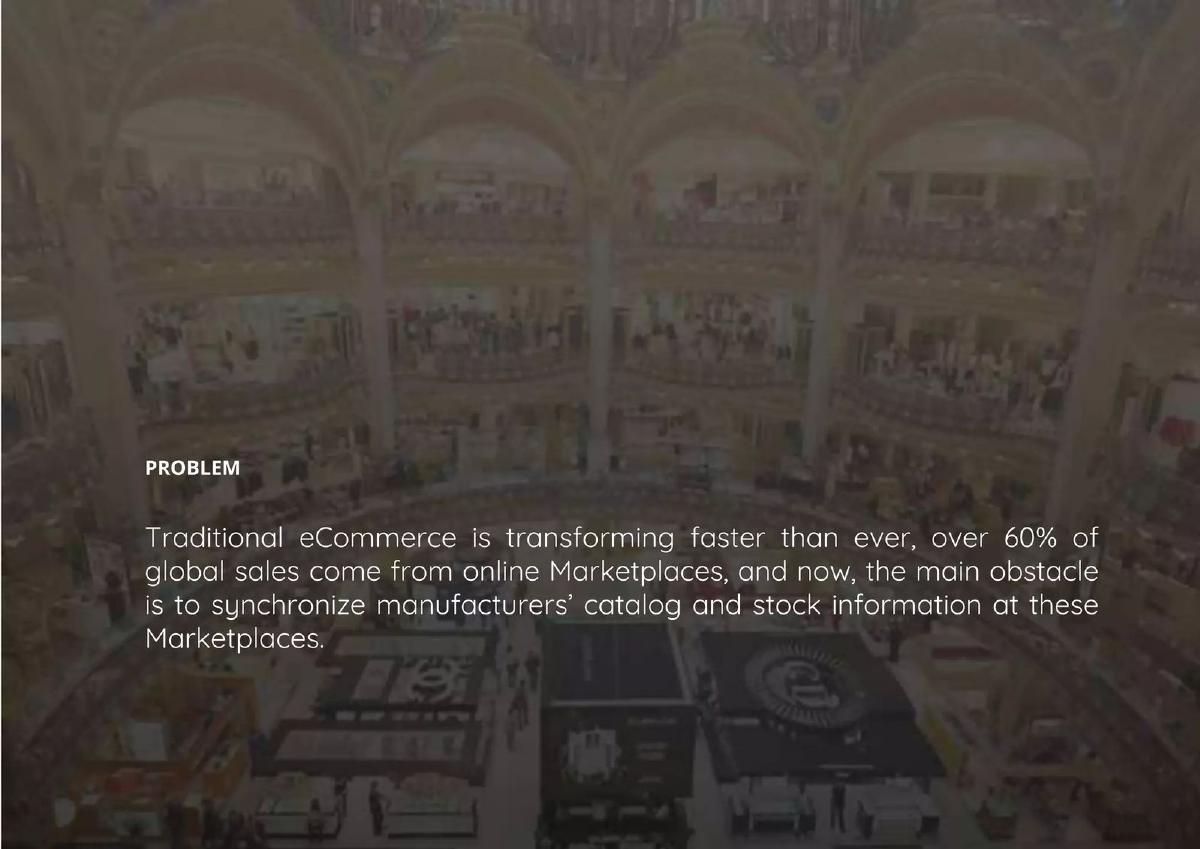
Catalog and stock sync for marketplaces. One sentence over a dark photo. Partial example.
QaShops deck, slide 2. Exact stored slide matched to this analysis.
Our analysis: It names a precise step (keeping catalog and stock in sync across marketplaces) and sizes the channel, but not the loss.
Evidence and limitation: "Over 60% of global sales" from marketplaces; not sourced or dated.
What a founder can adapt: Say what an out-of-sync listing costs a manufacturer: cancelled orders, delisting, penalties.
Supporting analysis
What the deck claims: "Problem." "Traditional eCommerce is transforming faster than ever, over 60% of global sales come from online Marketplaces, and now, the main obstacle is to synchronize manufacturers' catalog and stock information at these Marketplaces."
Presentation choice: The step is specific; the number sizes the market rather than the pain.
When it does not fit: Low-contrast text on a busy photo is hard to read; source and date the 60%.
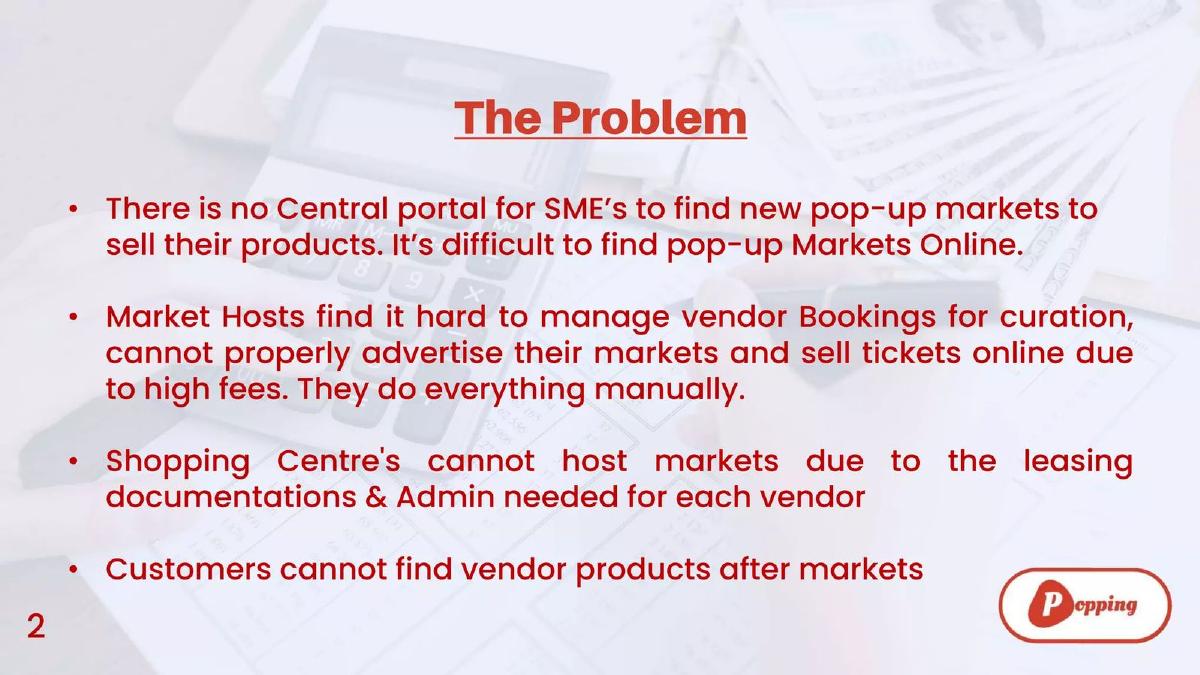
Pop-up market booking for small sellers. Four red bullets. Partial example.
Popping deck, slide 2. Exact stored slide matched to this analysis.
Our analysis: Four different parties each get a problem, so none is developed; the first bullet describes a missing portal (the solution).
Evidence and limitation: No figures.
What a founder can adapt: Lead with the seller: how many markets they miss, or sales lost, for lack of a way to find them.
Supporting analysis
What the deck claims: "The Problem." "There is no Central portal for SME's to find new pop-up markets to sell their products. It's difficult to find pop-up Markets Online." "Market Hosts find it hard to manage vendor Bookings for curation, cannot properly advertise their markets and sell tickets online due to high fees. They do everything manually." "Shopping Centre's cannot host markets due to the leasing documentations & Admin needed for each vendor." "Customers cannot find vendor products after markets."
Presentation choice: It shows how many parties a small-seller channel touches, and why picking one matters.
When it does not fit: "No central portal" is your product; state the cost of not having it.
Online store for baby products. Three numbered problems and an illustration. Weak on purpose.
Kiddo deck, slide 2. Exact stored slide matched to this analysis.
Our analysis: Three overlapping shopper inconveniences with no number, no step where a sale is lost and a generic illustration.
Evidence and limitation: No figures.
What a founder can adapt: Measure one: trips or hours per month parents spend buying baby essentials, or money spent across stores.
Supporting analysis
What the deck claims: "Problem 1: The Mommies have to visit many stores to get her and her baby stuff [a pharmacy, clothes store, toys store and maybe a furniture store]." "Problem 2: The market has million of brands with different price scale and quality." "Problem 3: Time consuming and effort to get your baby new stuff carrying a baby."
Presentation choice: It shows the minimum an e-commerce problem slide needs: who loses, where, and how much.
When it does not fit: "Million of brands" is an unmeasured claim; merge problems 1 and 3, which are the same.
Whether each slide names who loses, the step where it happens, and a number.
Example
Who loses
Step in selling online
Number
Honey
Yes (merchants, via shoppers)
Yes (checkout promo box)
Yes (163.2M shoppers)
Synder
Yes (e-commerce businesses)
Yes (accounting and reconciliation)
Yes ($200/week)
EQL
Yes (retailers and fans)
Yes (product launch)
No
DRF
Yes (brands and retailers)
Partly (reaching buyers offline)
No
Ecommerce Technology
Yes (merchants and tech providers)
Yes (choosing tools)
No
QaShops
Partly (manufacturers)
Yes (marketplace catalog sync)
Market size only (60%)
Popping
Partly (four parties)
Partly (finding markets)
No
Kiddo
Shoppers only
No
No
Key Takeaways
Pick who loses: the merchant, the brand or the shopper. Most strong slides pick the merchant.
Name the step: checkout, product launch, marketplace listing, fulfilment, accounting.
Measure the loss in the merchant's units: abandoned carts, crashed launches, hours or dollars per week.
Show the moment if you can; Honey's promo-code box makes the problem visible in one glance.
Several unrelated shopper annoyances are weaker than one measured merchant loss.
Build your e-commerce problem slide
One party who loses, one step, one number.
Who. Merchant, brand or shopper? Name one, with their size (for example, stores under $5M a year).
Step. Where does it go wrong: product page, checkout, launch, marketplace listing, fulfilment, accounting?
Loss. What does it cost: abandoned carts, cancelled orders, hours, dollars per week?
Today. What do they do about it now, and what does that cost?
Copyable framework: [Merchant type] lose [number and unit] at [step] because [cause]. Today they [workaround], which costs [amount]. (Source: [source].)
Illustrative example 1 — written by us
Before: Online selling is complicated and merchants struggle.
After: Shopify stores selling on 3+ marketplaces cancel 4% of orders because stock doesn't sync; the fix today is a part-time assistant at $1,200 a month. (Source: our survey of 80 stores.)
What improved: Our illustrative rewrite; the figures are invented for the example. It names who loses, the step, a number, the workaround and a source.
What this guide adds
The consumer problem guide covers products bought by individuals, the marketplace guide covers two-sided platforms, and the logistics guide covers delivery. This guide covers the online store itself: checkout, launches, catalog syncing, bookkeeping and finding tools. E-commerce investors ask whose revenue or margin leaks and where, because most e-commerce startups sell to merchants, not shoppers.
Six slides here are written from the merchant or brand side (Synder, EQL, DRF, QaShops, Ecommerce Technology, Popping). Honey shows a shopper action that costs the merchant. Kiddo stays on the shopper side only.
Three things an e-commerce problem slide proves
Who loses: a merchant, brand or shopper, named in the first line (Synder's "E-Commerce businesses"; DRF's two columns, "Brands" and "Retailers").
Where in selling online: checkout (Honey), launch day (EQL), marketplace catalog sync (QaShops), accounting (Synder).
How much: Honey's 163.2 million shoppers, Synder's $200 a week, QaShops' "over 60% of global sales". Half the slides skip this.
Common mistakes
Shopper annoyance without a lost sale. Connect the inconvenience to a cart abandoned or an order not placed.
Too many parties. Brands, hosts, malls and customers on one slide means none is developed.
Market size instead of pain. "60% of sales are on marketplaces" sizes the channel, not the loss.
Missing portal as the problem. "No central platform" describes your product; state what its absence costs.
Unreadable slide. Dark photos and long small text hide the one line that matters.
Diagnostic checklist
It names who loses: merchant, brand or shopper.
It names the step in selling online.
It gives one number for the loss.
It says what they do today and what that costs.
The number has a source.
Frequently asked questions
How we chose these examples
Corpus: published pitch deck teardowns on StartupFundraising.com. Founder-uploaded private decks are excluded.
Selection (2026-09-25): we searched slides 2–6 for problem slides mentioning e-commerce, merchants, shoppers, brands or retailers. Nine stored images were inspected. Homehub was excluded because its problem slide appears in the consumer problem guide; Unea because it appears in the marketplace problem guide; Bigblue and Mandaê because they appear in the logistics guides; payment-processing decks were left out as fintech. QaShops and Popping are marked partial; Kiddo is kept as a weaker contrast.
Overlap check: none of these eight slides appears in another guide. Honey's business model slide (slide 6) appears in the marketplace business model guide; this guide uses its slide 2. Synder's traction slide appears in the traction guide; this guide uses its slide 3.
Review: all eight stored slide images were inspected on 2026-09-25 and matched to company, deck and slide number (editorial model review). No person has yet completed an editorial review of this page.
Claims are as shown on the slides; we have not verified them. We make no claim that any slide caused a fundraising outcome.