Awards on a Pitch Deck: What 6 Real Award Slides Prove
How founders use awards, rankings and competition wins on a pitch deck: six real slides, what each kind of award shows an investor, and what it cannot show.
How to Use Awards and Recognition on a Pitch Deck
Six slides from real startup pitch decks that list awards, rankings, analyst mentions or pitch-competition wins. We record what each slide states, what kind of evidence each award is, and what it leaves out.
TL;DR
An award tells an investor that somebody outside the company looked at it and picked it. Its value depends on who did the picking and on what basis. A growth ranking compiled from revenue says something about revenue, an inventor award from a patent office says something about the technology, an employer award says something about the workplace, and a pitch-competition win says the founders pitched well on the day. Of the six slides here, only Skeleton Technologies places its award directly beside the claim it supports. Virti puts its prizes next to cited research. The other four present a list of badges and leave the reader to work out what each one proves.
None of the six slides links to an award page, names the judging criteria, or says how many companies competed. If you list awards, give the year, the awarding body, whether you won or were shortlisted, and one line on what was judged. That turns a logo into evidence a reader can check.
Award and recognition slides from real pitch decks
Each example shows the exact page from the original public deck above its analysis and links to the full teardown. Awards and figures are the companies' own claims and have not been verified. Page numbers are PDF pages.
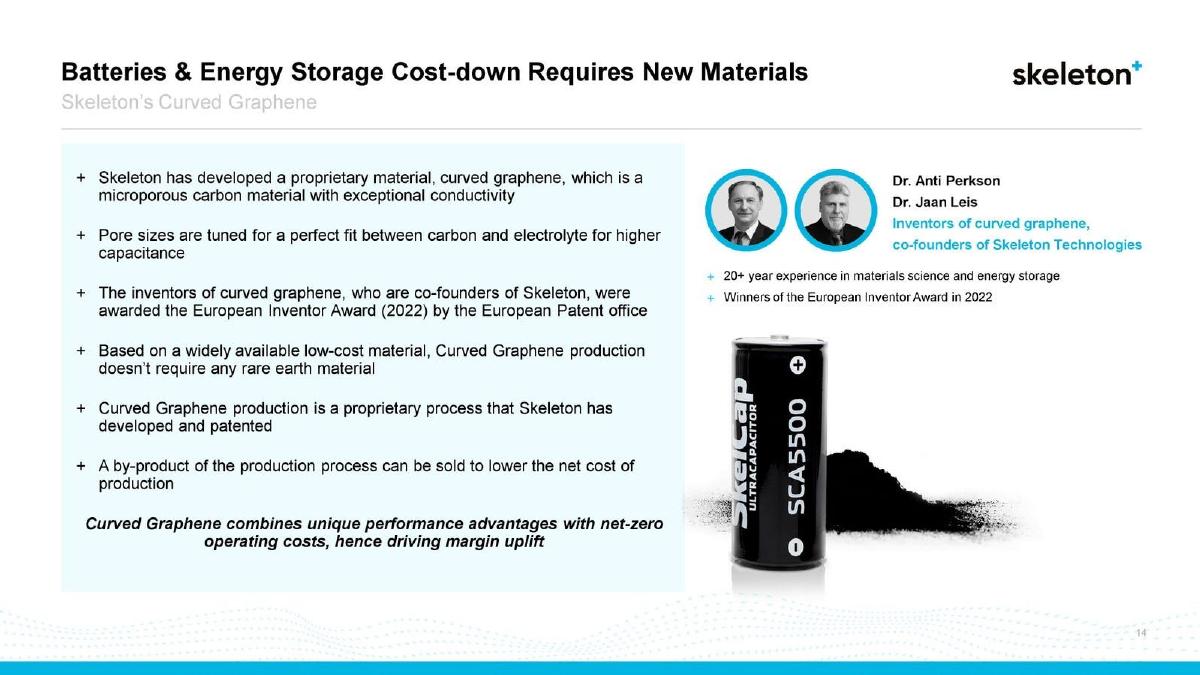
Skeleton Technologies traction slide — slide 14
Energy storage (ultracapacitors and curved-graphene material). A technology slide, not a separate awards slide.
Skeleton Technologies deck, slide 14. Exact stored slide matched to this analysis.
Our analysis: The award is from the patent office and judges the invention, and it sits beside the patent claim it supports.
Evidence and limitation: The award supports the invention, not the slide's margin and cost claims. Don't let an award stand behind a claim it didn't judge.
What a founder can adapt: Place a technical award on the slide that makes the technical claim, and name the awarding body.
Supporting analysis
What the deck claims: "The inventors of curved graphene, who are co-founders of Skeleton, were awarded the European Inventor Award (2022) by the European Patent Office", next to "Curved Graphene production is a proprietary process that Skeleton has developed and patented".
Presentation choice: The award is from the patent office and judges the invention, and it sits beside the patent claim it supports.
When it does not fit: The award supports the invention, not the slide's margin and cost claims. Don't let an award stand behind a claim it didn't judge.
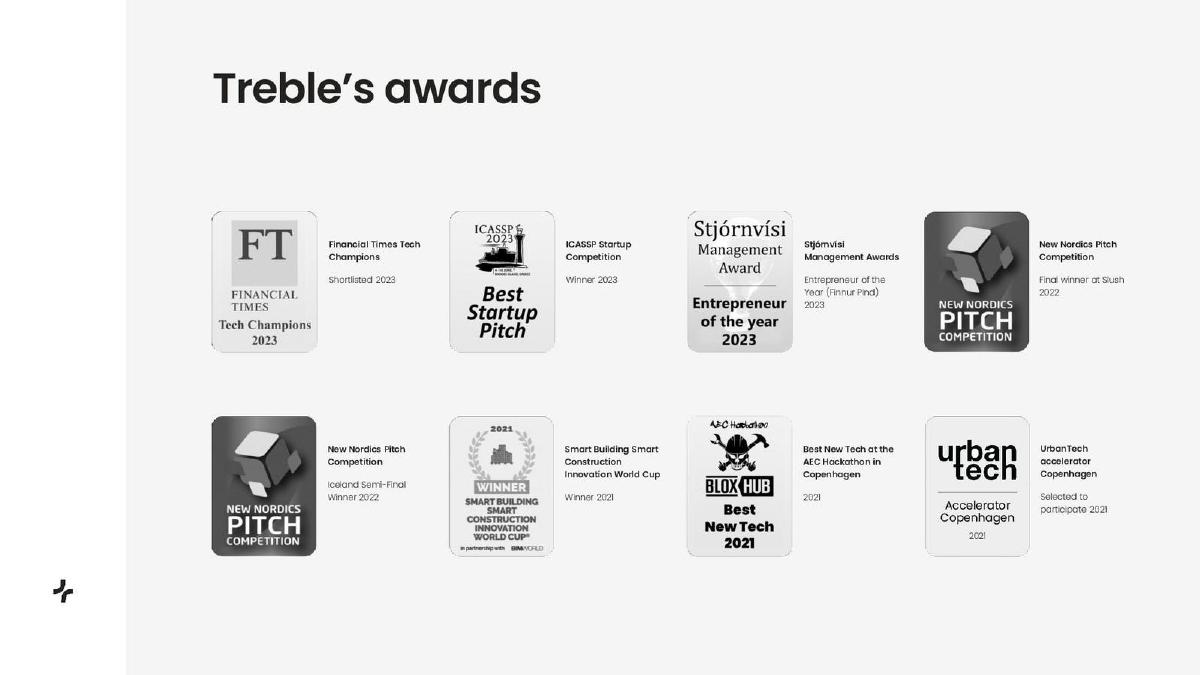
Acoustic simulation software. A dedicated "Treble's awards" slide with eight badges.
Treble deck, slide 21. Exact stored slide matched to this analysis.
Our analysis: Every badge states whether it was a win, a shortlist or a selection, and its year.
Evidence and limitation: Most entries are pitch or innovation competitions, which judge the pitch, not the market. The semi-final and the final of one competition appear as two badges. No field sizes are given.
What a founder can adapt: Give a status and year for every award, and keep a shortlist separate from a win.
Supporting analysis
What the deck claims: Eight entries with status lines, including ICASSP Startup Competition "Winner 2023", Financial Times Tech Champions "Shortlisted 2023", New Nordics Pitch Competition "Final winner at Slush 2022", and UrbanTech accelerator "Selected to participate 2021".
Presentation choice: Every badge states whether it was a win, a shortlist or a selection, and its year.
When it does not fit: Most entries are pitch or innovation competitions, which judge the pitch, not the market. The semi-final and the final of one competition appear as two badges. No field sizes are given.
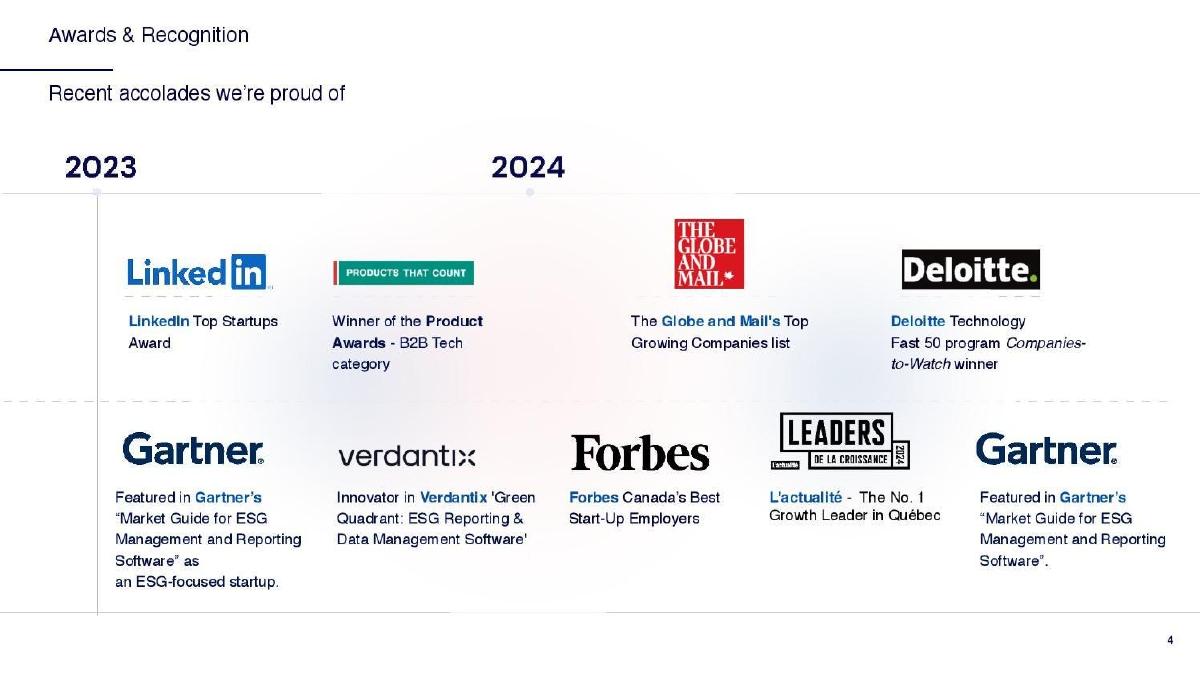
ESG reporting software. "Awards & Recognition" timeline for 2023 and 2024, early in the deck.
Novisto deck, slide 4. Exact stored slide matched to this analysis.
Our analysis: Analyst mentions (Gartner, Verdantix) show the company is known to the analysts buyers read, which matters in enterprise software.
Evidence and limitation: The Gartner mention appears twice. Growth, product and employer awards are mixed with no growth figure on the slide. Being listed in a market guide is a mention, not a ranking.
What a founder can adapt: Group recognition by kind (analyst, growth, product, employer) and say what each confirms.
Supporting analysis
What the deck claims: Nine entries, including Products That Count "Winner of the Product Awards - B2B Tech category", Deloitte Technology Fast 50 "Companies-to-Watch winner", Gartner "Market Guide for ESG Management and Reporting Software" (twice), Verdantix "Innovator", and Forbes Canada's Best Start-Up Employers.
Presentation choice: Analyst mentions (Gartner, Verdantix) show the company is known to the analysts buyers read, which matters in enterprise software.
When it does not fit: The Gartner mention appears twice. Growth, product and employer awards are mixed with no growth figure on the slide. Being listed in a market guide is a mention, not a ranking.
Fluency deck, slide 10. Exact stored slide matched to this analysis.
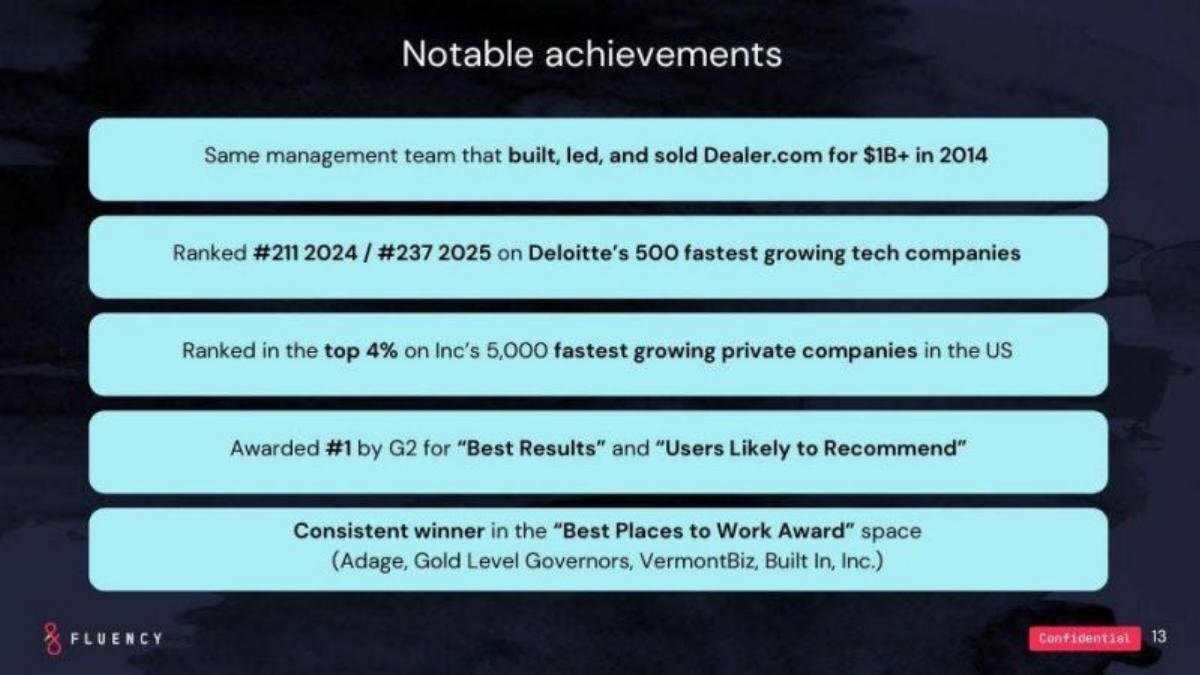
Our analysis: Two years of the same ranking let a reader see that it held its place, which says more than a single year.
Evidence and limitation: The rankings replace a revenue number rather than confirming one. The team's earlier exit is a founder credential, not an award, and is mixed into the same list.
What a founder can adapt: If you cite a growth ranking, give the growth figure it is based on beside it.
Supporting analysis
What the deck claims: Deloitte's 500 fastest growing tech companies "#211 2024 / #237 2025"; "top 4%" of the Inc. 5000; G2 "#1" for "Best Results" and "Users Likely to Recommend"; "Consistent winner" of Best Places to Work; team "sold Dealer.com for $1B+ in 2014".
Presentation choice: Two years of the same ranking let a reader see that it held its place, which says more than a single year.
When it does not fit: The rankings replace a revenue number rather than confirming one. The team's earlier exit is a founder credential, not an award, and is mixed into the same list.
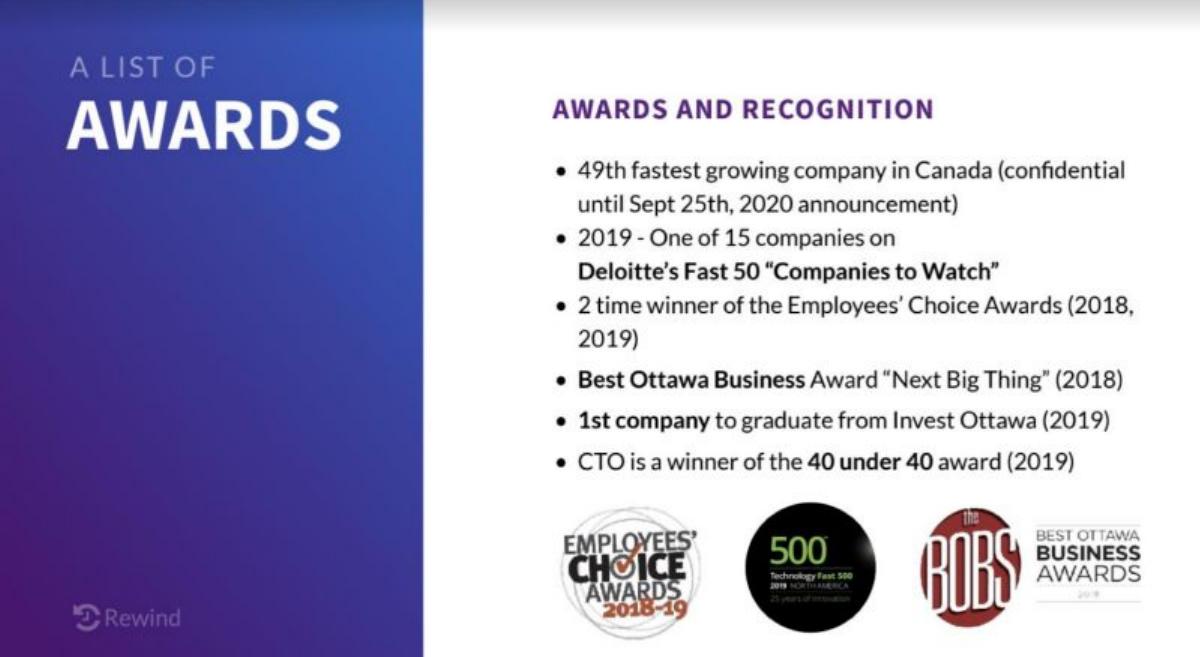
Backup software for SaaS data. "A list of awards" slide.
Rewind deck, slide 10. Exact stored slide matched to this analysis.
Our analysis: Every line is dated, one gives the size of the field, and an award to an individual is labelled as such.
Evidence and limitation: There is no growth figure behind the growth ranking, and employer and local awards sit beside growth awards with equal weight.
What a founder can adapt: Date each award, give the field size where you know it, and flag embargoed results.
Supporting analysis
What the deck claims: "49th fastest growing company in Canada (confidential until Sept 25th, 2020 announcement)"; "2019 - One of 15 companies on Deloitte's Fast 50 'Companies to Watch'"; Employees' Choice Awards 2018 and 2019; Best Ottawa Business "Next Big Thing" (2018); "1st company to graduate from Invest Ottawa (2019)"; "CTO is a winner of the 40 under 40 award (2019)".
Presentation choice: Every line is dated, one gives the size of the field, and an award to an individual is labelled as such.
When it does not fit: There is no growth figure behind the growth ranking, and employer and local awards sit beside growth awards with equal weight.
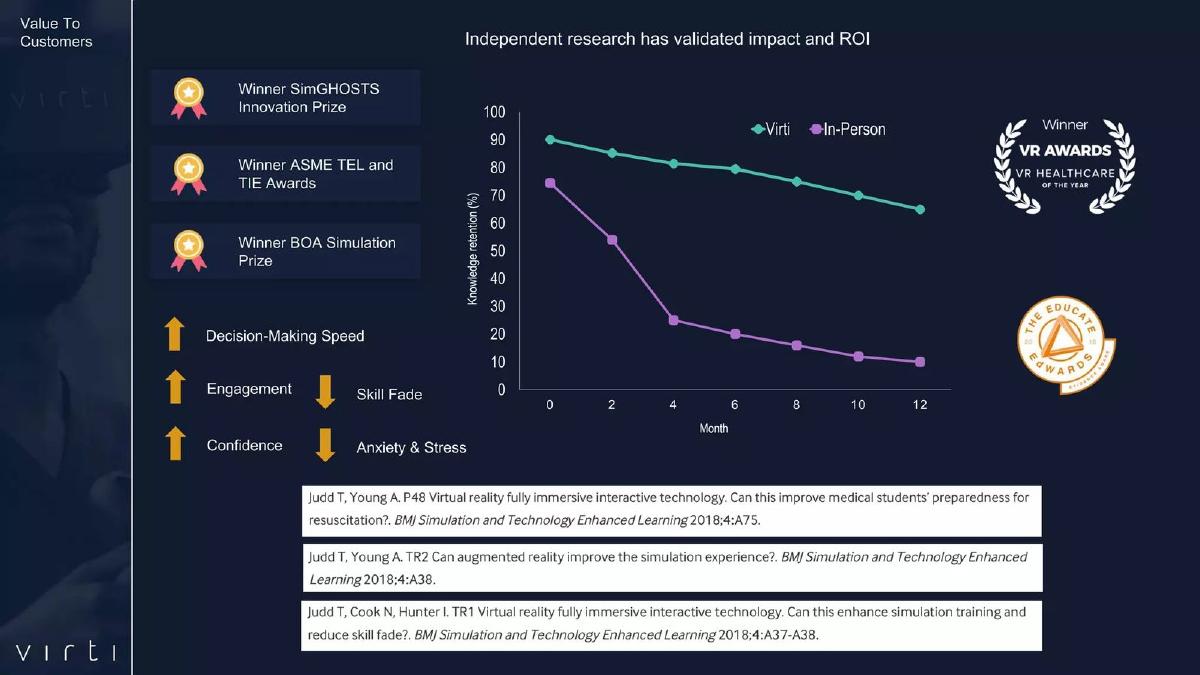
Immersive (VR) training software for healthcare and enterprise. "Value To Customers" slide.
Virti deck, slide 6. Exact stored slide matched to this analysis.
Our analysis: The prizes come from the product's own field and appear next to cited evidence, so each supports the other.
Evidence and limitation: The chart has no sample size or method, the citations are abstracts, and "validated impact and ROI" has no return figure on the slide.
What a founder can adapt: Put field-specific awards beside the outcome data they relate to, with a citation.
Supporting analysis
What the deck claims: "Winner SimGHOSTS Innovation Prize", "Winner ASME TEL and TIE Awards", "Winner BOA Simulation Prize", VR Awards "VR Healthcare of the Year", beside a 12-month knowledge-retention chart (Virti about 90% to 65%, in-person about 75% to 10%) and three cited 2018 BMJ STEL abstracts.
Presentation choice: The prizes come from the product's own field and appear next to cited evidence, so each supports the other.
When it does not fit: The chart has no sample size or method, the citations are abstracts, and "validated impact and ROI" has no return figure on the slide.
Growth rankings, employer, local business, accelerator, individual
Yes for every line
No
Not stated (rank only)
Virti
Field-specific prizes
Winner; no years
Yes (outcome chart)
Retention chart, method not stated
Key Takeaways
Match the award to the claim. Skeleton Technologies cites the European Inventor Award (2022), "awarded … by the European Patent Office" to its co-founders, on the same slide as its patented curved-graphene process.
Say whether you won, were shortlisted or were selected. Treble's slide separates "Winner 2023", "Shortlisted 2023" and "Selected to participate 2021"; most award walls blur the three.
A growth ranking stands in for a growth number. Fluency's Deloitte 500 ranks (#211 2024 / #237 2025) and Inc 5000 "top 4%" imply fast revenue growth, but the slide gives no revenue figure.
Employer awards show something about the workplace, not about customers. Novisto, Fluency and Rewind all mix employer awards with growth and product awards on one slide.
Prizes next to evidence carry more weight than prizes alone. Virti pairs three simulation prizes with a retention chart and three cited 2018 BMJ conference abstracts.
Date every line. Rewind dates each award and notes a ranking that was "confidential until Sept 25th, 2020 announcement", so a reader knows when each was won and what was not public yet.
Write your award line
One line per award. If you can't fill the "judged on" field, think about whether the award belongs in the deck.
Body. Who gave the award or compiled the ranking?
Year. When was it awarded?
Status. Won, shortlisted, selected, or ranked number what?
Judged on. What did the judges assess: revenue growth, invention, product, workplace, pitch?
Field. How many companies competed or were ranked, if known?
Claim. Which claim in the deck does this award support, and is it on that slide?
Copyable framework: [Status] — [award] by [body], [year], judged on [criteria]; [x] of [y] entrants. Supports: [claim on this slide].
Illustrative example 1 — written by us
Before: Award-winning team
After: Winner, European Inventor Award 2022 (European Patent Office), for the curved-graphene process we patented
What improved: Names the body, year and what was judged, and ties the award to a claim.
Illustrative example 2 — written by us
Before: Deloitte Fast 500
After: Ranked #211 on Deloitte Technology Fast 500 (2024), based on [x]% revenue growth over [period]
What improved: The ranking confirms a stated growth number instead of replacing it.
What an award can and cannot prove
Most of what a pitch deck says comes from the founders. An award is one of the few items that comes from someone else, which is why founders like to include it. But an award proves only what its judges assessed. A ranking built on reported revenue growth is evidence of growth, as reported to that ranking. A product award judged by a panel is evidence that a panel liked the product. A pitch-competition win is evidence that the founders pitched well to that jury. An employer award is evidence about how staff rate the company.
An investor reading an award wall is asking the same question for each badge: what did these judges look at, and does it matter for this investment? A slide that answers that question for the reader is more useful than one that only shows logos. This guide sorts the six examples by the kind of award they show and by how much of that question each slide answers.
Press coverage is a separate kind of outside attention and has its own guide. Awards differ because someone made a selection against stated or implied criteria, which is what gives them weight and also what a reader needs to know.
Five kinds of award, and what each is evidence of
Growth rankings (Deloitte Technology Fast 500 and Fast 50, Inc. 5000, national fastest-growing lists): these rank companies on revenue growth over a period, using figures the company submits. They suggest growth without stating it. Our explanation: the rankings publish their own criteria, but the slides here do not repeat them, so a reader has to know the ranking to understand what it measured.
Technology and inventor awards (the European Inventor Award): these judge an invention and its inventors. They are most useful next to the technical claim they support, as Skeleton Technologies places it.
Product and user-review awards (Products That Count, G2): these judge the product, either by a panel or from user reviews. They support a claim about product quality or customer satisfaction, but they are not customer counts.
Employer awards (Best Places to Work, Employees' Choice, Forbes Best Start-Up Employers): these rate the company as an employer. They can support a hiring argument but say nothing about customers or revenue.
Pitch competitions, hackathons and accelerator selection: these judge a pitch, a prototype or an application, usually at an early stage. They show that a jury found the team convincing on the day. A slide that relies only on these is showing early validation, not market results.
Skeleton Technologies: an award that backs up the claim beside it
Source facts: on a slide titled "Batteries & Energy Storage Cost-down Requires New Materials", Skeleton describes its curved-graphene material, states that "Curved Graphene production is a proprietary process that Skeleton has developed and patented", and says the inventors, who are co-founders, "were awarded the European Inventor Award (2022) by the European Patent Office". The photo caption repeats "Winners of the European Inventor Award in 2022" and "20+ year experience in materials science and energy storage".
Why it works: the award comes from the body that grants patents in Europe and is given for an invention. It sits next to the patent claim it supports, so the reader does not have to guess why it is there. What the slide does not state: the slide makes cost claims ("net-zero operating costs, hence driving margin uplift") that the award does not support. The award backs the invention, not the economics.
Treble: competition wins with the status stated
Source facts: "Treble's awards" shows eight badges, each with a status line: Financial Times Tech Champions "Shortlisted 2023"; ICASSP Startup Competition "Winner 2023" (badge: "Best Startup Pitch"); Stjórnvísi Management Awards "Entrepreneur of the Year" 2023; New Nordics Pitch Competition "Final winner at Slush 2022" and "Iceland Semi-Final Winner 2022"; Smart Building Smart Construction Innovation World Cup "Winner 2021"; "Best New Tech at the AEC Hackathon in Copenhagen" 2021; UrbanTech accelerator Copenhagen "Selected to participate 2021".
Why it is useful: each badge says what happened, so a reader can tell a win from a shortlist from an accelerator place. Our count: five of the eight are wins at pitch or innovation competitions or a hackathon, one is a personal award to a founder, one is a shortlist and one is an accelerator selection. What the slide does not state: how many entrants each competition had, what was judged, or any customer or revenue figure. Two of the eight badges are stages of the same competition, which makes the wall look longer than the number of distinct selections.
Novisto, Fluency and Rewind: award walls that mix kinds
Novisto's "Awards & Recognition" slide lays out 2023 and 2024 on a timeline. Source facts: LinkedIn Top Startups; Products That Count "Winner of the Product Awards - B2B Tech category"; The Globe and Mail's Top Growing Companies list; Deloitte Technology Fast 50 program "Companies-to-Watch winner"; featured in Gartner's "Market Guide for ESG Management and Reporting Software" (listed twice, once in each year); "Innovator" in a Verdantix Green Quadrant; Forbes Canada's Best Start-Up Employers; L'actualité "The No. 1 Growth Leader in Québec". Our count: nine entries from eight bodies, mixing growth lists, analyst mentions, a product award and an employer award.
Fluency's "Notable achievements" (PDF page 10, printed slide 13). Source facts: "Same management team that built, led, and sold Dealer.com for $1B+ in 2014"; "Ranked #211 2024 / #237 2025 on Deloitte's 500 fastest growing tech companies"; "Ranked in the top 4% on Inc's 5,000 fastest growing private companies in the US"; "Awarded #1 by G2 for 'Best Results' and 'Users Likely to Recommend'"; "Consistent winner in the 'Best Places to Work Award' space" (Adage, Gold Level Governors, VermontBiz, Built In, Inc.). Our calculation: top 4% of 5,000 is roughly the top 200.
Rewind's "Awards and Recognition". Source facts: "49th fastest growing company in Canada (confidential until Sept 25th, 2020 announcement)"; "2019 - One of 15 companies on Deloitte's Fast 50 'Companies to Watch'"; "2 time winner of the Employees' Choice Awards (2018, 2019)"; Best Ottawa Business Award "Next Big Thing" (2018); "1st company to graduate from Invest Ottawa (2019)"; "CTO is a winner of the 40 under 40 award (2019)".
What the three share: each places growth rankings, employer awards and other recognition side by side with no indication of which matters for which claim. Each relies on the growth rankings to suggest revenue growth without giving a revenue figure on the slide. Rewind does the most to help a reader: every line has a year, one line gives the size of the field ("one of 15"), and the embargoed ranking is flagged as such.
Virti: prizes next to cited evidence
Source facts: on "Value To Customers", headed "Independent research has validated impact and ROI", Virti lists "Winner SimGHOSTS Innovation Prize", "Winner ASME TEL and TIE Awards" and "Winner BOA Simulation Prize", with VR Awards "VR Healthcare of the Year" and an Educate Awards badge. Beside them is a chart of knowledge retention over 12 months: the Virti line falls from about 90% to about 65%, the in-person line from about 75% to about 10% (values read from the chart). Three references to 2018 abstracts in BMJ Simulation and Technology Enhanced Learning are printed below.
Why it is useful: the prizes are from simulation and education bodies, so they match the product's field, and they appear next to cited research rather than standing alone. What the slide does not state: the chart has no sample size or study design, and the references are conference abstracts, not full papers. The heading's "validated impact and ROI" is the company's claim; nothing on the slide shows a return-on-investment figure.
How to present your own awards
Recommendation: keep only awards that support a claim the deck makes, and put each one next to that claim. An inventor or technology award belongs on the technology slide, a growth ranking on the traction slide next to the revenue it reflects, an employer award on the team or hiring slide. A separate awards slide is fine for a long list, but sort it by kind and lead with the ones that matter for the investment.
For each award, give four facts: the awarding body, the year, the status (won, shortlisted, selected, ranked number X), and what was judged. Where the field size is known, give it ("one of 15"). Where a ranking is based on revenue growth, state the growth figure as well, so the ranking confirms a number rather than replacing it.
Leave out awards whose judges or criteria you cannot describe, duplicated stages of one competition counted as separate wins, and awards to individuals presented as if they were awards to the company. If an award is embargoed, say so as Rewind does, and confirm you are allowed to share it with investors.
Common mistakes
Logos without a status. A badge doesn't say whether you won, were shortlisted or simply applied.
A ranking instead of a number. A growth ranking implies growth; give the growth figure it is based on.
Mixing kinds with equal weight. An employer award and a growth ranking prove different things. Sort them, or move each to the slide it supports.
Counting one competition twice. A semi-final and a final are one selection, not two awards.
Individual awards shown as company awards. Say when an award went to a founder or employee, as Rewind does for its CTO.
Undated awards. An undated award may be years old. Give the year.
Diagnostic checklist
Every award names the body, the year and the status (won, shortlisted, selected, ranked).
Each award sits next to the claim it supports, or on a sorted awards slide.
Growth rankings appear beside the growth figure they reflect.
Pitch-competition and accelerator selections are described as such, not as market results.
Individual awards are labelled as individual.
Embargoed or confidential awards are flagged, and you are allowed to share them.
Frequently asked questions
Do awards matter to investors?
These slides can't measure that. What they show is that an award is only as useful as what its judges assessed. An award that judges the thing the deck claims, like Skeleton's inventor award beside its patent claim, adds outside support. A long list of mixed badges asks the reader to do that sorting.
Should I include pitch-competition wins?
They show a jury found the team convincing, which is real but early validation. Treble's slide states them honestly, with win, shortlist and selection kept apart. If you also have customer or revenue evidence, lead with that and treat competition wins as background.
Is a Deloitte or Inc. ranking enough to show growth?
A ranking suggests fast growth but doesn't give the number. Fluency and Rewind cite rankings without a revenue figure on the slide. Give the growth rate and period beside the ranking, so the ranking confirms a number the reader can see.
Where should awards go in a deck?
Next to the claim they support where possible: technology awards on the technology slide, growth rankings on traction, employer awards on team or hiring. Novisto and Rewind use a separate awards slide, which works for a long list if it is sorted by kind.
Is an analyst mention, like a Gartner market guide, an award?
No. Being listed in a market guide is a mention, not a ranking or a prize. It shows the analysts know the company, which can matter for enterprise buyers. Describe it as a mention, as Novisto's wording ("Featured in") does.
How we chose these examples
Search (2026-10-01): the durable corpus index (docs/seo/artifacts/corpus-search, 70,729 unique pages, deduplicated by deck-file sha256 + page) was searched for winner/finalist/awarded near award/prize/competition; 49 pages matched.
Left out: listed or public companies (Barfresh, CEMATRIX, Compass Pathways, Genius Group, MEDIROM, PBIO, Trupanion), generic matches, and decks already used heavily in other guides. Six pages were rendered from the original public deck files and read against the text: Novisto 4, Skeleton Technologies 14, Treble 21, Virti 6, Fluency 10, Rewind 10. None of these pages is used in another guide.
Our explanations: what growth rankings measure (revenue growth from submitted figures) is general knowledge about those rankings and is not stated on the slides. Chart values for Virti are read from the chart and approximate. Counts and the "top 4% of 5,000" figure are our calculations.
How we built this: drafted and checked with AI assistance (editorial model review against the original slide images); no human editor has reviewed this guide.