UnitesUs was a 2015 Southern California startup pitching a cloud hiring platform that used IBM Watson psychometrics and a proprietary algorithm to grade and rank pre-screened candidates for employers. Its 20-slide seed deck contains every section investors expect — market sizing, priced business model, five-year projections, exit comps and a computed 74% IRR. It contains no traction, no unit economics, no matching-accuracy evidence and no funding ask, which is why a structurally complete deck still is not a fundable one.
Key takeaways
- The UnitesUs 2015 seed pitch deck is 20 slides long and never states a funding ask, a valuation or a use of funds, which makes its 74% IRR claim impossible for a reader to verify.
- The deck's strongest slide is its business model: four named packages priced at $49.95 per interview request, $2,500/month for 100 requests, $10,000/month unlimited and $15,000/year non-profit licensing.
- UnitesUs claimed its matching algorithm was built over three years from 300 structured interviews with 100 employers, 100 recruiters and 100 job seekers — the only defensibility evidence in the deck.
- The financial projections forecast 874% revenue growth in year two, EBITDA profitability from year two, and a $27 customer acquisition cost against a $27,000 cheapest annual package.
- The deck sized the external source of hiring market at $124 billion, claimed 69.6% of it as addressable, and narrowed to a $31.4 billion hospitality, food and beverage and retail beachhead.
- UnitesUs claimed 'first to market advantage' on the slide immediately after a competitor logo grid showing Indeed, LinkedIn, Monster, CareerBuilder and Craigslist.
- The deck contradicts itself repeatedly: 'across all industries' versus three verticals, 'cloud based' on the cover versus 'move to cloud computing' as a Series A milestone, and predictive algorithms today versus machine learning at Series B.
- The transferable lesson is that investors score decks on the ratio of claims to proof, not on section coverage — a five-slide deck with one paying customer beats a complete 20-slide deck with none.
What this deck actually is
This is a real seed-stage investor pitch deck, uploaded in August 2015 by UnitesUs, a Southern California startup building what the cover page calls a "Cloud Based Hiring Platform: Faster. Cheaper. Better." It is 20 slides long, marked "Strictly Proprietary and Confidential" on nearly every page, and it ends with a founder's mobile phone number and email rather than a data room link — the signature of a deck that was emailed and pitched in person to angels rather than pushed through a warm VC network.
It is not a company overview, not a sales deck, and not a template recreation. It has a market size slide, a business model slide, five-year financial projections, a comps-and-exit slide, an IRR slide and a milestone slide tied to Seed, Series A and Series B. Those are all investor-deck moves. What it does not have is the one slide that decides most seed rounds: traction. There is no user count, no revenue, no pilot, no letter of intent, no waitlist. The only capital figure in the entire deck is "$100K From Management Team," and there is no ask — no dollar amount requested, no use of funds, no valuation, no round structure.
So the honest classification is: a complete-looking seed deck written by first-time founders who studied what a pitch deck is supposed to contain, assembled every expected section, and then filled the sections with description instead of evidence. That gap — structure without proof — is what makes it a genuinely useful teardown. Most bad decks are bad because they are missing sections. This one has all the sections and is still not fundable, which is the failure mode far more founders actually experience.
Slide-by-slide walkthrough
Slide 1 — Cover: "Taking the work out of finding work!"
The cover carries a tagline, the words "Pitch Deck", a positioning line ("Cloud Based Hiring Platform: Faster. Cheaper. Better."), a confidentiality stamp, and the founder's name, phone number and email. Three observations. First, the tagline is a pun, not a positioning statement — it tells an investor nothing about who pays or how much. Second, "Faster. Cheaper. Better." is the weakest possible claim structure because it asserts all three superlatives at once and supports none; a deck that could prove even one of them would lead with the number instead. Third, labelling the file "Pitch Deck" on the cover is wasted pixels — the investor already knows what they opened. The cover is the single highest-attention slide in any deck and this one spends it on decoration.
Slide 2 — What is UnitesUs?
One paragraph, six lines, describing "a cloud based hiring platform that utilizes cognitive computing, big data analysis and predictive algorithms to automatically find, grade and list prescreened and pre-qualified applicants in front of the right employers based on personality, company cultural fit and all the core qualifications required to successfully fulfill a position, across all industries."
That is a 55-word sentence containing four buzzword categories and one real idea. The real idea — grade and rank candidates automatically so employers see only qualified, culture-matched people — is good and easy to explain. The deck buries it under "cognitive computing, big data analysis and predictive algorithms," which in 2015 was the exact phrase cluster every investor had learned to discount. Worse, the paragraph ends with "across all industries," which contradicts slide 9, where the company narrows to three verticals. Two slides in, the deck has already told the reader two different scope stories.
Slide 3 — The product: three functionalities
This slide is more substantive and contains the deck's most credible detail: the matching algorithm "was developed over a span of 3 years by interviewing 100 employers, 100 recruiters and 100 job seekers." That is a specific, checkable research claim, and it is the strongest single sentence in the deck — 300 structured interviews is real primary research and most seed decks have nothing comparable.
The slide also discloses that "the 1 minute psychometric test is administered by IBM Watson and is 100% verified," with an alternative 15-minute test owned by UnitesUs. Naming the dependency is honest. But "100% verified" is a meaningless validation claim — verified by whom, against what outcome? The obvious investor question is whether a one-minute psychometric test predicts job performance or retention, and the deck never engages it. The company is selling matching quality; matching quality is the entire product; and there is not a single accuracy, precision or placement-outcome number anywhere in twenty slides.
Slide 4 — What differentiates us
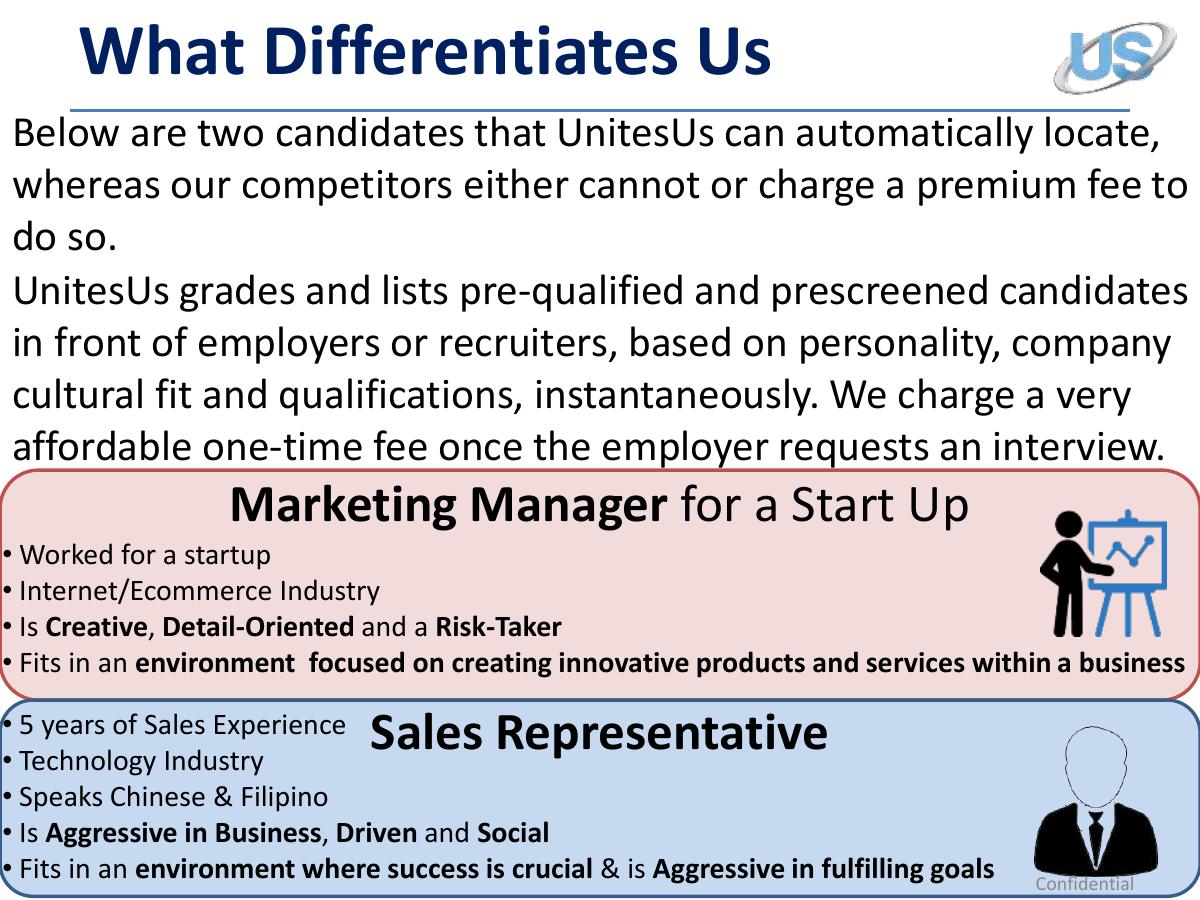
Two example candidate profiles — a startup marketing manager and a bilingual sales rep — presented as searches competitors "either cannot [do] or charge a premium fee to do." The example format is smart: it turns an abstract matching claim into something a hiring manager can picture. The bullets mix hard filters (5 years of sales experience, speaks Chinese and Filipino, technology industry) with soft ones (creative, detail-oriented, risk-taker, "aggressive in fulfilling goals").
The slide also drops the pricing model in a throwaway line: "We charge a very affordable one-time fee once the employer requests an interview." Charging on interview request rather than on placement is a genuine business-model choice with real consequences, and it deserves its own argument rather than an adjective. "Very affordable" is also the founder's opinion, not a positioning; the actual price appears eleven slides later.
Slide 5 — Value for job seekers
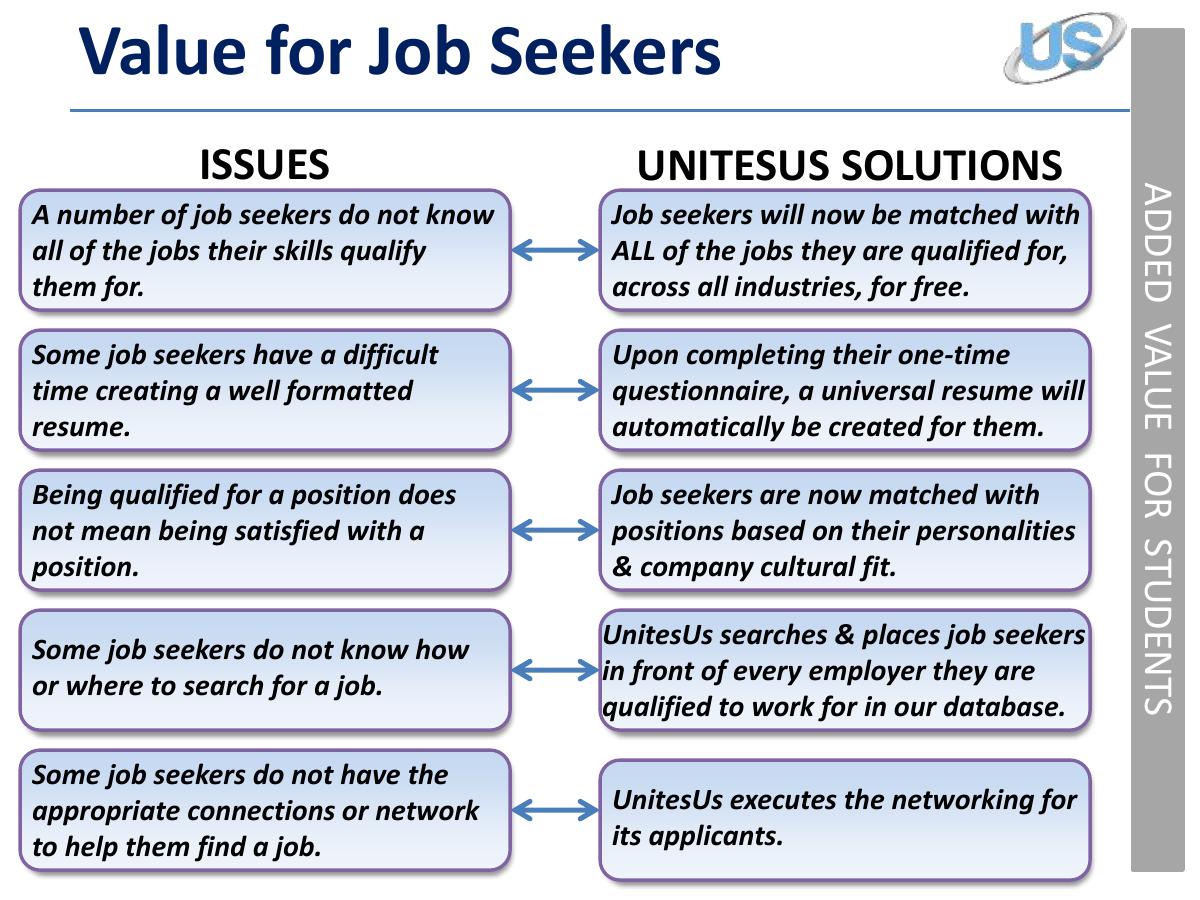
A clean two-column Issues/Solutions table covering five job-seeker pain points: not knowing every job they qualify for, struggling to format a resume, being qualified but unsatisfied, not knowing where to search, and lacking connections. Each maps to a UnitesUs solution, including an auto-generated "universal resume" produced from a one-time questionnaire. A sidebar flags added value for students.
Structurally this is the best-built slide in the deck: problem, solution, one row per pain point, no jargon. Strategically it is aimed at the wrong audience. The job seeker is the free side of a two-sided marketplace. An investor reading a marketplace deck wants to know which side is hard to acquire and what it costs to get them. Spending a full slide on the free side's benefits — with zero acquisition cost or supply-liquidity discussion — signals that the founders think of adoption as persuasion rather than as unit economics.
Slide 6 — Listed and graded candidates
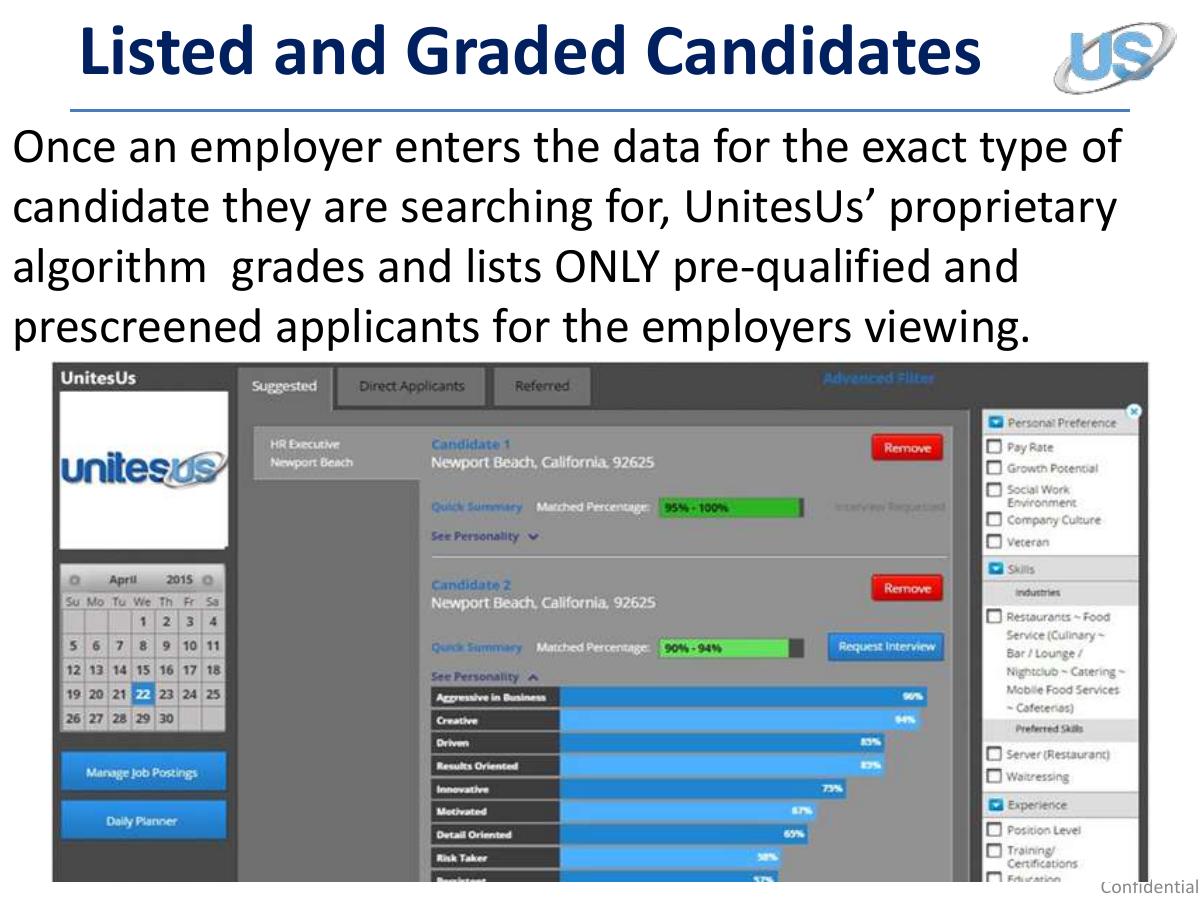
A product screenshot slide: once an employer enters the criteria, the algorithm "grades and lists ONLY pre-qualified and prescreened applicants." Showing the actual product at slide 6 is the right instinct and the right position in the story. What is missing is the number that makes a screenshot persuasive: how many candidates are in the database, what a grade actually means numerically, and whether any employer has ever run this search on live data. A screenshot proves a build exists. It does not prove the build works.
Slide 7 — Opportunity: 18–35 year olds
A dual-axis chart plotting US unemployment rate by age bracket (17.9% for 18–19, 10.8% for 20–24, 6.2% for 25–35, declining thereafter) against LinkedIn's user base share by age, sourced to bls.gov. The argument: the youngest, highest-unemployment cohort is underserved by the incumbent professional network.
This is the sharpest analytical slide in the deck and the closest it comes to a real wedge. Two brackets of high youth unemployment plus low incumbent penetration is a legitimate market-entry thesis, and it is sourced to a public dataset rather than asserted. The failure is that the insight stops at the chart. Nothing later in the deck — not the pricing, not the go-to-market, not the milestones — is derived from this cohort finding. A wedge you identify and then abandon reads to investors as a slide, not a strategy.
Slide 8 — Market size
The External Source of Hiring market is put at $124 billion, segmented into referrals (19.2%), career sites (19.1%), job boards (15.4%), direct sourcing (12.1%) and pipeline (3.9%). UnitesUs claims it targets 69.6% of those segments, or $86.3 billion, and then narrows to hospitality, restaurant/food and beverage and retail for an initial $31.4 billion.
The three-tier structure — total market, addressable slice, initial beachhead — is exactly how a market slide should be built, and the beachhead number is the one that matters. But the arithmetic is doing something the deck never justifies: the listed segments add to 69.7% of the total, meaning "targeting 69.6% of ESOH" simply means "we compete with every category except one." Claiming 69.6% of a market as addressable is not a filter; it is the absence of a filter. And no source is given for the $124B, unlike the unemployment chart on the previous slide, which is properly cited. Consistency in sourcing is what makes a market slide survive diligence.
Slide 9 — Target market: not displacing competition
A bar chart of annual US open positions, with retail, hospitality and food and beverage isolated at roughly 12 million target positions against the remaining industries. The written rationale is genuinely good: those three verticals have the highest turnover rates, they value personality and culture fit in hiring, they employ the target job-seeker demographic, and the team already has a network there.
Four independent reasons for a beachhead, one of which is an unfair-advantage claim — that is textbook. High-turnover industries are also the correct hunting ground for a per-interview pricing model, because volume hiring is where a $49.95 transaction fee compounds. The slide title, "Not Displacing Competition," is the weak part: framing yourself as non-threatening to incumbents is defensive positioning, and it quietly concedes you are taking the segment nobody fought for.
Slide 10 — Sales and marketing channels
Sales channels: an IBM sales advocate, the founders' HR-association and college-career-services network, recruiters serving target customers, a strategic referral program, and B2B sales subcontractors. Marketing channels: viral social expansion, a named marketing firm, strategic alliances with businesses, non-profits and universities, SEO and PPC.
This is a list of every channel a founder can name, not a go-to-market plan. There is no channel ranked first, no cost per channel, no expected conversion, no sequencing, and no experiment already run. Compare it to slide 16, which asserts a $27 customer acquisition cost: that CAC has to come from one of these channels, and the deck never connects the two. When an investor sees nine channels and one unexplained CAC number, the CAC is the thing they stop believing.
Slide 11 — Team
Three founders. The CEO is a serial entrepreneur with a biology/pre-medicine degree from SDSU who ran startup laboratories and an import/export business. The co-founder and chief of talent has nine years in recruitment, ran his own recruitment firm for two years, and managed a high-grossing Wells Fargo branch. The CTO holds computer and materials science degrees from Arizona State, spoke at IBM InterConnect 2015 on enterprise architecture for big data, and was promoted to Systems Architect IV at AAA at 24.
The recruitment co-founder is the strongest asset on this slide and the deck under-plays him: nine years inside the exact industry being disrupted is domain credibility that most 2015 HR-tech founders did not have. The CTO's IBM InterConnect appearance is also real, verifiable and directly supports the Watson dependency. What the slide does instead is pad — "grew up in a business oriented family" and "at the age of 18, started his own online performance parts distribution catalogue" are biography, not evidence of ability to execute this company. Every line on a team slide should answer "why is this person unfair for this problem."
Slide 12 — Advisory board
Four advisors — a health-system CFO as financial advisor, a foodservice-sales founder who chairs Tech Coast Angels membership in Orange County as strategic advisor, a 40-year marketing executive who worked on Wendy's "Where's the Beef" campaign, and a SCORE Orange County HR director as recruitment advisor — each with a live URL to a third-party bio.
Linking to verifiable external profiles is a diligence-friendly detail more decks should copy. But a full slide of advisors placed before the competition and business-model slides inverts the priority order: advisors are supporting evidence, never the argument. And one of the four is the membership chairman of the angel group most likely to be in the room, which is closer to a fundraising channel than an operating advantage.
Slide 13 — Competition: focused on simple keyword matching
A logo grid — Indeed, Craigslist, LinkedIn, CareerBuilder, Monster, TheLadders and others — positioned on an axis running toward "Affordable," under the argument that incumbents only do simple keyword matching.
The framing has a real insight in it: in 2015, keyword-based ATS filtering genuinely was the industry norm, and personality/culture matching genuinely was under-served. But a logo grid is not a competitive analysis. There is no feature comparison, no pricing comparison, and no mention of the direct competitors that mattered most — HireVue, Pymetrics, Koru and the other assessment-based matching startups already funded by 2015. Claiming "First to Market Advantage" on the next slide, in a market containing those companies, is the moment a sophisticated investor stops trusting the deck's market awareness.
Slide 14 — Competitive advantage and barriers to entry
Five bullets: the proprietary algorithm fine-tuned over three years, a business model and price point that "prevents large corporations from mimicking what we do," an IBM revenue-sharing partnership, first-to-market advantage, and cognitive computing technology. A footnote clarifies that UnitesUs only pays IBM when it calls their API, and that only one of seven revenue streams triggers that callback.
The footnote is the best content on the slide — it shows the founders understood their cost structure and negotiated a variable-cost dependency rather than a fixed licence. The bullets above it are weak in a specific and instructive way. A price point is not a barrier to entry; large corporations can and routinely do undercut on price. "First to market" is an assertion contradicted by slide 13's own logo grid. And "cognitive computing technology" is not a moat when the cognitive computing in question is a third party's API that anyone else can also call. Strip the unsupportable claims and what is left is one real advantage: three years of proprietary matching research the team owns.
Slide 15 — Business model
Four packages, priced explicitly: $49.95 per interview request pay-as-you-go; $2,500/month ($27,000/year) for up to 100 interview requests; $10,000/month ($108,000/year) unlimited; and $15,000/year non-profit licensing of the algorithm. Six additional revenue streams are listed with the stage at which each turns on — background-check commissions at 18%, newsletters and resume assistance at seed; certification advertising at Series A; targeted advertisements and merchandise at Series B.
This is the strongest slide in the deck and it is not close. Named tiers, real prices, annualised equivalents, a distinct non-profit motion, and a staged revenue roadmap that says which lines are hypothetical and when. Very few seed decks are this specific about money. Two problems remain. The $2,500 tier prices an interview request at $25 versus $49.95 pay-as-you-go — a 50% volume discount with no stated rationale — and seven revenue streams at seed stage is a focus signal in the wrong direction. Investors read a long revenue-stream list as uncertainty about which one actually works.
Slide 16 — Financial projections
Five years, in thousands: units sold 545 → 5,896 → 12,477 → 22,941 → 51,789; revenue $198K → $1.929M → $4.150M → $8.561M → $18.847M; EBITDA ($178K) → $479K → $1.350M → $3.711M → $9.897M; customer acquisition cost $27 → $26 → $21 → $19 → $19.
Run the arithmetic the investor will run. Revenue per unit in year one is $363 — not $49.95 — so "units" must be a blend of subscriptions and transactions the slide never defines. Year two grows revenue 874% and EBITDA flips positive in the same year, meaning the model assumes profitability from year two onward on a product with no customers today. Year five EBITDA margin is 52.5%. And a $27 CAC against a business whose cheapest annual package is $27,000 implies a 1,000x LTV:CAC ratio, which no HR-tech company has ever achieved. Each number individually is arguable; together they describe a company that never has to spend to grow. That is the projection slide most likely to end a meeting, because it invites the investor to test the model rather than the business.
Slide 17 — Investments and exit opportunity
Prior capital: $100K from the management team. Exit candidates: IBM, Craigslist, Monster, Oracle, LinkedIn, Yahoo, CareerBuilder, Amazon. Comps: Yahoo/HotJobs at $436M, Oracle/Taleo at $1.9B, IBM/Kenexa at $1.3B.
Founder money in is the right disclosure and $100K of it is meaningful skin in the game. The comps are real transactions and correctly chosen for the category. But three billion-dollar-scale acquisitions of mature companies with hundreds of millions in revenue are not comparables for a pre-revenue seed company; they are aspiration slides. Listing Amazon and Craigslist as likely acquirers of an HR matching platform weakens the slide further — a credible exit slide names two or three strategics and explains why each would need to buy you rather than build.
Slide 18 — Rate of return
"Based on a projected annual revenue and an Enterprise value/Revenue multiple of 3, the projected Initial Rate of Return (IRR) is 74%," footnoted with the assumption of acquisition at 3x revenue in five years, justified because "8 startups in the similar field as UnitesUs were acquired at an average of 3 times their annual revenue."
Sourcing the multiple to eight comparable transactions is diligence-minded and rare at seed. The problem is the slide exists at all. A founder computing the investor's IRR is stacking assumption on assumption — a five-year revenue forecast that is itself unvalidated, multiplied by a revenue multiple, on a company with zero customers. Investors build their own return models; they do not adopt the founder's. It also does the deck real damage: without a stated raise amount or valuation anywhere in the twenty slides, a 74% IRR cannot even be computed by the reader, which makes the number look decorative.
Slide 19 — Milestones
Three columns. Seed: start generating revenue, obtain 70–100K users, improve the algorithm, purchase software to import user information, raise Series A in 12–18 months, integrate APIs to import positions from Taleo and Kenexa. Series A: move to cloud computing, reach 1.5–2M users, rewrite in Angular for scalability and cost, increase algorithm precision, expand into English-speaking markets, use more Watson capabilities. Series B: 0.35% minimum market share, machine-learning algorithms, 10M users, international expansion into Spanish, Arabic and Chinese-speaking markets.
Tying milestones to funding stages is the correct structure and the user targets are refreshingly specific. The content, though, tells an investor several things the founders did not intend. "Move to cloud computing" at Series A contradicts the cover slide's claim to be a "Cloud Based Hiring Platform." "Implement machine learning algorithms" at Series B contradicts slide 2's claim of predictive algorithms and cognitive computing today. A naming a specific framework rewrite as a milestone is an engineering task, not a business outcome. And the roadmap is entirely user-count driven with no revenue, retention or employer-side targets — for a platform monetised on the employer side, the milestones measure the free side.
Slide 20 — Closing
The cover repeated: tagline, "Pitch Deck", founder name, phone, email, confidentiality stamp. No ask, no use of funds, no next step beyond a phone number. The final slide of an investor deck is the highest-conversion real estate in the document and this one asks for nothing specific. After nineteen slides of market, model and projections, the reader is left to invent both the round size and the reason to take the meeting.
What this deck does better than most startup pitch decks
It publishes real prices. Four packages with dollar figures and annual equivalents on a single slide. Most seed decks say "SaaS subscription" and move on; this one lets an investor model revenue in thirty seconds. · It sources its best chart. The unemployment-by-age data on slide 7 carries a bls.gov URL. Citing a public dataset on the slide, not in an appendix, is a diligence habit that buys credibility for everything around it. · It names the primary research behind the product. 300 structured interviews — 100 employers, 100 recruiters, 100 job seekers — over three years is a specific, checkable claim, and it is the only real defensibility argument the company has. · It picks a beachhead and defends it with four independent reasons. High turnover, culture-driven hiring, demographic overlap, and existing network. That is a better beachhead argument than most Series A decks make. · It discloses its dependency and its cost structure. The IBM Watson relationship is stated plainly, and the footnote explains that payment is variable and triggered by only one of seven revenue lines. · Its advisors are verifiable. Each advisor bio links to a third-party page. Nobody has to take the founders' word for a credential. · It ties milestones to funding stages. Seed, Series A and Series B columns with numeric user targets show the founders thought in rounds rather than in a single undifferentiated roadmap.
Where this deck would fail in an investor meeting
There is no ask. Twenty slides, no raise amount, no valuation, no use of funds, no runway. The investor cannot say yes to an unstated number, and the IRR slide is uncomputable without it. · There is no traction slide. No users, no employers, no pilots, no LOIs, no waitlist, no revenue. For a 2015 marketplace with a live product screenshot, the absence reads as "we have not tried to sell this yet." · The projections break under one minute of arithmetic. 874% year-two growth, EBITDA positive in year two, a 52% year-five margin, and a $27 CAC against a $27,000 entry package. Any single figure invites the investor to audit the whole model. · No unit economics. No LTV, no payback period, no churn, no gross margin, no cost per API callback. A per-interview pricing model lives or dies on repeat purchase and the deck never mentions it. · Moat claims that contradict the deck's own slides. "First to market" sits one slide after a competitor logo grid; "cognitive computing" as a barrier when the cognition is IBM's API; "price point" as a barrier to well-capitalised incumbents. · No matching-accuracy evidence. The entire product is match quality, and there is not one precision, retention or placement-outcome number — nor any validation of the one-minute psychometric test against job performance. · Scope contradicts itself. "Across all industries" on slide 2, three verticals on slide 9. Cloud-based on the cover, "move to cloud computing" as a Series A milestone. Predictive algorithms on slide 2, "implement machine learning" at Series B. · An IRR slide instead of an evidence slide. Slide 18 spends the deck's most persuasive position modelling the investor's return rather than proving a single customer wants the product.
Structure versus evidence: what this deck has and what a fundable seed deck needs
Problem Described in prose across two slides Quantified: cost per hire, time to fill, turnover cost per employee
Product Screenshot plus capability description Screenshot plus a measured outcome from real usage
Traction Absent Users, employers, revenue or signed pilots — even if tiny
Market $124B → $86.3B → $31.4B, largely unsourced Bottom-up: target accounts × contract value, with the source cited
Business model Four priced tiers plus six future streams One or two priced tiers, plus evidence someone paid
Unit economics A $27 CAC with no derivation Measured CAC, LTV, payback and gross margin, with the sample size
Competition Logo grid, "first to market" Feature and price comparison against named direct competitors
Moat Algorithm, price point, partner API Proprietary data that compounds, and why it compounds
Financials Five-year forecast, profitable in year two 18–24 months of plan tied to the raise, with assumptions listed
Ask None Amount, runway, use of funds, milestones the money buys
How you would rebuild this deck today
Put the ask on the cover and repeat it on the last slide. "Raising $1.5M seed to reach 50 paying employers in hospitality and retail within 18 months." That single sentence fixes the deck's largest structural failure. · Replace slide 2's buzzword paragraph with one measured claim. Something like "Employers using UnitesUs interview 3 candidates per hire instead of 9." If you do not have that number yet, run five pilots and get it before you raise. · Cut slides 5, 12, 17 and 18 entirely. The job-seeker benefits table, the advisory board, the exit comps and the IRR calculation are all supporting material. Move them to an appendix and reclaim four slides for evidence. · Insert a traction slide at position 4. Even three signed pilots at $2,500/month, or 200 employer-side signups from one vertical, changes this deck from a plan into a business. · Rebuild the market slide bottom-up. Count hospitality, restaurant and retail employers in the launch metro, multiply by an achievable annual contract value, and show that number instead of $86.3B. A defensible $40M beachhead beats an indefensible $124B. · Show the matching algorithm's accuracy. Take the 300 interviews and turn them into a validation exhibit: predicted fit versus actual retention on any sample you can assemble, even a backtest on historical hires. · Cut seven revenue streams down to one. Lead with the $2,500/month package, name the customer profile that buys it, and put the other six in a single "future monetisation" line. · Replace the five-year forecast with an 18-month plan. Show what the raise buys, month by month, with the two or three assumptions the whole plan depends on stated explicitly so the investor can argue with them. · Rewrite the competition slide as a comparison table. Name the assessment-based matching startups that existed in your category, compare on price, speed and match method, and drop "first to market." · Make the milestones revenue-shaped. Paying employers, monthly recurring revenue and retention, not user counts on the free side of the marketplace.
The transferable lesson
The UnitesUs deck is a warning about a specific and very common failure: completeness masquerading as credibility. Every section an investor expects is present, in roughly the right order, with charts and tables and citations. It looks like a fundable deck. And it fails, because in twenty slides there is not one piece of evidence that anybody outside the founding team has ever wanted, used or paid for the product.
Investors do not score decks on coverage. They score them on the ratio of claims to proof. A five-slide deck with one paying customer, one measured conversion rate and one honest ask outperforms a twenty-slide deck with a market-size pyramid, an advisory board and a computed IRR — every time. When you have no traction, the answer is not to fill the gap with projections and exit comps; it is to go get the smallest possible piece of real evidence and lead with it.
The second lesson is internal consistency. This deck says "all industries" then names three, says "cloud based" then plans to move to the cloud, says "predictive algorithms" then schedules machine learning for Series B, and claims "first to market" next to a slide of competitors. None of those contradictions is fatal alone. Together, they teach the reader that the deck's claims are not load-bearing — and once an investor learns that, every remaining number, including the good ones, gets discounted.
Read your own deck the way a stranger with no context would: circle every claim, and next to each one write the evidence. Whatever has no evidence beside it is either deleted or gets replaced by the smallest true fact you can prove this month.
Frequently asked questions
- What is UnitesUs?
- UnitesUs was a Southern California startup founded around 2012-2015 building a cloud-based hiring platform. It used a proprietary matching algorithm plus IBM Watson psychometric testing to automatically grade and rank pre-screened, pre-qualified candidates for employers based on skills, personality and company culture fit, charging employers a fee when they requested an interview rather than on placement.
- Is the UnitesUs deck a real investor pitch deck?
- Yes. It is a genuine 20-slide seed-stage investor deck from August 2015, marked strictly proprietary and confidential, containing market sizing, a priced business model, five-year financial projections, exit comparables, a rate-of-return calculation and stage-based milestones. It is not a company overview or a template recreation, though it omits both traction and a funding ask.
- How much was UnitesUs raising?
- The deck never says. Across all 20 slides there is no raise amount, no valuation, no round structure and no use of funds. The only capital figure disclosed is $100,000 invested by the management team. This is the deck's single largest structural failure, because its 74% IRR claim cannot be computed without a stated round size and price.
- What was the UnitesUs business model?
- Four packages: $49.95 per interview request pay-as-you-go; $2,500 per month ($27,000/year) for up to 100 interview requests; $10,000 per month ($108,000/year) for unlimited requests; and $15,000 per year for non-profits licensing the algorithm. Six additional revenue streams were planned, including 18% background-check commissions at seed and advertising at Series A and B.
- Which UnitesUs slides should founders copy?
- Three. The business model slide, because it publishes real prices with annual equivalents so an investor can model revenue immediately. The opportunity slide, because it cites its unemployment data to bls.gov on the slide itself. And the target market slide, because it defends a three-vertical beachhead with four independent reasons including the team's existing network.
- Why would investors pass on the UnitesUs deck?
- No traction of any kind — no users, employers, pilots, letters of intent or revenue. No unit economics beyond an unexplained $27 CAC. No evidence the matching algorithm actually predicts fit, despite match quality being the whole product. Projections that assume 874% year-two growth and year-two profitability. And no ask, so there is nothing concrete to say yes to.