Unframe’s Series B deck is a high-signal, low-noise presentation that prioritizes momentum over mechanics. By highlighting a 400% NRR on slide 7 and a projected $100M TCV on slide 9, the company positions itself as the solution to the '$40,000,000,000' enterprise AI spending problem cited on slide 3. The deck effectively uses a 'Quick Glance' slide to establish immediate credibility through a team with deep roots in Noname Security and Facebook. While it lacks a traditional competition slide or detailed financial projections, the narrative focus on 'sequels'—repeat customer business—creates a…
Key takeaways
- The company leads with a 'Quick Glance' slide that combines team pedigree, blue-chip logos like Cushman & Wakefield, and a 4-month sales cycle (Slide 2).
- Unframe frames the market problem as a 'delivery problem' rather than a lack of models, citing that 95% of AI initiatives deliver zero returns (Slide 3, 4).
- The product is positioned as a 'Managed AI Delivery Platform' that bridges raw models with enterprise realities like governance and security (Slide 4).
- A massive 400% Net Revenue Retention (NRR) is used as the primary evidence of product-market fit and expansion potential (Slide 7).
- The business model disrupts traditional SaaS by removing tokens, seat licenses, and platform fees, opting for a performance-based 'only get paid when it works' approach (Slide 8).
- The deck sets an aggressive growth target of $100M Total Contract Value (TCV) within 12 months (Slide 9).
- The team slide highlights significant experience from Noname Security, Nutanix, and Facebook, suggesting a strong background in enterprise infrastructure (Slide 2).
- The deck omits a traditional 'Ask' slide, competitive landscape, and detailed use cases, relying instead on high-level architectural blocks (Slide 5).
The Repeat Customer Company: A Narrative of Momentum
Unframe’s pitch deck is a masterclass in brevity and metric-driven storytelling. In just nine slides, the company manages to define a massive market failure, present a structural solution, and provide astronomical growth data. The deck, used to raise a $50M Series B in 2024, moves away from the technical minutiae of LLMs and focuses entirely on the 'delivery problem' facing modern enterprises. By branding themselves as 'The Repeat Customer Company,' Unframe signals that their value isn't just in the initial sale, but in the rapid, compounding expansion within a single organization.
Slide 1: The Hook
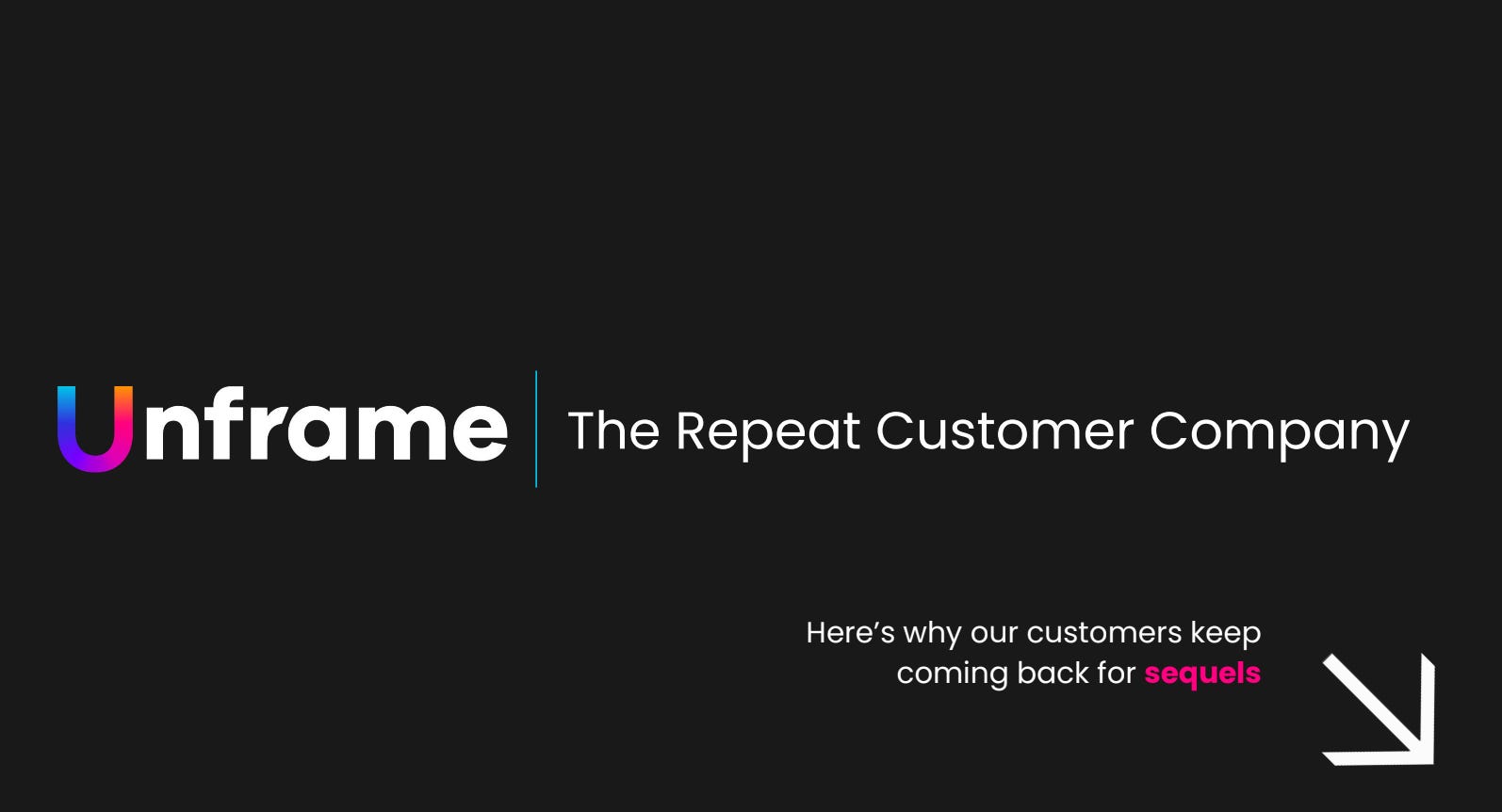
The title slide introduces the core brand identity: 'Unframe | The Repeat Customer Company.' The subtitle, 'Here’s why our customers keep coming back for sequels,' immediately sets a theme of retention and expansion. This is a strategic choice for a Series B deck; at this stage, investors are less interested in the 'what' and more interested in the 'how much more.' The use of the word 'sequels' suggests a repeatable process rather than a one-off consulting engagement.
Slide 2: The Credibility Injection
Slide 2, titled 'Quick Glance,' is a dense information hub. It serves as a combined Team, Traction, and Social Proof slide. The leadership team is led by CEO Shay Levi, with a notable concentration of talent from Noname Security (Levi, Schneider, Azarya, and others). This suggests a 'mafia' style startup where a proven team is reuniting to solve a new problem. The slide also lists heavy-hitting investors like Bessemer Venture Partners, Craft, and TLV Partners. Most importantly, it highlights three key metrics: a 4-month average sales cycle, 400% NRR, and 100 employees. The inclusion of logos like Cushman & Wakefield and Neue Zürcher Zeitung provides immediate enterprise validation.
Slide 3 & 4: The $40 Billion Problem
Slide 3 uses a massive font to highlight a '$40,000,000,000' spend on AI, contrasted with a sobering statistic from MIT: '95% of these initiatives delivered 0 returns.' This creates a 'gap' in the market that Unframe intends to fill. Slide 4 defines this gap as a 'delivery problem.' It visualizes the journey from 'Raw AI Models' to 'AI Solutions your teams can use,' placing Unframe’s 'Managed AI Delivery Platform' in the middle. The hurdles listed—Data & Integrations, Governance, Security, and 'other Enterprise Realities'—are the specific friction points Unframe claims to resolve.
Slide 5 & 6: The Architecture of Expansion
Slide 5, 'Behind the Magic,' introduces the product components: 'Building Blocks' (pre-built technical blocks) and 'Framery' (Unframe’s Open Platform/AI OS). The messaging here is that while every enterprise problem looks unique, the underlying infrastructure is standardized. Slide 6, 'How it works,' is a conceptual graph showing how use cases compound. The formula '1+1 > 2' and the phrase 'Context keeps compounding with every new use case' explain the mechanism behind their high retention. It suggests that the more an enterprise uses Unframe, the easier and more valuable subsequent deployments become.
Slide 7: The 'Spreadsheet Breaker'
Slide 7 is the emotional and logical peak of the deck. It features the number '400% NRR' in giant text. The subtext, 'The number that broke our spreadsheet,' adds a layer of 'insider' excitement. By comparing themselves to 'Great SaaS companies' (120% NRR) and 'The best' (150%), Unframe positions its performance as an outlier. For a Series B investor, this single slide justifies the valuation and the round size, as it implies a highly efficient engine for growth where every dollar of acquired revenue quadruples over time.
Slide 8: De-risking the Sale
Slide 8 addresses the business model: 'We only get paid when it works.' This is a bold claim that differentiates them from traditional SaaS vendors. By explicitly stating 'No tokens. No seat licenses. No platform fees,' Unframe removes the common budgetary barriers that slow down enterprise procurement. This slide explains the '4-month sales cycle' mentioned earlier in the deck; if there is no upfront cost or commitment, the 'yes' becomes much easier for a corporate buyer.
Slide 9: The $100M North Star
The final slide, 'On the road to $100M TCV in 12 months,' provides a clear target for the next phase of the company. Total Contract Value (TCV) is a standard enterprise metric, and $100M is a significant milestone that suggests Unframe is moving toward IPO-readiness. It ends the deck on a high note of ambition and forward momentum.
What Works in This Deck
Extreme Focus on NRR: In the current venture climate, retention is king. By making 400% NRR the centerpiece of the deck, Unframe speaks directly to the primary concern of growth-stage investors. · Team Pedigree: The 'Quick Glance' slide effectively leverages the team's past success at Noname Security to build immediate trust. · Problem Framing: Identifying the '$40B AI spend with 0 returns' is a compelling way to frame the market opportunity as a rescue mission for wasted enterprise capital. · Frictionless Model: The 'only get paid when it works' messaging is a powerful counter-narrative to the 'AI fatigue' many enterprises are feeling regarding expensive, unused software seats.
What is Missing
Competitive Landscape: The deck does not mention other AI orchestration layers or enterprise AI platforms (e.g., Palantir, C3 AI, or internal build-outs). · Specific Use Cases: While it mentions 'sequels' and 'use cases,' it doesn't detail what these actually are. Are they customer support bots, supply chain optimizers, or code assistants? The deck remains very high-level. · Financial Depth: There is no slide detailing burn rate, margins, or a breakdown of the $100M TCV. Investors would need to see the underlying unit economics to understand if the 'no upfront cost' model is sustainable. · The 'Ask': The deck does not explicitly state how much they are raising or what the funds will be used for (though Business Insider reported the $50M figure).
Founder Takeaways
Lead with the Team: If your team has a history of successful exits or deep domain expertise, put it on slide 2. Don't wait until the end of the deck to establish why you are the right people to solve the problem. · Use 'Anchor' Metrics: Find one metric that is so impressive it 'breaks the spreadsheet' and give it its own slide. For Unframe, it was 400% NRR. For others, it might be CAC payback or viral coefficient. · Simplify the Product: You don't need 10 slides of screenshots. Unframe uses simple icons for 'Building Blocks' and 'AI OS' to convey the essence of their tech without getting bogged down in the UI. · Address Procurement Friction: If your industry is known for long sales cycles, explicitly state how your business model or product architecture shortens them.
Frequently asked questions
- What is Unframe's core product offering?
- Unframe describes itself as a 'Managed AI Delivery Platform.' According to slides 4 and 5, it acts as a bridge between raw AI models and usable enterprise solutions. It utilizes 'Building Blocks'—pre-built technical components—and an 'AI OS' called Framery to handle data integration, governance, and security, allowing enterprises to deploy AI solutions that actually deliver returns.
- How does Unframe make money if they don't charge for seats or tokens?
- Slide 8 explicitly states they have 'No tokens. No seat licenses. No platform fees.' Instead, they operate on a performance-based model where they 'only get paid when it works.' While the specific pricing mechanics (e.g., gain-share or milestone payments) aren't detailed, this approach is designed to eliminate upfront friction and commitment for the enterprise.
- Is the 400% NRR figure realistic for an enterprise AI company?
- While 400% NRR is exceptionally high (slide 7 notes that 'the best reach 150%'), it reflects a land-and-expand strategy where a single customer rapidly adds new use cases. Slide 6 illustrates this 'compounding context,' where the first use case leads to a second, third, and 'nth' use case as different departments within the same company adopt the platform.
- Who are the key people behind Unframe?
- The leadership team, shown on slide 2, has significant enterprise tech pedigree. CEO Shay Levi, COO Larissa Schneider, and VP R&D Adi Azarya all come from Noname Security. Other team members bring experience from Facebook, Nutanix, and Indeni. This suggests a team highly experienced in scaling security and infrastructure software for large organizations.
- What is the primary goal of this pitch deck?
- The deck is designed for a Series B round (reported as $50M in 2024). Its primary goal is to demonstrate hyper-growth and efficiency. By focusing on a 4-month sales cycle and a path to $100M TCV, the deck aims to convince investors that the company has solved the 'delivery problem' that plagues other AI startups.