Earl Grey Capital, led by Clearbit co-founders Amit Vasudev, Matt Sornson, and Alex MacCaw, utilizes an 8-slide deck to raise their $20M Fund II. The presentation is a textbook example of 'operator-led' venture capital, focusing heavily on the GPs' ability to win deals through their technical reputation and founder-friendly reputation. Rather than relying on theoretical market sizes, the deck showcases a high-velocity investing track record from Fund I, including 110 investments and 3 unicorns. By highlighting a network of over 80 high-profile LPs—including David Sacks and Josh Kopelman—the G…
Key takeaways
- The fund targets a $20M raise focused on the 'programmatic layers of the internet,' specifically APIs, protocols, and platforms as stated on slide 1.
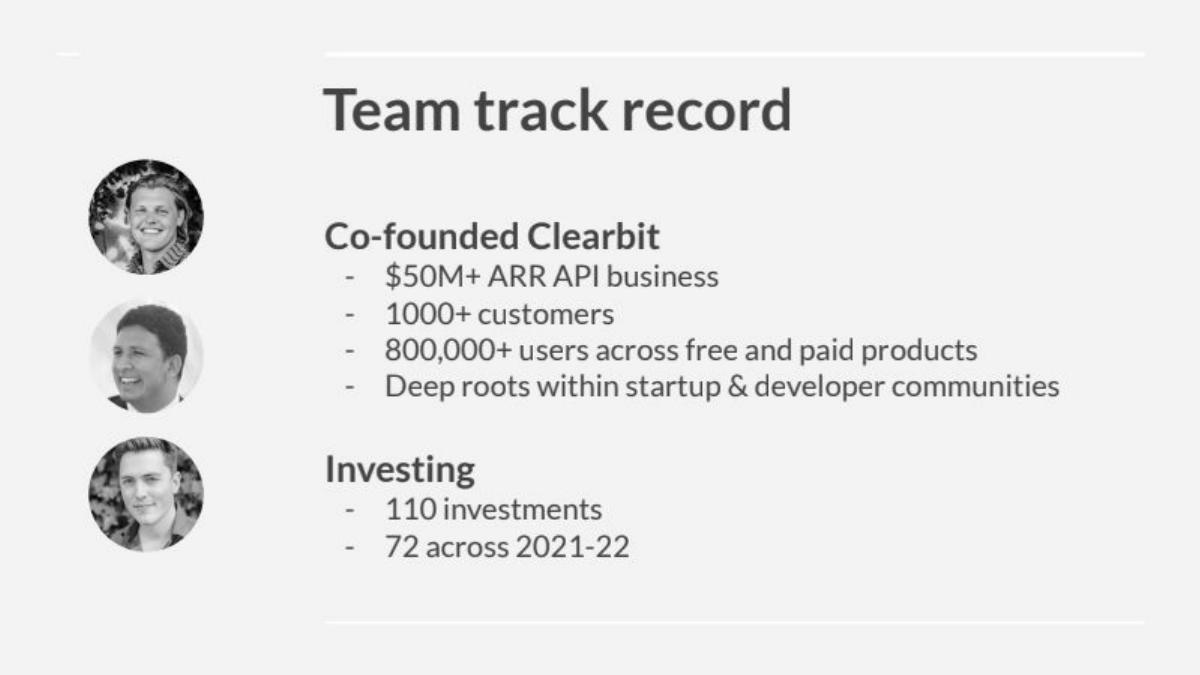
- The GPs leverage their operational success at Clearbit, citing a $50M+ ARR API business and 1000+ customers on slide 3.
- Investing velocity is a core theme, with the team reporting 110 total investments, 72 of which occurred across 2021-22 as noted on slide 3.
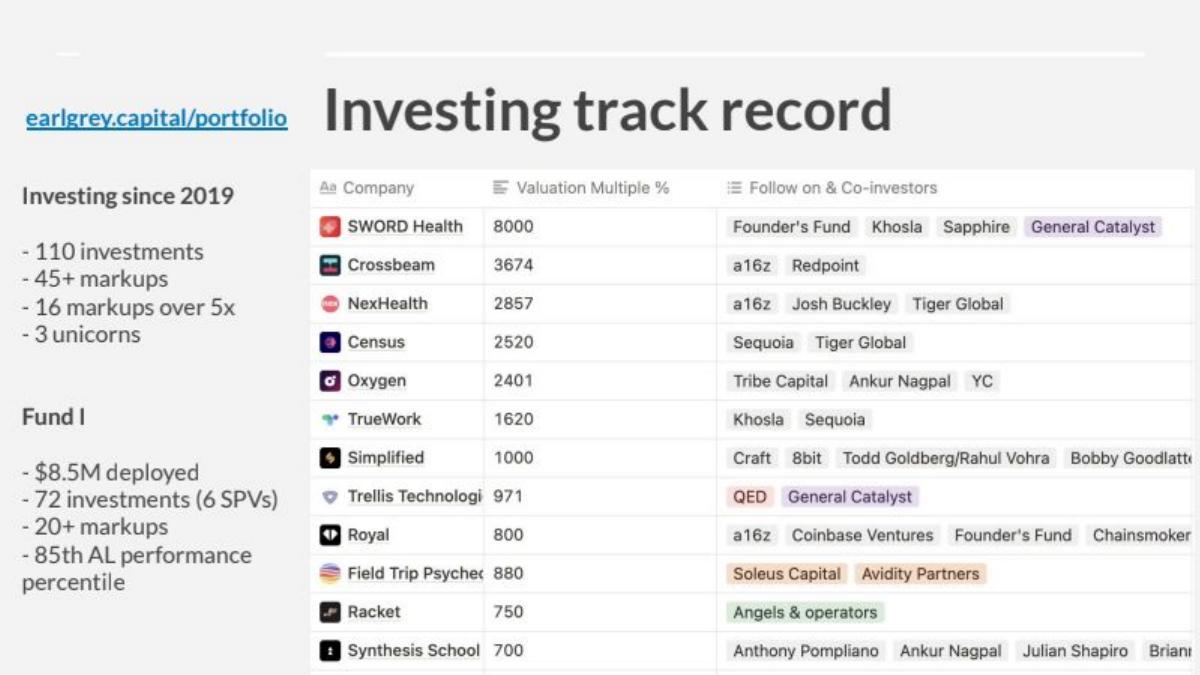
- Slide 5 provides a detailed performance table showing valuation multiples for top portfolio companies, including SWORD Health at 8000% and Crossbeam at 3674%.
- Fund I performance is benchmarked at the 85th percentile on AngelList, with $8.5M deployed across 72 investments as seen on slide 5.
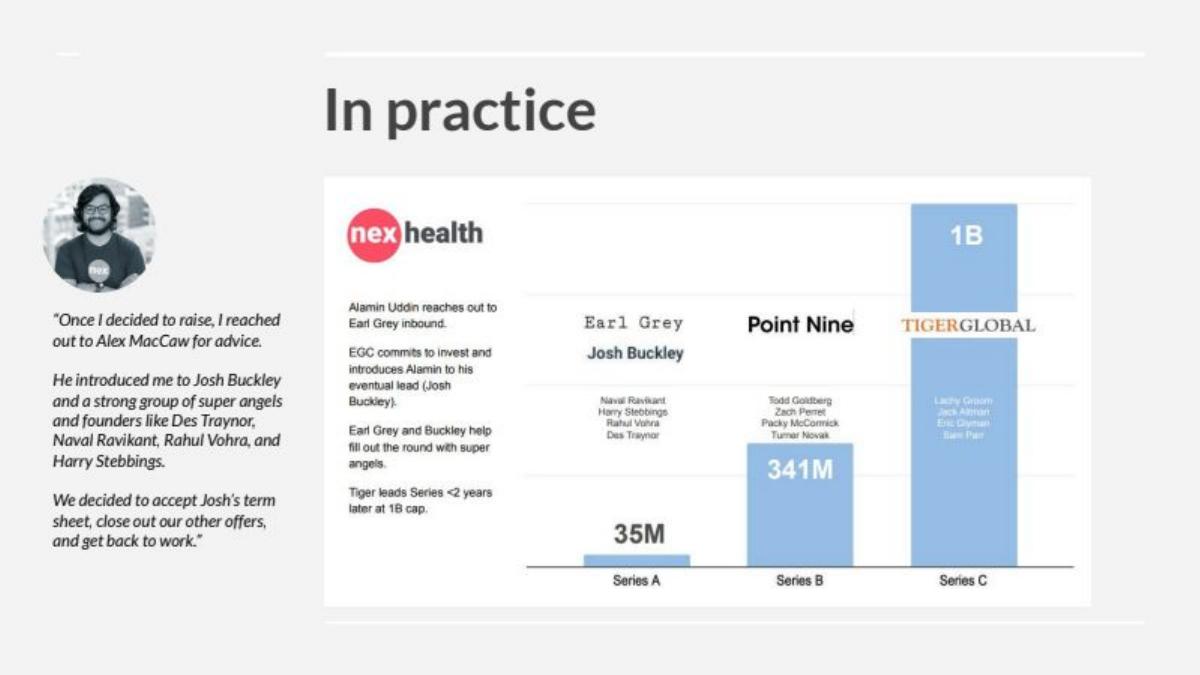
- The deck utilizes a specific case study for NexHealth on slide 4 to demonstrate how the GPs provide value beyond capital through introductions to lead investors like Josh Buckley.
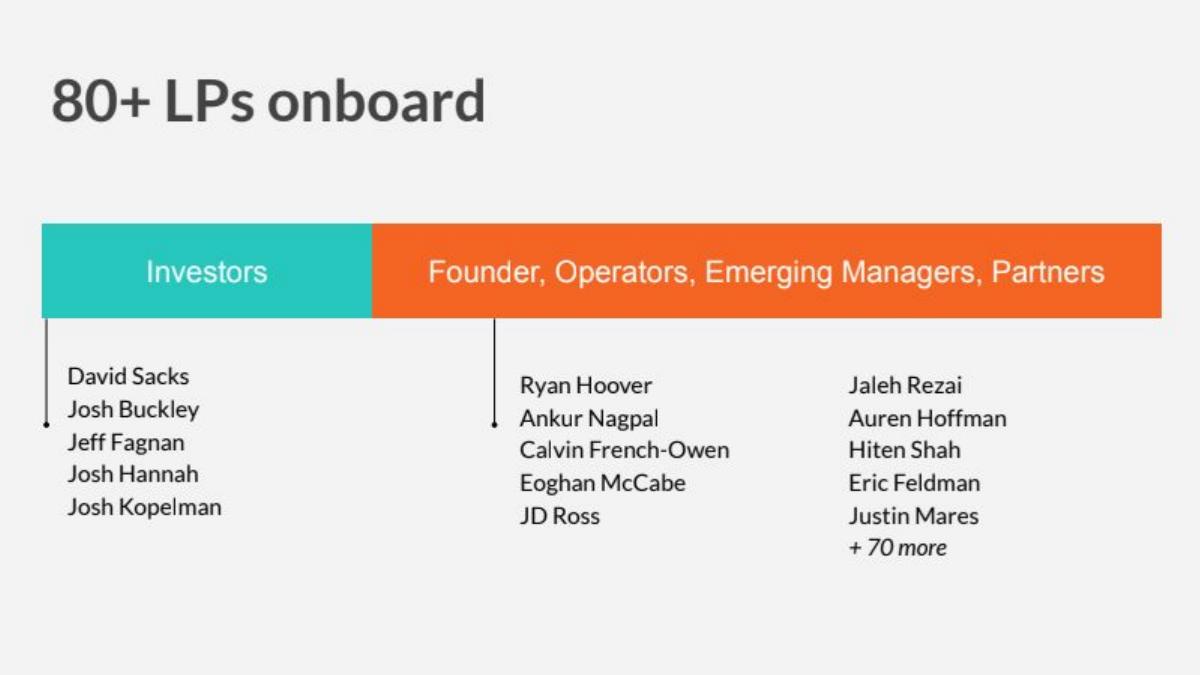
- The LP base is a significant part of the pitch, featuring 80+ LPs including prominent names like Ryan Hoover, Hiten Shah, and David Sacks on slide 6.
- The fund offers a 'Deal Partner' incentive where LPs can earn carry on any deal they introduce to the fund, according to slide 7.
The Power of the Operator-Investor
The Earl Grey Capital Fund II pitch deck is a lean, 8-slide presentation that prioritizes speed, reputation, and track record over traditional venture capital fluff. In an era where 'operator-led' funds are proliferating, this deck serves as a blueprint for how to transition from successful founder to professional investor. The GPs—Amit Vasudev, Matt Sornson, and Alex MacCaw—rely heavily on their Clearbit pedigree to establish immediate credibility with potential Limited Partners (LPs).
Slide 1: The Thesis
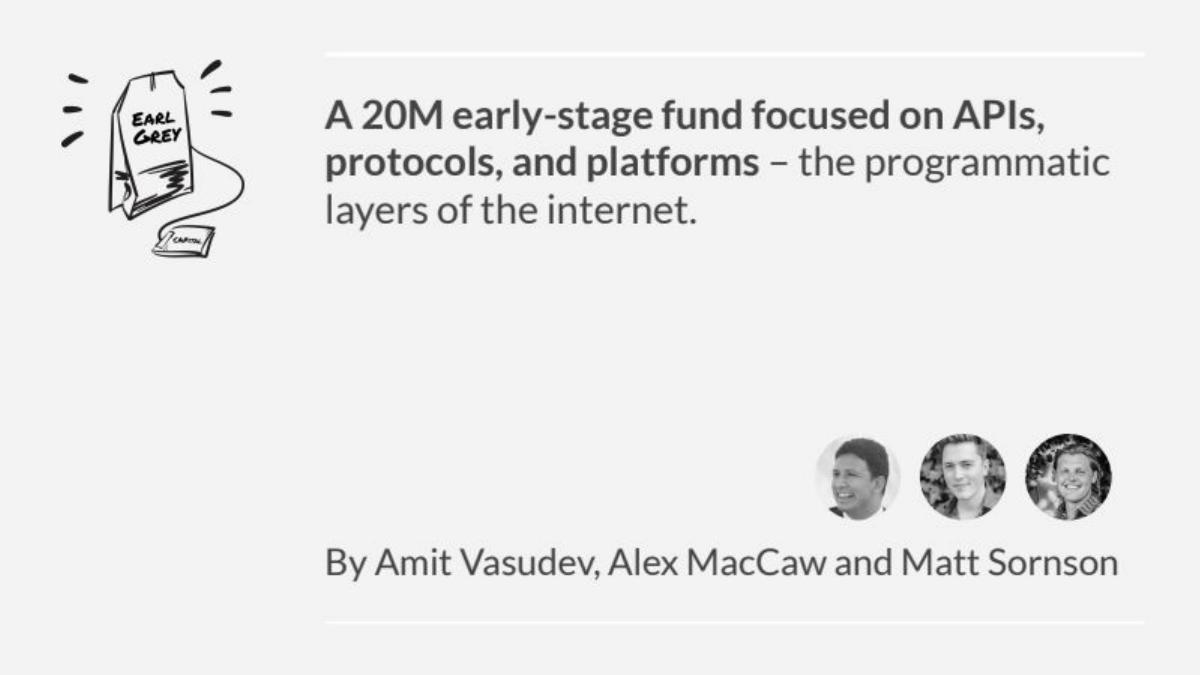
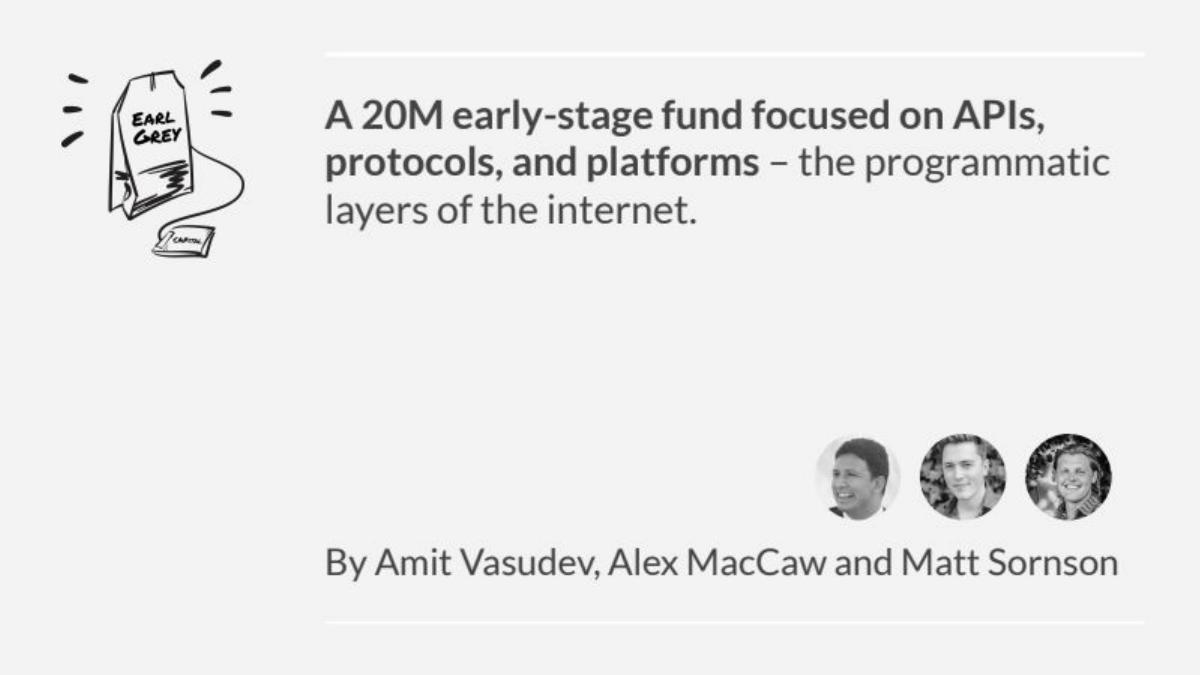
The cover slide does more than just name the fund. It establishes a clear, technical niche: "A 20M early-stage fund focused on APIs, protocols, and platforms – the programmatic layers of the internet." By defining their focus as the "programmatic layers," they signal to LPs that they are not generalists. They are specialists in the exact type of business they built with Clearbit. The inclusion of the GPs' names and photos at the bottom reinforces that this is a talent-led vehicle.
Slide 2: Portfolio Highlights
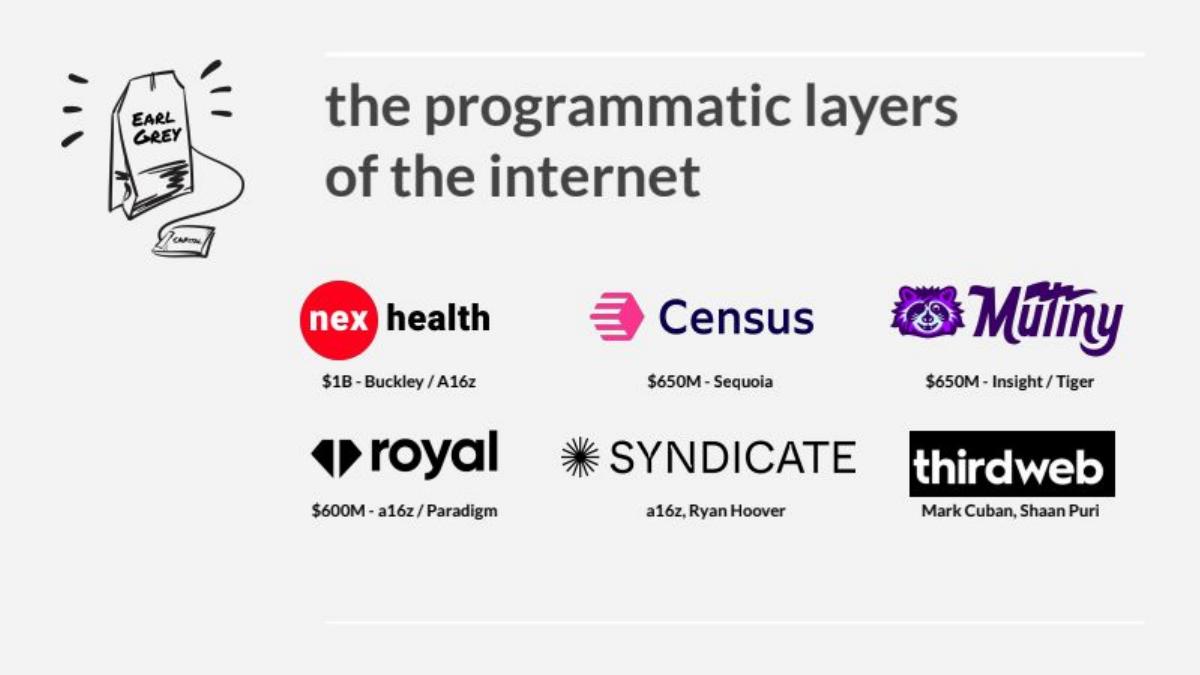
Slide 2 is a pure social proof slide. It features six logos: NexHealth, Census, Mutiny, Royal, Syndicate, and Thirdweb. Beneath each logo, they list the valuation and the high-profile co-investors or lead investors. For example, NexHealth is listed at $1B with Buckley/a16z, and Census at $650M with Sequoia. This slide serves two purposes: it proves they can get into competitive deals and shows that the 'smart money' in Silicon Valley (a16z, Sequoia, Tiger Global) follows their lead.
Slide 3: Team Track Record
This slide bridges the gap between their operational past and their investing future. Under the heading "Co-founded Clearbit," they list impressive metrics: $50M+ ARR, 1000+ customers, and 800,000+ users. This isn't just vanity; it's a justification for their thesis. If you are investing in APIs, you want the team that built a $50M ARR API business. The bottom half of the slide transitions to their investing activity, noting 110 total investments, with a staggering 72 of those occurring in the 2021-22 window. This indicates a high-velocity, high-conviction approach.
Slide 4: The 'In Practice' Case Study
Slide 4 is perhaps the most important slide for a new fund. It explains the 'how.' Using NexHealth as a case study, it tracks the company from a Series A at a $35M valuation to a Series C at a $1B valuation. The text explains that GP Alex MacCaw provided the initial advice and introduced the founder to Josh Buckley, who led the round. This narrative counters the common LP fear that small funds are just 'passive checks.' It proves Earl Grey adds tangible value by navigating founders toward lead capital and top-tier angels like Naval Ravikant and Harry Stebbings.
Slide 5: Investing Track Record (The Data)
While slide 2 was about logos, slide 5 is about the math. It features a table showing "Valuation Multiple %" for 12 portfolio companies. The numbers are aggressive: SWORD Health at 8000, Crossbeam at 3674, and NexHealth at 2857. To the left, they summarize Fund I: $8.5M deployed, 72 investments, 3 unicorns, and an 85th percentile performance ranking on AngelList. This data-heavy approach is designed to satisfy the analytical requirements of institutional LPs or family offices who need to see realized or marked-up gains before committing to Fund II.
Slide 6: The LP Network
Slide 6 highlights the "80+ LPs onboard." By categorizing them into "Investors" and "Founders, Operators, Emerging Managers, Partners," Earl Grey shows the breadth of their network. The list of names is a 'who's who' of the tech ecosystem: David Sacks, Josh Kopelman, Ryan Hoover, and Hiten Shah. For a prospective LP, seeing these names creates a 'fear of missing out' (FOMO) and suggests that by joining the fund, they are joining an elite syndicate of information sharing.
Slide 7: The LP Value Proposition
This slide explicitly states what LPs get beyond just financial returns. It lists "Co-invest with us," "Deal partner (Carry on any deal you intro)," and "Network opportunities." The 'Deal Partner' mention is a clever tactical move. It incentivizes their 80+ LPs to act as a decentralized sourcing engine, effectively giving the $20M fund the reach of a much larger firm. They also clarify that both QP (Qualified Purchaser) and non-QP investors are eligible, provided they are accredited, widening the net for potential capital.
Slide 8: Resources
The final slide is a simple directory of links to their memo, team bios, full portfolio, and Fund I updates. This transparency is a hallmark of the 'new' wave of venture capital, where GPs provide LPs with the same level of data and documentation that they would expect from their own portfolio companies.
What Earl Grey Capital Does Well
The strength of this deck lies in its brevity and focus . It does not waste time explaining why the internet is growing or why APIs are important. It assumes the audience is sophisticated enough to understand the market and instead focuses entirely on why this specific team is the best at capturing that market. The use of a specific case study (NexHealth) to illustrate their value-add is much more effective than a generic list of 'services' like recruiting or marketing support. Furthermore, the transparency regarding their Fund I performance—specifically the 85th percentile ranking—provides a hard benchmark that is difficult for LPs to ignore.
What is Missing from the Deck
While the deck is highly effective for a specific type of investor, it omits several traditional elements. There is no mention of management fees or fund terms (though these may have been in the linked memo). There is also no discussion of the competitive landscape of other seed-stage funds. The GPs assume their 'operator' status is a unique enough differentiator. Additionally, there is no mention of the target number of investments for Fund II or the expected check size, which are standard metrics LPs use to model their own portfolio construction. Finally, the deck lacks a macro-economic outlook ; it was raised in 2022, a volatile time, yet it remains focused entirely on internal metrics.
Founder and GP Takeaways: What to Copy
Focus on the 'Programmatic' Niche: Don't just say you invest in 'SaaS.' Define the specific layer of the stack you understand better than anyone else. · Use a 'Deal Partner' Model: If you are raising a smaller fund, incentivize your LPs to bring you deals by offering them a share of the carry. It turns your cap table into a sales force. · Visualizing the 'Follow-on' Path: Slide 4's bar chart showing the valuation growth from Series A to C, along with who led those rounds, is a brilliant way to show that you are a 'kingmaker' who can get companies to the next level. · The Power of the Table: Instead of just listing logos, list the multiples. In a fund deck, the math is the only thing that eventually matters. · Social Proof as a Moat: If you have high-profile LPs, name them. In venture capital, your network is your net worth, and this deck leverages that principle to the maximum.
Frequently asked questions
- What is the primary investment thesis of Earl Grey Capital Fund II?
- The fund focuses on the 'programmatic layers of the internet.' This specifically includes APIs, protocols, and platforms. The GPs leverage their background as founders of Clearbit, a successful API-first business, to identify and support companies building technical infrastructure at the early stage.
- How does the team demonstrate their value to founders?
- Slide 4 uses a case study of NexHealth to show the 'Earl Grey in practice' model. It illustrates how GP Alex MacCaw introduced the founder to their eventual lead investor, Josh Buckley, and helped fill the round with 'super angels.' This positions the GPs as connectors rather than just sources of capital.
- What are the specific performance metrics of their first fund?
- According to slide 5, Fund I deployed $8.5M across 72 investments and 6 SPVs. It achieved an 85th percentile performance ranking on AngelList. The portfolio includes 3 unicorns and 16 markups over 5x, with top performers showing valuation multiples between 700% and 8000%.
- Who are the General Partners and what is their background?
- The fund is run by Amit Vasudev, Alex MacCaw, and Matt Sornson. They are the co-founders of Clearbit, which they grew to over $50M in ARR. Their background is deeply rooted in the developer and startup communities, which they cite as a primary source of deal flow.
- What incentives do they offer to their Limited Partners (LPs)?
- Beyond standard returns, slide 7 outlines three benefits for LPs: the ability to co-invest, a 'Deal Partner' arrangement where LPs can earn carry on deals they introduce, and access to networking opportunities within the portfolio. This encourages an active, rather than passive, LP base.