Early Logic’s pitch deck is a mission-oriented presentation focused on solving dyscalculia and mathematical learning disabilities in young children. The deck excels at defining a specific, underserved clinical problem—the inability to perform calculations due to neurological or environmental factors—and positioning their product as both a diagnostic and therapeutic tool. However, the presentation is heavily weighted toward the 'why' and the 'who,' while leaving significant gaps in the 'how' and 'how much.' There are no slides detailing unit economics, revenue models, or specific user growth m…
Key takeaways
- The company targets a specific age demographic of children between 4 and 9 years old (Slide 4).
- The problem is bifurcated into clinical dyscalculia and general mathematical difficulties caused by poor curriculum or lack of diagnosis (Slide 3).
- The solution is positioned as a dual-purpose platform for both diagnosis and therapy (Slide 4).
- The team slide features seven members but lacks professional titles, roles, or biographical summaries (Slide 6).
- The deck identifies eight competitors or 'copmetitors,' including PWN, eduterapeutica, and Young Digital Planet (Slide 8).
- Early Logic has secured prior backing from Lerni and Data Techno Park (Slide 9).
- There is a total absence of financial projections, business model details, or a specific funding request in the provided slides.
- The mission statement emphasizes social impact, stating they want to show that math problems are a 'real issue that can be solved for real' (Slide 5).
Slide-by-Slide Analysis
Slide 1: Title Slide
The title slide features the company logo: a yellow, fuzzy character wearing large blue glasses, flanked by the words 'early' and 'logic.' The design is friendly and clearly oriented toward a pediatric or educational market. There is no tagline or high-level value proposition on this slide.
Slide 2: Problem Introduction
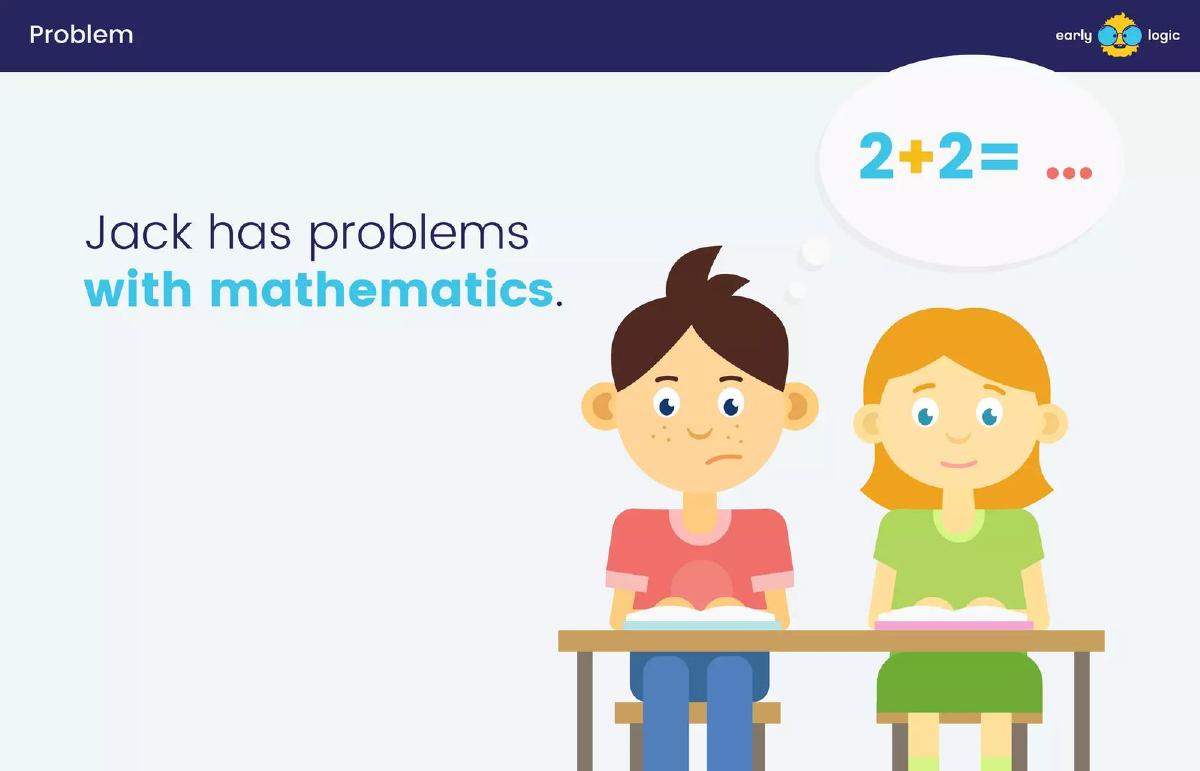
This slide introduces a persona, 'Jack,' who 'has problems with mathematics.' It uses a simple illustration of two children at a desk, with Jack looking confused by a basic addition problem (2+2). This is a classic 'storytelling' opening, though it remains very high-level.
Slide 3: Defining the Problem
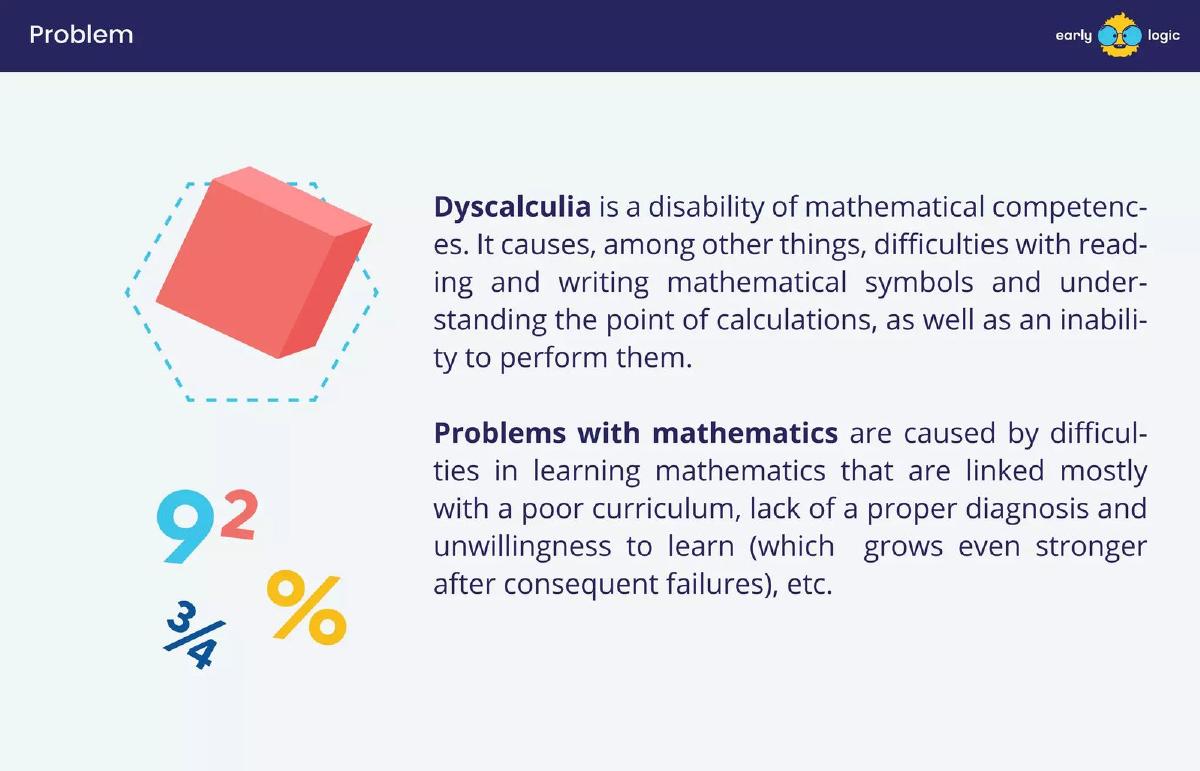
Slide 3 provides a more technical definition of the market need. It distinguishes between Dyscalculia (a disability of mathematical competencies) and general Problems with mathematics . It attributes the latter to 'poor curriculum, lack of a proper diagnosis and unwillingness to learn.' This slide is critical because it establishes that the company is not just a tutoring app, but a clinical or remedial tool.
Slide 4: The Solution
The solution is defined as 'Diagnosis and therapy of dyscalculia and other mathematical disorders in children aged 4-9.' The illustration shows a child using a tablet while a teacher or parent stands by. This confirms the product is a digital software solution, likely tablet-based, targeting the early childhood education (ECE) and special education sectors.
Slide 5: The Mission
This slide is purely philosophical, stating a desire to show that math problems are a 'real issue' that can be 'solved for real.' While it reinforces the founders' passion, it adds little in the way of data or strategic direction.
Slide 6: Zespół (The Team)
The team slide, titled in Polish ('Zespół'), shows seven individuals: Jacek Dymel, Katarzyna Karkowska, Michał Niedźwiedź, Katarzyna Leniar, Renata Broniek, Tadeusz Ratusiński, and Joanna Major. Critically, the slide lacks any information regarding their roles, expertise, or past achievements. An investor cannot tell who is the CEO, who is the lead developer, or if there are any clinical psychologists on staff.
Slide 7: Universalism
This slide argues that because 'Mathematics is everywhere,' the 'Solutions are universal.' It features a globe and various mathematical symbols. This is an attempt to suggest a large Total Addressable Market (TAM) without actually providing any market sizing numbers (SAM/SOM).
Slide 8: Copmetition
The deck uses the term 'Copmetition' (a likely typo for Competition or a play on 'Cooperation/Competition'). It lists eight logos of other EdTech and mathematical learning companies. There is no analysis of how Early Logic differs from these established players like PWN or Young Digital Planet.
Slide 9: Investors
This slide displays the logos of Lerni and Data Techno Park . This provides some social proof, indicating that the company has already passed some level of due diligence with regional investors or incubators.
Slide 10: Closing Quote
The final slide in this set is a quote from Confucius about the long-term value of educating children. It serves as a thematic bookend but does not provide contact information or a call to action.
What Works
Specific Problem Identification: By focusing on dyscalculia rather than just 'math help,' Early Logic carves out a niche in the special education market. This specificity is usually more attractive to investors than a generic 'learning app' because the barriers to entry (clinical validity) are higher.
Clear Demographic Targeting: Stating the age range of 4-9 (Slide 4) immediately tells an analyst which part of the school system or home-learning market the company occupies.
Visual Consistency: The deck uses a consistent, child-friendly illustration style that matches the product's likely user interface. This suggests a cohesive brand identity.
What is Missing
Business Model and Revenue: There is no mention of how the company makes money. Is it a B2B sale to schools, a B2C subscription for parents, or a B2B2C model through clinics? This is a major omission for a sales or pitch deck.
Product Details: While we know it is a 'diagnosis and therapy' tool on a tablet, we don't see the actual software. There are no screenshots of the exercises, the diagnostic reports, or the data dashboard for teachers.
Market Sizing: Slide 7 hints at a global market but provides no data. Investors need to see the number of children affected by dyscalculia and the current spend in the special education technology sector.
Team Credentials: Listing names without titles or bios is a significant weakness. In a clinical EdTech startup, the presence of PhDs or experienced educators is a primary value driver.
The Ask: The deck ends without asking for anything. There is no funding goal, no milestone roadmap, and no explanation of what the next 12-24 months look like for the company.
Founder Recommendations
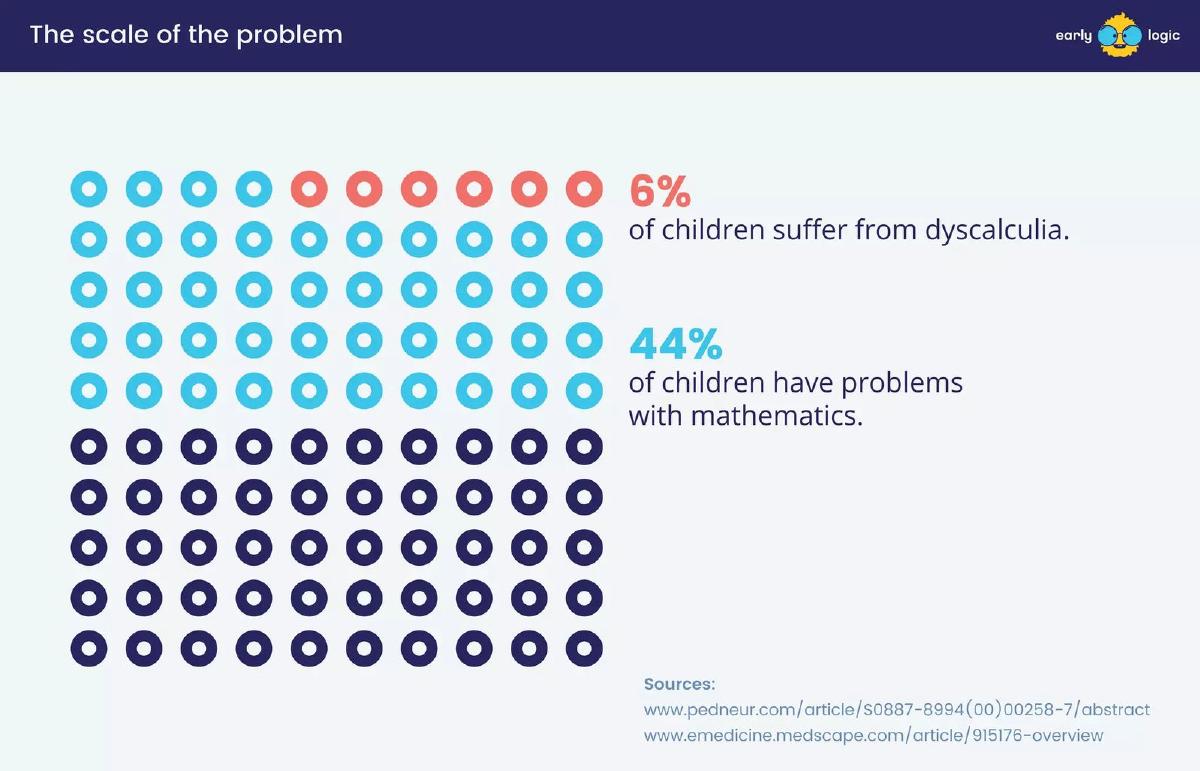
Quantify the Problem: Instead of just defining dyscalculia, add a slide with statistics. What percentage of children suffer from this? What is the cost to the education system when these children are not diagnosed early?
Show, Don't Just Tell: Replace the mission slide (Slide 5) or the universalism slide (Slide 7) with actual product screenshots. Show the 'Diagnosis' interface and the 'Therapy' interface to prove the product exists and is functional.
Fix the Team Slide: At a minimum, add titles (CEO, CTO, Lead Researcher) and one sentence of 'claim to fame' for each key member. This builds the trust necessary for an investor to move to a second meeting.
Define the Business Logic: Add a slide explaining the go-to-market strategy. If the company is targeting Poland first (given the Polish heading on Slide 6), explain the plan for international expansion, especially since Slide 7 claims the solution is 'universal.'
Frequently asked questions
- What specific problem does Early Logic solve?
- Early Logic addresses dyscalculia and general mathematical learning difficulties. According to Slide 3, dyscalculia is a disability affecting the reading and writing of mathematical symbols and the understanding of calculations. They also address non-clinical math struggles caused by poor school curricula or a child's 'unwillingness to learn' following repeated failures.
- Who is the target audience for this product?
- The product is designed for children in the early developmental stages, specifically those aged 4 to 9. Slide 4 illustrates a child using a tablet device under the supervision of an adult, suggesting the tool is intended for use in both home and educational or clinical settings.
- Does the deck provide a clear business model?
- No. The provided slides do not mention pricing, subscription tiers, licensing fees, or any other revenue generation strategies. It focuses entirely on the social and educational mission rather than the commercial mechanics of the business.
- What is the competitive landscape for Early Logic?
- Slide 8 lists several competitors under the heading 'Copmetition.' These include PWN, eduterapeutica, Young Digital Planet, eduSensus, NumberGym, conquermaths.com, Dynamo Maths, and Mathlingz. The deck does not provide a feature-by-feature comparison to explain Early Logic's unique advantage.
- Is there a clear investment 'Ask' in the deck?
- The deck does not include a slide detailing how much capital the company is seeking or how they intend to use the funds. While it lists existing investors on Slide 9, it functions more as a brand introduction than a transactional fundraising document.