Tax Credits and Subsidies in Your Pitch Deck: Show Who Gets
If a tax credit, rebate or subsidy improves your price, payback or costs, show the program, who receives it, the numbers with and without it, and when it ends.
Tax Credits and Subsidies in Your Pitch Deck: How to Show Numbers That Depend on Government Money
Five slides from real pitch decks lean on a tax credit, rebate or government subsidy: in a customer's payback, in a market's cost curve, in the company's own production costs, as a revenue line, and as a service the company sells. We compare what each lets an investor check, and show how to present incentive-dependent numbers so they survive diligence.
TL;DR
When a government incentive improves your numbers, the investor needs four things: the program's name, who receives the money (your customer or your company), your key figure both with and without it, and the date or condition on which it ends. Without those, an investor cannot tell whether your price, payback or margin is a property of the business or of a policy that may change.
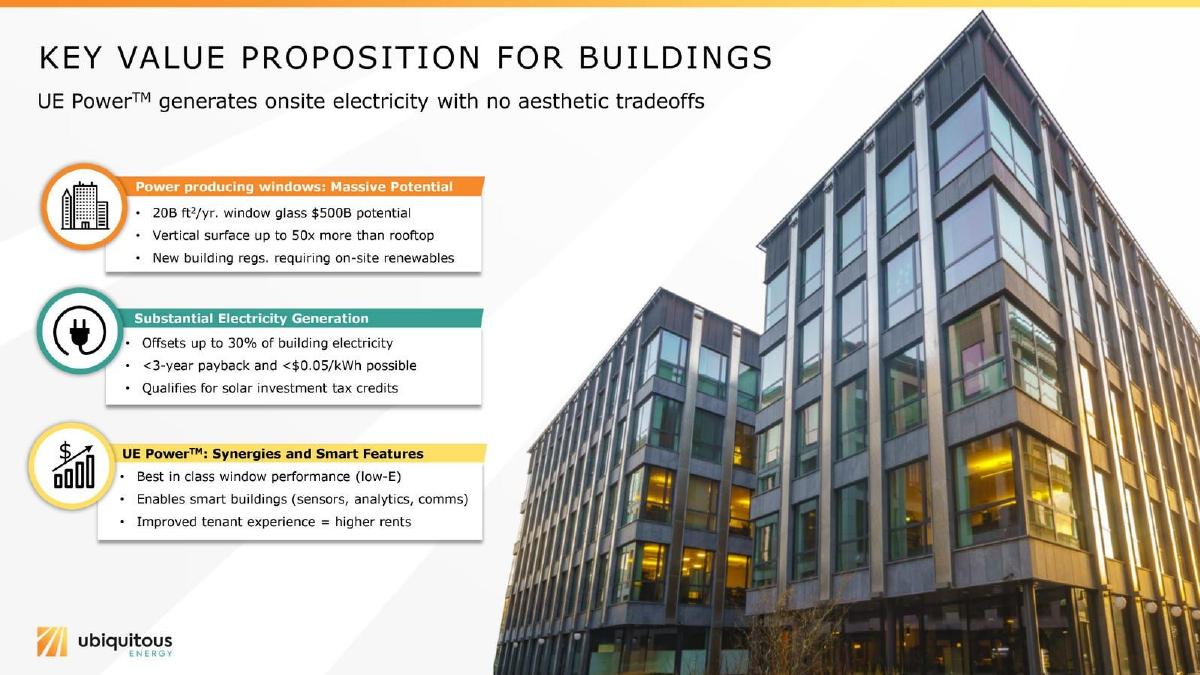
In the slides below, SunRoof does one part well: its cost chart is labelled "Unsubsidized", so the reader knows the comparison excludes incentives. Ubiquitous Energy puts "<3-year payback" and "Qualifies for solar investment tax credits" next to each other without saying whether the payback includes the credit. Kairos says up to 40% of its production costs are reimbursed by the Canadian government but does not name the program. EnfoGrid lists "Government Subsidies" as a revenue stream with no program, amount or duration. ecoCompass sells help with incentives as a service, which is a different and often sturdier position.
Government incentives on real slides
Each example shows the exact stored slide, rendered from the original public deck file, above its analysis. Slide claims are the companies' own and have not been verified unless we say so.
Ubiquitous Energy business model slide — slide 6
Transparent solar window company, 2024 Series B deck. A page headed "Key Value Proposition for Buildings".
Ubiquitous Energy deck, slide 6. Exact stored slide matched to this analysis.
Our analysis: A customer incentive, mentioned beside economics it may or may not be inside.
Evidence and limitation: The slide does not say whether the payback and cost per kWh include the credit, who claims it, or which credit. Section 48E's solar eligibility was later cut back by the 2025 law (IRS Notice 2025-42). Company figures are unverified.
What a founder can adapt: Give payback before and after the credit, name it with its conditions and end date, and say the owner claims it.
Supporting analysis
What the deck claims: Under "Substantial Electricity Generation": "Offsets up to 30% of building electricity", "<3-year payback and <$0.05/kWh possible", "Qualifies for solar investment tax credits". Other panels: "20B ft²/yr. window glass $500B potential", "New building regs. requiring on-site renewables".
Presentation choice: Puts the credit on the value proposition, where a building owner's decision is made, and uses "possible" rather than presenting the payback as typical.
When it does not fit: Don't place an incentive next to a payback figure without saying whether the figure includes it.
Solar roof company, 2023 growth deck. "3. The Market: Building-Integrated Photovoltaics Market Growth Catalysts".
SunRoof deck, slide 5. Exact stored slide matched to this analysis.
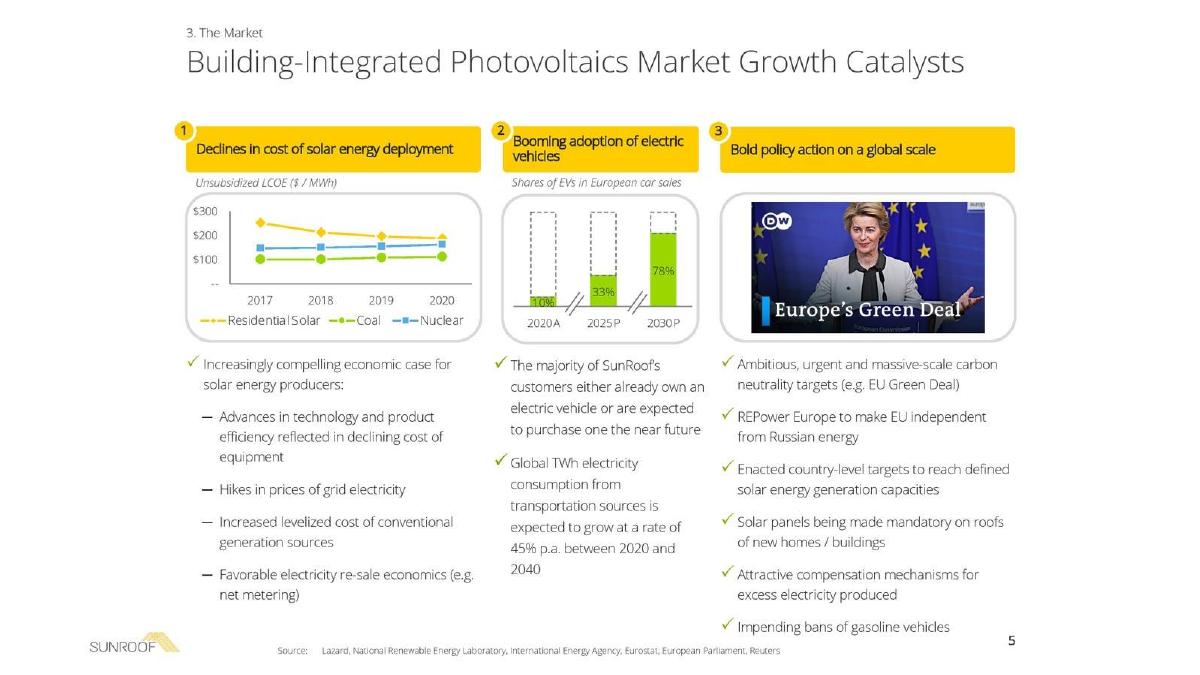
Our analysis: Market-level incentive context, with the cost comparison explicitly excluding subsidies.
Evidence and limitation: Lazard's LCOE+ reports compare technologies on an unsubsidized basis, matching the chart label. Net metering and compensation mechanisms are named as categories with no country, rate or figure; we did not verify them.
What a founder can adapt: Name the main markets' compensation schemes and rates, and say how much of a customer's return comes from selling excess power.
Supporting analysis
What the deck claims: A chart titled "Unsubsidized LCOE ($ / MWh)" for residential solar, coal and nuclear, 2017 to 2020; "Favorable electricity re-sale economics (e.g. net metering)"; "Attractive compensation mechanisms for excess electricity produced". Source line: Lazard, NREL, IEA, Eurostat, European Parliament, Reuters.
Presentation choice: The "Unsubsidized" label tells the reader exactly what the chart excludes, and the chart has a named source.
When it does not fit: Don't list incentive categories as catalysts without saying which apply to your customers.
Kairos Transmedia, Canadian media company; undated deck. "Compelling Content Is the Magnet: Ours is a Low cost Content Model".
Kairos deck, slide 9. Exact stored slide matched to this analysis.
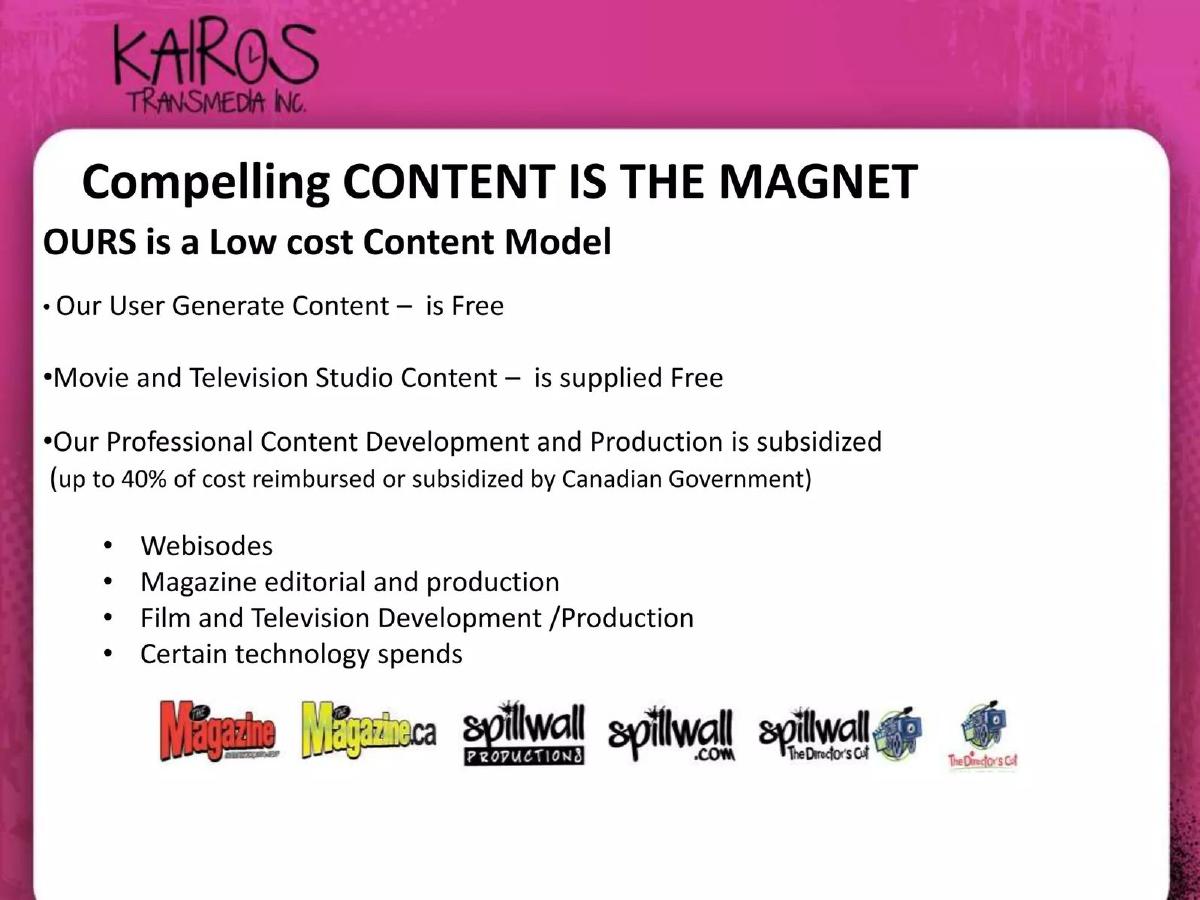
Our analysis: A company cost incentive, used to support a low-cost content model.
Evidence and limitation: No program is named, so we could not check the rate or conditions. "Up to 40%" is the slide's ceiling.
What a founder can adapt: Name each program, the expected rate on your actual spending, margin with and without it, and the delay before reimbursement arrives.
Supporting analysis
What the deck claims: "Our Professional Content Development and Production is subsidized (up to 40% of cost reimbursed or subsidized by Canadian Government)": webisodes, magazine editorial and production, film and television development/production, certain technology spends. Also user-generated and studio content "is Free".
Presentation choice: Says plainly that the cost model depends on government money and gives a ceiling.
When it does not fit: Don't present a reimbursement ceiling as your cost structure.
Energy information company; "WIP Business Model Canvas" page, footer dated April 16, 2012.
EnfoGrid deck, slide 4. Exact stored slide matched to this analysis.
Our analysis: A company revenue incentive, listed as equal to product sales.
Evidence and limitation: No program, amount, period or award is given.
What a founder can adapt: Show subsidy income as a separate line under sales, with the program, award and period.
Supporting analysis
What the deck claims: Revenue streams: "Sales from Smart products and services to both Energy and Non Energy Retailers" and "Government Subsidies". Cost centres: hardware and software, operations and administration.
Presentation choice: Discloses that the plan expects public money, rather than hiding it inside sales.
When it does not fit: Don't list an unnamed subsidy as a revenue stream beside customer sales.
Energy efficiency marketplace, circa 2012 deck. "How We Solve The Problem: Service".
ecoCompass deck, slide 13. Exact stored slide matched to this analysis.
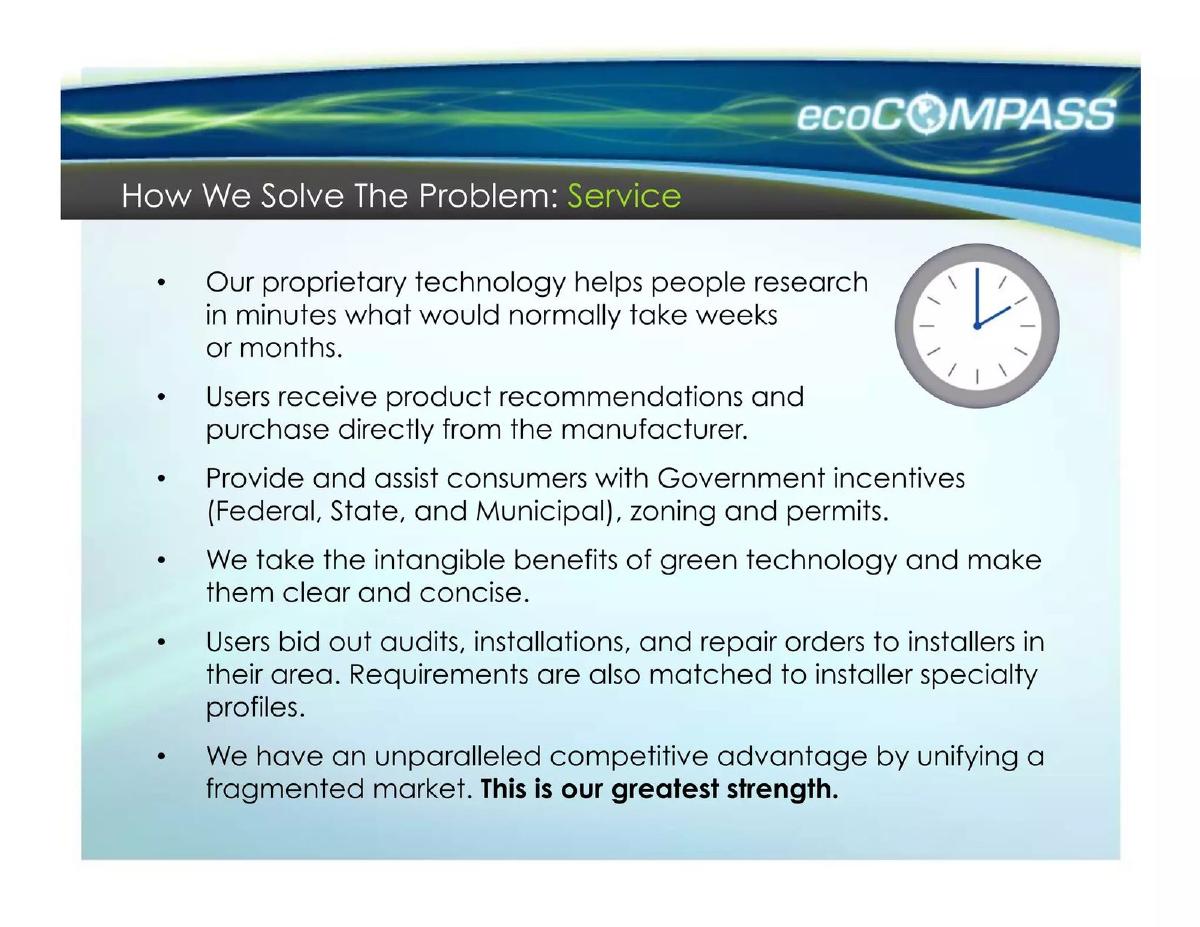
Our analysis: Incentive help sold as a service, not dependence on one program.
Evidence and limitation: The slide does not say how many programs are covered, how much customers recover, or how the company is paid for this help.
What a founder can adapt: Add the number of programs tracked, the typical amount a customer recovers, and whether the help is paid or part of winning the sale.
Supporting analysis
What the deck claims: "Provide and assist consumers with Government incentives (Federal, State, and Municipal), zoning and permits." Also research, product recommendations and installer bidding.
Presentation choice: Positions the company as helping customers claim many incentives, which spreads policy risk.
When it does not fit: Don't leave the value of incentive help as a feature with no number.
Our reading of each slide against what an incentive-dependent figure needs. "Partly" means present but incomplete.
Company
Who receives it
Program named
With and without
End date or condition
Position
Ubiquitous Energy
Customer (implied)
Partly ("solar ITC")
No
No
Customer incentive
SunRoof
Customer (implied)
No
Partly ("Unsubsidized" chart)
No
Market context
Kairos
Company
No
No (ceiling only)
No
Cost incentive
EnfoGrid
Company
No
No
No
Revenue incentive
ecoCompass
Customer
Partly (federal, state, municipal)
Not applicable
Not applicable
Incentive help as a service
Key Takeaways
Name the program, not "government incentives" or "subsidized".
Say who receives the money: your customer (it changes their price) or your company (it changes your costs or revenue).
Show the key figure twice: with the incentive and without it. Label which is which.
Give the incentive's end date, phase-down or eligibility condition, from the official source.
Do not count an incentive as revenue unless you have a confirmed award, and show it separately from sales.
Say what happens to price, demand or margin if the incentive ends or shrinks.
Helping customers claim incentives is a different business from depending on them. Say which one you are.
Show your incentive-dependent numbers
Fill these in for each incentive before designing the slide. If you cannot fill the without column, you do not yet know your own economics.
Program. Exact name, section or scheme, and the official source.
Who receives it. Your customer, your company as a cost reduction, or your company as revenue.
Rate you expect. The rate on your actual spending or sales, not the maximum.
Figure with incentive. Payback, net price, margin or revenue including it.
Figure without. The same figure excluding it, calculated the same way.
Timing. When the money arrives, if after the cost is paid.
End date or condition. Phase-down, termination, budget cap or eligibility condition.
If it ends. What happens to price, demand or margin.
Copyable framework: [Figure] is [x] before incentives and [y] with [program] ([rate], claimed by [customer / us]; available until [date or condition]). If it ends, [effect].
Illustrative example 1 — written by us
Before: <3-year payback. Qualifies for solar investment tax credits.
After: Hypothetical: Payback [x] years before incentives; [y] years if the owner claims [credit, section] at [rate] (available for projects that [condition]). The owner claims it, not us.
What improved: Invented for illustration; bracketed values are placeholders. States both figures, the recipient and the end condition.
Illustrative example 2 — written by us
Before: Revenue streams: product sales; government subsidies.
After: Hypothetical: Product sales [$x]. Subsidy income [$y] from [program], awarded [date], covering [period]; not projected after [date].
What improved: Invented for illustration. Separates subsidy from sales and backs it with an award.
Why incentive-dependent numbers need extra care
Tax credits, rebates and grants are real money. A solar investment credit can cut a project's cost by a large share; a production subsidy can make a content business viable. Investors do not object to a company benefiting from them. They object to not being able to see how much of the business depends on them, because policy changes on a schedule the company does not control.
The risk is easy to underrate. A payback period, a cost per kilowatt-hour or a gross margin quoted without a label usually reads as the company's own economics. If an investor later works out that the figure assumes a credit, they will wonder what else on the deck assumes something unstated. Saying it plainly on the slide costs one line and removes that doubt.
This guide is about incentives inside the business model: a customer's price, a company's costs, a revenue line. It is different from two neighbouring topics. Using a new law as the reason a market is opening is covered in the regulation why-now guide. Raising grants or other non-dilutive money for the company is covered in the grant-funding guide. Here the question is narrower: when a government program sits inside your unit economics, how do you show it honestly?
First question: who receives the money?
Our classification, used throughout this guide. Incentives reach a business in one of three ways, and each needs different numbers on the slide.
A customer incentive is paid to, or claimed by, the buyer. A solar tax credit claimed by the building owner is one. It lowers the buyer's net cost, so it changes your effective price and payback, not your revenue. Show the buyer's cost before and after, and say who claims it.
A company cost incentive reduces what the company pays to make its product, such as a production tax credit or a reimbursement of part of its labour. It changes your gross margin. Show margin with and without it, and say when the money arrives, because reimbursements often come months after the spending.
A company revenue incentive is a payment to the company for an activity, such as a subsidy per unit sold or a feed-in payment. Show it as its own line beneath sales, never mixed into them, and give the award or contract that backs it.
A fourth position is not dependence at all: selling help with incentives. A company that finds, explains or files incentives for customers benefits when incentives exist, but its product is the service. Its exposure is to the incentive landscape as a whole, not to one program.
With and without: the one table that answers most questions
Our recommendation: for every figure that an incentive changes, show both versions side by side. For a customer incentive, that is the buyer's net cost and payback with and without the credit. For a cost incentive, gross margin with and without the reimbursement. For a revenue incentive, total revenue with and without the subsidy line.
SunRoof's market slide shows the convention in a market chart: its cost comparison is labelled "Unsubsidized LCOE ($ / MWh)" and cites Lazard, whose levelized cost reports compare technologies on an unsubsidized basis. A reader knows the solar line is not flattered by credits. The same discipline applied to a company's own payback or margin is what most incentive slides lack.
If space is short, give the unsubsidized figure on the slide and the subsidized one in a footnote. That order is deliberate: the figure that survives a policy change is the one an investor can underwrite. (Lazard)
End dates and conditions: check the official source before presenting
Incentives are written with conditions, and they change. The US clean electricity investment credit is a useful example because one of our sample slides relies on solar credits. The IRS describes the credit (section 48E) as available for qualified facilities placed in service after December 31, 2024, with a base amount of 6% of the qualified investment, increased up to 30% for facilities meeting prevailing wage and registered apprenticeship requirements, and further bonuses for domestic content and energy communities.
That description is not the end of the story. IRS Notice 2025-42 explains that the 2025 law known as the OBBBA terminates the section 48E credit for applicable wind and solar facilities placed in service after December 31, 2027, with that termination applying to facilities whose construction begins after July 4, 2026. A deck written in 2024 that said "qualifies for solar investment tax credits" described a credit whose availability for solar projects has since been cut back.
We are not judging whether any particular product counts as an applicable solar facility; that is a tax question for the company's advisers. The lesson is about presentation: name the credit, state its rate and conditions as the official source gives them, give its end date or phase-down, and update the slide when the law changes. An investor reading an old claim will check the current rule. (Internal Revenue Service, Internal Revenue Service)
Cost incentives: margin, timing and the name of the program
Kairos's slide says its professional content development and production is subsidized, "up to 40% of cost reimbursed or subsidized by Canadian Government". This is a company cost incentive: it lowers what Kairos pays to produce webisodes, magazine editorial and film and television work, and it appears to apply to "certain technology spends" too.
Three things are missing. The program is not named, so an investor cannot check eligibility rules or rates; we did not identify which program or programs the slide means, and do not guess. "Up to 40%" is a ceiling, not the rate the company expects on its actual spending. And "reimbursed" implies the money comes back after the cost is paid, which matters for cash: a company that spends a dollar and recovers forty cents a year later needs to fund the gap.
Our recommendation for cost incentives: name each program; give the rate you expect on your own spending mix, not the maximum; show gross margin with and without it; and say how long after spending the money typically arrives, from your own history if you have one.
Revenue incentives: a separate line, backed by an award
EnfoGrid's business model canvas, dated April 16, 2012 in its footer, lists two revenue streams: sales of smart products and services to energy and non-energy retailers, and "Government Subsidies". Nothing on the page says which subsidy, how much, for how long, or whether the company has been awarded any.
Putting a subsidy on a revenue list is not wrong in itself. Some businesses earn per-unit payments from public programs. But an unnamed subsidy beside product sales invites the reader to treat them as equivalent, and they are not: one depends on customers, the other on a public budget and an application. Our recommendation: show subsidy income as its own line under sales, name the program and the award, give the period it covers, and do not project it beyond the award without saying so.
Selling incentive help is a different position
ecoCompass's service slide lists, among its features: "Provide and assist consumers with Government incentives (Federal, State, and Municipal), zoning and permits." Here the incentive is not inside the company's price or costs. It is part of what the company does for buyers of energy-efficiency products, alongside research, recommendations and installer bidding.
That position has a different risk profile. If one program ends, the service still has work while others exist, and the value of help often rises when rules are complicated. The slide could be stronger by saying how many programs the company tracks, how much the typical customer recovers, and whether the company is paid for this help or uses it to win the sale. But it is honest about its role: it helps customers claim incentives rather than relying on one.
A worked example: from "qualifies for tax credits" to a checkable claim
Hypothetical example, invented for illustration. A startup sells an on-site energy system to commercial building owners. Its draft slide reads: "3-year payback. Qualifies for federal tax credits."
The founder works out the numbers. Installed cost to the owner: $100,000. Annual electricity savings: $20,000. Without any credit, simple payback is $100,000 / $20,000 = 5.0 years. If the owner claims a 30% investment credit, net cost is $100,000 x (1 - 0.30) = $70,000, and payback is $70,000 / $20,000 = 3.5 years. Neither is 3 years: the draft's figure was rounded down and silently included the credit.
Rewritten: "Payback 5.0 years before incentives; 3.5 years if the owner claims a 30% federal investment credit ([credit name, section], subject to [conditions]; available for projects that [end-date condition, from the official source]). The owner claims the credit, not us. Our price does not change if the credit ends; owner payback returns to 5.0 years." Bracketed values are placeholders the founder fills from the official source and their advisers.
The rewrite separates the business from the policy, says who receives the money, and tells the investor exactly what changes if the policy does. It also corrects the arithmetic, which an investor would otherwise discover in diligence.
Where incentives belong in the deck
Our recommendation. On the business model or unit economics slide: the with-and-without figure and who receives the incentive. On the market slide: say whether market figures assume incentives, as SunRoof's chart label does. On the financials: incentives as their own line, never blended into sales or cost of goods, with the assumption stated. On the risks slide: what happens if the main incentive ends or shrinks, and by when it could. In the appendix or data room: the program name, citation, rate, conditions and your eligibility basis.
If an incentive is central to the business, say so early rather than letting an investor find it in the model. Many strong businesses were built on incentives; the problem is never the incentive, only the surprise.
Common mistakes
Unlabelled figure. A payback or margin that includes an incentive without saying so.
Unnamed program. "Government subsidies" or "subsidized" with nothing an investor can look up.
Ceiling as rate. Quoting "up to" a percentage as if it were the rate on your spending.
Subsidy mixed into sales. Treating public money as equivalent to customer revenue.
Stale rule. Citing a credit whose availability has changed since the deck was written.
Arithmetic drift. Rounding a with-incentive payback down and presenting it as the headline.
Diagnostic checklist
Each incentive is named with its program or section.
The slide says who receives the money.
Every affected figure appears with and without the incentive.
The rate is the expected rate, not the maximum.
The end date or condition is given from the official source.
Subsidy income is a separate line from sales.
The risks slide says what happens if the incentive ends.
Frequently asked questions
Will investors discount a business that depends on incentives?
They discount what they cannot measure. Showing the figure without the incentive lets them value the business on its own terms and treat the incentive as upside or as a risk they can size.
Should my headline payback include the tax credit?
Our recommendation: lead with the figure before incentives, then give the figure with them and name the credit. If you lead with the incentive-inclusive figure, label it clearly on the slide itself.
How do I show a credit that is ending?
Give its end date or condition from the official source, and show what your numbers look like after it. IRS Notice 2025-42, for example, sets out when the clean electricity investment credit ends for wind and solar facilities. (Internal Revenue Service)
Is this tax advice?
No. This guide is about presenting numbers in a pitch deck. Whether your product or customer qualifies for a credit is a question for your tax advisers.
How we chose these examples
Search (2026-10-03): the durable corpus index was searched for tax credit, investment tax credit, subsidy, subsidized, rebate, net metering, feed-in tariff and government incentive language. Decks from publicly listed companies or made for listings (Ady, Ciralight, Fisker's SPAC deck, Broadwind) were excluded; Ziyen Inc. was set aside because its listing status at the deck date was not verified.
Five pages were rendered from the original public deck files and read from the images: Ubiquitous Energy 6, SunRoof 5, Kairos 9, EnfoGrid 4 and ecoCompass 13, all new uploads. ecoCompass page 9 is used in a different guide for a different task.
Tax credit facts are from IRS Notice 2025-42 and the IRS Clean Electricity Investment Credit page; the unsubsidized-cost point is from Lazard's LCOE+ page. Company figures are not verified. The worked example is invented and its arithmetic checked.
Classifications and recommendations are our editorial reading, not tax or legal advice. Drafted with AI assistance and checked by an editorial model against the slide images and sources; not reviewed by a person.