Moonshot’s 16-slide deck focuses on the intersection of deep human expertise and custom-made technology to solve 'online harms.' The company positions itself as a critical infrastructure layer for governments and tech giants, moving beyond its initial success in counter-terrorism into broader markets like disinformation and organized crime. The deck is notable for its high-caliber founder profiles and a clear transition from bespoke services to a centralized data processing and licensing model. While it lacks granular financial projections or a specific dollar 'ask' on the final slides, the s…
Key takeaways
- The problem is defined as a dual failure: governments lack technology and the tech industry lacks specialist subject-matter expertise (Slide 3).
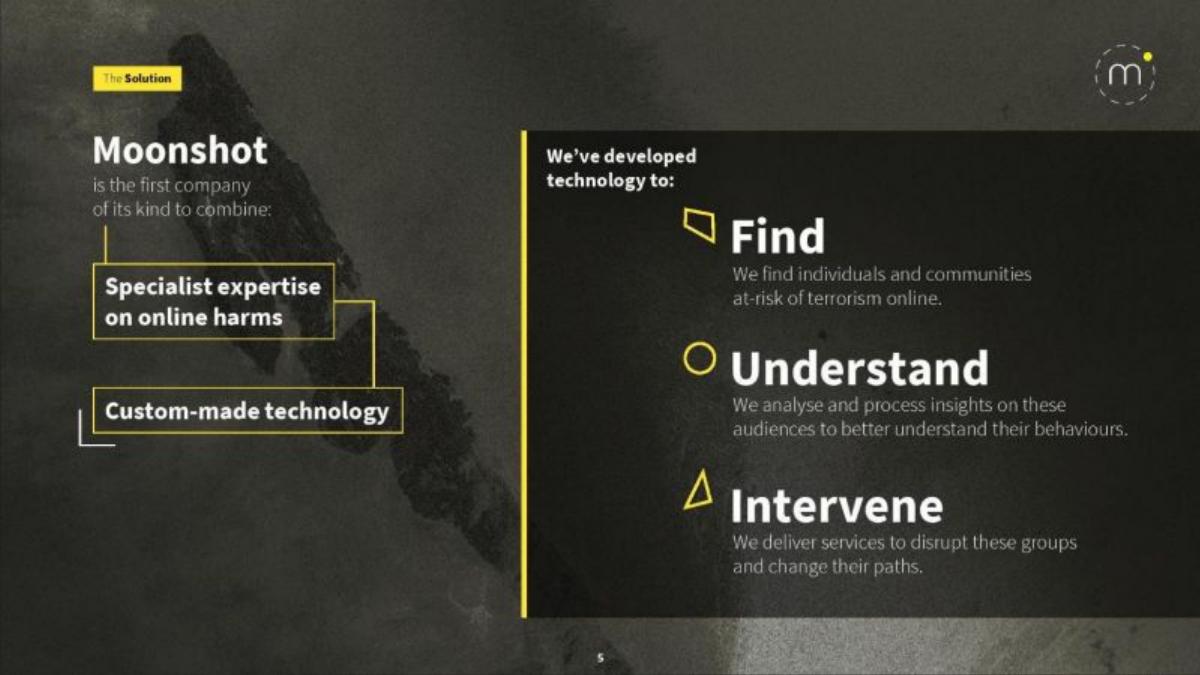
- The solution is a three-step process: Find individuals at risk, Understand their behaviors through data, and Intervene to disrupt groups (Slide 5).
- Founder Vidhya Ramalingam is presented as a global expert who has testified before the US Congress and advised the FBI (Slide 7).
- The business model is transitioning to a centralized data processing engine that outputs scalable licenses for data insights and visualization (Slide 9).
- The company has already secured a high-tier client base including the US Department of State, the UK Home Office, and the United Nations (Slide 10).
- Moonshot identifies three expansion markets: Organised crime, Disinformation, and Private security services (Slide 11).
- The accessible market for Private Security Services alone is estimated at £34.5Bn (Slide 13).
- Investment proceeds are earmarked for two specific goals: enhancing technology for the licensing model and accelerating market transition (Slide 14).
Executive Summary: The Specialist Tech Play
Moonshot’s Series A deck is a study in positioning. In a world where 'big data' often feels commoditized, Moonshot carves out a niche by focusing on 'online harms'—a sector where the stakes are life and death. The deck successfully argues that technology alone cannot solve problems like violent extremism; it requires a marriage of custom-made software and deep human expertise. By the end of the 16 slides, the investor is left with the impression of a company that has already 'cracked' the hardest market (counter-terrorism) and is now ready to apply that same engine to larger, more commercial verticals.
Slides 1-3: Defining a Global Crisis
Slide 1 is a minimalist title slide featuring the Moonshot logo over a dark, topographical map of the Earth. This sets a somber, global tone appropriate for a company dealing with international security.
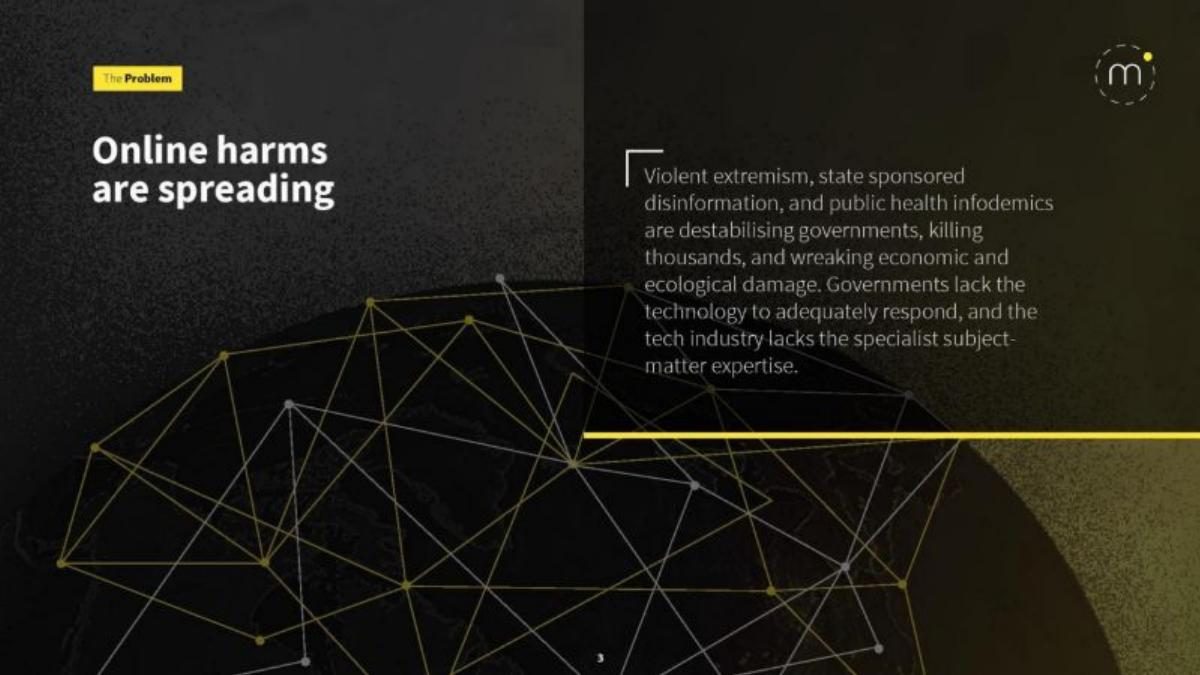
Slide 3 articulates the core thesis of the company. It states that 'Online harms are spreading,' specifically citing violent extremism, state-sponsored disinformation, and public health infodemics. The slide identifies a critical gap: 'Governments lack the technology to adequately respond, and the tech industry lacks the specialist subject-matter expertise.' This is a classic 'gap in the market' slide that justifies Moonshot’s existence as a bridge between two failing status quos.
Slides 4-5: The Three-Step Solution
Slide 5 introduces the Moonshot methodology. The company claims to be the first to combine 'Specialist expertise on online harms' with 'Custom-made technology.' They break their operational process into three pillars: Find (identifying individuals at risk), Understand (analyzing behaviors and processing insights), and Intervene (delivering services to disrupt groups). This framework moves the company from a passive 'monitoring' tool to an active 'intervention' platform, which is a significant value add for government clients.
Slides 6-7: Extreme Founder-Market Fit
Slide 7 is perhaps the strongest slide in the deck. It profiles Vidhya Ramalingam and Ross Frenett. The credentials listed are exceptional for a Series A startup. Ramalingam is described as a 'leading expert on terrorism' who has testified before the US Congress and was appointed by the EU Commissioner for Home Affairs. Frenett is credited with leading the creation of the 'world’s first global network of former terrorists' with Google financing. For an investor, these biographies de-risk the 'specialist expertise' claim made on Slide 3. This isn't a team of generalist developers; these are practitioners with deep institutional credibility.
Slides 8-9: The Transition to a Scalable Model
Slide 9 uses a sophisticated infographic to explain how Moonshot scales. On the left, 'Hidden data from the darkest corners of the internet' flows into a central circle labeled 'Centralized data processing and analysis.' From this center, multiple 'Licenses' flow out to the right, resulting in 'Data insights and visualization.' This slide is crucial because it signals a shift from a service-based consultancy (which is hard to scale) to a software-licensing model (which has high margins and venture-scale potential). It shows that the 'specialist expertise' has been codified into a repeatable technology product.
Slides 10-11: Traction and Expansion
Slide 10 , titled 'Success,' displays a 'diverse client base for our product line in Counter-Terrorism.' The logos are a 'who's who' of global power: Facebook, Google, Jigsaw, the UK Ministry of Defence, the US Department of State, the United Nations, and the Canadian government. This slide serves as the ultimate social proof. If these organizations trust Moonshot with their most sensitive counter-terrorism data, the technology is effectively pre-vetted for any other market.
Slide 11 looks at 'What’s next.' It identifies three new markets where Moonshot has 'proof of concept': Organised crime, Disinformation, and Private security services. This slide answers the 'Why now?' and 'How big can this get?' questions by showing that the counter-terrorism work was just the entry point.
Slides 12-13: The £55Bn+ Market Opportunity
Slide 13 quantifies the 'Accessible market.' Moonshot estimates the following opportunities: £34.5Bn for Private Security Services, £17.2Bn for Counter-Terrorism, and £3.7Bn for Organised Crime. They also list 'Disinformation' as an emerging market with an unknown but growing value. A key detail here is the phrase 'values driven company,' noting that they only target clients likely to meet their 'high ethical standards.' This is a strategic inclusion that protects the brand's reputation, which is its most valuable asset in the security space.
Slides 14-16: Use of Funds and Closing
Slide 14 outlines how the investment will be used. There are two primary buckets: 'Enhance technology to scale licensing model' and 'Accelerate transition to new markets.' This aligns perfectly with the shift shown on Slide 9. The goal is to move faster into the £34.5Bn private security market by automating more of the data processing.
Slide 16 is a standard promotional slide for bestpitchdeck.com and is not part of the original Moonshot presentation.
What Works in This Deck
Credibility-First Approach: In the 'impact' or 'security' tech space, trust is the primary currency. By leading with world-class founder bios and a client list of sovereign nations, Moonshot bypasses the need for traditional 'growth' charts. · Clear Productization: Slide 9 is the 'money slide.' It clearly illustrates how the company moves from bespoke human-led interventions to a scalable data-licensing engine. This is exactly what a Series A investor wants to see: a path to 80%+ gross margins. · The 'Values' Filter: By explicitly stating they are a values-driven company on the market slide, they preemptively answer concerns about the ethics of 'monitoring the dark corners of the internet.' They frame their ethics as a market filter, not a limitation.
What Is Missing
Financial Performance: There is a total absence of revenue data. While the client list is impressive, the deck doesn't disclose if these are $50k pilots or $5M annual recurring revenue (ARR) contracts. · The 'Ask': The deck does not state how much money they are raising. While common in 'leaked' or public versions of decks, a true pitch deck usually includes a specific round size and a high-level breakdown of how that capital provides 18-24 months of runway. · Competition: There is no competitive landscape slide. Moonshot implies they are 'the first of its kind' (Slide 5), but in reality, they compete with both traditional intelligence firms (Palantir) and newer AI-driven safety platforms.
What Other Founders Should Copy
The 'Problem' Framing: Use Slide 3 as a template. Don't just say the problem is 'big'; say the problem exists because of a specific mismatch between two existing industries (in this case, Tech vs. Subject Matter Expertise). · Visualizing the Engine: If you are a service-heavy company trying to raise venture capital, you must have a slide like Slide 9. You need to show investors the 'black box' that turns raw input into scalable, high-margin output. · Founder-Market Fit: If your team has unique, high-level credentials, don't bury them at the end. Moonshot puts their founders right after the solution because the founders are the reason the solution works.
Frequently asked questions
- What is Moonshot's core product?
- Moonshot's core product is a centralized data processing and analysis platform. According to slide 9, the platform ingests 'hidden data from the darkest corners of the internet' and processes it to provide data insights and visualizations. These insights are delivered via a licensing model to clients, allowing them to find, understand, and intervene in online harms such as terrorism and disinformation.
- Who are Moonshot's primary customers?
- Based on slide 10, Moonshot serves three main categories of high-stakes clients: major technology platforms (Facebook, Google, Jigsaw), national government agencies (UK Ministry of Defence, US Department of State, Public Safety Canada), and international organizations (United Nations, Global Coalition). This diverse base validates their 'values-driven' approach to sensitive data.
- How does Moonshot define its market opportunity?
- Moonshot breaks its market into four segments on slide 13: Private Security Services (£34.5Bn), Counter-Terrorism (£17.2Bn), Organised Crime (£3.7Bn), and Disinformation (marked as an emerging market with unknown but substantial potential). The company emphasizes that these estimates are based on a 'values-driven' filter, targeting only clients that meet their ethical standards.
- What makes the founding team unique?
- The team possesses extreme founder-market fit. Slide 7 highlights that Vidhya Ramalingam is a Fortune 'Most Powerful Women' honoree and an Obama Leader, while Ross Frenett led the creation of the first global network of former terrorists and was financed by Google. Their backgrounds bridge the gap between high-level policy/intelligence and digital innovation.
- What is missing from this pitch deck?
- The deck is missing several standard Series A components: there are no historical revenue charts, no unit economics (CAC/LTV), no detailed 5-year financial projections, and no specific 'Ask' slide detailing the amount of capital sought or the valuation. It functions more as a strategic narrative than a financial deep-dive.