Mootral's May 2019 introduction deck focuses on a specific climate tech niche: reducing methane emissions from the world's 1.5 billion cows. The company proposes a dual-value proposition: a natural feed supplement that reduces methane by 30% and a proprietary carbon credit program called 'CowCredits.' The deck leans heavily on scientific validation, citing over 20 studies and a high-profile advisory board including experts from UC Davis and the University of Ghent. While the deck excels at establishing the scale of the problem—equating global adoption to taking 1 billion cars off the road—it…
Key takeaways
- The solution targets a 30% reduction in methane, which is noted as being 28x more powerful than CO2 (Slide 11).
- Mootral claims that universal adoption across 1.5 billion cows would reduce global GHG emissions by 1.5 Gigaton CO2e per year (Slide 5).
- The business model relies on 'CowCredits,' where one cow fed Mootral Ruminant for one year equals one tradable carbon credit (Slide 7).
- Scientific credibility is established through partnerships with institutions like UC Davis, INRA, and Ghent University (Slide 9).
- The deck lacks a specific funding ask, financial projections, or a detailed go-to-market strategy beyond general 'business development' contacts (Slide 13).
- The product is positioned as '100% natural' and claims to provide yield benefits for farmers, though specific yield data is omitted (Slide 11).
- The deck uses a 2018 IPCC report to frame the urgency of keeping global warming below 1.5 degrees Celsius (Slide 3).
Mootral Pitch Deck Analysis
The Mootral deck from May 2019 is a mission-driven presentation that attempts to solve one of the most difficult problems in agriculture: enteric fermentation (cow burps). The deck is structured to move from a global climate crisis to a specific, scientifically-backed solution, eventually introducing a financial instrument to incentivize adoption. However, as a fundraising tool, it leaves significant questions regarding the business's operational viability and financial health.
Slide 1: Title and Branding
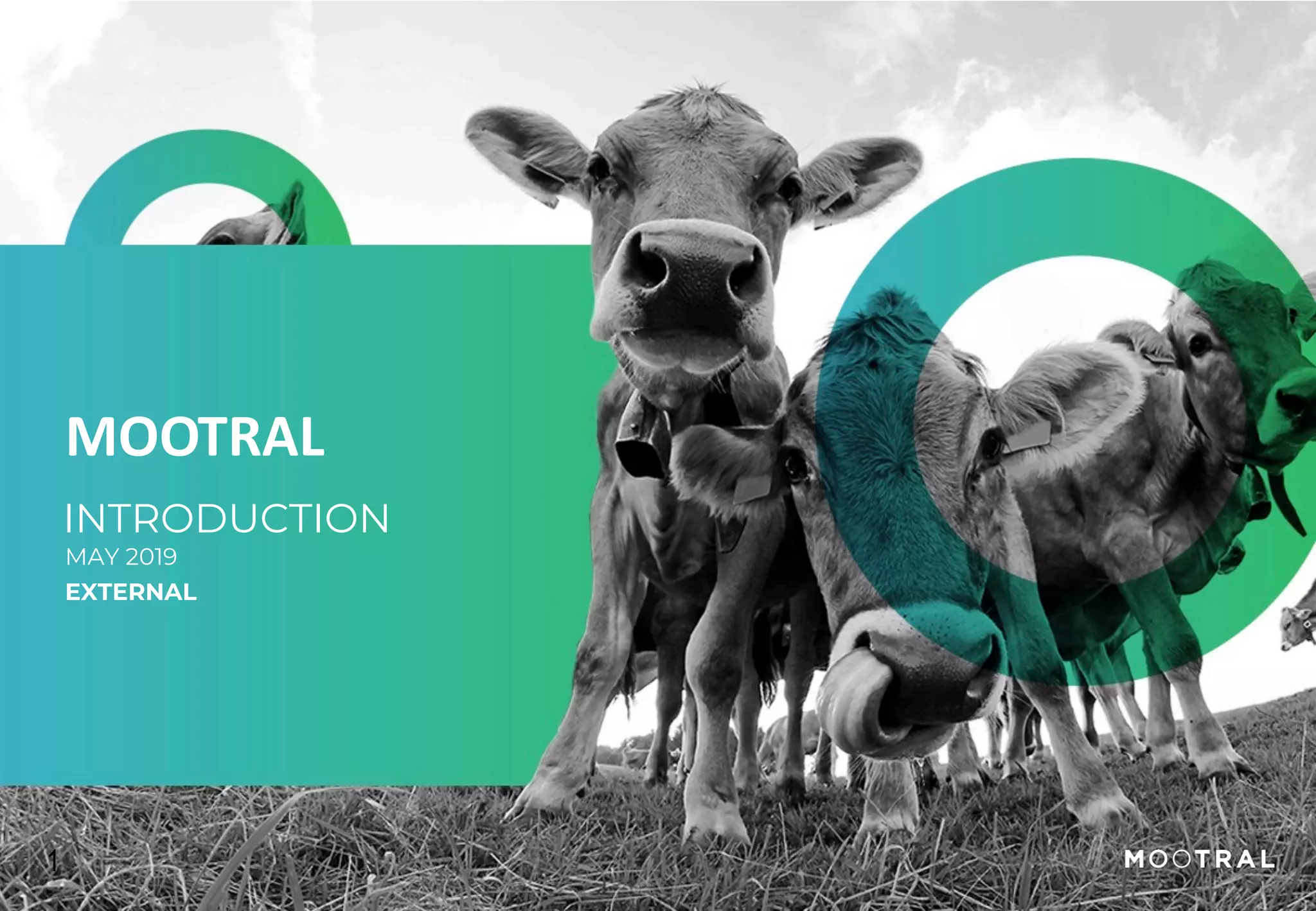
The cover slide establishes a clean, professional brand identity. It features high-contrast, black-and-white imagery of cows overlaid with teal and green circular motifs. The date "May 2019" and the label "External" suggest this was intended for public or semi-public distribution rather than a closed-door investor meeting. The branding is modern and avoids the typical 'dusty farm' aesthetic often seen in AgTech, signaling a high-tech approach to a traditional industry.
Slide 3: The Global Challenge
Mootral begins with the 'Why.' Citing the 2018 IPCC report, the slide sets a clear goal: keeping global warming below 1.5 degrees Celsius. By framing the company's mission within the context of 'irreversible impacts,' the founders are positioning Mootral not just as a feed company, but as a critical infrastructure player in the fight against climate change. This is a standard 'Problem' slide that uses high-authority sources to validate the urgency of the venture.
Slide 5: The Gigaton Solution
This slide translates the scientific problem into a relatable scale. It states that there are 1.5 billion cows on earth. If all were fed Mootral Ruminant, the result would be a reduction of 1.5 Gigatons of CO2e per year. To make this number tangible, the slide uses an infographic of cars, stating this is equivalent to taking 1 billion cars off the road. This is a powerful visualization of the Total Addressable Impact (TAI), which is often more important to ESG and Climate Tech investors than traditional TAM in the early stages.
Slide 7: The CowCredit Program
Slide 7 introduces the business model innovation. Mootral isn't just selling a supplement; they are creating a 'CowCredit.' The formula is simple: 1 Cow + 1 Year of Mootral = 1 CowCredit. By branding the carbon credit, Mootral attempts to create a proprietary asset class within the voluntary carbon market. This indicates that the company intends to generate revenue from two streams: the sale of the physical supplement and the brokerage or sale of the resulting carbon offsets. This 'double-dip' revenue model is a key highlight of the deck.
Slide 9: Scientific Validation
For any AgTech company, the 'Science' slide is where the deal is won or lost. Mootral performs well here, listing 14 research partners including heavyweights like UC Davis and the French National Institute for Agricultural Research (INRA). The claim of 'more than 20 studies over the past ten years' suggests a deep moat of R&D. The inclusion of direct quotes from their Scientific Advisory Board—specifically Prof. Gerhard Breves and Prof. Ermias Kebreab—provides social proof that the product's methane reduction claims are verifiable and 'significant.'
Slide 11: The 5 Key Advantages
This slide summarizes the value proposition. The most important figure here is the 30% reduction in methane. It also mentions that the product is '100% natural' and provides 'yield benefits for farmers.' The latter is a crucial point that is unfortunately not expanded upon. In agriculture, supplements that only provide environmental benefits are hard to sell; supplements that increase milk or meat yield while being green are 'must-haves.' The deck would have been stronger if it quantified these yield benefits.
Slide 13: Contact and Call to Action
The final slide is a standard contact page. It lists three individuals under 'Business Development.' Notably, it does not list a CEO or Founder, nor does it provide a specific 'Ask.' There is no mention of the round size, the valuation, or how the funds will be used. This suggests the deck was used more for partnership building or as a general introduction rather than a targeted Series A or B pitch.
What Mootral Does Well
The deck is exceptionally strong at framing the scale of the opportunity . By comparing cow emissions to car emissions, they immediately make the problem understandable to a non-specialist investor. The scientific backing is also top-tier; listing specific professors and their institutions adds a layer of credibility that is often missing from early-stage AgTech pitches. Finally, the CowCredit branding is a clever marketing move that turns a commodity (a feed additive) into a high-value financial product.
What is Missing from the Deck
While the 'What' and 'Why' are clear, the 'How' is largely absent. There are four major omissions that an investor would immediately flag:
Unit Economics: How much does it cost to produce enough supplement for one cow for a year? If the cost of the supplement exceeds the value of the CowCredit and the yield increase, the business is not viable. · The Team Slide: While the Scientific Advisory Board is impressive, there is no information on the management team. Investors back people, and the lack of bios for the CEO, COO, or CFO is a significant gap. · Competitive Landscape: Mootral is not the only company working on methane reduction (e.g., seaweed-based solutions). The deck fails to explain why their 'natural ruminant' is superior to competitors. · The Ask: A pitch deck without a funding request is just a brochure. The absence of a clear financial goal makes it difficult to evaluate the company's trajectory.
Lessons for Founders
Founders can learn two distinct lessons from the Mootral deck. First, tangible analogies work . If you are working in a complex field like GHG equivalents, find a way to compare your impact to something everyone understands, like cars on the road. Second, leverage third-party authority . If you have 20 studies, don't just say you have them—list the logos of the universities that conducted them. It builds an immediate 'moat of credibility.'
However, founders should avoid the mistake of being too 'academic.' A pitch deck must eventually transition from a science project to a business. You must show how you will scale manufacturing, how you will reach the 1.5 billion cows, and exactly how much capital you need to get there. Without those details, you are pitching a mission, not a company.
Frequently asked questions
- What is a CowCredit and how is it generated?
- According to slide 7, a CowCredit is a branded carbon credit. It is generated when one cow is registered in the CowCredit Program and fed the Mootral Ruminant supplement for one year. The deck states these credits are intended to be tradable on voluntary carbon emission markets, effectively monetizing the methane reduction achieved by the supplement.
- How effective is the Mootral Ruminant supplement?
- Slide 11 claims a 30% reduction in methane emissions. The deck emphasizes that methane is a highly potent greenhouse gas, 28 times more powerful than CO2 over a 100-year horizon. This reduction is supported by testimonials from the Scientific Advisory Board, including Prof. Gerhard Breves, who cites a 'clear dosage-related methane reduction.'
- What scientific evidence does Mootral provide?
- Slide 9 states that the research encompasses more than 20 studies conducted over the past ten years. The company lists 14 research partners, including government bodies like the UK's Defra and academic institutions like Texas A&M and UC Davis. The deck also features a four-member Scientific Advisory Board consisting of professors from the UK, Germany, Belgium, and the USA.
- What is the total addressable market mentioned in the deck?
- While the deck does not provide a dollar value for the market, slide 5 identifies the total population of cows on earth as 1.5 billion. It frames the market opportunity in terms of environmental impact, stating that treating all these cows would be equivalent to taking more than 1 billion cars off the road.
- What information is missing from this pitch deck?
- The deck is missing several critical components for a standard investment round: a clear 'Ask' (how much money they are raising), financial projections, unit economics (cost to produce vs. price of the supplement), a competitive analysis, and a detailed management team slide. It functions primarily as a conceptual and scientific validation document.