iPoS Print Pvt Ltd focuses on the hardware layer of the retail technology stack, specifically targeting the transition from expensive, monolithic legacy POS systems to modular, tablet-based alternatives. The deck outlines a product line featuring integrated thermal printers (2-inch and 3-inch models) and various peripheral configurations including NFC readers and pole displays. While the company demonstrates early sales traction through partnerships with ERP providers like Effiasoft and Cozy Infosystems, the deck is heavily weighted toward technical specifications and hardware configurations.…
Key takeaways
- The company identifies high maintenance costs and limited software capabilities of monolithic POS designs as a primary market pain point on slide 2.
- Product differentiation relies on integrated thermal printers (Seiko brand for 3-inch models) and support for tablets ranging from 7 to 10 inches as shown on slide 3.
- Slide 5 details a complex 'Solution #6' configuration involving eight distinct components, including MSR and NFC readers, indicating a focus on high-end retail needs.
- Early market validation is evidenced by the sale of 30 total units to two Hyderabad-based partners, Effiasoft and Cozy Infosystems, as listed on slide 7.
- The company plans to move up the stack by integrating with ePaisa for EMV-based payment services and proprietary POS software, according to slide 6.
- A long-term strategic goal includes establishing an assembly unit in India to optimize the supply chain, as noted in the vision roadmap on slide 8.
- The deck completely omits a team slide, financial projections, and a specific investment 'ask,' despite listing 'Team' in the table of contents on slide 1.
- There is a stated need for external assistance in outsourcing after-sales service and sourcing custom tablet hardware on slide 8.
Executive Summary: The Hardware-First Approach to Retail Tech
iPoS Print Pvt Ltd operates in the competitive landscape of retail hardware, specifically targeting the modernization of Point of Sale (POS) terminals. The deck positions the company as a bridge between legacy, monolithic cash registers and the modern era of tablet-based commerce. By focusing on the physical integration of printers, scanners, and tablets, iPoS Print attempts to solve the 'clutter' and maintenance issues associated with traditional systems. However, the presentation is primarily a product catalog rather than a comprehensive investment case, lacking the financial rigor usually required for venture capital or professional angel investment.
Slide 1: Title and Table of Contents
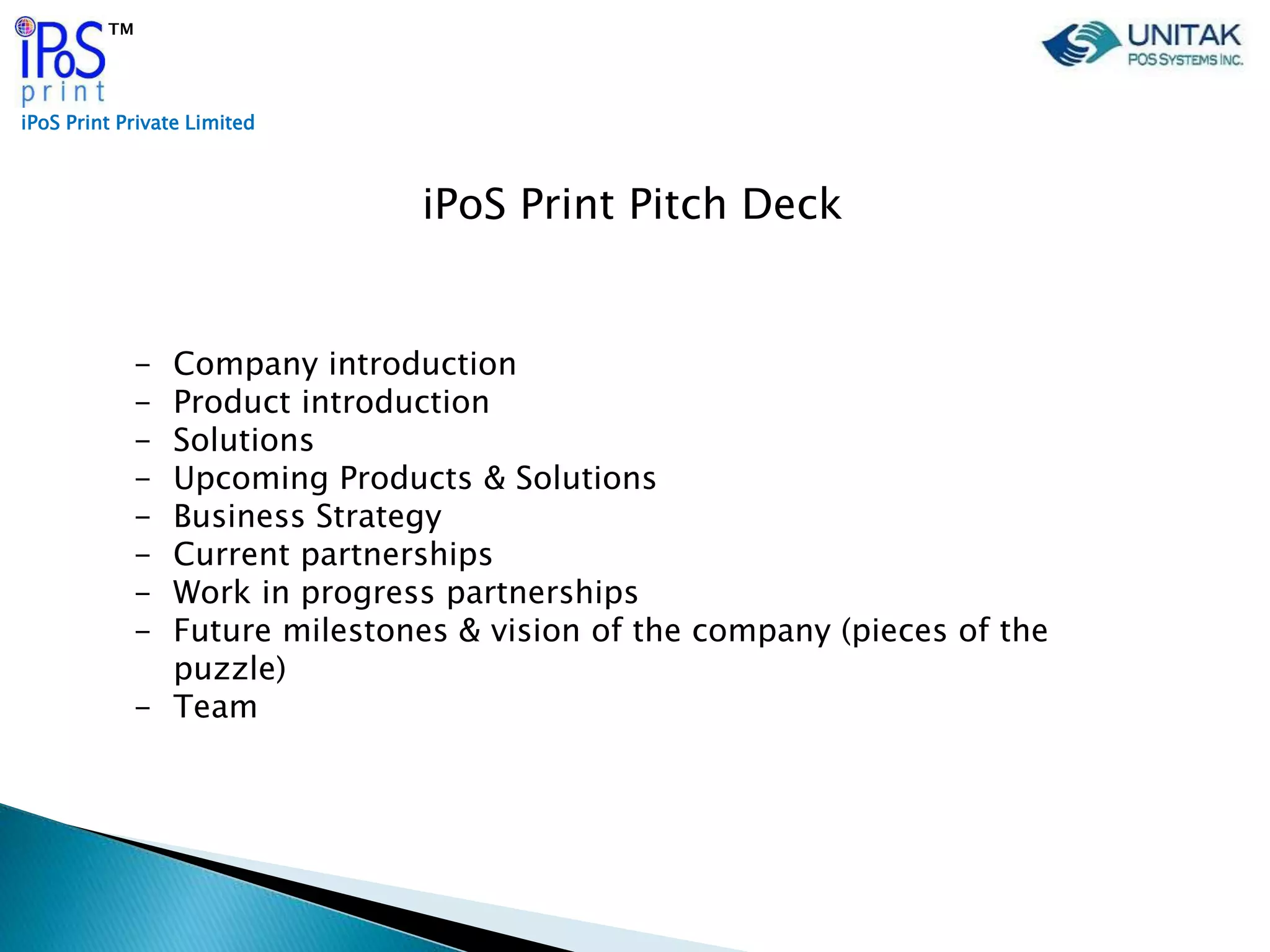
The cover slide introduces iPoS Print Private Limited alongside a logo for 'UNITAK POS SYSTEMS INC.' The table of contents lists nine sections: Company introduction, Product introduction, Solutions, Upcoming Products & Solutions, Business Strategy, Current partnerships, Work in progress partnerships, Future milestones & vision, and Team. It is worth noting that several of these sections, most notably the 'Team' slide, are missing from the provided materials, which immediately creates a gap in the narrative regarding founder expertise.
Slide 2: Identifying the Legacy Problem
Slide 2 serves as a rudimentary 'Problem' slide. It displays images of traditional, bulky POS terminals. The text identifies the 'next iteration' as Micro and Mini POS systems. The company lists the 'Pros' of current systems as being 'Easy to use' and 'All in one,' but counters these with significant 'Cons': monolithic design, limited software capabilities, and expensive maintenance. This sets the stage for a modular solution, though it lacks data on exactly how much more expensive legacy maintenance is compared to the proposed alternative.
Slide 3: Modular Hardware Specifications
This slide introduces the core hardware. The company offers two main variants: a system with an in-built 2-inch thermal printer and a system with an in-built 3-inch Seiko thermal printer with an auto-cutter. The hardware is designed to hold tablets ranging from 7 to 10 inches. Technical features highlighted include Bluetooth connectivity, battery options for portability, and multiple ports for peripheral expansion. The emphasis here is on flexibility, allowing the merchant to choose their own tablet and connectivity method.
Slide 4: Solution #3 – The Entry-Level Configuration
Slide 4 illustrates a specific use case titled 'Solution #3,' aimed at stores with barcoded products. The configuration includes a tablet with POS billing software, a PT 2200B battery-powered model, and a wireless barcode scanner connected via Bluetooth. The slide notes that this setup allows for cash transactions without a traditional cash drawer and can function as a standalone unit or connect to a back office. This highlights the company's focus on mobility and space-saving for smaller retail environments.
Slide 5: Solution #6 – The Full-Scale Retail Setup
In contrast to the previous slide, 'Solution #6' represents a high-complexity environment. The components list grows to eight items: the PT 2200 base, an Android tablet, POS software, a USB barcode scanner, a cash drawer, a pole display, a Magnetic Stripe Reader (MSR), and an NFC reader. This slide demonstrates the hardware's ability to act as a hub for a wide array of peripherals, catering to larger retailers who require customer-facing displays and diverse payment acceptance methods.
Slide 6: Upcoming Solutions and Software Integration
Slide 6 signals a shift in strategy from pure hardware to integrated solutions. It mentions an upcoming 'All-in-one POS solution #2' that includes proprietary POS software and integration with ePaisa for EMV-based payments. By partnering with ePaisa, iPoS Print moves closer to the transaction layer of the business. The slide lists components including a wireless card reader and wireless barcode scanner, suggesting a move toward a fully wireless ecosystem for restaurants and retail stores.
Slide 7: Current Partnerships and Traction
This is the most critical slide for validating market demand. The company lists two 'Full fledged' partnerships in Hyderabad. Effiasoft Private Limited is noted as having purchased 20 pieces, while Cozy Infosystems Pvt Ltd has purchased 10 pieces. Both partners are described as POS Software and ERP companies. While the volume is low (30 units total), it demonstrates that software providers see value in bundling iPoS Print hardware with their digital offerings. The 'Comments' column indicates they are 'actively pursuing other business ventures' with these partners.
Slide 8: Future Milestones and Strategic Vision
The vision slide uses a chevron process graphic to outline six stages: Marketing & Promotion, After Sales Service, Own Tablet, Own Software, New Products, and Assembly unit in India. The text below clarifies that they view marketing as essential for capturing a 'niche industry.' Interestingly, the company admits to needing 'assistance with finding the right party to outsource our after sales service' and finding partners to develop a proprietary tablet PC. This transparency regarding their operational gaps is unusual for a pitch deck and suggests they are looking for strategic partners as much as financial investors.
Slide 9: Conclusion
The final slide is a simple 'Thank You' note on a yellow sticky-pad graphic. It contains no contact information, website links, or a call to action, which is a missed opportunity to direct interested investors to the next step of the process.
What Works in This Deck
Clear Product Visuals: The use of high-quality renders and photos of the hardware in various configurations (Slides 3, 4, and 5) makes it very clear what the company is selling. · Specific Use Cases: By breaking down 'Solution #3' vs. 'Solution #6,' the founders demonstrate an understanding of different retail tiers, from small kiosks to full-scale grocery lanes. · Early Traction: Listing specific partners and the exact number of units sold (Slide 7) provides a baseline of credibility that the product is functional and market-ready. · Hardware Flexibility: The emphasis on supporting various tablet sizes (7-10 inches) and multiple connection protocols (Bluetooth, USB, RS232) highlights a competitive advantage in a market often locked into proprietary ecosystems.
What is Missing from This Deck
The Team Slide: Despite being listed in the table of contents, there is no information on the founders, their backgrounds, or their technical expertise. In early-stage hardware, the team's ability to manage supply chains is paramount. · Financials and Unit Economics: There is no mention of the Cost of Goods Sold (COGS), retail pricing, or margins. Investors cannot evaluate the business without knowing if the hardware is sold at a profit or as a loss-leader for software. · Market Sizing (TAM/SAM/SOM): The deck mentions a 'niche industry' but does not quantify the number of retail outlets in India or the broader region that need to upgrade their POS systems. · The Ask: The deck does not state how much money is being raised, the valuation, or the specific milestones that the funding will enable. · Competitive Analysis: There is no mention of competitors like Square, Pine Labs, or other local hardware manufacturers, leaving the company's market positioning unclear.
Founder's Guide: What to Copy and What to Avoid
Copy the modular solution breakdown: If you are selling a complex hardware product, using slides like 4 and 5 to show 'Good/Better/Best' configurations is an excellent way to help investors visualize the product's versatility. It turns an abstract piece of hardware into a concrete business solution.
Avoid the 'Missing Slide' trap: Never include a table of contents that lists slides you haven't included. It suggests a lack of attention to detail. If a section like 'Team' is not ready, remove it from the index. In this case, the omission of the team is a significant red flag for investors who bet on people first.
Avoid the 'Outsourcing' admission without a plan: While honesty is good, stating on slide 8 that you 'need assistance finding the right party' for core functions like after-sales service can make the company look unprepared. Instead, frame this as a 'Key Hire' or a 'Strategic Partnership Goal' that the funding will help secure.
Include a clear Call to Action: The 'Thank You' slide should always include a name, email address, and phone number. A pitch deck is a lead-generation tool; failing to provide contact info is a fundamental error.
Final Analyst Thoughts
iPoS Print Pvt Ltd has a tangible product and early distribution traction, which puts them ahead of many 'idea-stage' startups. However, the deck functions more as a sales brochure for potential distributors than a fundraising document for investors. To be successful in a capital raise, the company needs to bridge the gap between 'here is what we built' and 'here is how this becomes a massive, profitable business.' The transition toward proprietary software and local assembly is the right strategic move to protect margins, but the deck needs a complete financial and leadership overhaul to be investment-ready.
Frequently asked questions
- What is the core product offering of iPoS Print?
- iPoS Print offers modular Point of Sale hardware stands that integrate thermal printers (2-inch or 3-inch Seiko models) with consumer tablets. These systems are designed to be more flexible and less expensive to maintain than traditional 'all-in-one' monolithic POS terminals. The hardware supports various connectivity options including Bluetooth and multiple USB/RS232 ports for peripherals.
- Who are the company's current partners and customers?
- According to slide 7, the company has 'full-fledged' partnerships with two Hyderabad-based firms: Effiasoft Private Limited and Cozy Infosystems Pvt Ltd. Both partners are POS software and ERP providers. At the time of the deck's creation, iPoS Print had sold 20 pieces to Effiasoft and 10 pieces to Cozy Infosystems.
- What is the company's strategy for software integration?
- While currently a hardware-focused provider, slide 6 and slide 8 indicate a transition toward software. The company highlights an upcoming 'All-in-one' solution featuring its own POS software and integration with ePaisa for EMV-based payments. The long-term vision includes developing 'Own Software' to provide a complete end-to-end solution for stores and restaurants.
- What are the main weaknesses of the iPoS Print pitch deck?
- The deck suffers from significant information gaps. It lacks a team slide (despite listing one in the index), has no financial data or unit economics, and does not define the Total Addressable Market (TAM). Most importantly, there is no 'Ask' slide detailing how much capital is being raised or how it will be deployed.
- What does the company's future roadmap look like?
- The roadmap on slide 8 follows a progression from marketing and promotion to establishing after-sales service, developing proprietary tablets and software, and eventually launching an assembly unit in India. This suggests a goal of vertical integration to reduce reliance on third-party hardware components and increase profit margins.