Amify’s 14-slide deck is a masterclass in demonstrating traction and strategic evolution. Founded in 2011 and bootstrapped to over $25 million in revenue by 2017, the company used this deck to raise $5.8 million in Series A funding. The narrative centers on a pivot: moving from a traditional 'retailer' model to an 'Amazon Brand Partner' model, which is more scalable and inventory-light. The deck highlights a massive market opportunity—Amazon's $330 billion platform—and Amify's ability to provide services at half the cost of in-house teams. While the visual design is utilitarian, the financial…
Key takeaways
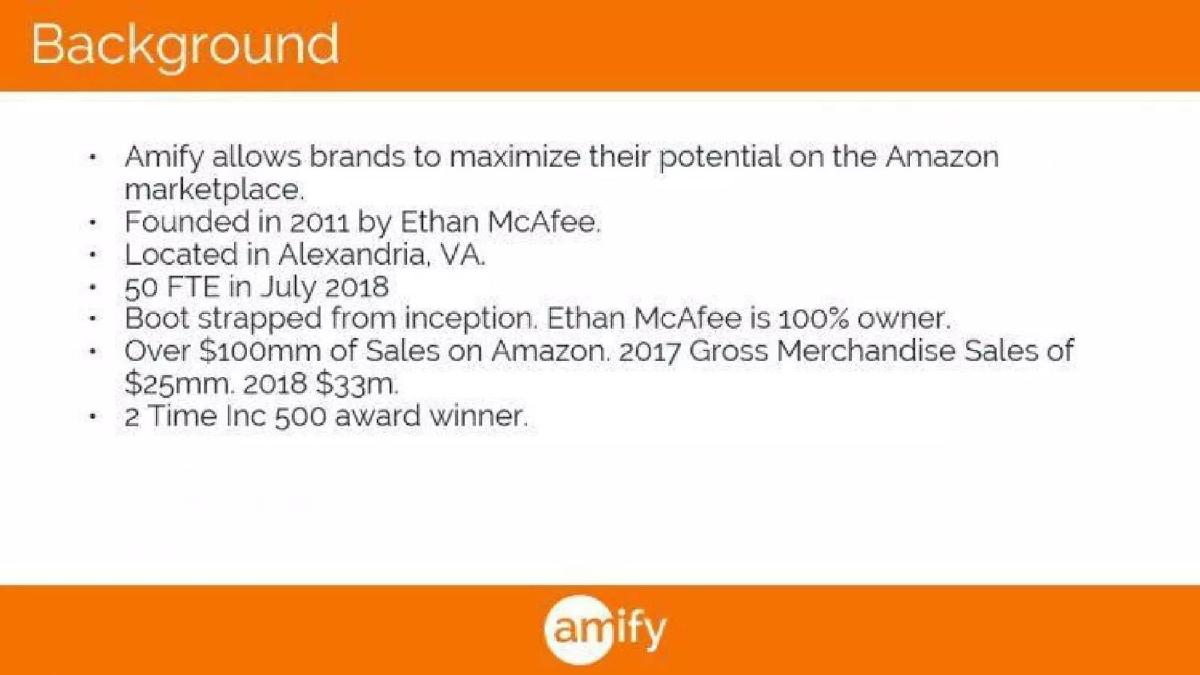
- The company was entirely bootstrapped from 2011 until this raise, reaching $25 million in Gross Merchandise Sales in 2017 (Slide 2).
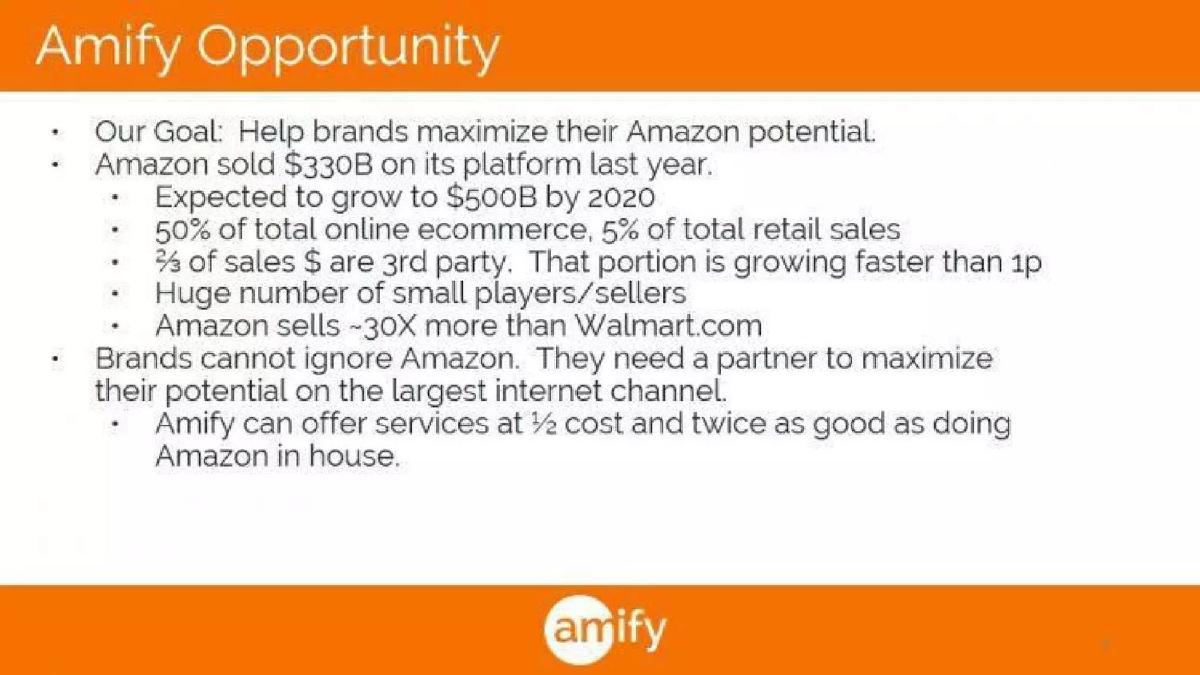
- Amify claims to offer services at 1/2 the cost and twice the quality of brands managing Amazon in-house (Slide 3).
- The business model shifted from a traditional retailer to an 'Amazon Partner,' which grew from 5% to 60% of total revenue in just two years (Slide 8).
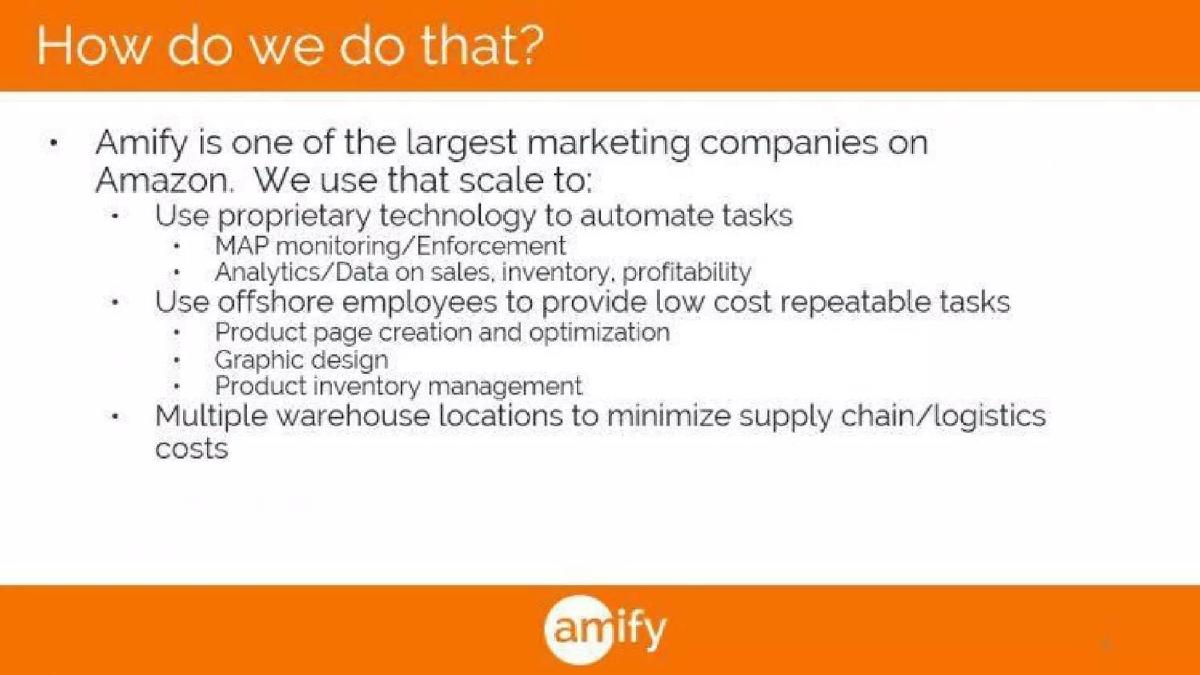
- Amify utilizes offshore employees for repeatable tasks like graphic design and product page creation to maintain low costs (Slide 5).
- The deck identifies a 'share of wallet' opportunity, noting that while they sold $25 million of product for partners, those brands sold $200 million total on Amazon (Slide 12).
- Strategic discipline is shown by the decision to cut off over 80% of non-strategic accounts to focus on long-term growth (Slide 11).
- The funding ask was specifically for building an 'A+ Management Team,' including a Head of Marketing, CFO, and CTO (Slide 14).
- Revenue growth was significant even in the early phases, jumping from $300k in 2011 to $1.2 million in 2012 with only one employee (Slide 9).
Executive Summary: The Transition from Reseller to Platform Powerhouse
Amify’s pitch deck is a document of evolution. It tells the story of a company that spent six years in the trenches of Amazon reselling before realizing that their true value lay in the data, technology, and processes they built to survive that competitive landscape. By the time they sought this $5.8 million Series A, they were already a $25 million revenue business. This teardown examines how they presented their transition from a high-volume retailer to a high-margin strategic partner.
Slides 1-2: The Foundation of a Bootstrapped Success
The deck opens with a minimalist title slide, followed immediately by a 'Background' slide that serves as a massive credibility builder. Slide 2 establishes that Amify was founded in 2011 by Ethan McAfee, who remained the 100% owner at the time of the deck. This is a powerful signal to investors: the founder has successfully navigated the market for seven years without outside capital. The slide lists 50 FTEs as of July 2018 and highlights a 2017 Gross Merchandise Sales (GMS) figure of $25 million, with a 2018 projection of $33 million. By stating they have seen over $100 million of total sales on Amazon, they position themselves as veterans of the ecosystem rather than experimental newcomers.
Slides 3-5: The Amazon Opportunity and the Amify Solution
Slide 3, 'Amify Opportunity,' frames the macro environment. It cites Amazon’s $330 billion platform spend and its 30x lead over Walmart.com. The key insight here is that 2/3 of sales are 3rd party, a segment growing faster than Amazon’s own first-party sales. Amify positions itself as the essential partner for brands that 'cannot ignore Amazon.' Crucially, they claim to offer services at '1/2 cost and twice as good' as in-house efforts.
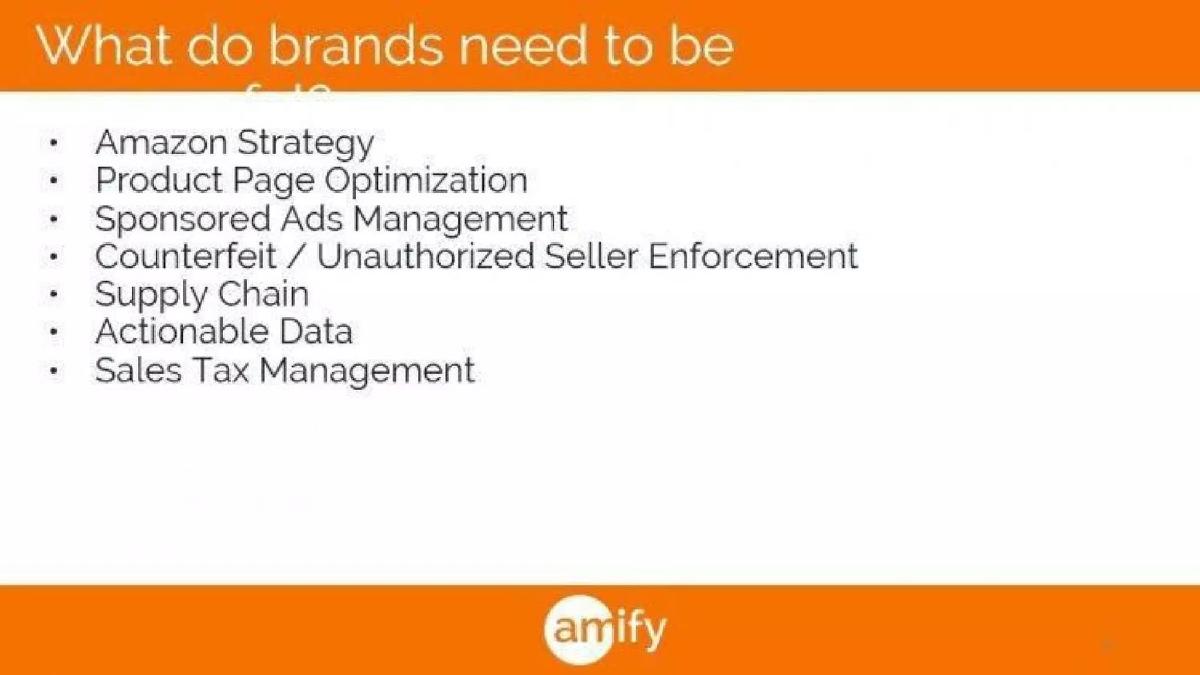
Slide 4 and 5 detail the 'What' and 'How.' The services listed on Slide 4—Strategy, Optimization, Ads, Enforcement, Supply Chain, Data, and Tax—cover the entire lifecycle of an e-commerce brand. Slide 5 explains their operational leverage: proprietary technology for automation and offshore employees for 'low cost repeatable tasks' like graphic design and inventory management. This combination of tech and global labor is a classic margin-expansion play for service businesses.
Slides 6-8: Visual Proof and Business Model Pivot
Slide 6 provides a 'Product Listings Example' using Benchmade knives. It shows a 'Current' vs. 'Proposed' layout, demonstrating how Amify improves imagery and brand storytelling. This visual evidence is vital for investors to understand the tangible output of the agency's work.
Slide 7 and 8 are the most important slides for a Series A investor. Slide 7 outlines three business models: Outsourced (revenue share), Semi/Exclusive Retailer (exclusive selling rights), and Vendor Central Management (percentage of revenue). This variety shows they can capture value regardless of how a brand prefers to structure its Amazon relationship. Slide 8 provides the 'Gross merchandise sales by model' chart. It shows a dramatic shift: the 'Amazon Partner' revenue (orange) grew from 5% to 60% of total revenue in just two years, while the 'Traditional Retailer' model (blue) is being intentionally phased out. This proves the company is successfully moving toward a more scalable, service-oriented revenue stream.
Slides 9-11: The Three Phases of History
These slides provide a chronological deep dive. Phase 1 (2011-2013) was about proving the model, reaching $1.2 million in revenue with just the founder. Phase 2 (2013-2016) saw the company grow to 23 employees and $25 million in revenue by using data to identify profitable products to resell. Phase 3 (2017+) marks the 'Amify' era, where they transitioned to a 'brand partner' and made the difficult strategic choice to 'cut off 80%+ accounts that are non strategic.' This willingness to fire customers to focus on a long-term vision is a trait often sought by venture capitalists.
Slides 12-14: The Growth Engine and The Ask
Slide 12, 'Upselling Gameplay,' is a masterclass in account expansion strategy. It notes that Amify only has 12.5% of the 'wallet' of their 300 current partners. They outline a three-step ladder to move from a simple monitoring service to 100% exclusivity. This provides a clear roadmap for how the company can grow revenue without even acquiring new customers.
Slide 13 and 14 conclude with the rationale for the raise. Slide 13, 'Why raise money now?', is honest: they are missing out on opportunities due to a lack of resources and need an 'A+ management team' to reach $100 million+. Slide 14 specifies the ask: ~$3-5 million (though the catalogue facts state they eventually raised $5.8 million). The funds are earmarked for hiring a Head of Marketing, CFO, and CTO, and doubling the size of the Business Development and Account Management teams. It is a very specific, execution-oriented use of funds.
What Works in This Deck
Proven Traction: The deck doesn't lead with 'vision'; it leads with $25 million in revenue and a seven-year track record of profitability. · Strategic Pivot: The clear distinction between the old 'Retailer' model and the new 'Partner' model shows a company that understands where the real value lies in its industry. · Operational Clarity: Explaining the use of offshore labor and proprietary tech (Slide 5) answers the 'how do you scale services?' question that plagues most agency pitches. · The Upsell Ladder: Slide 12 is exceptional. It shows investors that the company has a repeatable process for increasing customer lifetime value.
What Is Missing
Unit Economics: While they mention revenue and GMS, the deck lacks specific data on Customer Acquisition Cost (CAC) or Lifetime Value (LTV) in dollar terms. · Competitive Landscape: There is no slide addressing other Amazon agencies or aggregators. Investors would want to know how Amify stays ahead of the thousands of other consultants in the space. · Technology Deep Dive: They mention 'proprietary technology' several times but never show a screenshot or explain what the tech actually does beyond 'automation.' · Retention Metrics: For a service-based business, churn rate is a critical metric that is absent from this deck.
What a Founder Should Copy
The 'Phases' Narrative: Grouping your company’s history into distinct phases (Slides 9-11) helps investors understand your evolution and why the current moment is an inflection point. · The 'Share of Wallet' Argument: If you are in a service or marketplace business, showing how much of your existing customers' total spend you don't yet have is a powerful way to demonstrate growth potential without needing to find new leads. · Specific Hiring Plan: Don't just say 'we will hire.' List the specific roles (CFO, CTO, etc.) and the exact headcount increases for each department as Amify did on Slide 14. This shows you have a concrete plan for the capital. · Honesty About Bootstrapping: If you have built a business to significant revenue without funding, make that your primary headline. It proves you know how to manage cash and build a real product people pay for.
Frequently asked questions
- What is Amify's core value proposition to brands?
- Amify positions itself as a full-service partner that helps brands maximize their potential on Amazon. According to Slide 3 and 4, they handle everything from Amazon strategy and product page optimization to sponsored ads management, supply chain logistics, and counterfeit enforcement. Their primary hook is efficiency: they claim to perform these tasks at half the cost of an in-house team while delivering superior results through proprietary automation and specialized expertise.
- How does Amify make money?
- The company employs three distinct business models as detailed on Slide 7. First is the 'Outsourced Model,' where they run a brand's Amazon presence for a percentage of revenue. Second is the 'Semi/Exclusive Retailer' model, where they provide services for 'free' in exchange for being the exclusive seller. Third is 'Vendor Central Account Management,' where they manage the brand's direct relationship with Amazon for a percentage of revenue. This flexibility allows them to work with brands at various stages of Amazon maturity.
- What does the 'Upselling Gameplay' slide reveal about their strategy?
- Slide 12 is a critical strategic component. It shows that Amify uses low-barrier services, like MAP (Minimum Advertised Price) monitoring, as a 'foot in the door' to start conversations with the right stakeholders. Once a relationship is established, they upsell to enforcement services to increase their share of the brand's sales from ~12.5% to 25%, eventually aiming for 100% exclusivity by managing all page enhancements and advertising.
- Why did a profitable, bootstrapped company decide to raise venture capital?
- According to Slide 13, Amify reached a ceiling where lack of resources caused them to miss opportunities. They had proven the model to the tune of $25 million+ in revenue but needed an 'A+ management team' to scale to $100 million+. The raise was intended to transition from a founder-led operation to a corporate structure with dedicated C-suite executives and expanded business development and account management teams.
- What technical advantages does Amify claim to have?
- Slide 5 and Slide 10 highlight Amify's use of proprietary technology. In Phase 2 of their history (2013-2016), they built a database of all products on Amazon to identify the most profitable opportunities. Currently, they use technology to automate tasks like MAP monitoring and data analytics for inventory and profitability, which allows them to scale without a linear increase in domestic headcount.