AMPAworks raised $1.4 million in 2019 for their computer vision-based hospital inventory system. The deck is remarkably concise, consisting of only 11 slides that move rapidly from problem to solution to traction. It anchors the pitch on a staggering $30 billion waste figure in the U.S. hospital supply chain and validates the product with early revenue ($4,700 MRR) and high-profile logos like Cedars-Sinai and Dignity Health. While the deck lacks a formal 'Ask' slide and detailed unit economics, it compensates with a founding team that possesses deep domain expertise from institutions like Sta…
Key takeaways
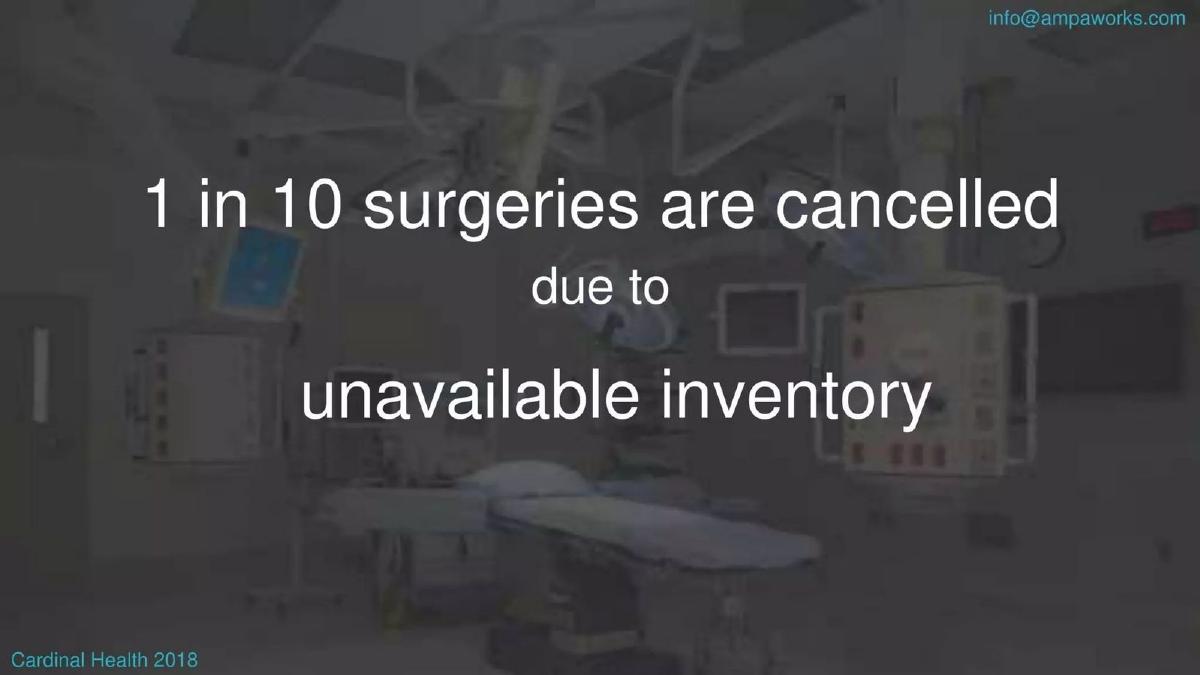
- The deck identifies a specific, high-stakes problem: 1 in 10 surgeries are cancelled due to unavailable inventory (Slide 4).
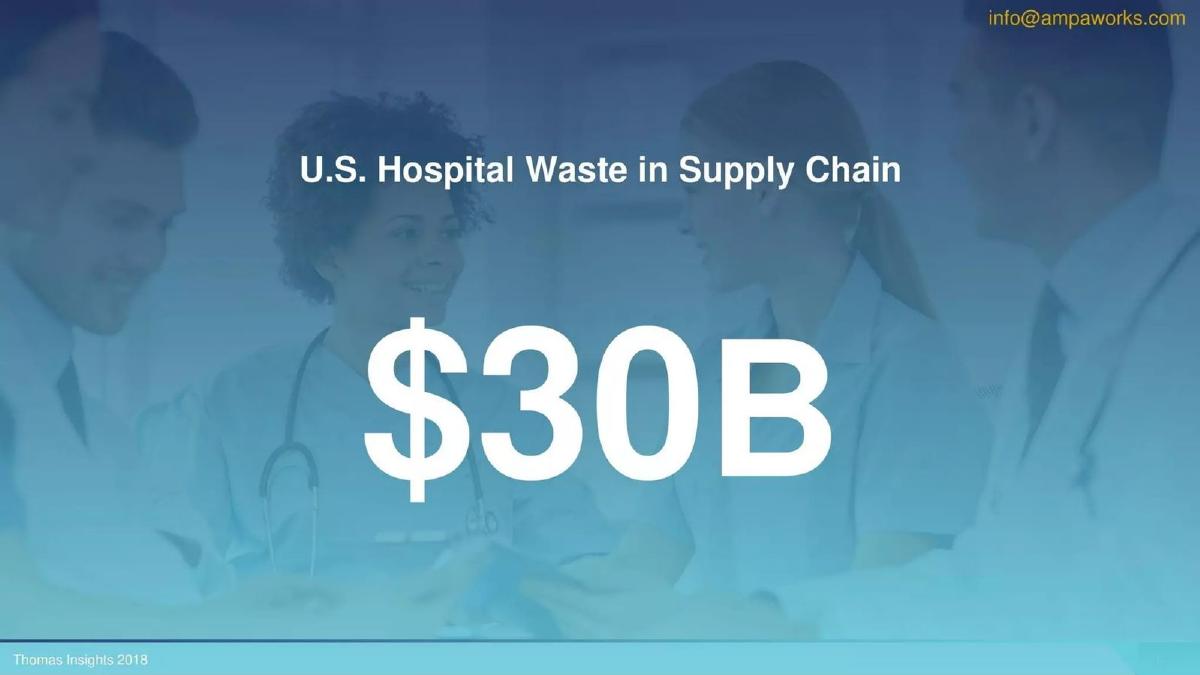
- It quantifies the total addressable pain point as $30 billion in U.S. hospital supply chain waste (Slide 6).
- The solution is presented as a three-pillar system: Smart shelf, Par level alerts, and Auto-Reordering (Slide 7).
- Traction is evidenced by $4,700 in Monthly Recurring Revenue (MRR) with 62% Month-over-Month growth (Slide 9).
- The company has secured pilot or customer relationships with major health systems including Cedars-Sinai and RWJBarnabas Health (Slide 9).
- The founding team features a strong mix of clinical and technical backgrounds from Stanford, Johns Hopkins, and Berkeley (Slide 10).
- The deck completely omits a financial 'Ask' slide, leaving the specific funding requirements and use of proceeds unstated.
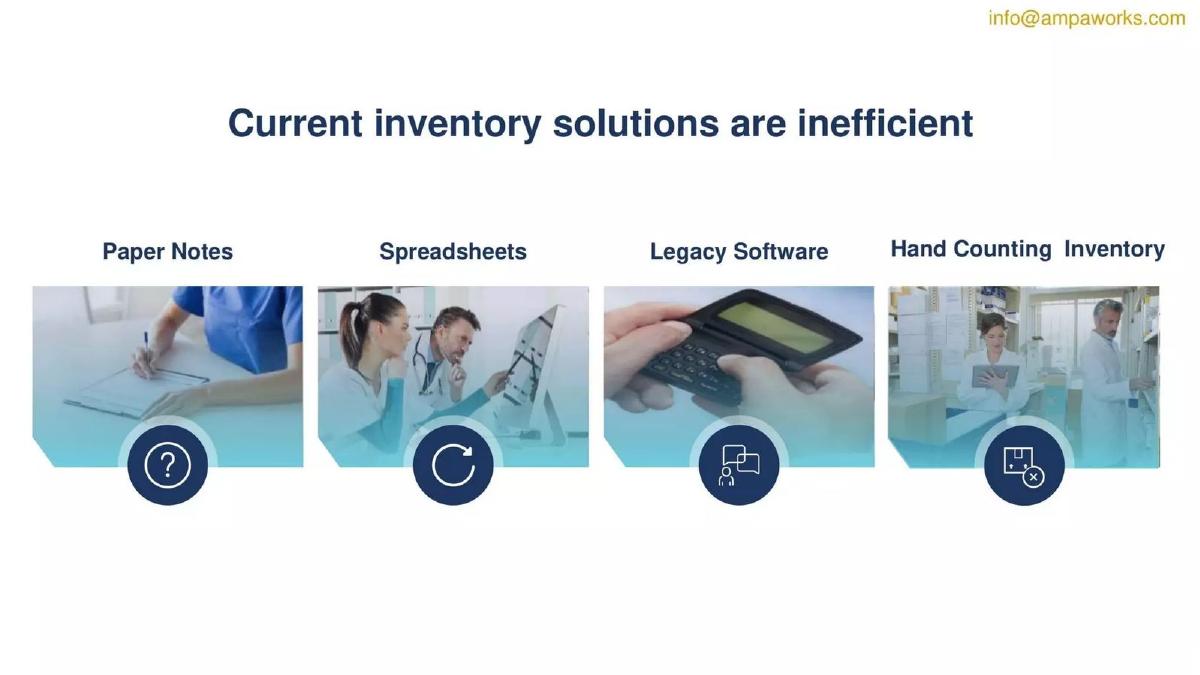
- There is no competitive landscape slide, which assumes the investor is already aware of the 'inefficient' status quo mentioned on Slide 5.
The Lean Approach to Medical IoT
The AMPAworks pitch deck is a study in brevity. At just 11 slides, it avoids the common pitfall of over-explaining the technical nuances of deep learning and computer vision, focusing instead on the operational nightmare of hospital inventory management. In a sector often bogged down by regulatory complexity and long sales cycles, AMPAworks uses this deck to signal that they have a working product, early revenue, and a team that understands the hospital environment from the inside out.
The Hook and the Problem (Slides 1-4)
Slide 1 introduces the company with the clear tagline: Image Recognition for Hospital Inventory . This immediately grounds the investor in the 'what' and the 'where'. Slide 2 is a wordless emotional hook, showing a frustrated medical professional, which leads directly into the core problem statement on Slide 3: Missing inventory delays care . This is a powerful framing because it moves the conversation from 'saving money' to 'saving lives' or at least improving patient outcomes.
Slide 4 provides the critical data point that validates the urgency of the problem. Citing Cardinal Health 2018, it states that 1 in 10 surgeries are cancelled due to unavailable inventory . For a hospital, a cancelled surgery is a massive loss of revenue and a significant risk to patient health. By starting here, AMPAworks ensures the investor understands that this is not a 'nice-to-have' efficiency tool, but a solution to a systemic failure in the operating room.
The Market Opportunity and Current Inefficiency (Slides 5-6)
Slide 5, titled Current inventory solutions are inefficient , uses four icons to represent the status quo: Paper Notes, Spreadsheets, Legacy Software, and Hand Counting Inventory. This slide serves as the 'competitor' slide without naming specific companies, instead attacking the manual processes that dominate the industry. It sets the stage for an automated, high-tech replacement.
Slide 6 delivers the 'Big Number'. It highlights $30B as the U.S. Hospital Waste in Supply Chain, citing Thomas Insights 2018. In seed-stage pitching, investors look for a massive Total Addressable Market (TAM) or a massive problem to solve. A $30 billion waste problem suggests that even a small penetration by AMPAworks could result in a very large business.
The Solution and Product Interface (Slides 7-8)
Slide 7 introduces the AMPAworks Inventory System . It shows a monitor displaying a refrigerator shelf where vaccine boxes are identified by green, red, and yellow bounding boxes—a classic visualization of computer vision at work. The slide lists three core features: Smart shelf , Par level alerts , and Auto-Reordering . This is the first time the deck explains how the technology actually works, and it does so with a single, clear image.
Slide 8 expands on the software side, titled Real-Time Data for Managers . It shows a dashboard (Task Unite) that tracks Staff Utilization and Productivity Metrics and Supply Usage . This slide is important because it shifts the value proposition from just 'counting boxes' to 'providing management insights'. It suggests that the data collected by the cameras can be used to optimize the entire workforce, not just the supply closet.
Traction and Team (Slides 9-10)
Slide 9 is the 'Traction' slide, and it is arguably the most important in the deck. It features a map of the U.S. with dots on both coasts and states $4,700 MRR with 62% MoM Growth . While $4,700 is a modest revenue figure for a seed round, the 62% growth rate indicates rapid adoption. Below the map, the deck displays four heavy-hitting logos: Loomis Basin Equine , Cedars-Sinai , RWJBarnabas Health , and Dignity Health . Securing pilots or contracts with these institutions is a major hurdle in healthcare; seeing them here provides significant de-risking for an investor.
Slide 10 introduces the Founding Team . The credentials here are impeccable for a healthcare startup. The team includes a PhD from Stanford/Wharton (Bianca Gonzalez), a PharmD from Kaiser/Wharton (Flora Chang), an MD from Sutter/Johns Hopkins (John Chou), and a Tech Lead from Autodesk/Berkeley (Trevor Owens). This slide answers the 'Why you?' question by showing a perfect overlap of clinical knowledge, business acumen, and engineering skill.
What Works in This Deck
The primary strength of this deck is its clarity of purpose . It doesn't get lost in the 'how' of the AI. Instead, it focuses on the 'so what?' of the business. By citing specific industry pain points (1 in 10 cancelled surgeries) and backing them up with reputable sources (Cardinal Health), the founders build a logical bridge to their solution. The inclusion of real MRR and high-tier hospital logos on Slide 9 proves that this isn't just a lab project; it’s a commercial product that hospitals are willing to pay for.
What Is Missing
The most glaring omission is a formal 'Ask' slide . The deck ends abruptly with a contact slide (Slide 11) without stating how much capital is being raised, what the valuation is, or how the funds will be allocated. While this information is often handled in person, a deck used for fundraising usually benefits from a slide outlining the milestones the team intends to hit with the new capital.
Additionally, there is no Business Model slide. While Slide 9 mentions MRR, it doesn't explain the pricing structure. Is it a per-camera fee? A per-shelf subscription? A percentage of savings? Investors in the IoT space are often wary of hardware costs, so a slide explaining the unit economics and how they scale would have added significant value. Finally, the Competitive Landscape is ignored. While Slide 5 mentions 'Legacy Software', it doesn't address other emerging computer vision or RFID-based competitors in the hospital space.
What a Founder Should Copy
Founders should emulate the visual simplicity of this deck. Each slide has one job and one message. Slide 6 is just a number. Slide 4 is just a stat. This prevents the 'wall of text' syndrome that kills investor interest. Furthermore, the Team Slide (Slide 10) is a perfect example of how to use logos to validate expertise. Instead of writing long bios, they used the logos of the prestigious institutions where they were trained or worked, which allows an investor to 'scan' their credibility in seconds. Lastly, the use of a real product screenshot on Slide 7 is much more effective than a conceptual diagram; it proves the technology is built and functional.
Final Analysis
AMPAworks successfully raised $1.4 million because they identified a massive, quantifiable inefficiency in a high-value industry and proved they had the team to solve it. The deck is a 'signal' deck—it provides just enough information to prove the opportunity is real and the team is capable, leaving the deeper technical and financial due diligence for the follow-up meeting. For seed-stage founders, this 'less is more' approach is often the most effective way to get that second meeting.
Frequently asked questions
- How much did AMPAworks raise with this deck?
- According to catalogue data from pitchdeckhunt.com, AMPAworks raised $1,400,000 in a Seed round in 2019. Interestingly, the slide deck itself does not include a specific 'Ask' slide or a target raise amount, which suggests the deck may have been used as a teaser or in conjunction with a verbal pitch where the terms were discussed separately.
- What is the core technology behind the AMPAworks system?
- The system leverages computer vision and deep learning to monitor inventory. As shown on Slide 7, the technology uses a 'Smart shelf' equipped with cameras that can identify specific medication boxes (highlighted with bounding boxes in the software interface) to automate counting and trigger re-ordering when stock hits 'par levels'.
- What specific problem does the company solve for hospitals?
- AMPAworks targets the inefficiency and waste in hospital supply chains. Slide 4 notes that 10% of surgeries are cancelled due to missing inventory, and Slide 6 cites a $30 billion annual waste figure. The company claims in its self-description to save the average hospital $10 million annually by automating manual counting tasks.
- Who are the founders and what is their background?
- The team consists of four key members: Bianca Gonzalez, PhD (CEO) with ties to Stanford and Wharton; Flora Chang, PharmD (COO) from Kaiser Permanente and Wharton; John Chou, MD (CSO) from Sutter Health and Johns Hopkins; and Trevor Owens, MEng (Tech Lead) from Autodesk and Berkeley. This provides a balance of clinical, operational, and technical expertise.
- What traction did the company have at the time of the pitch?
- At the time of this Seed round deck in 2019, AMPAworks reported $4,700 in Monthly Recurring Revenue (MRR). While the absolute dollar amount was low, they demonstrated significant momentum with a 62% Month-over-Month growth rate and logos from major providers like Cedars-Sinai and Dignity Health on Slide 9.