Synthara’s 11-slide deck focuses on the widening chasm between AI compute demands and the limitations of Moore’s Law. By introducing 'ComputeRAM,' the company aims to provide 100x better compute efficiency for embedded chips. The deck is notable for its clear articulation of the 'Beyond Moore' problem, using high-authority quotes from industry leaders at OpenAI and Google to validate the market urgency. Strategically, Synthara opts for a semi-IP business model—licensing technology to chipmakers rather than manufacturing hardware—which promises higher scalability and lower capital intensity. W…
Key takeaways
- The deck identifies a critical market gap where AI compute costs double every 3-4 months, outpacing Moore's Law (Slide 2).
- Synthara claims their solution enables 100x better embedded chips through In-Memory Computing (Slide 1).
- The business model is built on IP licensing, generating revenue through technology licenses, maintenance fees, and royalties per chip (Slide 6).
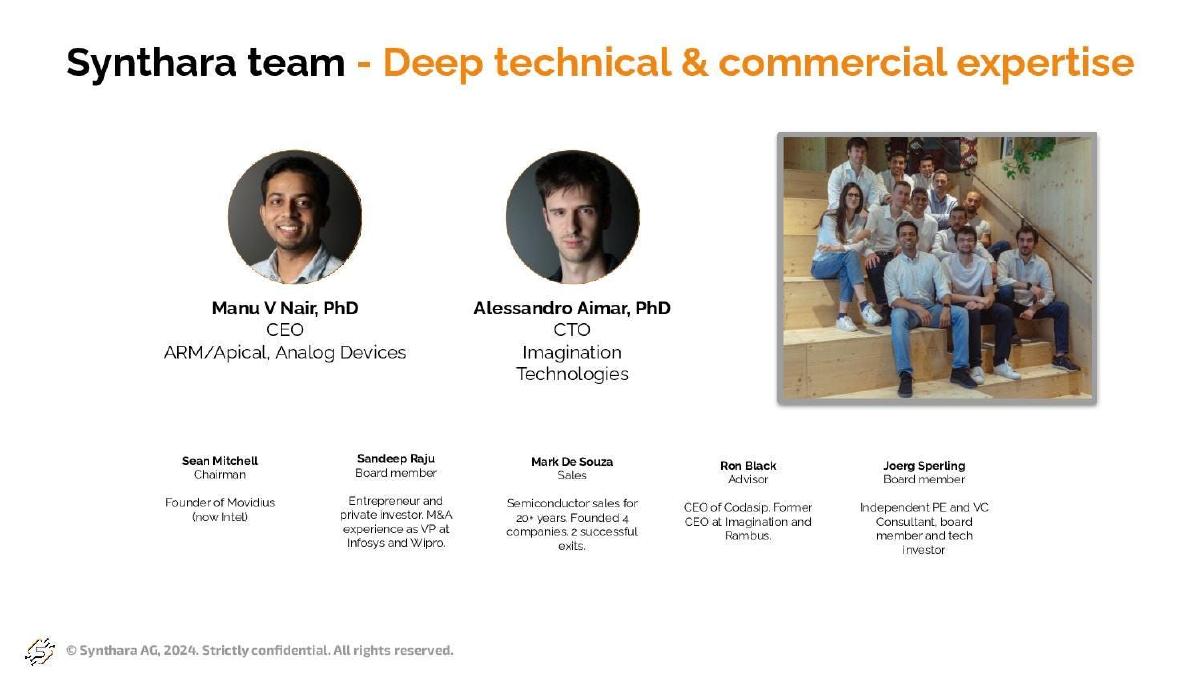
- The team features deep technical expertise, including a CEO from ARM/Analog Devices and a CTO from Imagination Technologies (Slide 8).
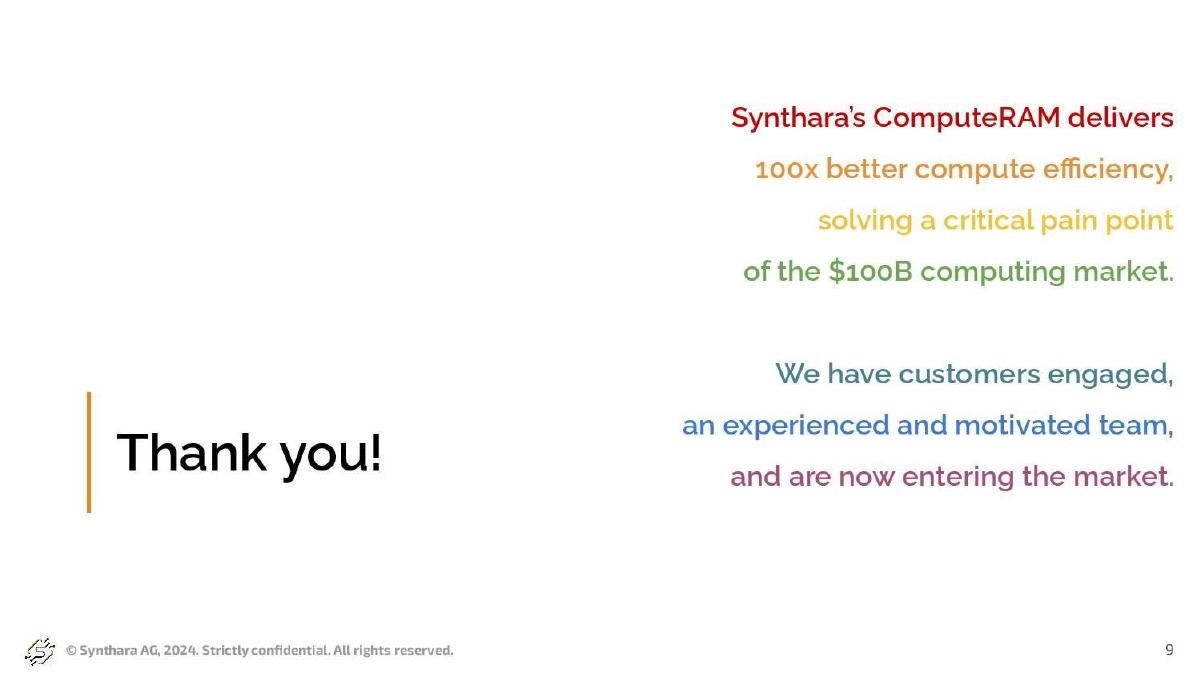
- The company targets a $100B computing market with its proprietary 'ComputeRAM' technology (Slide 9).
- The deck highlights that AI companies currently spend over 80% of their capital on compute resources, emphasizing the need for efficiency (Slide 2).
- The technical value proposition focuses on lightening processor workloads and drastically cutting data traffic (Slide 4).
- Advisors and board members include founders and CEOs from Movidius (Intel), Codasip, and Rambus, providing significant industry credibility (Slide 8).
Synthara Pitch Deck Teardown: The Efficiency Play for Edge-AI
In the high-stakes world of semiconductor startups, the narrative usually revolves around two things: massive capital expenditure or brilliant intellectual property. Synthara, a European hardware startup, successfully raised $11M in 2024 by leaning heavily into the latter. Their pitch deck is a masterclass in identifying a macro-trend—the unsustainable growth of AI compute costs—and positioning a technical solution as the only viable path forward.
Slide 1: The Vision
The title slide is minimalist, featuring the company logo and a clear sub-headline: "Unleashing In-Memory Computing: Enabling 100x better embedded chips." This is a strong start because it immediately quantifies the value proposition (100x) and identifies the specific technology (In-Memory Computing) and target market (embedded chips). For a hardware investor, these are the three most important variables to establish upfront.
Slide 2: The 'Beyond Moore' Problem
Slide 2 is the most effective slide in the deck. It uses a dual-axis graph to show the divergence between Moore's Law (performance doubling every two years) and AI compute demands (costs doubling every 3-4 months). By citing heavyweights like Dario Amodei (OpenAI/Anthropic), John Hennessy (Google), and the partners at a16z, Synthara validates that this isn't just a technical hurdle—it's a financial crisis for AI companies. The claim that "Companies spend more than 80% of their total capital raised on compute resources" creates a sense of urgency that makes their solution feel like a necessity rather than a luxury.
Slide 4: The Technical Solution (IMC)
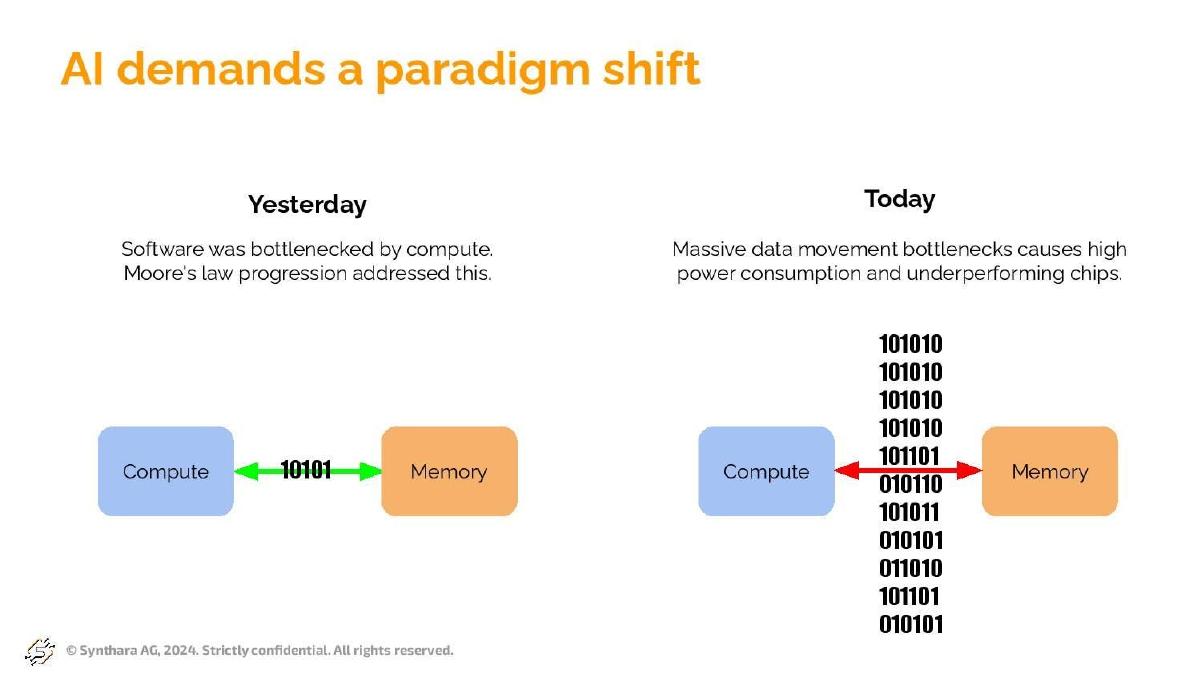
Slide 4 introduces In-Memory Computing (IMC). The slide is visually sparse, which is a common trait in technical decks intended to be presented rather than read in isolation. It lists three key benefits: "Lightens processor workload," "Drastically cuts down data traffic," and "Dramatic increase in throughput." The diagram shows a simplified flow between 'Compute' and a memory block, illustrating that the bottleneck in modern computing is often the movement of data between these two points. By processing data inside the memory, Synthara eliminates the 'Von Neumann bottleneck.'
Slide 6: The Semi-IP Business Model
For investors, the business model is often more important than the technology. Slide 6 outlines a classic semiconductor IP play, similar to the model used by ARM. Synthara sits at the start of the chain, providing a "Technology license" to chipmakers. In return, they receive "License + maintenance fees" and a "Royalty per chip." This model is highly attractive to VCs because it avoids the massive costs of building a fabrication plant (fab) while allowing the company to scale alongside the entire semiconductor ecosystem. The slide notes their mission is to "Transition every chipmaker to the era of In-Memory Computing."
Slide 8: The Team and Pedigree
In deep tech, the team is the primary de-risking factor. Slide 8 showcases a team with "Deep technical & commercial expertise." CEO Manu V Nair and CTO Alessandro Aimar both hold PhDs and have backgrounds at industry giants like ARM, Analog Devices, and Imagination Technologies. However, the 'Board and Advisors' section is equally impressive, featuring the founder of Movidius (acquired by Intel) and the former CEO of Rambus. This level of industry backing suggests that Synthara has the 'adults in the room' necessary to navigate the complex semiconductor sales cycle.
Slide 9: The Market Opportunity
The closing slide reiterates the 100x efficiency gain and identifies the "$100B computing market" as the target. It also provides a brief status update: "We have customers engaged, an experienced and motivated team, and are now entering the market." While the deck lacks a specific 'Ask' slide (common in decks released to the public post-raise), the $11M venture round reported by Business Insider suggests this narrative was sufficient to convince institutional investors of their market readiness.
What Works in the Synthara Deck
The Macro-to-Micro Narrative: The deck starts with a global problem (AI compute costs) and narrows down to a specific technical solution (ComputeRAM). This makes the technical details feel relevant even to non-specialist investors.
Authority Bias: By quoting Google and OpenAI executives on Slide 2, Synthara lets the market leaders do the heavy lifting of proving that a problem exists. This saves the founders from having to defend their market assumptions.
Scalability: The IP-licensing model shown on Slide 6 is a 'force multiplier.' It demonstrates that Synthara doesn't need to beat Intel or NVIDIA; they just need to be inside their chips.
What is Missing from the Synthara Deck
Competitive Landscape: There is no slide comparing Synthara to other IMC startups or traditional NPU (Neural Processing Unit) designers. Investors would typically want to know why Synthara's approach is superior to existing accelerators.
Product Roadmap: The deck doesn't explain the timeline for their IP cores. Are they in silicon now? Are they in the RTL (Register Transfer Level) phase? For hardware, the stage of development is a critical valuation driver.
Use of Funds: There is no mention of how the $11M will be spent. Usually, a hardware startup would specify how much is going toward tape-outs, software toolchain development, or sales expansion.
What Founders Should Copy
The 'Gap' Visualization: The graph on Slide 2 is a perfect example of how to visualize a market opportunity. It shows two diverging lines, creating a 'wedge' of opportunity that is easy to understand at a glance.
Simplified Technical Diagrams: Slide 4 doesn't use complex circuit diagrams. It uses blocks and arrows to explain a concept. Founders should remember that their deck is a sales tool, not a white paper.
Strategic Advisor Placement: Including high-profile advisors with successful exits (like the Movidius founder) on the team slide is a powerful way to signal that the company is being built on a solid foundation of industry experience.
Frequently asked questions
- What is Synthara's core technology?
- Synthara develops 'ComputeRAM,' an In-Memory Computing (IMC) solution. According to Slide 4, this technology lightens processor workloads, drastically cuts down data traffic, and provides a dramatic increase in throughput. The ultimate goal stated on Slide 1 is to enable embedded chips that are 100x more efficient than current standards.
- How does Synthara plan to make money?
- Synthara utilizes a 'Semi-IP' business model, as detailed on Slide 6. They license their technology to chipmakers in exchange for upfront technology license fees and ongoing maintenance fees. Additionally, they collect a royalty for every chip produced that utilizes their IP, creating a recurring revenue stream tied to manufacturing volume.
- Who is behind the company?
- The leadership team has significant semiconductor experience. CEO Manu V Nair, PhD, comes from ARM and Analog Devices, while CTO Alessandro Aimar, PhD, was previously at Imagination Technologies. The board and advisory team include Sean Mitchell (Founder of Movidius) and Ron Black (former CEO of Imagination and Rambus), as shown on Slide 8.
- What market problem are they solving?
- Slide 2 outlines the 'Beyond Moore' problem: while Moore's Law sees compute performance double every two years, AI compute costs are doubling every three to four months. This creates an exponential gap that makes current hardware unsustainable for advanced Edge-AI applications.
- What is missing from the Synthara pitch deck?
- The deck is light on specific product specifications, a detailed roadmap, and financial projections. While Slide 9 mentions 'customers engaged,' it does not name specific partners or provide case study data. There is also no explicit 'Ask' slide detailing how the $11M will be allocated across R&D, sales, or operations.