tagMonkey’s 2016 pre-seed deck is a concise exercise in identifying a technical bottleneck within a growing hardware market. The company positions itself as the software glue for RFID (Radio Frequency Identification), a technology often hampered by proprietary silos and scaling difficulties. By highlighting that a single store can generate 150 million reads per day, the deck successfully argues for the necessity of an automated, scalable backend. While the presentation is light on team biographies and a specific financial 'ask,' it compensates with immediate traction data, reporting $40,000 i…
Key takeaways
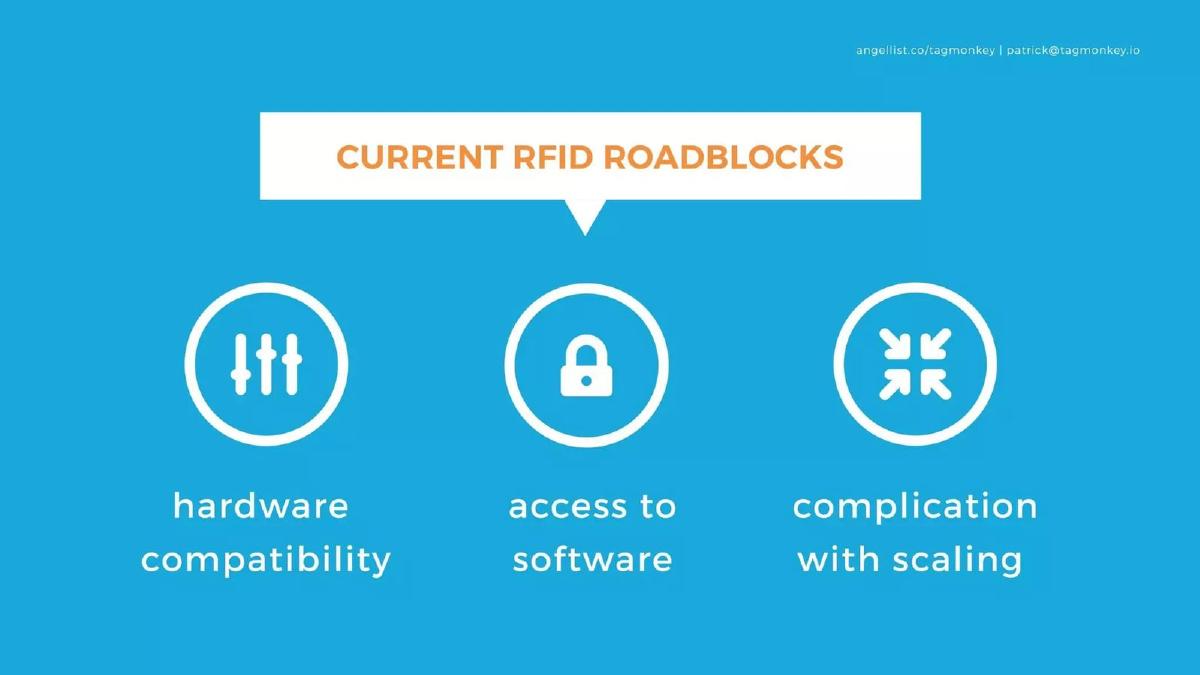
- The deck identifies three primary roadblocks to RFID adoption: hardware compatibility, access to software, and scaling complications (Slide 5).
- tagMonkey positions its solution as 'hardware neutral,' allowing it to sit above various RFID reader manufacturers (Slide 7).
- The company demonstrates significant early traction, claiming $40k in revenue within the first 60 days of operation (Slide 9).
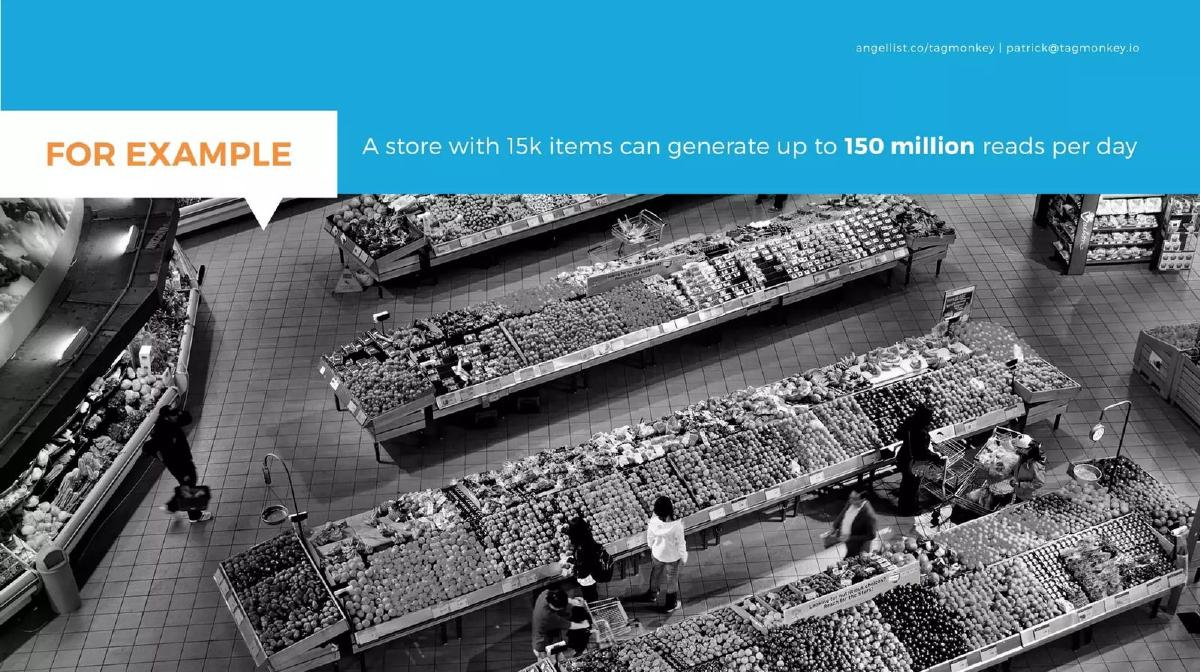
- The scale of the data problem is quantified by the fact that a store with 15k items can generate up to 150 million reads per day (Slide 6).
- The market opportunity is projected to grow from $8B in 2015 to $24B by 2022 (Slide 10).
- The product suite includes web tools, mobile apps, and a developer API to provide a comprehensive management layer (Slide 2).
- The deck highlights '3 years developing RFID applications' as a core competency, specifically referencing work for Zappos (Slide 8).
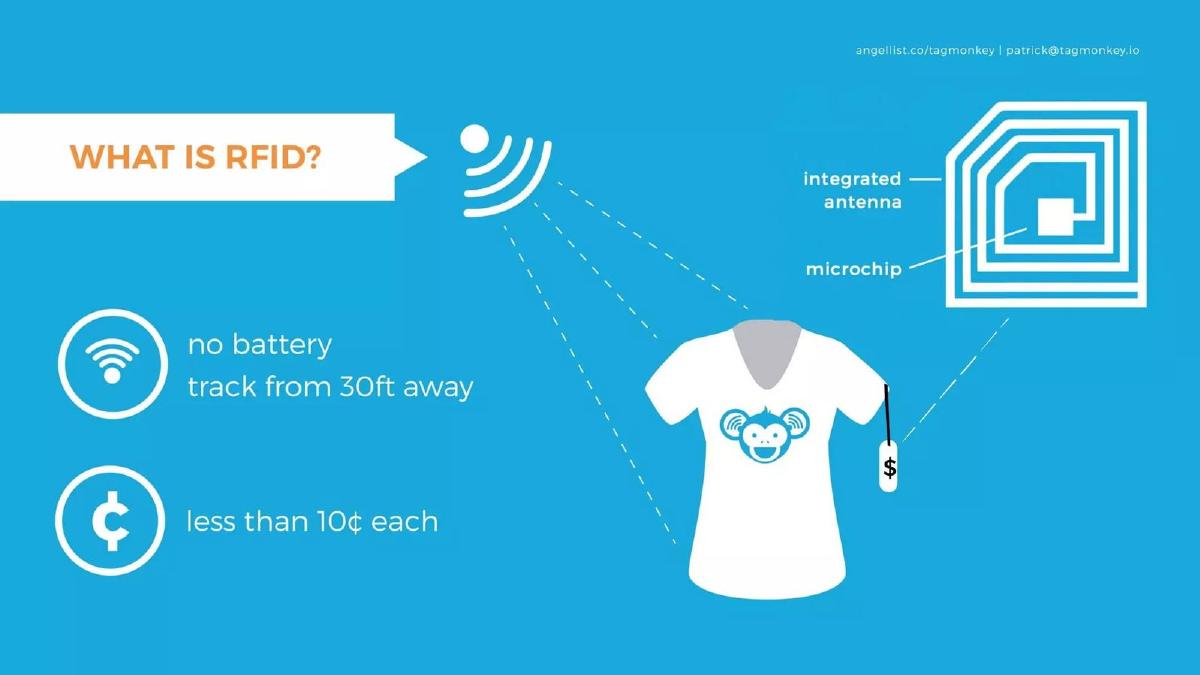
- RFID tags are noted for their low cost (less than 10 cents each) and lack of battery requirements, making them viable for mass-market items like apparel (Slide 3).
Introduction: The Middleware of the Physical World
The tagMonkey pitch deck from 2016 is a 10-slide presentation that focuses on the infrastructure layer of the Internet of Things (IoT). Specifically, it targets the RFID (Radio Frequency Identification) market. At the time of this pre-seed raise, the company sought to position itself as the essential software platform that makes hardware-agnostic RFID deployment possible. The deck is characterized by a minimalist aesthetic, heavy use of iconography, and a clear focus on the 'why now' of the RFID industry.
Slide 1: Title and Vision
The cover slide introduces the company name, tagMonkey , and its slogan: "A Trillion Items, One Platform." It features Patrick McLain, CEO, as the primary contact. The branding is friendly, using a monkey mascot with RFID signal waves for ears, signaling a focus on accessibility in a traditionally complex industrial sector.
Slide 2: The Product Suite
Slide 2 quickly defines the product's scope. It identifies three core components of the platform: Web , Mobile Apps , and a Developer API . An image of a mobile dashboard labeled "Chimp & Co. Dashboard" shows metrics like "986 Total Items" and "2 Devices Down," illustrating that the software provides real-time monitoring of both inventory and the hardware health of the RFID readers themselves.
Slide 3: RFID Fundamentals
To ensure the investor understands the underlying technology, Slide 3 answers "What is RFID?" It highlights three key economic and technical drivers: no battery requirement, the ability to track from 30 feet away, and a cost of less than 10 cents each . By showing a t-shirt with a tag, the deck anchors the technology in the high-volume apparel and retail industries.
Slide 4: Market Demand and Use Cases
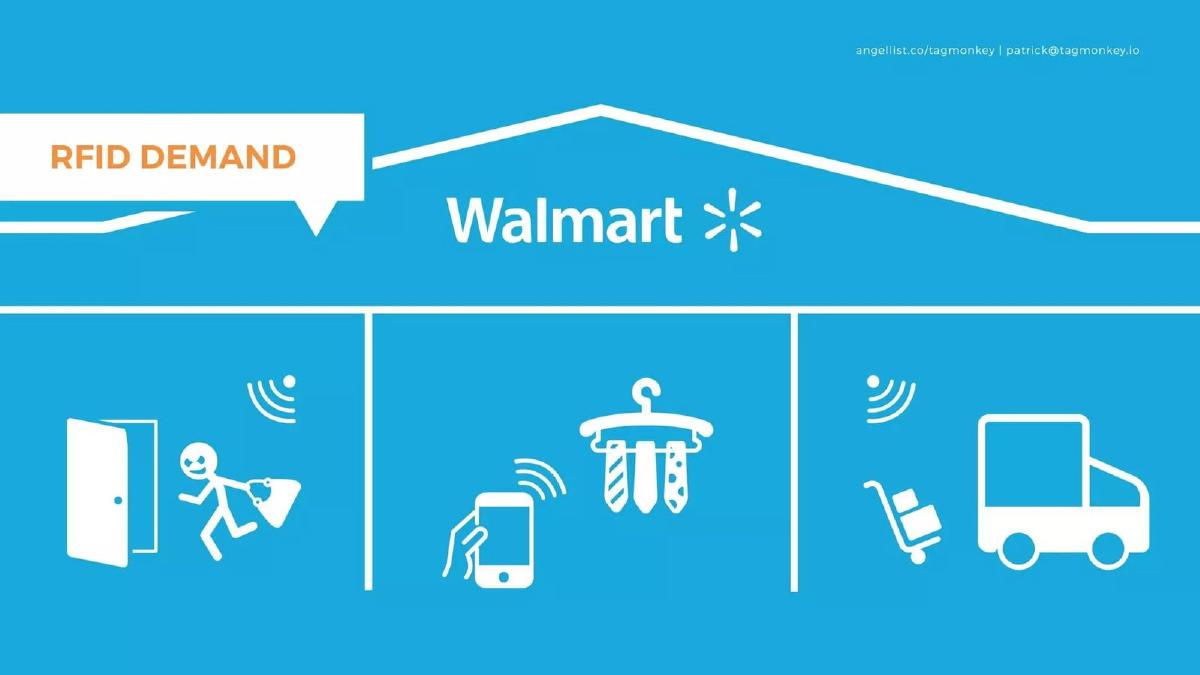
Slide 4 uses Walmart as a case study for RFID demand. It breaks down the utility into three visual categories: loss prevention (a figure running with a bag), inventory management (apparel on a rack), and logistics (a delivery truck). This slide establishes that the world's largest retailers are already committed to this technology, creating a massive downstream market for software providers.
Slide 5: Identifying the Roadblocks
This is the 'Problem' slide. tagMonkey identifies three "Current RFID Roadblocks": hardware compatibility , access to software , and complication with scaling . This slide is crucial because it moves the conversation from 'why RFID is good' to 'why RFID is currently failing to reach its potential,' setting the stage for tagMonkey's specific value proposition.
Slide 6: The Data Explosion
Slide 6 provides a quantitative look at the scaling problem. Over a background image of a grocery store, the text states: "A store with 15k items can generate up to 150 million reads per day ." This effectively communicates that the challenge isn't just reading tags—it's managing the astronomical amount of data those tags produce, which requires specialized backend architecture.
Slide 7: The tagMonkey Solution
The 'Solution' slide directly mirrors the 'Roadblocks' slide. tagMonkey offers a platform that is hardware neutral , provides flexible software , and features automatic scaling . This direct mapping shows a disciplined approach to product-market fit, promising to solve the exact pain points identified earlier in the deck.
Slide 8: Team Experience and Validation
Instead of a traditional team slide with headshots and resumes, Slide 8 focuses on practical experience. It claims "3 Years Developing RFID Applications" and shows a photo of a "Zappos.com Magic Checkout" kiosk. This provides immediate social proof, suggesting the founders have already built and deployed high-stakes RFID solutions for major brands before starting tagMonkey.
Slide 9: Early Traction and Milestones
Slide 9 covers the first 60 days of the company's life. It reports $40k in revenue , "Multiple" manufacturing (MFG) partnerships, and a volume of 100k items per month . For a pre-seed deck, these are strong figures, demonstrating that the product is not just a concept but is already being used in commercial environments.
Slide 10: Market Opportunity
The final slide addresses the Total Addressable Market (TAM). It uses a graphic to show the market growing from $8B in 2015 to $24B in 2022 . This 3x growth projection over seven years provides the 'venture scale' argument necessary to justify an investment, though it lacks a specific breakdown of how much of that market is addressable by software alone.
What Works in This Deck
Clarity of the Data Problem: The most effective part of the deck is Slide 6. By citing the "150 million reads per day" figure, the founders move the pitch away from a simple 'inventory tracking' story and into a 'big data' story. This makes the need for a sophisticated software layer feel inevitable rather than optional.
Direct Problem-Solution Mapping: The symmetry between Slide 5 (Roadblocks) and Slide 7 (Solution) is a masterclass in clear communication. It leaves no doubt in the investor's mind about what the product does and why it matters.
Immediate Traction: Reporting $40,000 in revenue within the first 60 days is an exceptional milestone for a pre-seed company. It proves that there is a 'pull' from the market and that the founders can execute sales cycles quickly.
What Is Missing From This Deck
The Ask: The most glaring omission is a slide detailing the fundraising goal. There is no mention of how much capital tagMonkey is seeking, the valuation, or the specific milestones they intend to hit with the new funding. This information is typically standard in a pitch deck.
Team Biographies: While the Zappos reference is strong, the deck lacks a dedicated team slide. Investors generally want to see the specific backgrounds of the founders—where they went to school, where they worked previously, and their technical credentials—to assess 'founder-market fit.'
Competitive Landscape: The deck mentions that hardware compatibility is a roadblock, but it does not name any competitors or explain how tagMonkey's API differs from existing middleware solutions like those from Impinj or Zebra. A competitive matrix would have helped define their moat.
Unit Economics: There is no mention of how tagMonkey charges its customers. Is it a monthly subscription per reader? A fee per 1,000 tags? Without a business model slide, it is difficult to project how the $40k in revenue scales as the company grows.
What a Founder Should Copy
The 'For Example' Slide: Use a specific, high-impact statistic to illustrate the technical difficulty of your space. tagMonkey's use of the "150 million reads" stat is the 'aha' moment of the deck. Founders should find their own version of this—a number that makes the status quo look impossible to maintain without their solution.
Iconography Over Text: This deck is very light on word count. It relies on clean icons and bold headers. This is ideal for a presentation where the founder is speaking over the slides, as it prevents the audience from getting distracted by reading long paragraphs.
Proof of Work: If you have done consulting or project work in the same industry before starting your SaaS company, highlight it as tagMonkey did with the Zappos slide. It proves you aren't just an outsider with an idea, but an insider who has felt the pain of the current tools.
Focus on Interoperability: In a crowded hardware market, positioning yourself as the 'neutral' layer is a classic and effective strategy. If your industry has many competing hardware standards, copy the 'hardware neutral' messaging to appeal to the widest possible customer base.
Frequently asked questions
- What is the core problem tagMonkey is solving?
- According to Slide 5, tagMonkey addresses 'RFID Roadblocks' including hardware compatibility, limited access to software, and the technical difficulty of scaling. The deck argues that while RFID hardware is cheap and effective, the software infrastructure required to manage the resulting data is often fragmented and difficult to deploy.
- How does tagMonkey generate revenue?
- The deck does not explicitly detail its pricing model (e.g., SaaS vs. per-tag), but Slide 9 shows the company achieved $40,000 in revenue within its first 60 days. It also mentions 'MFG Partnerships' and tracking '100k items per month,' suggesting a volume-based or partnership-driven revenue stream.
- What is the scale of the data tagMonkey handles?
- Slide 6 provides a specific example of the data burden: a single store with 15,000 items can generate up to 150 million RFID reads per day. This highlights the need for tagMonkey's 'automatic scaling' software to process massive amounts of raw sensor data into actionable business insights.
- Who is the target customer for this platform?
- While the deck is broad, Slide 4 uses Walmart as a primary example of RFID demand, focusing on loss prevention, inventory management, and logistics. Slide 8 also references Zappos, indicating that large-scale retail and e-commerce fulfillment centers are the primary users of the technology.
- Is there a specific investment ask in the deck?
- No. The 10-slide deck concludes with market size projections on Slide 10 but does not include a slide detailing the amount of capital being raised, the valuation, or the intended use of funds. Catalogue facts indicate they eventually raised $125,000.