How biotech and drug-discovery startups present the problem in a pitch deck: show where drug development fails, what it costs and how long it takes.
Biotech Problem Slide: Real Pitch Deck Examples
Eight problem slides from biotech, drug-discovery and pharma-services startups, shown in full, compare whether each slide says where drug development breaks, measures the cost or failure rate with a source, and names the patients or buyers affected.
TL;DR
A biotech problem slide should say exactly where drug development fails, measure it and cite the source. Lantern Pharma leads with "Only 6% of clinical trials using traditional drug discovery approaches succeed" (footnoted to BIO clinical-success data), then gives three numbers: "Average cost to bring a new cancer drug to market is $2.8 billion", "Out of 20,000 trials from 2012-2022, 19,200 trials failed", and development taking "3-5+ Years" early and "6-12+ Years" late. Ourotech names the patient-level failure: "Multiple drugs target the same cancer subtype but they don't work on all patients." Aevus's diagram of three labels with no figures or patients is the weaker pattern.
Biotech problem slides from real pitch decks
Each example shows the exact stored slide above its analysis and links to the full teardown. Claims are as shown on the slides; we have not verified them.
Lantern Pharma problem slide — slide 4
AI-guided cancer drug development. A headline figure and three challenges.
Lantern Pharma deck, slide 4. Exact stored slide matched to this analysis.
Our analysis: The strongest example here: one sourced headline figure, then cost, risk and time each measured.
Evidence and limitation: Success rate, cost, trial count and timelines; headline figure footnoted.
What a founder can adapt: Lead with one sourced figure; give each supporting point its own number.
Supporting analysis
What the deck claims: "Only 6%* of clinical trials using traditional drug discovery approaches succeed." "Current Challenges": "Costly: Average cost to bring a new cancer drug to market is $2.8 billion"; "Risky: Out of 20,000 trials from 2012-2022, 19,200 trials failed"; "Slow: Early-Stage development takes 3-5+ Years, late-stage development takes 6-12+ Years." "Current oncology drug development is being improved by data-driven, and AI-enabled approaches and technology." Footnote: "Clinical Development Success Rates and Contributing Factors 2011-2020, BIO Stats."
Presentation choice: "Costly, Risky, Slow" gives three words an investor remembers, each with a number.
When it does not fit: Cite the $2.8 billion and 20,000-trial figures too, not only the headline.
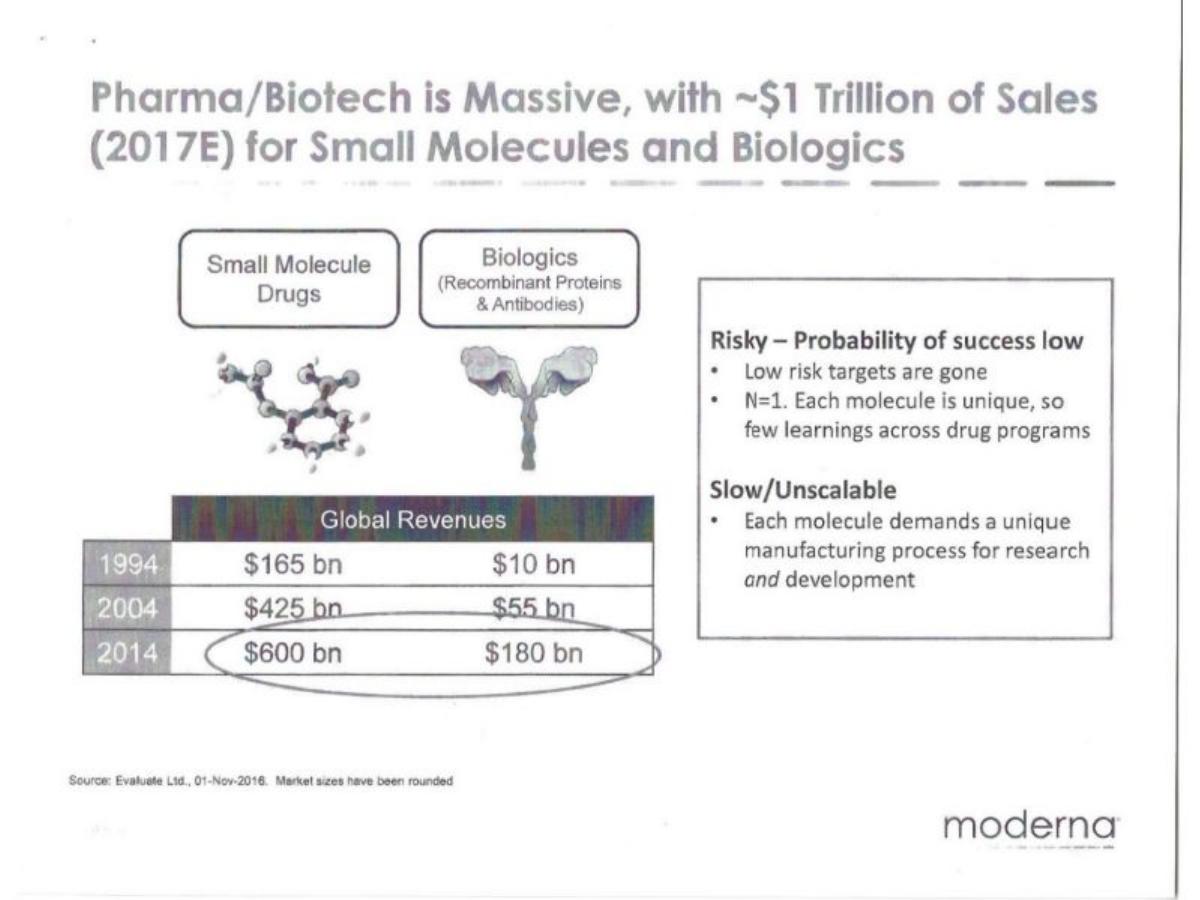
mRNA medicines (early private deck). Market table plus a problem box.
Moderna deck, slide 4. Exact stored slide matched to this analysis.
Our analysis: It names a structural problem (every drug starts from scratch) that sets up a platform answer.
Evidence and limitation: Sourced revenue table; problem points unmeasured.
What a founder can adapt: If you're a platform, say why today's work doesn't carry over from one drug to the next.
Supporting analysis
What the deck claims: "Pharma/Biotech is Massive, with ~$1 Trillion of Sales (2017E) for Small Molecules and Biologics." Global revenues 1994 "$165 bn" / "$10 bn" to 2014 "$600 bn" / "$180 bn". "Risky – Probability of success low: Low risk targets are gone; N=1. Each molecule is unique, so few learnings across drug programs." "Slow/Unscalable: Each molecule demands a unique manufacturing process for research and development." Source: "Evaluate Ltd., 01-Nov-2016."
Presentation choice: "N=1... few learnings across drug programs" is exactly what a platform company fixes.
When it does not fit: The market table takes most of the slide; the problem box is the point.
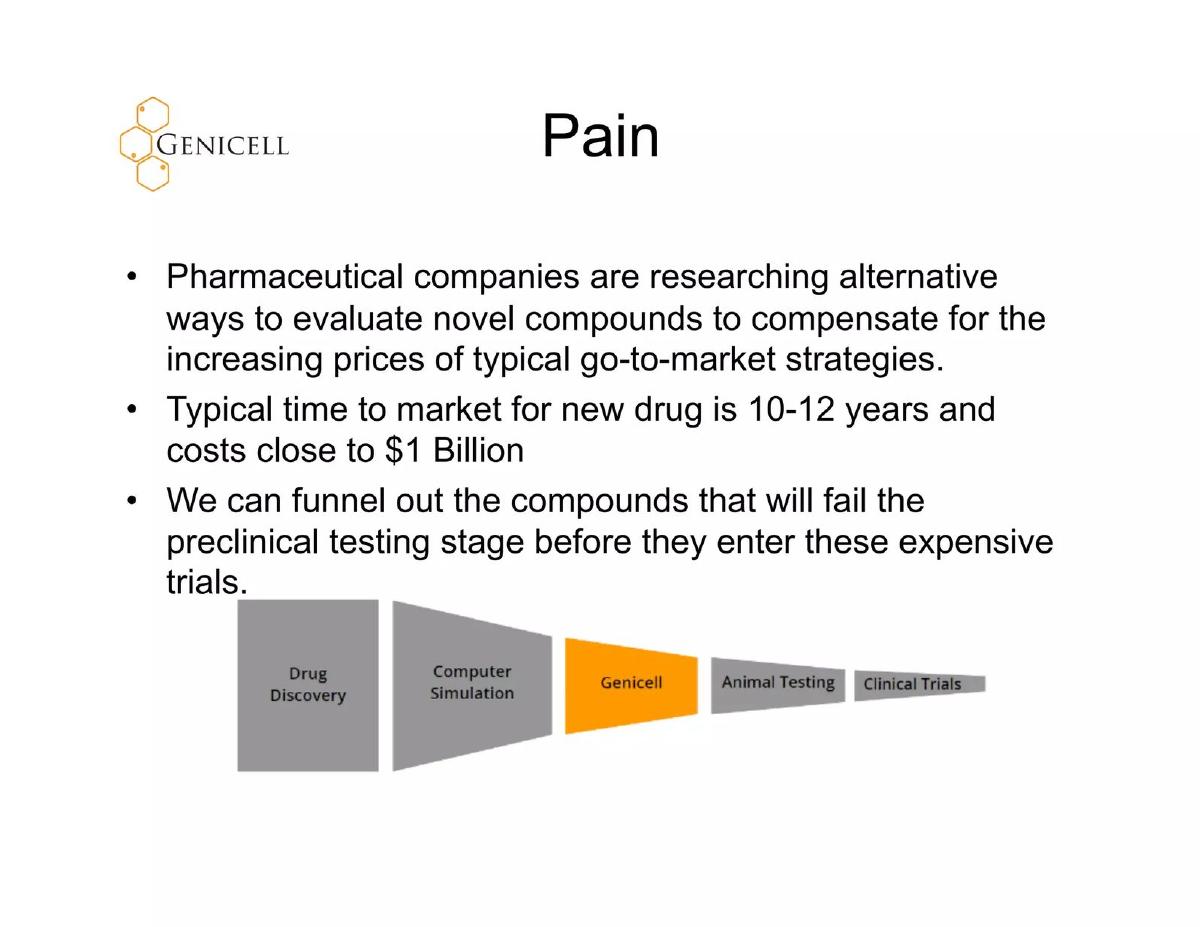
Cell-based compound screening. Bullets over a funnel diagram.
Genicell deck, slide 4. Exact stored slide matched to this analysis.
Our analysis: The funnel shows exactly where the company sits in drug development.
Evidence and limitation: Time and cost; no source.
What a founder can adapt: Draw the development stages and mark yours.
Supporting analysis
What the deck claims: "Pain." "Pharmaceutical companies are researching alternative ways to evaluate novel compounds to compensate for the increasing prices of typical go-to-market strategies." "Typical time to market for new drug is 10-12 years and costs close to $1 Billion." "We can funnel out the compounds that will fail the preclinical testing stage before they enter these expensive trials." Funnel: "Drug Discovery", "Computer Simulation", "Genicell", "Animal Testing", "Clinical Trials".
Presentation choice: An investor sees in one picture which stage gets cheaper.
When it does not fit: Keep the solution ("We can funnel out...") for the next slide; cite the figures.
Tumour models for choosing cancer drugs. Text beside a clinical photo.
Ourotech deck, slide 5. Exact stored slide matched to this analysis.
Our analysis: It names the patient-level problem (drugs that don't work for this patient) and why.
Evidence and limitation: No figures.
What a founder can adapt: Add how often it happens: the share of patients who don't respond to first treatment.
Supporting analysis
What the deck claims: "The Problem." "Multiple drugs target the same cancer subtype but they don't work on all patients." "Tumors can be resistant due to: Genetic resistance/mutation; Tumor microenvironment; Interaction with other cancer cells; Interaction with healthy cells."
Presentation choice: The four causes of resistance explain why a test before treatment would help.
When it does not fit: A stock photo in place of a figure.
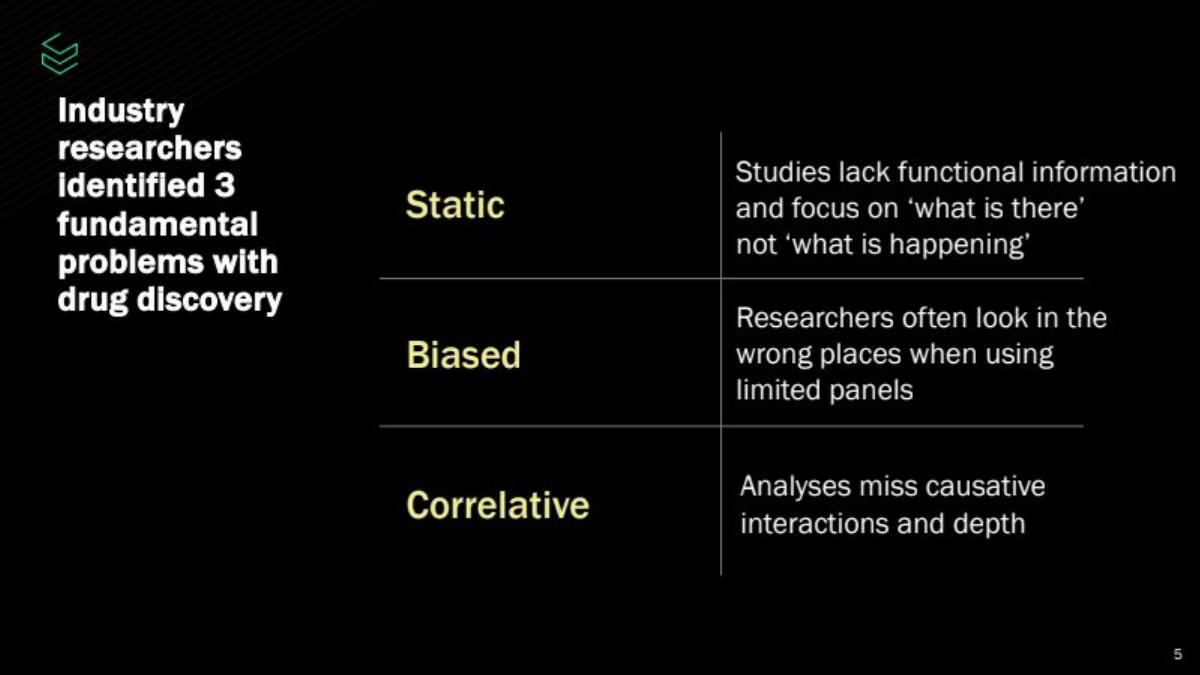
Drug-discovery data platform. Three words, each explained.
Pepper Bio deck, slide 5. Exact stored slide matched to this analysis.
Our analysis: Three clear technical problems in plain words, but "industry researchers" isn't a source.
Evidence and limitation: No figures or sources.
What a founder can adapt: Name who identified the problems, and add one result, such as the failure rate it causes.
Supporting analysis
What the deck claims: "Industry researchers identified 3 fundamental problems with drug discovery." "Static: Studies lack functional information and focus on 'what is there' not 'what is happening'." "Biased: Researchers often look in the wrong places when using limited panels." "Correlative: Analyses miss causative interactions and depth."
Presentation choice: "What is there, not what is happening" makes a technical gap easy to grasp.
When it does not fit: Unnamed authority ("industry researchers").
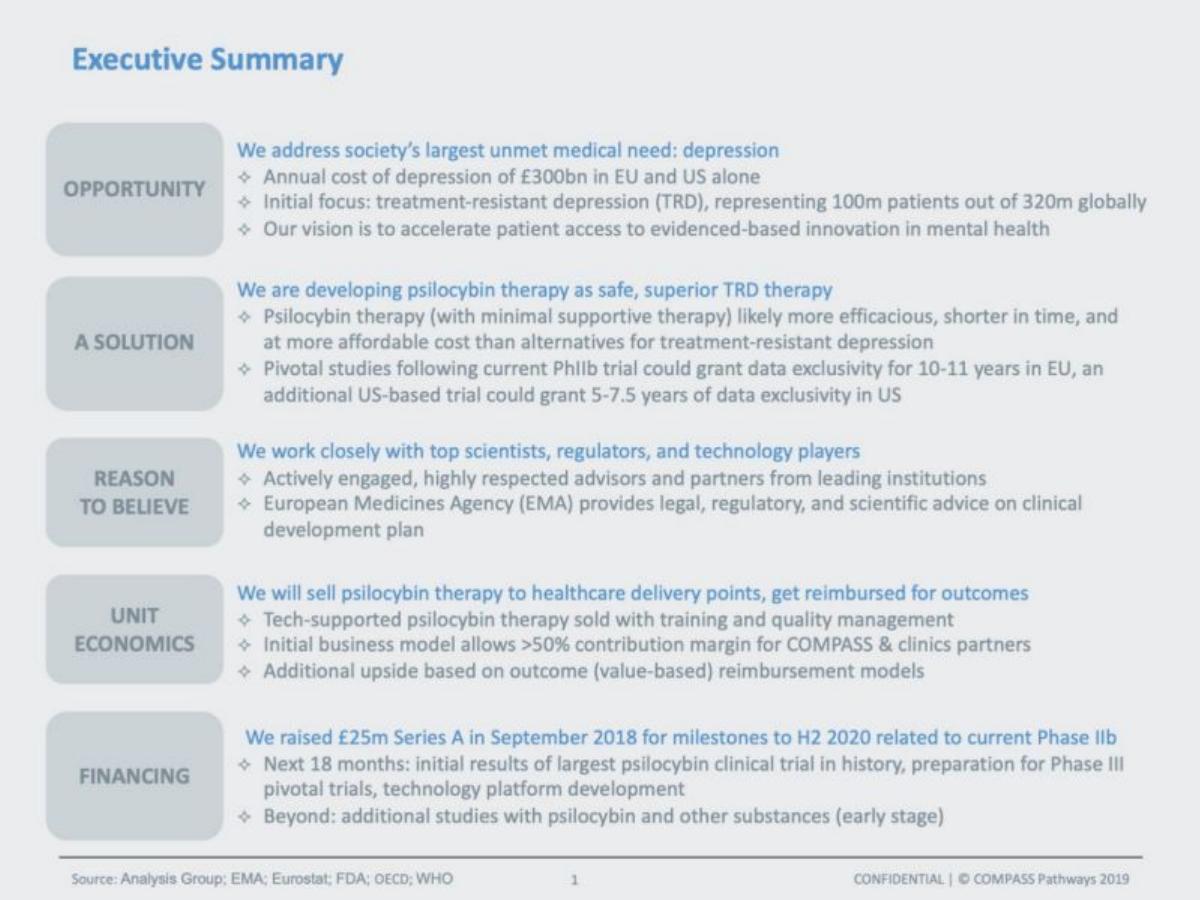
Psilocybin therapy for depression. An executive-summary slide whose first row states the need.
Compass Pathways deck, slide 2. Exact stored slide matched to this analysis.
Our analysis: Partial: strong numbers and a named patient group, but it's one row of a summary, not a full problem slide.
Evidence and limitation: Cost and patient numbers, with sources listed.
What a founder can adapt: Name the patient subgroup you treat first and how many there are.
Supporting analysis
What the deck claims: "Opportunity: We address society's largest unmet medical need: depression." "Annual cost of depression of £300bn in EU and US alone." "Initial focus: treatment-resistant depression (TRD), representing 100m patients out of 320m globally." Further rows: "A Solution", "Reason to Believe", "Unit Economics", "Financing". Source line: "Analysis Group; EMA; Eurostat; FDA; OECD; WHO."
Presentation choice: "100m patients out of 320m" shows which part of a big problem the company starts with.
When it does not fit: Putting the problem inside a crowded summary.
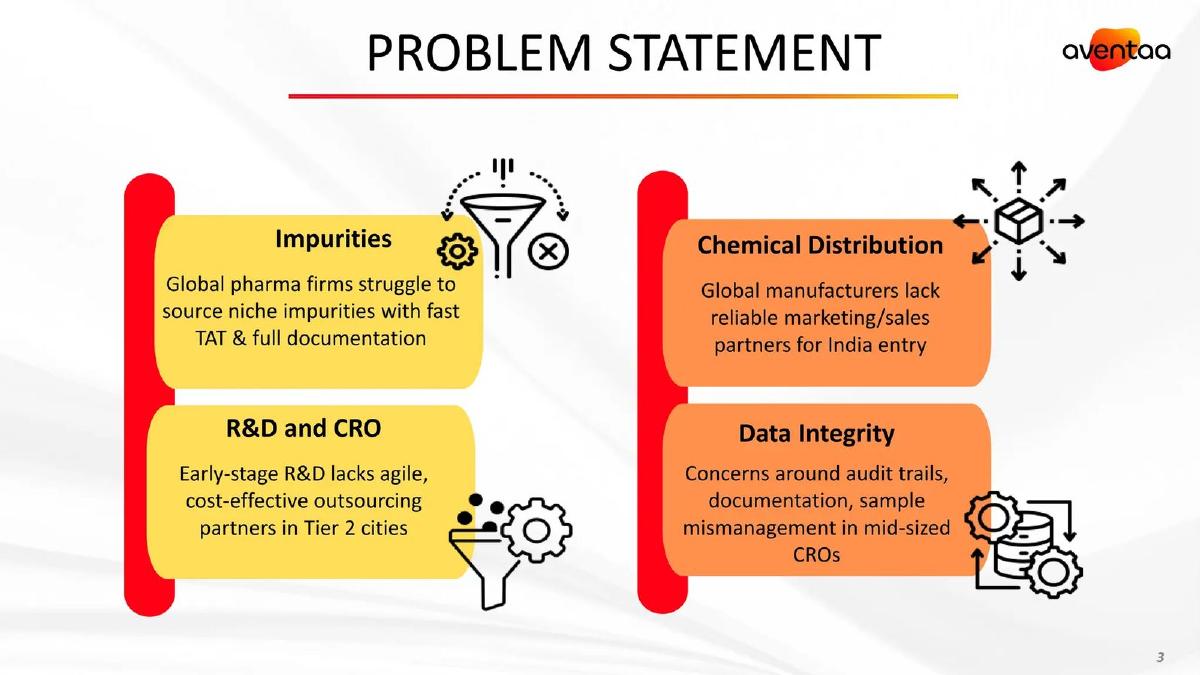
Pharma impurities, research services and chemical distribution in India. Four boxes.
Aventaa deck, slide 3. Exact stored slide matched to this analysis.
Our analysis: Partial: each box names a buyer, but four different problems for four businesses split the slide.
Evidence and limitation: No figures.
What a founder can adapt: Lead with one buyer and one problem; add how long sourcing takes today.
Supporting analysis
What the deck claims: "Problem Statement." "Impurities: Global pharma firms struggle to source niche impurities with fast TAT & full documentation." "R&D and CRO: Early-stage R&D lacks agile, cost-effective outsourcing partners in Tier 2 cities." "Chemical Distribution: Global manufacturers lack reliable marketing/sales partners for India entry." "Data Integrity: Concerns around audit trails, documentation, sample mismanagement in mid-sized CROs."
Presentation choice: Kept to show a supplier-side biotech problem, and the cost of covering several businesses at once.
When it does not fit: Four problems for four customers on one slide.
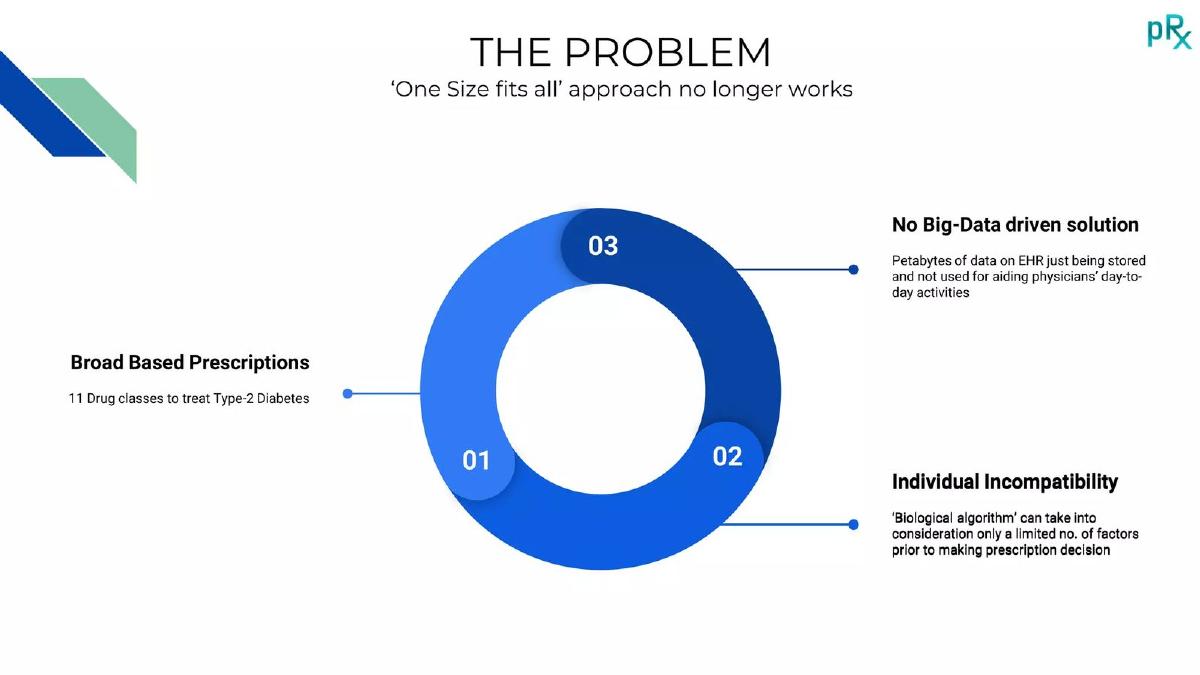
Data-driven prescribing for type 2 diabetes. A ring diagram with three labels.
Aevus deck, slide 2. Exact stored slide matched to this analysis.
Our analysis: Weak on purpose: small labels round a large ring; it doesn't say how many patients get the wrong drug or what that costs.
Evidence and limitation: One count (11 drug classes); no patient or outcome figure.
What a founder can adapt: Say how often the first prescription fails and what that costs the patient.
Supporting analysis
What the deck claims: "The Problem: 'One Size fits all' approach no longer works." "01 Broad Based Prescriptions: 11 Drug classes to treat Type-2 Diabetes." "02 Individual Incompatibility: 'Biological algorithm' can take into consideration only a limited no. of factors prior to making prescription decision." "03 No Big-Data driven solution: Petabytes of data on EHR just being stored and not used for aiding physicians' day-to-day activities."
Presentation choice: Kept as a contrast; compare Ourotech, which names the same kind of problem (drugs that don't suit the patient) in one sentence.
When it does not fit: A decorative diagram carrying three unmeasured claims.
Whether each slide says where development fails, measures it with a source, and names who is affected.
Example
Where it fails
Measured and sourced
Who is affected
Lantern Pharma
Yes (trials)
Yes (headline sourced)
Partly (developers)
Moderna
Yes (each molecule unique)
Partly (market sourced)
Partly
Genicell
Yes (preclinical)
Partly (no source)
Yes (pharma companies)
Ourotech
Yes (drug resistance)
No
Yes (cancer patients)
Pepper Bio
Yes (research methods)
No
Partly (researchers)
Compass Pathways
Partly
Yes
Yes (TRD patients)
Aventaa
Partly (four problems)
No
Yes (four buyers)
Aevus
Partly
No
Partly
Key Takeaways
Say where development fails: target choice, preclinical, trials, manufacturing, patient response.
Give the failure rate, cost and time, each with a source.
Name who pays for the failure: patients, pharma companies, researchers.
Industry-wide numbers set the scene; say which part your company fixes.
A diagram of labels without figures says little.
Build your biotech problem slide
Where it fails, what it costs, who pays.
Stage. Where does it fail: target, screening, preclinical, trials, manufacturing, patient response?
Figure. Failure rate, cost or time, with a named source.
Who. Which patients, developers or buyers bear it?
Your part. Which stage do you change? Mark it.
Copyable framework: [Figure] ([source]) at [stage]. [Who] [pays how]. We work at [stage].
Illustrative example 1 — written by us
Before: Drug discovery is static, biased and correlative.
After: About 9 in 10 drug candidates that enter trials fail (named industry study); many fail because the target was wrong. Our data shows which targets are active in patient tissue before trials start.
What improved: Our illustrative rewrite; the wording is ours and any figure must come from a source you cite. It adds a measured failure, a stage and a named source.
What this guide adds
The healthcare problem guide covers care delivery and digital health, including two drug companies (Healx and Being Health), and this guide doesn't repeat those slides. This guide is about drug discovery and development: why drugs fail, what that costs, and where a startup steps in. The biotech pipeline guide covers the later slide that shows development stages.
Three things a biotech problem slide proves
Where it fails: "19,200 trials failed" (Lantern), "Low risk targets are gone" (Moderna), "compounds that will fail the preclinical testing stage" (Genicell), tumours "resistant" to drugs (Ourotech).
What it costs: "$2.8 billion" (Lantern), "close to $1 Billion" and "10-12 years" (Genicell), "£300bn" annual cost of depression (Compass Pathways).
Who is affected: cancer patients (Ourotech), "100m" treatment-resistant depression patients (Compass Pathways), "Global pharma firms" (Aventaa).
Common mistakes
Unsourced industry numbers. Cite every cost and failure rate.
Market size in place of a problem. A $1 trillion market isn't a failure point.
Unnamed authority. "Researchers identified" needs a name.
Several businesses' problems at once. Lead with one buyer.
Decorative diagrams. Labels need numbers.
Diagnostic checklist
It says where development fails.
It gives one measured figure with a source.
It names who is affected.
It shows which stage you change.
The solution waits for the next slide.
Frequently asked questions
How we chose these examples
Corpus: published pitch deck teardowns on StartupFundraising.com. Founder-uploaded private decks are excluded.
Selection (2026-09-25): we searched slides 2–6 for problem slides mentioning drug discovery, drug development, clinical trials, pharma or biologics. Healx slide 2 and Being Health slide 4 were left out because they already appear in the healthcare problem guide; Antikor slide 4 and TransCode slide 3 were left out as market or capital slides; Scientus Pharma was left out because it appears in the cannabis problem guide. Compass Pathways and Aventaa are marked partial; Aevus is kept as a weaker contrast.
Overlap check: none of these eight slides appears in another guide. Genicell slide 7 appears in the biotech pipeline guide, Pepper Bio slide 4 in the deep-tech team guide and Aevus slide 4 in the healthcare solution guide; this guide uses different slides.
Review: all eight stored slide images were inspected on 2026-09-25 and matched to company, deck and slide number (editorial model review). No person has yet completed an editorial review of this page.
Claims are as shown on the slides; we have not verified them. We make no claim that any slide caused a fundraising outcome. Nothing here is medical or regulatory advice.