NativeAD's 2013 seed deck is a masterclass in using traction to justify a pivot in industry standards. With only 21 slides, many of which are minimalist transitions or single-metric highlights, the company communicated a clear value proposition: display advertising is dead, and native content is the future for the Hispanic market. The deck highlights $210,000 in booked sales over just three months (Slide 3) and a publisher network that includes giants like Yahoo! and MSN (Slide 4). By leveraging the expertise of a serial entrepreneur and a former media director, NativeAD presented a low-risk,…
Key takeaways
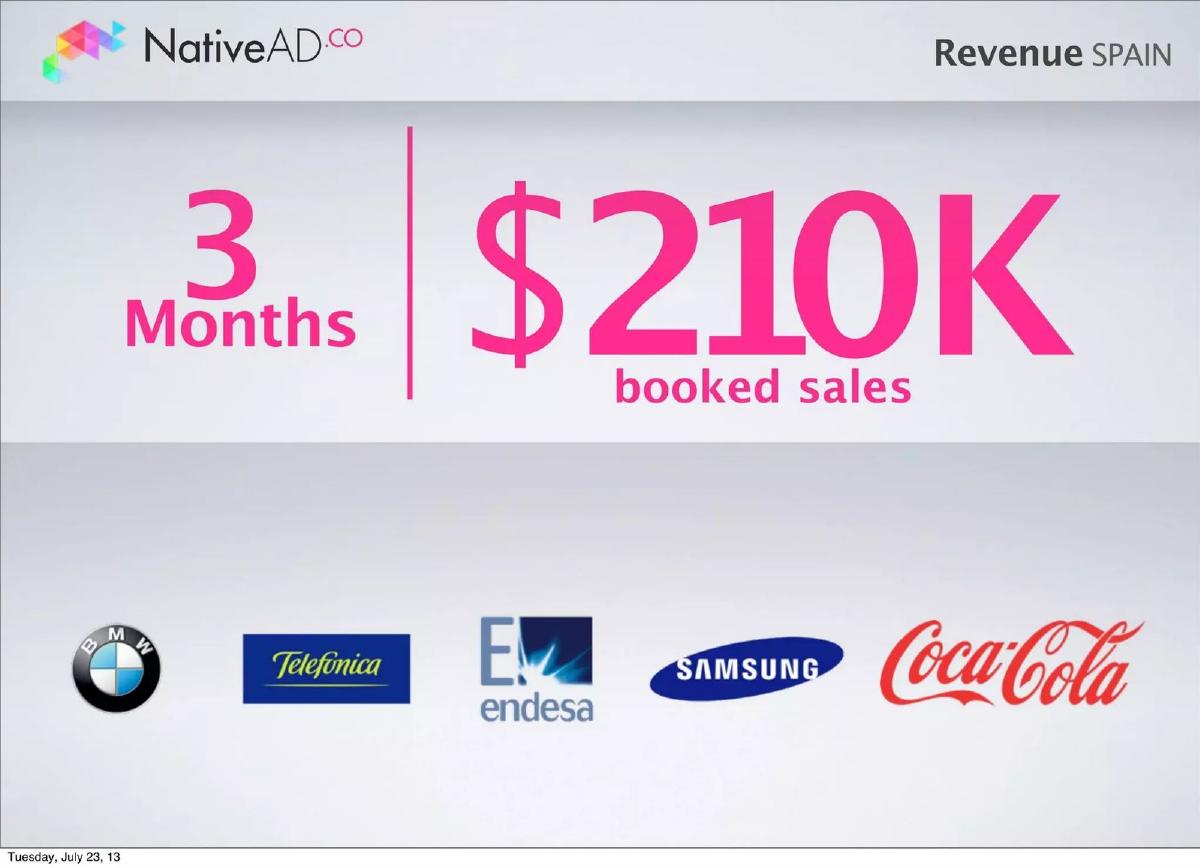
- The deck leads with immediate financial validation, showing $210K in booked sales within the first three months of operation on Slide 3.
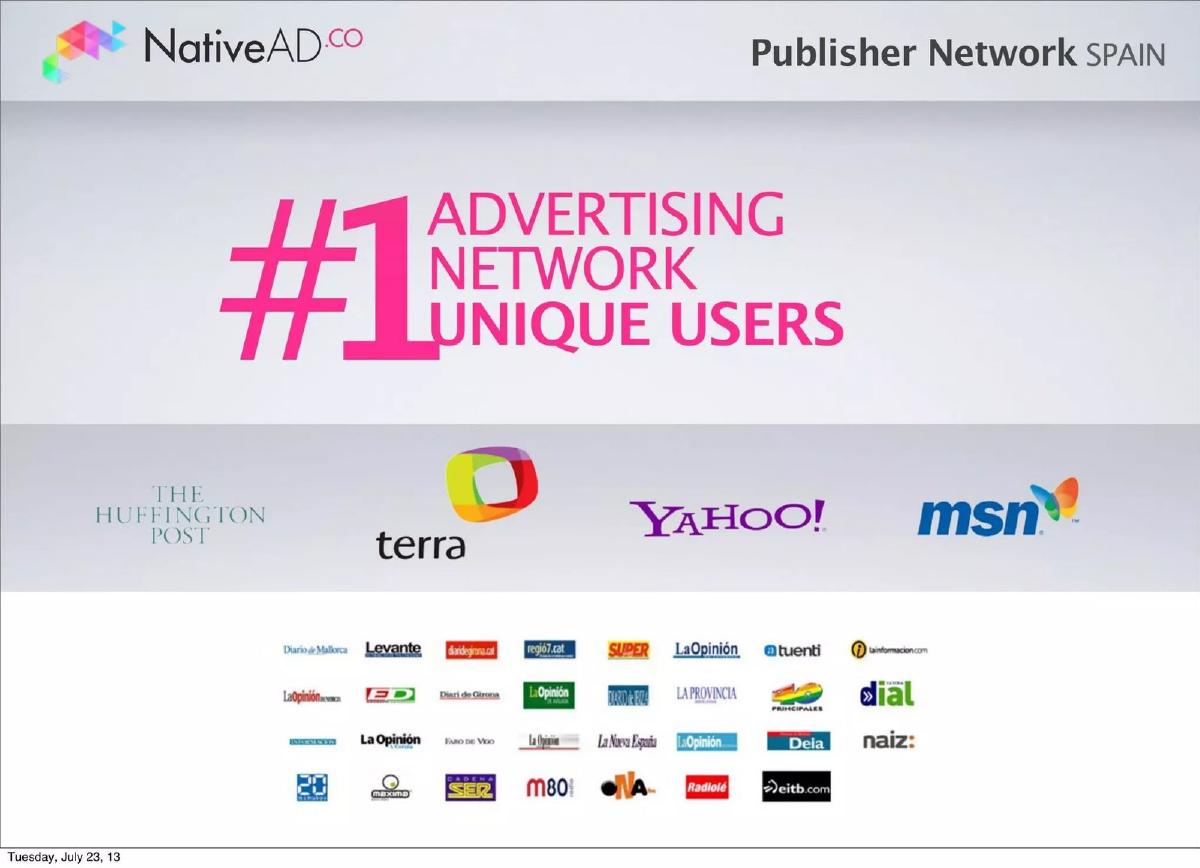
- NativeAD claims the #1 spot for advertising network unique users in Spain, as stated on Slide 5.
- The core thesis is built on the failure of traditional display ads, explicitly stating 'Display advertising no longer works' on Slide 7.
- The product is positioned as a 10x engagement boost for brands and a 30x profitability increase for publishers on Slide 13.
- Strategic partnerships are emphasized, including a sales force presence in 20 countries and a network of 1,000 publishers on Slide 15.
- The team slide highlights deep domain expertise, featuring a founder of six companies and a former R&D Director from Spain's largest media group on Slide 16.
- Previous funding of $150K came from high-profile individuals at Univision, Liberty Global, and Forbes, as shown on Slide 18.
- The specific ask is $1M to fund a US market entry and a New York City office on Slide 20.
Introduction: The Death of the Banner
NativeAD’s 2013 pitch deck arrived at a pivotal moment in digital advertising. The industry was grappling with the decline of click-through rates on traditional display banners, and 'native advertising' was the buzzy solution. This deck, which helped secure a $2.2 million seed round, relies heavily on high-contrast visuals and a 'less is more' approach to text. It focuses on two things: the failure of the status quo and the massive traction the company had already achieved in the Spanish market.
Slides 1-5: The Hook and Traction
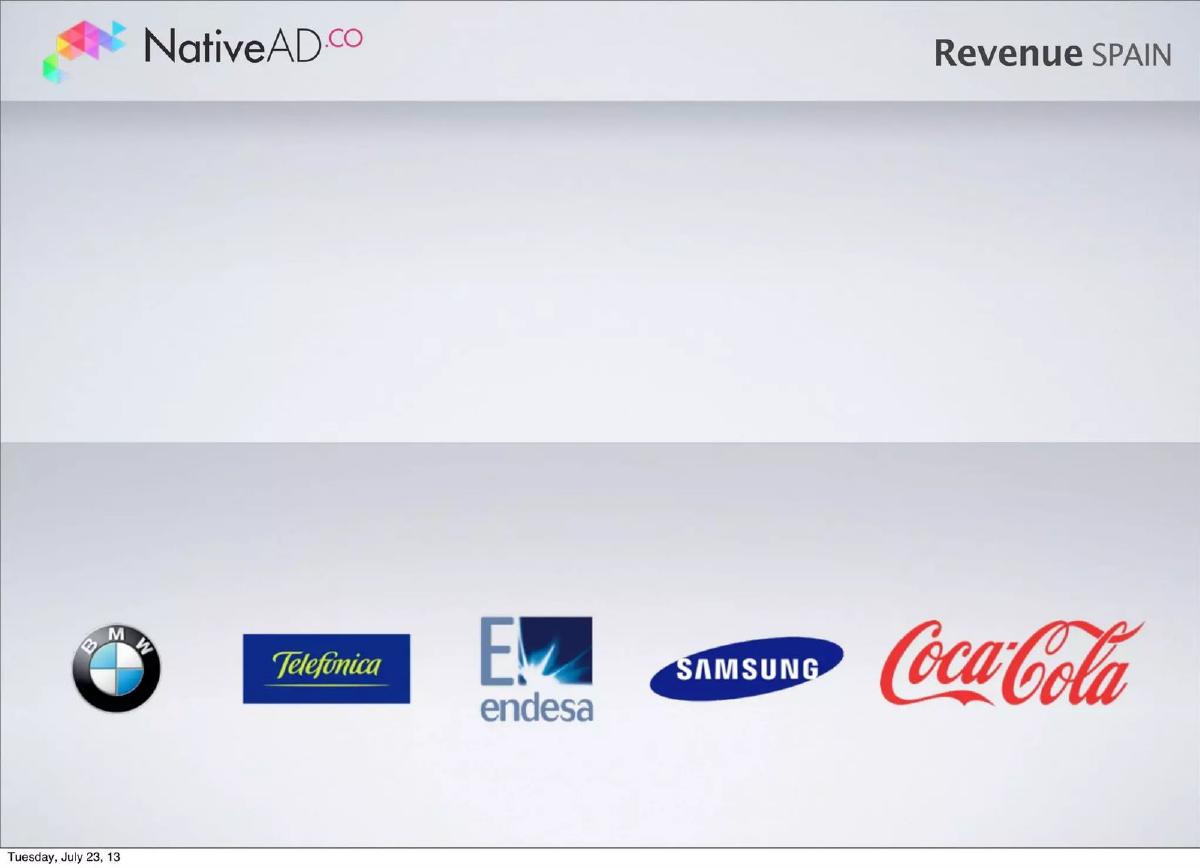
The deck opens with a clean title slide (Slide 1) establishing the brand as the 'Native Advertising Standard.' Rather than spending time on a long-winded problem statement, the founders immediately pivot to social proof. Slide 2 displays logos of blue-chip clients like BMW, Telefonica, Samsung, and Coca-Cola. Slide 3 adds the 'kicker': $210,000 in booked sales achieved in just three months. This is a powerful opening; it tells investors that the product is already being bought by the world's largest brands.
Slides 4 and 5 focus on the supply side of their marketplace. By showing logos for The Huffington Post, Yahoo!, and MSN, NativeAD demonstrates that they have the inventory to match their high-tier advertisers. Slide 5 makes a bold claim, stating they are the '#1 Advertising Network Unique Users' in Spain. This establishes them as a market leader before they even explain how the technology works.
Slides 6-13: The Problem and The Solution
Slide 6 is a blank transition, leading into the core thesis on Slide 7: 'Display advertising no longer works.' The visual shows a tablet with traditional ads being ignored. Slide 8 contrasts this with how users interact with social feeds on Twitter and Facebook, where ads look like content. This sets the stage for the NativeAD solution.
Slides 10, 11, and 12 demonstrate the product. An arrow on Slide 10 points to a 'native' article titled 'Coffee Everywhere: A Generation Speaks' embedded within a news site. This is the 'NativeAD Standard' in action. The payoff is delivered on Slide 13: 'BRANDS 10X engagement' and 'PUBLISHERS 30X profitable.' These are massive, round numbers designed to stick in an investor's mind, though the deck does not provide the underlying data to support the 30x profitability claim on this specific slide.
Slides 14-15: Market Expansion and Reach
Having proved the concept in Spain, the deck moves to the 'Why Now' and 'Where Next' sections. Slide 14 shows a map of the US and LATAM, and Slide 15 provides the scale: a sales force in 20 countries and a network of 1,000 publishers. It also mentions a partnership with EFE, described as the 'Leading Spanish speaking news agency.' This slide effectively communicates that NativeAD is not just a Spanish startup, but a global Hispanic media powerhouse.
Slides 16-21: Team, History, and The Ask
The team slide (Slide 16) is minimalist but effective. It highlights Gorka Muñecas’s history as a serial entrepreneur and Javier Lasa’s deep ties to Prisa, Spain's top media group. This combination of 'hustle' and 'industry insider' is a classic winning formula for seed-stage decks.
Slides 17 and 18 reveal the company's previous funding: $150,000 raised from executives at Univision, Liberty Global, and Forbes. This 'smart money' validation is crucial for a seed round, as it shows that industry veterans have already vetted the business. Slide 20 delivers the final ask: $1M for the US market and a NYC office. The deck concludes on Slide 21 with a call to action to 'GO NativeAD,' repeating the mantra that display advertising is dead.
What Works in This Deck
Immediate Traction: Leading with $210K in booked sales (Slide 3) is a brilliant move. It removes the 'will people buy this?' question from the investor's mind immediately.
Visual Simplicity: The deck uses very few words per slide. In an era of over-crowded PowerPoint presentations, the bold pink text on white backgrounds makes the key metrics (10x engagement, 30x profit) impossible to miss.
Strategic Validation: Listing investors from Univision and Forbes (Slide 18) provides massive credibility. It suggests that the people who run the world's largest media companies believe NativeAD is the future.
What Is Missing
Unit Economics: While the deck mentions $210K in sales, it says nothing about margins, cost of acquisition, or the split between the publisher and the platform. Investors are left to guess how much of that $210K actually stays with NativeAD.
Competitive Landscape: In 2013, companies like Taboola and Outbrain were already scaling rapidly. This deck completely ignores the competition, opting instead to fight against 'display ads' rather than other native ad networks.
Product Depth: There is no mention of the 'AdServer + Marketplace' technology mentioned in the company's self-description. The deck treats the technology as a black box, focusing entirely on the visual output and the results.
What a Founder Should Copy
The 'Traction First' Structure: If you have revenue or major partnerships, don't hide them on slide 12. Put them on slide 2 or 3. It changes the entire tone of the meeting from 'convincing' to 'updating.'
The 'Smart Money' Slide: If you have angel investors from your specific industry, highlight their names and their parent companies (as seen on Slide 18). It acts as a proxy for due diligence.
Clear Geographic Focus: NativeAD didn't just say they were an 'ad tech company.' They positioned themselves as the leaders in the Hispanic market. Finding a specific niche where you can claim to be '#1' (Slide 5) is far more effective than trying to be #10 in a broader market.
Final Thoughts
NativeAD’s deck is a product of its time—heavy on 'big idea' visuals and light on technical specifications. However, its success in raising $2.2M (surpassing the $1M ask on Slide 20) proves that at the seed stage, traction and team often outweigh detailed financial modeling. By framing their growth as an inevitable shift in industry standards, they made the investment feel like a bet on a sure thing.
Frequently asked questions
- What was NativeAD's primary value proposition?
- NativeAD positioned itself as the solution to 'banner blindness' and the declining effectiveness of display advertising. According to Slide 11 and 12, their native format integrates branded content directly into editorial spaces, resulting in 10x higher engagement for brands and making publishers 30x more profitable compared to traditional methods.
- How did the company demonstrate market traction?
- Traction was demonstrated through both revenue and reach. Slide 3 shows $210,000 in booked sales achieved in just three months. Slide 4 and 5 list a massive publisher network including The Huffington Post, Yahoo!, and MSN, claiming the position of the #1 advertising network by unique users in Spain.
- Who were the key members of the founding team?
- The team, shown on Slide 16, consists of Gorka Muñecas (CEO), a serial tech entrepreneur who founded his first company at age 16, and Javier Lasa (COO), the former R&D Director of Digital Innovation at Prisa, which the deck identifies as the #1 Spanish media group.
- What was the specific fundraising goal in this deck?
- Slide 20 explicitly states a fundraising target of $1,000,000. The primary use of these funds was to facilitate an expansion into the United States market and to establish a physical office in New York City.
- How did NativeAD differentiate itself from global competitors?
- While the deck focuses on the 'Native Advertising Standard,' the catalogue facts and Slide 15 emphasize their dominance in the Hispanic market. They highlight a sales force in 20 countries and a network of 1,000 publishers specifically targeting Spanish-speaking audiences in the US and LATAM.