Proptech Go-to-Market Slide Examples: 7 Real Pitch Decks
How property and real-estate startups explain how they will win customers: agent referrals, cost per agent by channel, phone sales to rental managers.
Proptech Go-to-Market Slide: Win the Agents and Managers, Then Give the Cost per Channel
Most property deals pass through someone: an estate agent, a property manager, a developer or a host. So property startups usually win customers by winning those people first, and investors read a proptech go-to-market slide for who the gatekeeper is, why they would bring business to you and what each one costs to sign. This guide uses seven go-to-market slides from property startups, from an agent tool that prices each channel per agent to a roof-inspection company whose revenue figures are printed on top of each other.
TL;DR
Name the people who control property decisions, show how you reach them and give the cost per channel. Reesio gives a cost per agent for each channel: Google ads at $21, press at $0 and events not yet known, with a target number of agents from each. Smart Host opens with "It costs us $200 to acquire a $4500 customer" and names who it sells to: vacation rental managers running 10 to 100 properties. Divvy Homes shows agents referring agents and clients: 20 new agents a week and 180 agents referring an average of 7 clients. Huntly sets out a $300,000 budget by channel but gives only targets, and Incitu describes developer relationships and awards with no figures at all.
Seven proptech go-to-market slides
Strongest first, warning examples last. Each example quotes the slide and notes what an investor can and cannot learn from it.
Reesio go to market slide — slide 11
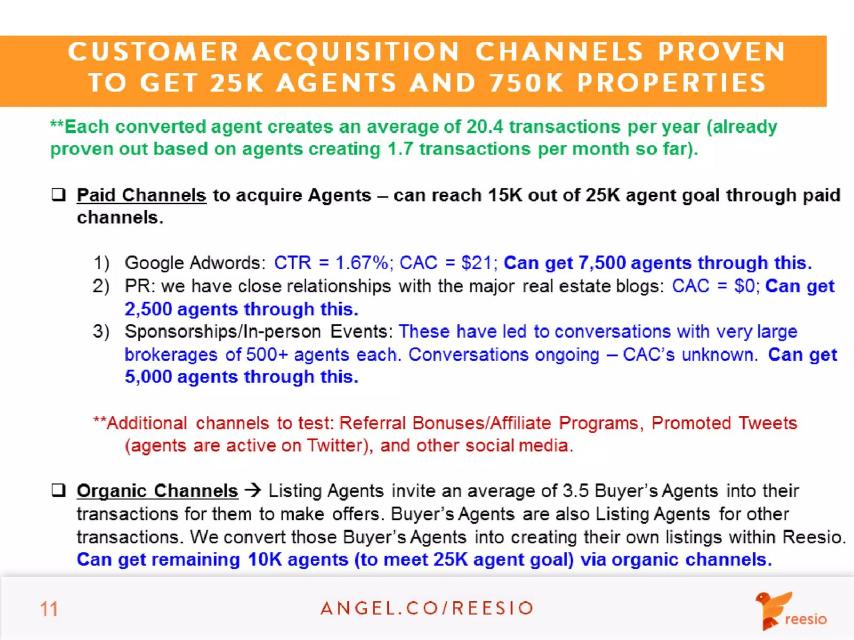
Transaction software for estate agents. Slide titled "Customer Acquisition Channels Proven to Get 25K Agents and 750K Properties".
Reesio deck, slide 11. Exact stored slide matched to this analysis.
Our analysis: A cost and target for each channel, with the untested channel marked as untested.
Evidence and limitation: Company figures and targets.
What a founder can adapt: Say how many agents each channel has brought in so far.
Supporting analysis
What the deck claims: "Each converted agent creates an average of 20.4 transactions per year (already proven out based on agents creating 1.7 transactions per month so far)." Paid channels: "Google Adwords: CTR = 1.67%; CAC = $21; Can get 7,500 agents through this"; "PR: … CAC = $0; Can get 2,500 agents through this"; "Sponsorships/In-person Events: … Conversations ongoing — CAC's unknown. Can get 5,000 agents through this." Organic: "Listing Agents invite an average of 3.5 Buyer's Agents into their transactions … Can get remaining 10K agents (to meet 25K agent goal) via organic channels."
Presentation choice: Investors can see which channel carries the plan and what is still unknown.
When it does not fit: A title that says "proven" when most of the 25,000 agents are targets.
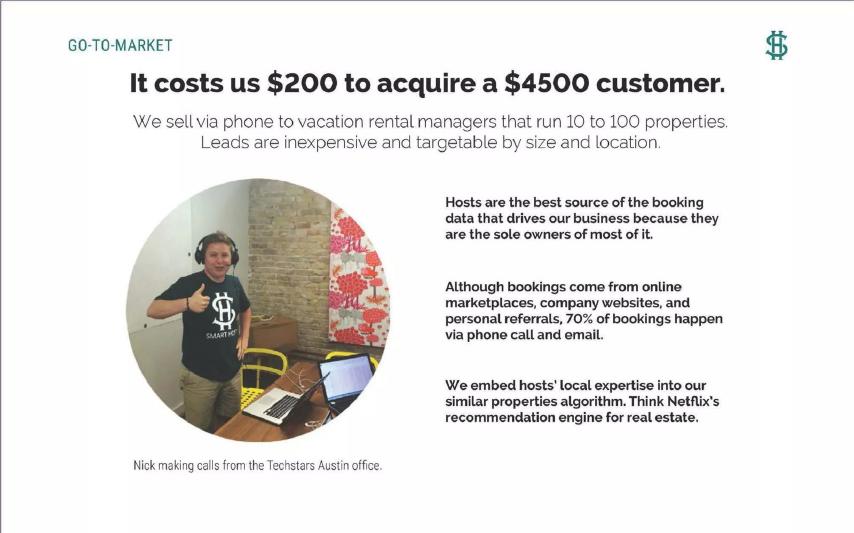
Pricing software for short-term rental managers. Slide titled "Go-to-market".
Smart Host deck, slide 8. Exact stored slide matched to this analysis.
Our analysis: Cost beside value in the headline, a named customer size and one sales channel.
Evidence and limitation: Company figures.
What a founder can adapt: Say whether $4,500 is yearly or lifetime value, and how many calls make one sale.
Supporting analysis
What the deck claims: "It costs us $200 to acquire a $4500 customer." "We sell via phone to vacation rental managers that run 10 to 100 properties. Leads are inexpensive and targetable by size and location." "Although bookings come from online marketplaces, company websites, and personal referrals, 70% of bookings happen via phone call and email." Photo caption: "Nick making calls from the Techstars Austin office."
Presentation choice: The headline answers the question investors care about most.
When it does not fit: Leaving the period of customer value unstated.
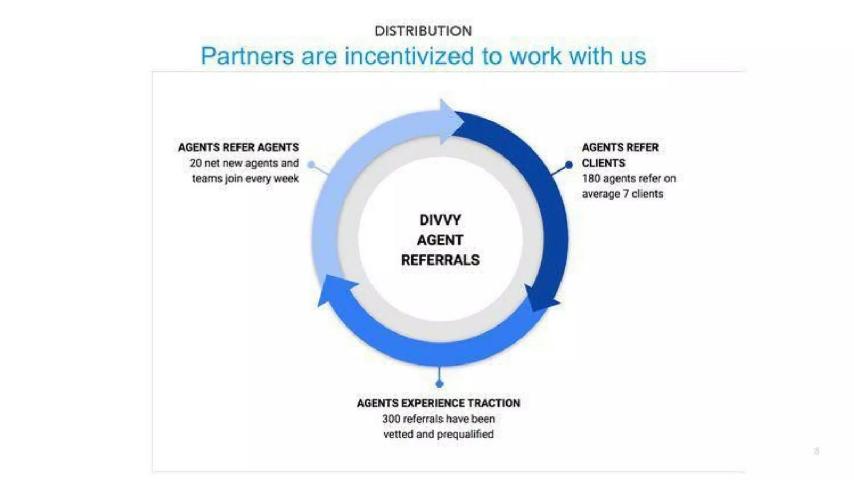
Rent-to-own home buying. Slide titled "Distribution: Partners are incentivized to work with us".
Divvy Homes deck, slide 11. Exact stored slide matched to this analysis.
Our analysis: A referral loop with a number at every step.
Evidence and limitation: Company figures.
What a founder can adapt: Add how many referrals became customers and what the incentive is.
Supporting analysis
What the deck claims: A loop labelled "Divvy Agent Referrals": "Agents refer agents: 20 net new agents and teams join every week"; "Agents refer clients: 180 agents refer on average 7 clients"; "Agents experience traction: 300 referrals have been vetted and prequalified".
Presentation choice: It turns a channel diagram into evidence.
When it does not fit: Claiming partners are incentivised without saying how.
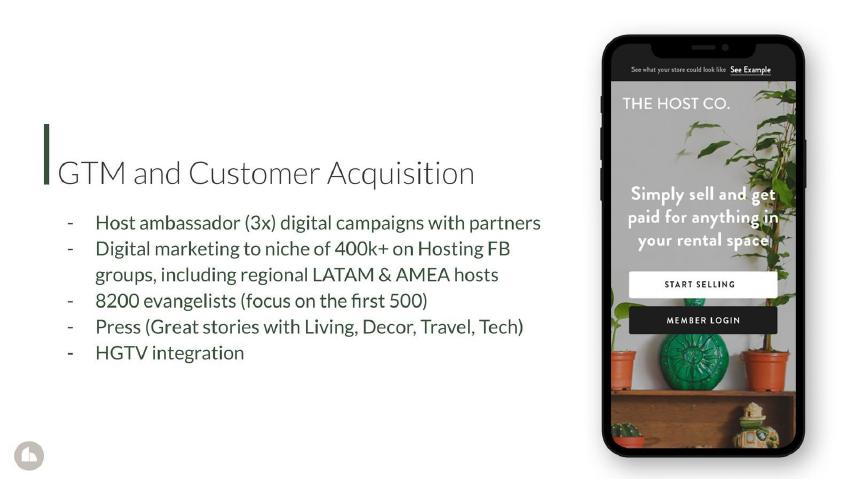
Marketplace for short-term rental hosts to sell items in their homes. Slide titled "GTM and Customer Acquisition".
The Host Co deck, slide 9. Exact stored slide matched to this analysis.
Our analysis: Real audiences named, with no cost or result for any channel.
Evidence and limitation: Company statements.
What a founder can adapt: Give sign-ups or sales from each channel so far.
Supporting analysis
What the deck claims: "Host ambassador (3x) digital campaigns with partners"; "Digital marketing to niche of 400k+ on Hosting FB groups, including regional LATAM & AMEA hosts"; "8200 evangelists (focus on the first 500)"; "Press (Great stories with Living, Decor, Travel, Tech)"; "HGTV integration".
Presentation choice: Focusing on 500 of 8,200 evangelists shows a sensible priority.
When it does not fit: Audience size presented as if it were customers.
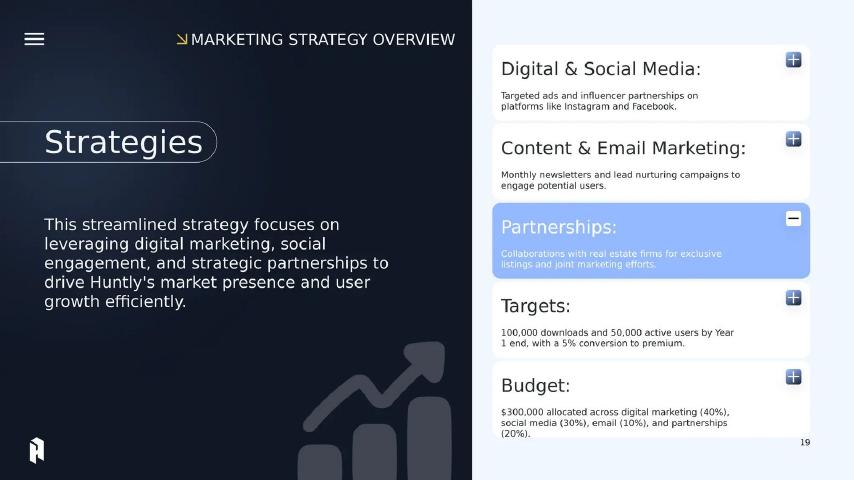
Home-search app using AI and 3D mapping. Slide titled "Marketing Strategy Overview".
Huntly deck, slide 20. Exact stored slide matched to this analysis.
Our analysis: A clearly labelled plan with a budget split, but no results and overlapping channel names.
Evidence and limitation: Company plans and targets.
What a founder can adapt: Add the implied cost per download and per premium user.
Supporting analysis
What the deck claims: "Digital & Social Media: Targeted ads and influencer partnerships on platforms like Instagram and Facebook." "Content & Email Marketing: Monthly newsletters and lead nurturing campaigns." "Partnerships: Collaborations with real estate firms for exclusive listings and joint marketing efforts." "Targets: 100,000 downloads and 50,000 active users by Year 1 end, with a 5% conversion to premium." "Budget: $300,000 allocated across digital marketing (40%), social media (30%), email (10%), and partnerships (20%)."
Presentation choice: The budget split shows priorities honestly.
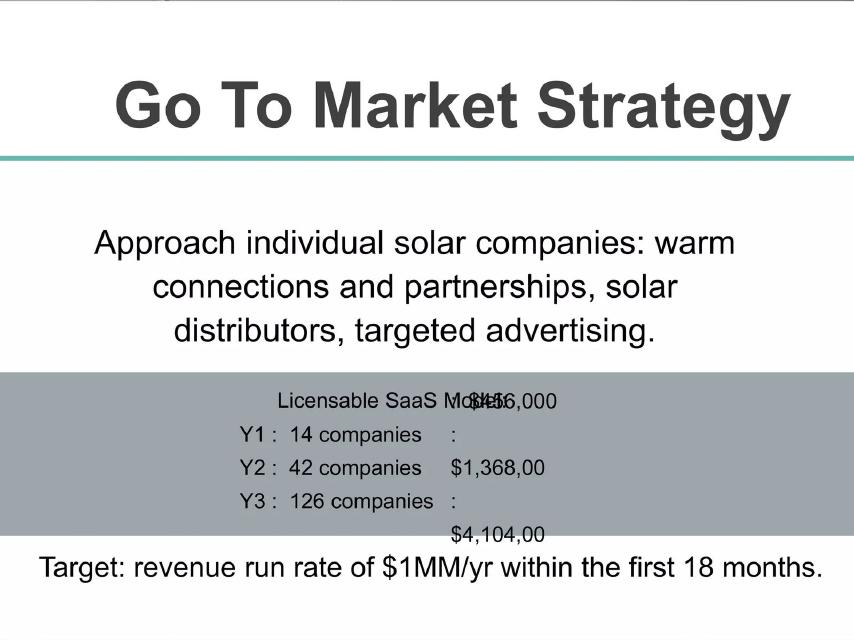
Aerial roof inspections and reports for solar installers. Slide titled "Go To Market Strategy". Warning example.
Hoverstat deck, slide 12. Exact stored slide matched to this analysis.
Our analysis: A reasonable plan undermined by overprinted text and misplaced commas.
Evidence and limitation: Company targets.
What a founder can adapt: Fix the layout and show price per company.
Supporting analysis
What the deck claims: "Approach individual solar companies: warm connections and partnerships, solar distributors, targeted advertising." "Licensable SaaS Model": "Y1: 14 companies", "Y2: 42 companies", "Y3: 126 companies", with revenue printed as "$456,000" (overlapping the label), "$1,368,00" and "$4,104,00". "Target: revenue run rate of $1MM/yr within the first 18 months."
Presentation choice: Layout errors make investors doubt the numbers.
When it does not fit: Shipping a slide without reading every figure.
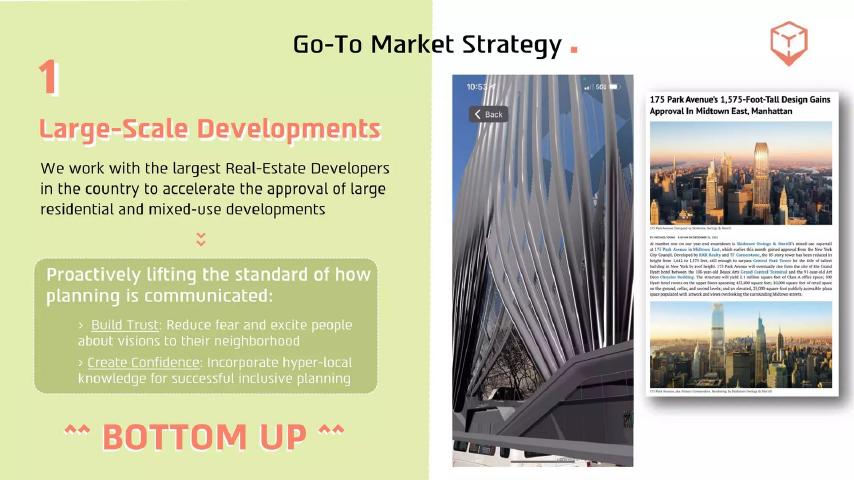
Augmented-reality visualisation for planned developments. Slide titled "Go-To Market Strategy", part 1 of 2. Warning example.
Incitu deck, slide 10. Exact stored slide matched to this analysis.
Our analysis: A strategy described in general terms with no named customer, cost or result.
Evidence and limitation: Company statements; no figures.
What a founder can adapt: Name the developers, the projects and what each paid.
Supporting analysis
What the deck claims: "1 Large-Scale Developments": "We work with the largest Real-Estate Developers in the country to accelerate the approval of large residential and mixed-use developments." "Proactively lifting the standard of how planning is communicated: Build Trust … Create Confidence …" "Bottom up". Image of a news headline about a Manhattan tower's approval.
Presentation choice: "The largest developers" is not the same as named, signed customers.
When it does not fit: A press headline standing in for a customer.
Whether each slide names who it sells to, gives a cost or value, and shows results so far.
Example
Who it sells to
Cost or value
Results so far
Reesio
Estate agents
Cost per agent by channel
1.7 transactions per agent per month
Smart Host
Managers of 10–100 rentals
$200 cost, $4,500 value
No
Divvy Homes
Agents and their clients
No
20 agents a week, 300 referrals
The Host Co
Short-term rental hosts
No
No
Huntly
Home searchers
$300,000 budget
No, targets only
Hoverstat
Solar companies
Garbled
No, targets only
Incitu
Large developers
No
No
Key Takeaways
Name the gatekeeper: agent, manager, developer or host.
Give the cost of winning a customer per channel.
Show why gatekeepers bring you business.
Separate results from targets and budgets.
Check that every figure on the slide is legible.
Build your proptech go-to-market slide
Answer these before you design the slide.
Gatekeeper. Who controls the decision: agents, managers, developers or hosts? How big is each one?
Channels. For each channel, what does one customer cost and how many has it brought so far?
Incentive. Why would that gatekeeper send business to you?
Plan. What do your budget and targets imply per customer?
Copyable framework: We sell to [gatekeeper] with [size]. [Channel]: [cost] per customer, [number] so far. Next: [channel], target [number] at [implied cost].
Illustrative example 1 — written by us
Before: We partner with real estate agents and use social media and SEO.
After: We sell to independent agents closing 10+ deals a year. Agent referrals: $0, 140 agents since March. Facebook ads: $38 per agent, 60 agents. Next: brokerage partnerships, target 500 agents at an implied $25 each.
What improved: Our illustrative rewrite; all figures are invented for the example. It names the customer, gives cost and results per channel and labels the plan.
What this guide adds
The general go-to-market guide covers any startup. Property is different because buyers, sellers, tenants and owners rarely act alone. Agents, brokers, property managers and developers sit between the startup and most transactions, deals are large and infrequent, and trust matters more than reach. Those features decide which channels work, and this guide shows how property startups present them.
How we read each slide
We read each stored slide image and quote the text on it. Small-text slides were read at full size; the others were legible at low resolution. We have not checked any company's costs, partners or results, and we make no claim that any slide affected a fundraising outcome.
Win the gatekeeper first
Each of the stronger slides names a specific group of professionals. Reesio targets estate agents and gives a goal of 25,000. Smart Host sells to "vacation rental managers that run 10 to 100 properties", which tells investors both who the customer is and how big each one is. Divvy Homes builds its distribution on agents who refer buyers. Incitu works with "the largest Real-Estate Developers in the country".
Naming the group is the start. Investors then want to know why that group would bring business to you rather than to a rival. Divvy's slide answers this in its heading, "Partners are incentivized to work with us", though it does not say what the incentive is. Smart Host explains that "hosts are the best source of the booking data that drives our business because they are the sole owners of most of it".
Cost per channel, not one blended figure
Reesio's slide is the clearest example of costing each channel separately. Google AdWords: "CTR = 1.67%; CAC = $21; Can get 7,500 agents through this." PR through real estate blogs: "CAC = $0; Can get 2,500 agents through this." Sponsorships and in-person events: conversations with brokerages of 500+ agents, "CAC's unknown", target 5,000 agents. It is also honest about what it hasn't measured.
A single blended cost can hide a channel that is getting more expensive. Showing each channel lets investors see which one carries the plan and what happens if it stops working. Smart Host gives one figure, $200 per customer, but puts it beside customer value, $4,500, which is the comparison that matters most.
Referral loops
Property professionals talk to each other, so referrals are a natural channel. Divvy draws a loop: agents refer agents, agents refer clients, and agents see results, which keeps them referring. Reesio describes a similar effect in its organic channel: "Listing Agents invite an average of 3.5 Buyer's Agents into their transactions", and those buyer's agents later create their own listings.
A loop on a slide is only a diagram until it has numbers. Divvy attaches one to each step: 20 net new agents and teams a week, 180 agents referring an average of 7 clients, 300 referrals vetted and prequalified. That turns the loop into evidence. The next figure investors will ask for is how many of those referrals became Divvy customers.
Communities and audiences
Short-term rental hosts gather in large online groups. The Host Co lists "Digital marketing to niche of 400k+ on Hosting FB groups, including regional LATAM & AMEA hosts", "8200 evangelists (focus on the first 500)" and an HGTV integration. Those are real audiences, but the slide does not say what each channel has produced or cost so far. Focusing on the first 500 of 8,200 evangelists is a sensible detail: it shows the founders know a small, active group is worth more than a large, passive one.
Budgets and targets are plans, not results
Huntly's slide lists its channels, then "Targets: 100,000 downloads and 50,000 active users by Year 1 end, with a 5% conversion to premium" and "Budget: $300,000 allocated across digital marketing (40%), social media (30%), email (10%), and partnerships (20%)". A budget split is useful because it shows priorities, but nothing on the slide has happened yet. Labelling it clearly as a plan, as Huntly does, is the honest way to present it.
Two improvements would help. First, dividing the budget by the target gives an implied cost: $300,000 for 100,000 downloads is $3 per download, or about $120 per premium user at 5% conversion. Putting that figure on the slide shows the plan has been tested. Second, "digital marketing" and "social media" overlap, so say what each covers.
Make every figure readable
Hoverstat, which sells aerial roof inspections to solar companies, plans "Y1: 14 companies", "Y2: 42 companies" and "Y3: 126 companies" under a "Licensable SaaS Model", with a target "revenue run rate of $1MM/yr within the first 18 months". But the revenue figures are printed over the label ("Model" and "$456,000" collide) and the later figures appear as "$1,368,00" and "$4,104,00", with the comma in the wrong place. Investors can work out that the plan is about $32,600 per company each year, but a layout error on the go-to-market slide makes them wonder what else was not checked.
What to put on a proptech go-to-market slide
Start with one line naming who you sell to and how big each customer is, as Smart Host does. Then list channels with a cost and a result for each, marking anything untested as untested, as Reesio does. If your growth depends on referrals, give the numbers at each step of the loop, as Divvy does. If you have a budget or targets, put them in a separate block labelled as plans and add the implied cost per customer. Finally, read every number on the finished slide at the size investors will see it.
Common mistakes
No named gatekeeper. Say who controls the decision.
One blended cost. Give cost per channel.
Loops with no numbers. Put a figure on each step.
Audience as customers. Show sign-ups or sales.
Unlabelled targets. Separate plans from results.
Overprinted figures. Read every number before sending.
Diagnostic checklist
Gatekeeper and customer size named.
Cost per channel given.
Customer value stated with its period.
Results so far for each channel.
Targets and budgets labelled as plans.
Every figure legible.
Frequently asked questions
What should a proptech go-to-market slide show?
Who controls the decision, how you reach them and what each channel costs. Reesio gives a cost per agent for each channel: $21 for Google ads and $0 for press.
Should I sell to agents or directly to buyers?
Most property startups reach customers through agents, managers or developers. Divvy Homes builds its distribution on agent referrals: 180 agents refer an average of 7 clients each.
How do I show cost of winning a customer?
Beside customer value. Smart Host's headline reads "It costs us $200 to acquire a $4500 customer".
Can I show a marketing budget instead of results?
Yes, if it is labelled as a plan. Huntly shows a $300,000 budget by channel beside its year-one targets; adding the implied cost per user would make it stronger.
How we chose these examples
Corpus: published pitch deck teardowns on StartupFundraising.com. Founder-uploaded private decks are excluded.
Selection (2026-10-01): we searched extracted slide text for go-to-market, customer acquisition, marketing strategy and distribution slides in decks from property companies already identified in other proptech guides. We shortlisted 9 slides, dropped one already used in another guide (Simpolium), viewed the remaining 8 and kept 7, using one of Incitu's two slides.
Review: stored slide images were read on 2026-10-01 against company, deck and slide number; small-text slides were read at full size (editorial model review). No person has yet completed an editorial review of this page. We did not verify any company's costs, partners or results.