Resonado Labs’ 8-slide pitch deck is a study in brevity and visual proof. The company successfully raised $5.5M in Seed funding in 2017 by identifying a specific bottleneck in hardware design: the conical shape of traditional speakers. The deck relies heavily on side-by-side visual comparisons to prove its value proposition, showing a slim, rectangular driver next to a bulky traditional one. While the deck is light on financial specifics and unit economics, it excels at showing market traction through '7 LOIs & 3 Pilots' and a massive '$16B B2B Speaker Market' opportunity. It positions the st…
Key takeaways
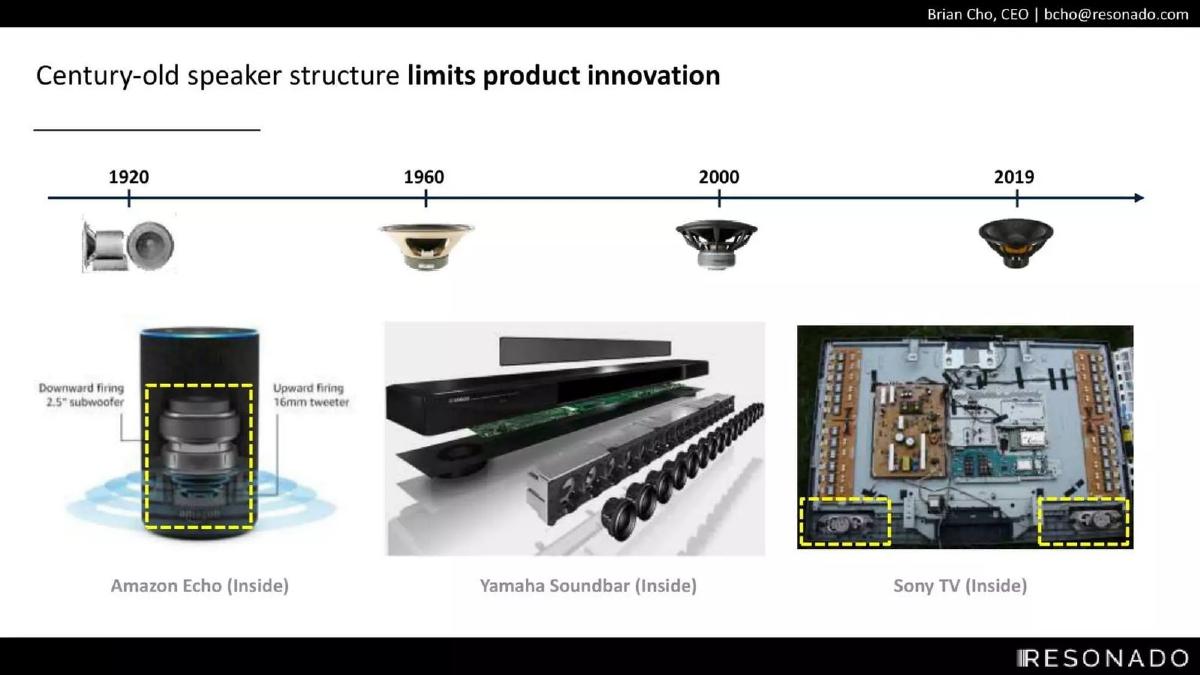
- The deck identifies a stagnant industry by showing that speaker structures have remained largely unchanged from 1920 to 2019 (Slide 2).
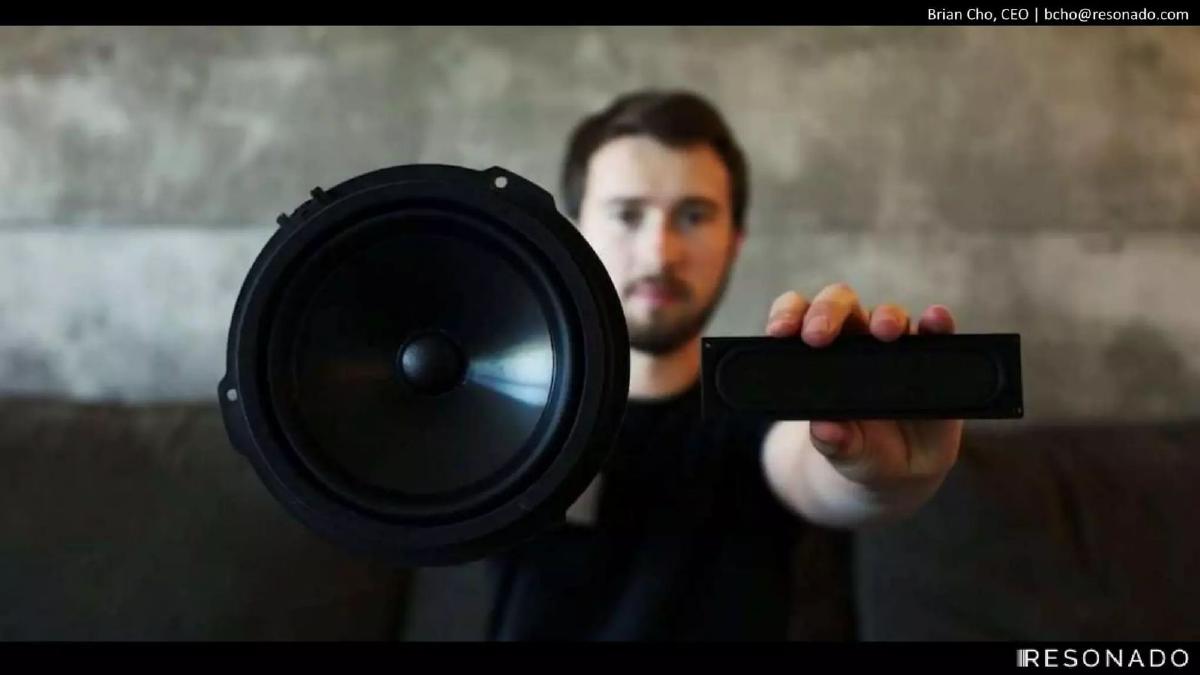
- A single powerful image on Slide 3 provides the 'aha' moment by comparing a traditional circular driver to the slim Resonado alternative.
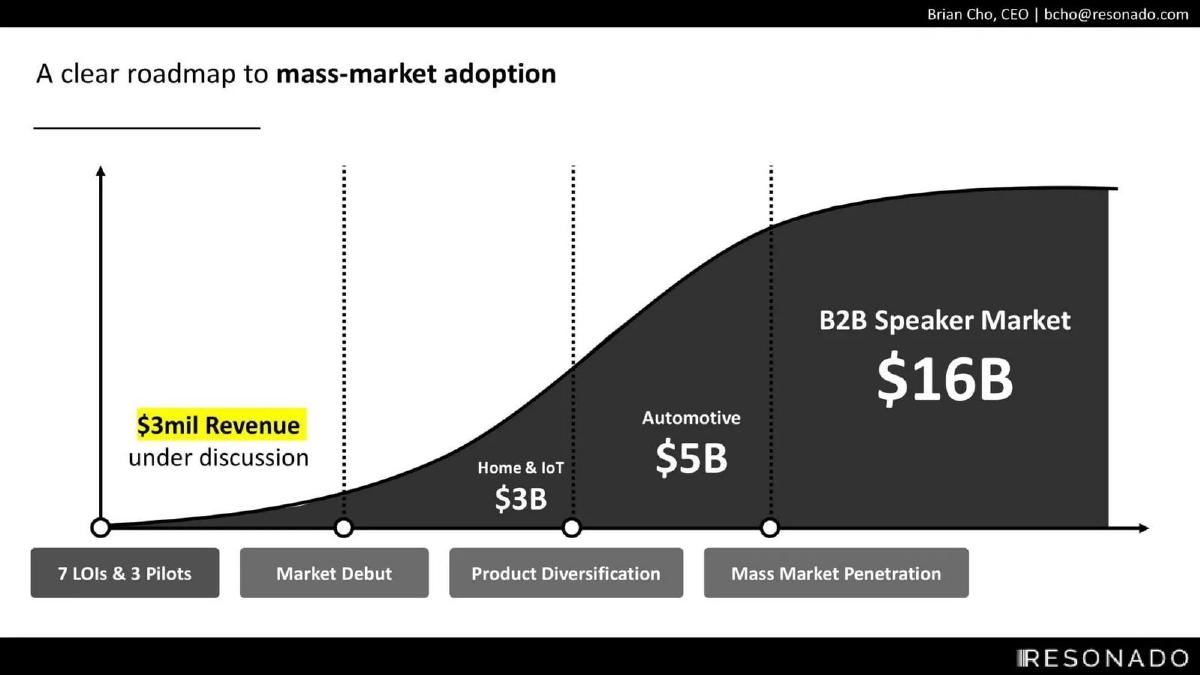
- The company claims a clear roadmap to mass-market adoption, starting with $3M in revenue under discussion (Slide 5).
- Resonado targets three distinct market tiers: Home & IoT ($3B), Automotive ($5B), and the broader B2B Speaker Market ($16B) (Slide 5).
- Traction is quantified by 7 Letters of Intent (LOIs) and 3 active pilots at the time of the presentation (Slide 5).
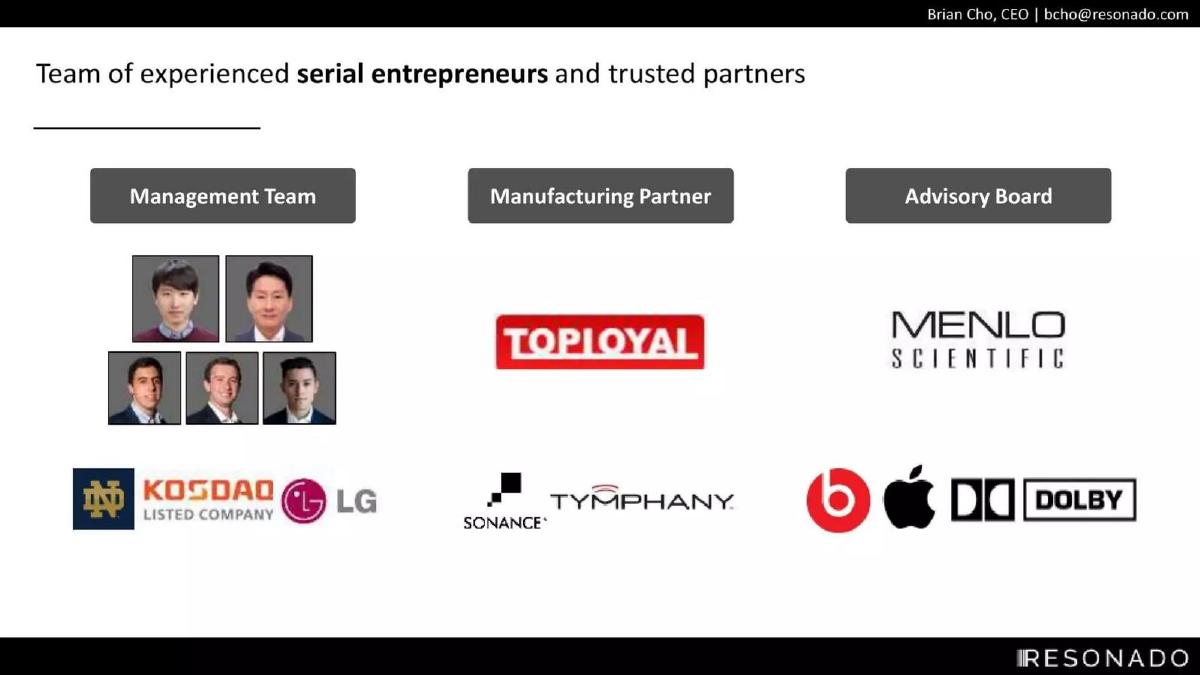
- The team slide leverages high-profile logos including LG, Apple, Beats, and Dolby to establish credibility through prior experience and advisors (Slide 6).
- The deck highlights a major competitive win by claiming to replace an unnamed partner's current relationship with Bose (Slide 7).
- The presentation completely omits a specific 'Ask' slide, financial projections, or detailed unit economics.
The Power of Visual Hardware Disruption
Resonado Labs’ pitch deck is an exercise in minimalism. At only 8 slides, it manages to convey a complex engineering breakthrough—Flat Core Speaker (FCS) technology—through high-impact visuals and clear market sizing. In a hardware world often bogged down by spec sheets, Resonado chose to focus on the physical constraints of their competitors. By showing how traditional speakers limit the design of modern products like the Amazon Echo or Sony TVs, they immediately established a 'why now' for their technology. The $5.5M Seed round suggests that investors were sold on the vision of Resonado becoming a fundamental component in the global B2B audio supply chain.
Slides 1-2: The Problem of Stagnation
Slide 1 is a standard title slide, featuring the Resonado logo in white against a black background. It establishes a clean, premium brand identity from the outset.
Slide 2 , titled 'Century-old speaker structure limits product innovation,' is the core problem statement. It features a timeline from 1920 to 2019, showing four speaker drivers that look remarkably similar. The implication is clear: while the rest of the tech world has miniaturized, audio hardware has been stuck. The bottom half of the slide shows 'inside' views of the Amazon Echo, a Yamaha Soundbar, and a Sony TV. By highlighting the bulky, circular drivers inside these sleek modern devices with yellow dashed lines, Resonado visually demonstrates the design bottleneck their technology aims to solve.
Slides 3-4: The 'Aha' Moment and Technology
Slide 3 is perhaps the most important slide in the deck, despite having no text. It shows a person holding a traditional, large circular speaker driver in one hand and Resonado’s slim, rectangular driver in the other. This side-by-side comparison is a powerful 'show, don't tell' moment. It proves the form-factor advantage without requiring the viewer to understand the underlying physics of transducers.
Slide 4 introduces the name of the innovation: 'Flat Core Speaker (FCS) technology.' The slide is minimalist, featuring only the title and a dark, textured background that likely served as a backdrop for a video or a deeper verbal technical explanation during a live presentation. By giving the technology a branded name (FCS), Resonado creates a proprietary asset that investors can associate with the company's value.
Slide 5: Market Opportunity and Traction
Slide 5 provides the 'clear roadmap to mass-market adoption.' It uses a growth curve to plot the company's trajectory across four phases: 7 LOIs & 3 Pilots, Market Debut, Product Diversification, and Mass Market Penetration. Crucially, it attaches dollar amounts to these segments: $3B for Home & IoT, $5B for Automotive, and a total $16B B2B Speaker Market. The slide also highlights '$3mil Revenue under discussion,' which provides a tangible figure for investors to anchor on regarding near-term commercial viability.
Slide 6: The Team and Ecosystem
Slide 6 addresses the 'Team of experienced serial entrepreneurs and trusted partners.' Rather than long bios, the slide uses logos to communicate credibility. The Management Team is linked to the University of Notre Dame, KOSDAQ, and LG. The 'Manufacturing Partner' section lists Toployal, Sonance, and Tymphany, which is vital for a hardware startup to prove they can actually build at scale. The 'Advisory Board' section is particularly strong, featuring logos for Menlo Scientific, Beats, Apple, Dolby, and LG. This suggests that while the founders may be young, they are surrounded by industry titans.
Slides 7-8: The Competitive Win and Closing
Slide 7 is a high-conviction traction slide. Over an image of a handshake, three boxes highlight major milestones: an 'Exclusive Brand Partnership,' the claim of 'Replacing its current partner Bose,' and reaching '5mil weekly viewer on national TV.' Replacing an incumbent like Bose is a massive signal of product superiority and market readiness. It moves the conversation from 'this might work' to 'this is already beating the industry leaders.'
Slide 8 returns to the logo, providing the CEO's contact information (Brian Cho) to close the deck.
What Works in the Resonado Labs Deck
Visual Proof: The comparison on Slide 3 is the strongest element of the deck. In hardware, seeing the physical difference in size and shape is more convincing than any chart. It immediately explains why a manufacturer would choose Resonado over a traditional supplier.
Logo Density: For a Seed stage company, the number of high-tier logos (Apple, LG, Dolby, Bose) is impressive. Resonado uses these logos not just to show where they worked, but to show who is advising them and who they are competing against. This builds 'borrowed credibility' very effectively.
Market Sequencing: The roadmap on Slide 5 is logical. By starting with Home & IoT before moving into the high-barrier Automotive sector, the company shows a realistic path to growth rather than claiming they will conquer every market simultaneously.
What is Missing from the Resonado Labs Deck
The Ask: There is no slide indicating how much capital the company is seeking or how they intend to spend it. While this is common in 'teaser' decks, a full pitch deck usually requires a clear call to action for the investor.
Unit Economics: There is no mention of the cost to produce an FCS driver versus a traditional one. If the technology is significantly more expensive to manufacture, the form-factor benefits might be negated for mass-market OEMs. The deck ignores the 'margin' side of the business entirely.
Technical Deep Dive: While the 'Flat Core' name is descriptive, the deck doesn't explain how it works. For a Seed round based on a hardware breakthrough, sophisticated investors would eventually need to see the IP defensibility and the engineering principles that allow a flat driver to move enough air to match traditional sound quality.
What a Founder Should Copy
The 'Problem' Timeline: Use a timeline to show how little your industry has changed. It creates a sense of urgency and makes the incumbent solutions look obsolete. Slide 2 does this perfectly by showing 100 years of identical speaker shapes.
The Side-by-Side Comparison: If your product is smaller, faster, or simpler than the status quo, put them in the same frame. Resonado’s Slide 3 is a masterclass in hardware marketing.
Traction as a Narrative: Instead of just listing 'We have 7 LOIs,' Resonado placed their traction on a growth curve (Slide 5). this helps investors visualize the momentum and see the LOIs as the starting point of a much larger journey toward a $16B market.
Focus on B2B Value: Resonado doesn't talk about 'better sound' for consumers; they talk about 'innovation' for manufacturers. By focusing on how they help OEMs (like the Sony TV example), they position themselves as a partner to giants rather than a competitor to them.
Frequently asked questions
- How much did Resonado Labs raise with this deck?
- According to catalogue data from pitchdeckhunt.com, Resonado Labs raised $5,500,000 in a Seed round in 2017. The deck itself does not state the amount being raised or the valuation, which suggests it may have been used as a supporting visual for a live pitch rather than a standalone document.
- What is Flat Core Speaker (FCS) technology?
- FCS is Resonado's proprietary transducer technology. As shown on Slide 3 and Slide 4, it replaces the traditional deep, conical motor structure of a speaker with a thin, flat architecture. This allows audio hardware to be integrated into much slimmer form factors, such as thin TVs or narrow automotive pillars, without sacrificing sound quality.
- Who are the key partners mentioned in the deck?
- Slide 6 lists several 'trusted partners' and advisory influences. Manufacturing partners include Toployal, Sonance, and Tymphany. The advisory board and management team backgrounds include associations with Menlo Scientific, LG, Apple, Beats, Dolby, and the University of Notre Dame.
- What market segments is Resonado targeting?
- Resonado outlines a multi-stage market entry on Slide 5. They begin with Home & IoT ($3B market), move into Automotive ($5B market), and eventually aim for the total B2B Speaker Market, which they value at $16B. The roadmap moves from 'Market Debut' to 'Mass Market Penetration'.
- What is missing from the Resonado Labs pitch deck?
- The deck is missing several standard components: a formal 'Ask' (how much money they want), a detailed breakdown of how funds will be used, a slide on unit economics or margins, and a specific competition matrix. It relies almost entirely on the strength of the hardware innovation and early B2B interest.